Search Header Logo
Unit 8 Retake

Unit 8 Retake

Assessment

Presentation

Science

7th Grade

Easy

NGSS
HS-LS3-1, MS-ESS1-1, MS-ESS2-4

+15

Standards-aligned

Created by

Heather Ziemba

Used 2+ times

FREE Resource

7 Slides • 26 Questions

1

media

Unit 8 Summative
Retake & Relearning

2

Genotypes (allele combinations) code for Phenotypes (physical, observable, traits).

media

3

media
  • DOMINANT ALLELE: always expressed when present. (capital letter). You only need one copy to express the trait!

  • RECESSEIVE: only expressed when the dominant one is absent. (lower case letter). You need 2 copies to express the trait!

Genotype = 2 alleles.

Allele = version of a gene.

In the flower example, purple flowers (B) are dominant to white flowers (b). Even when both are present, the B wins!

4

Match

Match the term to its definition

Genotype

Phenotype

Allele

Heredity

Types of genes an organism has

physical trait of an organism

Version of a gene

Passing traits down from parents to kids

5

Categorize

Options (6)

lower case letter

can be masked

2 copies are needed for the trait to show

upper case lettter

always shows through when present

only 1 copy is needed

Organize these options into the right categories

Recessive Allele
Dominant Allele

6

media
  • HOMOZYGOUS = both alleles are the same.

  • HETEROZYGOUS = both alleles are different.

  • IMPORTANT NOTE: even though the heterzygote has one of each allele, the dominant one wins, and the flower is purple!

Types of

Genotypes

7

Match

Match the following

Homozygous Dominant

Heterozygous

Homozygous recessive

having 2 dominant alleles for a trait

having 1 dominant and 1 recessive allele

having 2 recessive alleles for a trait

8

Categorize

Options (9)

AA

LL

ZZ

Ee

Ww

Jj

bb

nn

rr

Organize these options into the right categories

Homozygous Dominant
Heterozygous
Homozygous Recessive

9

Multiple Choice

Question image

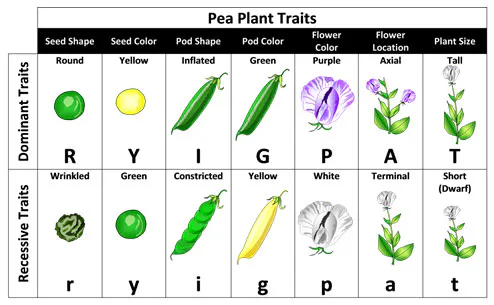
Reference the chart. What would the phenotype be for a plant with a genotype Rr?

1

Round seeds

2

Wrinkled Seeds

10

Multiple Choice

Question image

Reference the chart. What would the phenotype be for a plant with a genotype gg?

1

yellow pods

2

green pods

11

Multiple Choice

Question image

Reference the chart. A pea plant has inflated pods. What could its genotype be?

1

II

2

Ii

3

ii

4

II and Ii

12

Multiple Choice

Question image

Reference the chart. A pea plant is short. What could its genotype be?

1

TT

2

Tt

3

tt

4

Tt and tt

13

Multiple Choice

Question image

Reference the chart. A pea plant is heterozygous for seed color. What is its genotype and phenotype?

1

YY, yellow

2

Yy, yellow

3

Yy, green

4

yy, green

14

media
  • Parents go on the top and right side (purple boxes).

  • Offspring are in the middle (teal boxes), and take one allele from each parent.

  • Each box represents 25% or 1/4 probability.

Punnet Squares are models used to predict the genotypes and phenotypes of offspring based off the parent's genotypes.

The parents in this example are heterozygous (Bb) and have big beaks.

Possible Genotypes: 25% BB, 50% Bb, 25% bb

Possible Phenotypes: 75% big beaks, 25% small beaks

15

Drag and Drop

In a species of frogs, pink tongues (P) is dominant to gray tongues (g).


A frog with the genotype PP would have a ​
tongue.

A frog with the genotype ​
would also have a pink tongue.

A frog with the genotype ​
would have a gray tongue.​
Drag these tiles and drop them in the correct blank above
pink
Pp
pp
gray

16

Draw

In a species of frogs, having a pink tongue (P) is dominant to having gray tongues (p).

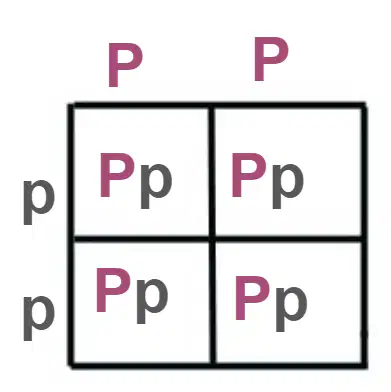
Create a Punnett Square to show the possibilities between a pink tongue frog with the genotype PP and a gray tongue frog pp.

17

Multiple Choice

Question image

When you crossed the PP frog and the pp frog, what were the possible genotypes in the offspring?

1

100% pp

2

All PP

3

All Pp

4

PP and Pp

18

Multiple Choice

Question image

When you crossed the PP frog and the pp frog, what were the possible phenotypes in the offspring?

1

100% pink tongue

2

100% gray tongue

3

50% pink tongue, 50% gray tongue

4

25% gray tongue, 75% pink tongue

19

Drag and Drop

In a species of plants, being tall (T) is dominant to being short.


A plant that is ​
would be tall.

A plant that is Tt would be ​
.

A plant that is tt would be ​
.​

Drag these tiles and drop them in the correct blank above
TT
tall
short

20

Draw

In pea plants, being tall (T) is dominant to being short (t)

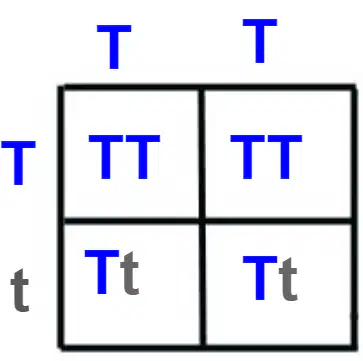
Create a punnett square to show the possibilities when you cross a heterozygous tall plant and a homozygous tall plant.

21

Multiple Choice

Question image

When you crossed the homozygous dominant tall plant with a heterozygous one, what percent of the offspring were tall?

1

0%

2

25%

3

50%

4

75%

5

100%

22

Multiple Choice

Question image

When you crossed the homozygous dominant tall plant with a heterozygous one, what percent of the offspring were heterozygous?

1

0%

2

25%

3

50%

4

75%

5

100%

23

media
media
media

​In heterozygous genotype the dominant allele completely masks the effect of the recessive allele on the organism's phenotype

Complete Dominance

​A type of inheritance in which two contrasting alleles contribute to the individual a trait not exactly like either parent; blending inheritance.

Incomplete Dominance

A condition in which both alleles for a gene are fully expressed

Codominance

24

media

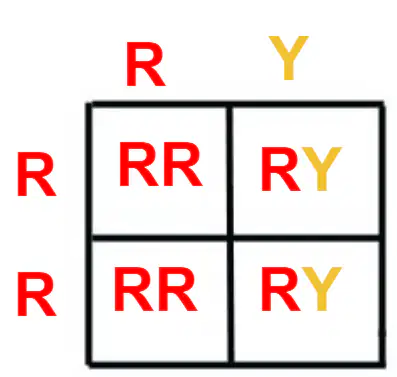
​This is an example of how to do a punnett square with incomplete dominance.


If it was codominance, 2/4 would have had white and red petals.

25

Match

In a a species of flowers, there is an allele for red flowers (R), and an allele for yellow flowers (Y). Heterozygotes are orange.

Match each genotype to its phenotype.

RR

RY

YY

red flower

orange flower

yellow flower

26

Draw

In a species of flowers, there is an allele for RED (R) and an allele for YELLOW (Y). Heterozygotes are orange.

Create a punnett square between an orange flower and a red flower.

27

Multiple Choice

Question image

What are the phenotypes of the offspring?

1

50% red, 50% orange

2

50% red, 50% yellow

3

100% red

4

50% yellow, 50% orange

28

Multiple Choice

Question image

What percent of the offspring are homozygous?

1

25%

2

50%

3

75%

4

100%

29

Match

In a different species of flowers, the alleles for white and red are codominant. Match the genotypes to their phenotypes.

RR

RW

WW

red flowers

flowers with red and white petals

White flowers

30

Draw

In a different species of flowers, the alleles for white (W) and red (R) are codominant.

Create a punnett square between two heterozygotes.

31

Multiple Select

Question image

When you crossed the two heterozygotes, which of the following statements were true?

THERE ARE 2 CORRECT ANSWERS

1

75% of the flowers were red

2

50% had red and white petals

3

25% had white petals

4

25% of the flowers were homozygous

32

Multiple Select

Question image

Dennis is doing a TikTok series where he tries to redo Mendel's experiment. He gets a pure purple plant, and a pure white plant.

A week later, a video pops up on your "for you" page.

"Sup peeps!  Check these results!  My parental generation was a purple and white flower.  When I crossbred them, their offspring, the F1 generation, ALL HAD PURPLE FLOWERS!  CRAZY!!!" 

You browse the comment section. Which 2 comments are true?

1

Purple is the dominant trait, my guy!

2

All of your F1 generation got a P from the purple parent, and a p from the white parent!

3

The white trait has completely disappeared from the population!

4

The F1 generation is all homozygous!

33

Open Ended

Question image

A week later, you see another video pop up.

"Okay my fellow flower fanatics!  When the F1 generation was bred, the offspring F2 showed a 3:1 ratio.  75% had purple flowers, and 25% had white flowers."  Now you leave a comment! Why did this happen?

media

Unit 8 Summative
Retake & Relearning

Show answer

Auto Play

Slide 1 / 33

SLIDE