
Charges and charging - Lesson
Presentation
•
Science
•
11th Grade
•
Medium
+10
Standards-aligned
Moitreyee Roy
Used 4+ times
FREE Resource
14 Slides • 17 Questions
1
2
3
4
Fill in the Blanks
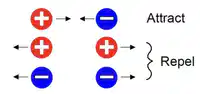
An atom contains three subatomic particles: Protons (+), Neutrons (0), and Electrons (-). Complete the sentence: All matter has electrical charges. There are two types of charges: Negatively charged objects:
5
Fill in the Blanks
Complete the sentence: Positively charged objects:
Type answer...
6
Fill in the Blanks
Complete the sentence: Neutral charged objects:
Type answer...
7
Fill in the Blanks
Complete the sentence: Only
8
Open Ended
Complete the sentence regarding the Fundamental Law of Charges: ________.
9
Open Ended
Sphere A is negatively charged; when placed next to sphere B they attract. What is the charge on sphere B?
10
11
12
Charging by friction.
Charging by conduction.
Charging by induction.
13
14
15
16
17
18
19
20
Open Ended
Your cat rubs against a rubber balloon. What will be the charge on the balloon?________ Your cat's fur?_____________
21
Open Ended
You use three charged objects – A, B & C for an experiment on charges. During the lab you make the following observations: - When you bring object A near object B, the objects attract each other. - When you bring object A near object C, the objects repel each other. What would happen if object B & C were brought together?
22
Open Ended
Describe why an object can have a positive or negative charge?
23
Open Ended
What is the fundamental law of charges, and how does it work?
24
Multiple Choice
You use 3 objects- A, B, and C for an experiment on charges. What would happen if object B & C were brought together?
During the lab you made the following observation:
1. A & B - attract each other.
2. A &C - repel each other.
Object B & C would repel each other
Object B & C would attract each other
Nothing would happen, since objects B & C are neutrally charged
The oppositely charged objects A & C will repel each other
25
Multiple Choice
Use the following electrostatic series to answer the question: Rubber, Ebonite, Polyethylene (Plastic), Cotton, Silk, Wool, Glass, Acetate, Fur. What would happen if a polyethylene ruler was rubbed with a wool cloth?
a) Nothing
b) The polyethylene ruler would take the wool’s positive charges
c) The wool cloth would take the polyethylene ruler’s negative charges
The polyethene ruler would take the wool's negative charge.
26
Multiple Choice
What would happen if you used a cotton cloth to wipe your glass window clean?
The glass window would become negatively charged
The cotton cloth would become negatively charged
The cotton cloth would become positively charged
The glass window & cotton cloth would stay neutrally charged
27
Multiple Choice
Which statement is completely true?
Fur rubbed with silk will become negatively charged because the silk will gain/receive negative charges
Acetate rubbed with cotton will become positively charged because the acetate will gain/receive positive charges
Ebonite rubbed with fur will become negatively charged because the ebonite will gain/receive negative charges
Polyethylene rubbed with wool will become negatively charged because the polyethylene will lose positive charges & the wool will gain/receive these positive charges
28
Multiple Choice
You have 2 spheres made of ebonite. You rub one with rubber & the other with cotton. What would happen if you brought the two spheres together?
Nothing, they are both neutrally charged
They will repel
They will attract
Nothing, they both carry no charge
29
Multiple Choice
You have 2 spheres made of ebonite. You rub one with wool & the other with silk. What would happen if you brought the two spheres together?
Nothing, they are both neutrally charged
They will repel
They will attract
Nothing, they both carry no charge
30
Multiple Choice
4. Spheres A & D are then set up side by side, as well as spheres B & D. Which diagram below correctly shows what would happen?
31
Show answer
Auto Play
Slide 1 / 31
SLIDE

Similar Resources on Wayground
20 questions
Water Use, Management & Conservation
Presentation
•
11th - 12th Grade
23 questions
Structure of the Integumentary System
Presentation
•
11th Grade
22 questions
P.5 A&C -Coulombs Law
Presentation
•
11th Grade
24 questions
FDAN - Nervous system
Presentation
•
11th Grade
26 questions
Anatomical Terms Lesson
Presentation
•
11th Grade
24 questions
Hurricane Notes
Presentation
•
12th Grade
25 questions
Electron Configuration, Orbital Notation, & Dot diagrams
Presentation
•
9th - 12th Grade
23 questions
Enthalpy, Exothermic, and Endothermic Reactions
Presentation
•
11th Grade
Popular Resources on Wayground
10 questions
How much do you know about our Portrait of an Eagle?
Quiz
•
10th Grade
10 questions
Fast Food Slogans
Quiz
•
6th - 8th Grade
21 questions
Continents and Oceans
Quiz
•
6th Grade
20 questions
Parts of Speech
Quiz
•
5th Grade
16 questions
Subject & Predicate
Quiz
•
5th Grade
25 questions
Multiplication Facts
Quiz
•
5th Grade
12 questions
Map Skills
Quiz
•
3rd Grade
22 questions
Continents and Oceans
Quiz
•
5th Grade
Discover more resources for Science
22 questions
Periodic Table Review
Quiz
•
9th - 12th Grade
14 questions
Periodic Trends
Interactive video
•
11th Grade
7 questions
Newton's Laws Video Quiz
Interactive video
•
9th - 12th Grade
10 questions
Electron configuration and Orbital Notation
Quiz
•
11th Grade
17 questions
Unit 3A: Cells Vocab
Quiz
•
9th - 12th Grade
89 questions
Unit 1 (Ch 2 & 3) Test Review - Water/Ocean Currents
Quiz
•
9th - 12th Grade
58 questions
Biomolecule Test Corrections
Quiz
•
9th - 12th Grade
20 questions
Unit 2: Cell Energy Review
Quiz
•
9th - 12th Grade