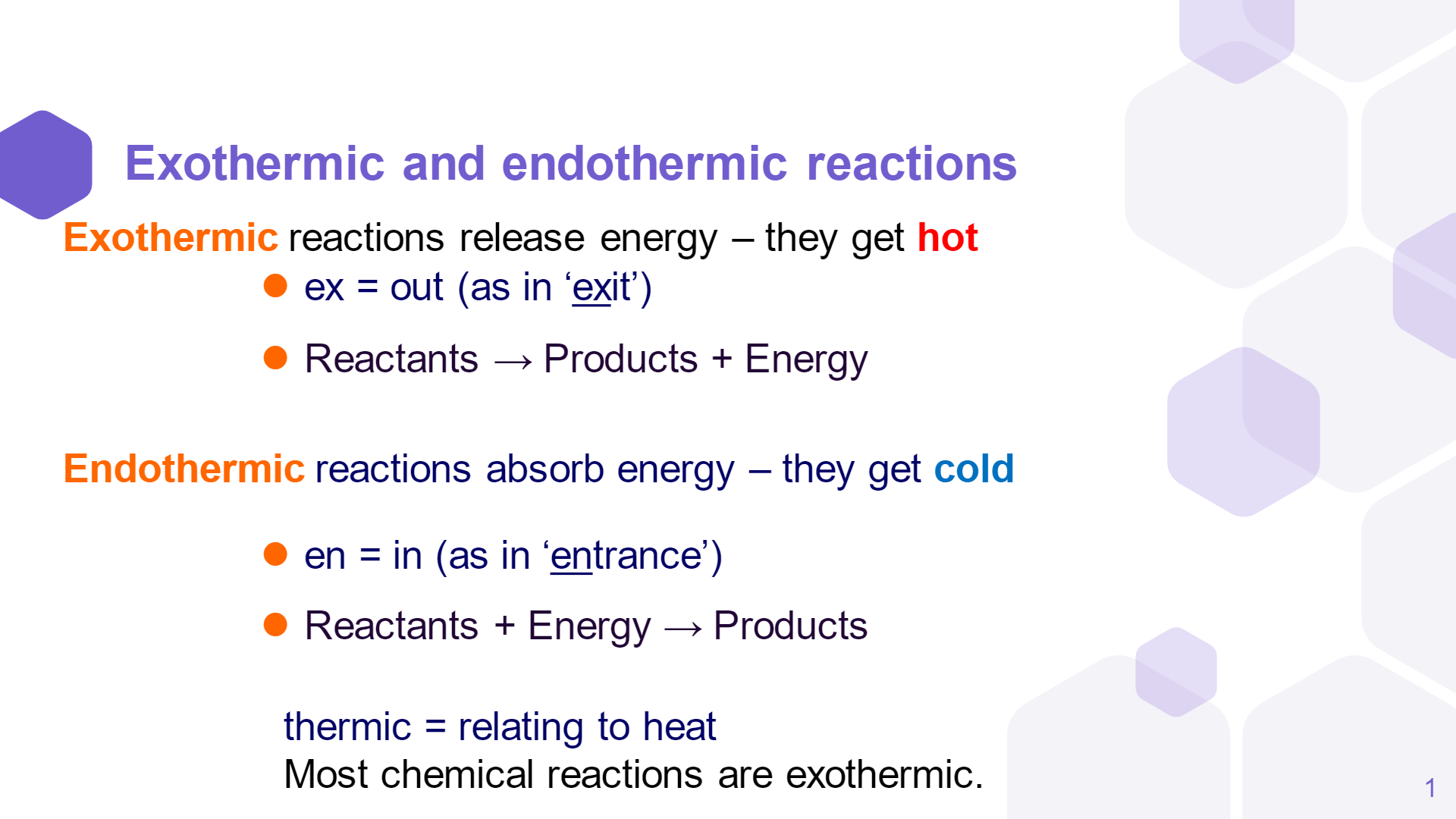
Endothermic and Exothermic Reactions
Presentation
•
Chemistry
•
9th - 12th Grade
•
Easy
+2
Standards-aligned
Takia Miller
Used 19+ times
FREE Resource
12 Slides • 20 Questions
1
Exothermic and Endothermic Reactions
2
3
4
5
6
7
8
9
10
Multiple Choice
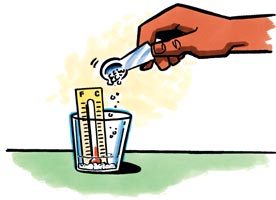
Equal amounts of four different substances where added separately to equal amounts of an acid and a thermometer placed in the mixture. For which substance is the reaction the most exothermic?
temperature rises by 3 °C
temperature falls by 5 °C
temperature falls by 3 °C
temperature rises by 5 °C
11
Multiple Choice
The breaking of bonds in a chlorine molecule must be?
endothermic
equilibrium
electrolytic
exothermic
12
Multiple Choice
Which of the following is a chemical change?
melting an ice-cube
lighting a match
cooling a cup of tea
dissolving sugar in coffee
13
Multiple Choice
Equal amounts of four different substances (A-D) where added separately to equal amounts of an acid and a thermometer placed in the mixture. For which substance is the reaction the least endothermic?
temperature falls by 3 °C
temperature rises by 5 °C
temperature falls by 5 °C
temperature rises by 3 °C
14
Multiple Choice
When ammonium chloride dissolves in water the temperature falls. The type of energy change is described as?
exothermic
activated
decomposition
endothermic
15
Multiple Choice
6.Which of these processes is always exothermic?
evaporation
burning
insulation
melting
16
Multiple Choice
When an exothermic reaction takes place, the reaction mixture gets hotter because?
more energy is released when new bonds are formed than is taken in when existing bonds in the reactants are broken
exothermic changes always produce gases
energy is always released in a chemical change which makes new substances
in an exothermic change the products are more stable than the reactants
17
Multiple Choice
When an endothermic reaction takes place, the reaction mixture takes in heat because?
in an endothermic change the products are less stable than the reactants
less energy is released when new bonds are formed than is taken in when existing bonds in the reactants are broken
energy is always absorbed in a chemical change which makes new substances
endothermic changes always produce energy
18
Multiple Choice
The chemical change when a fuel burns can be described as?
a precipitation
a reversible reaction
an endothermic reaction
an exothermic reaction
19
Multiple Choice
Change 1. When calcium carbonate forms calcium oxide and carbon dioxide heat is absorbed.
Change 2. Calcium oxide releases heat when shaken with carbon dioxide.
Which line BEST describes these changes?
change 1 is exothermic; change 2 is endothermic
change 1 is endothermic; change 2 is exothermic
change 1 is endothermic; change 2 is endothermic
change 1 is exothermic; change 2 is exothermic
20
21
Multiple Choice
In an endothermic reaction, heat is ...
taken in or absorbed
given out or released
22
Multiple Choice
23
Multiple Choice
If a chemical reaction is endothermic, the temperature would ___ as it absorbs energy.
Increase
Decrease
Stay the same
24
Multiple Choice
If a chemical reaction is EXOTHERMIC, the energy stored in the reactants is....
the same as the products
greater than the products
less than the products
25
Multiple Choice
In EXOTHERMIC reactions, energy is _____ from the reaction to the surroundings.
Absorbed
Released
Eliminated
Evaporated
26
Multiple Choice
In an endothermic reaction, energy is ---
Absorbed
Released
27
Multiple Choice
Chemical bonds __________ energy when new bonds are formed. (Products)
release
absorb
28
29
Multiple Choice
O2(g) + 2 H2 (g) → 2 H2O (g) + Energy
endothermic
exothermic
30
31
Multiple Choice
6 CO2+ 6 H2O + Energy → C6H12O6 + 6 O2
endothermic reaction
exothermic reaction
32
Multiple Choice
What type of reaction is this?
Exothermic
Endothermic
Kinetic
Potential
Exothermic and Endothermic Reactions
Show answer
Auto Play
Slide 1 / 32
SLIDE

Similar Resources on Wayground
27 questions
Day 1 of Solutions
Presentation
•
9th - 12th Grade
25 questions
Semicolons
Presentation
•
9th - 12th Grade
26 questions
Data Sampling
Presentation
•
9th - 12th Grade
26 questions
Preterite Tense AR Verbs
Presentation
•
9th - 12th Grade
26 questions
Characteristics of Quadratics
Presentation
•
9th - 12th Grade
26 questions
Half Life
Presentation
•
9th - 12th Grade
28 questions
Lab Demo: Conservation of Mass
Presentation
•
9th - 12th Grade
28 questions
History of the Periodic Table
Presentation
•
10th - 12th Grade
Popular Resources on Wayground
25 questions
The Ultimate College Knowledge Quiz
Quiz
•
8th Grade
20 questions
Math Review
Quiz
•
3rd Grade
15 questions
Fast food
Quiz
•
7th Grade
20 questions
Math Review
Quiz
•
6th Grade
20 questions
Context Clues
Quiz
•
6th Grade
20 questions
Inferences
Quiz
•
4th Grade
19 questions
Classifying Quadrilaterals
Quiz
•
3rd Grade
20 questions
Figurative Language Review
Quiz
•
6th Grade