

Atmosphere and Climate (Pages 4-10)

Presentation
•
Science
•
6th Grade
•
Practice Problem
•
Medium

Jason Heuvelman
Used 2+ times
FREE Resource
4 Slides • 5 Questions
1

3
4
Introduction
Look up into the sky. There’s a very thin,
invisible shield surrounding Earth. It’s called the
atmosphere. This invisible shield makes life on
Earth possible. It provides the air we breathe,
the weather we experience, and the conditions
needed for life on Earth. It protects us from the
Sun’s harmful rays. It controls the amount of
Earth’s heat that escapes into space.
In this book, you will learn about Earth’s
atmosphere, what it is made of, and how it makes
life possible. You will learn the difference between
weather over short and long periods of time.
You’ll also learn what makes up the atmosphere
and how it is changing.
Table of Contents
Introduction .............................................................. 4
Earth’s Invisible Shield ............................................ 5
Layers of Atmosphere ............................................. 8
Earth: Just Right for Life ......................................... 9
The Atmosphere and Weather .............................. 11
Wind’s Driving Force ............................................ 11
Water and Weather ............................................... 12
A Balancing Act .................................................... 14
The Atmosphere and Climate .............................. 15
Climate Zones ....................................................... 16
Climate Change ...................................................... 20
Consequences of Climate Change .......................... 22
Conclusion .............................................................. 24
Glossary ................................................................... 25
Index ........................................................................ 26
2
Open Ended
Why do you think they call our atmosphere an "invisible shield"?
3
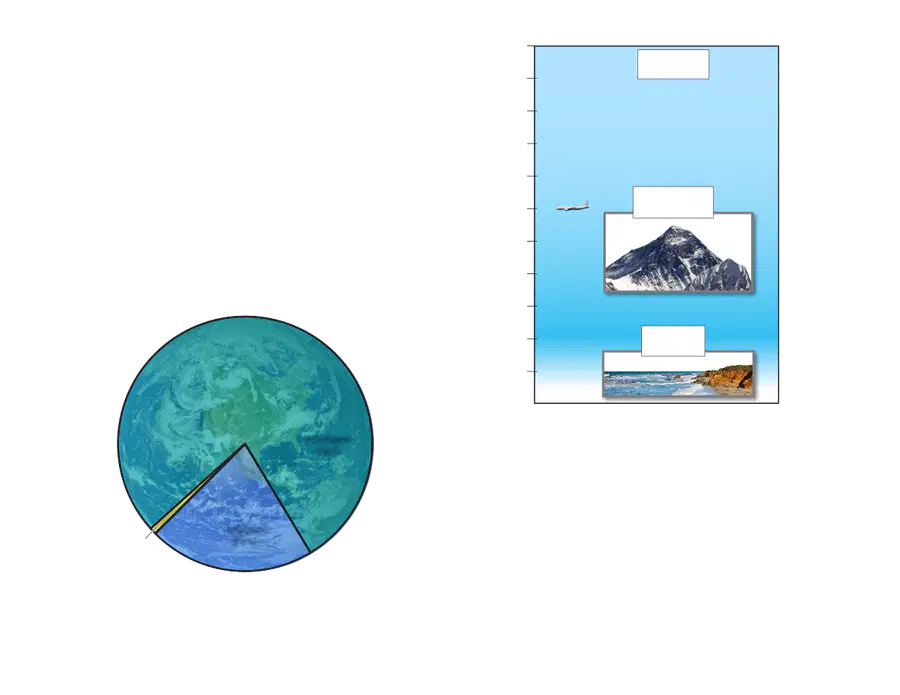
COMPOSITION OF EARTH’S ATMOSPHERE
Altitude (km)
20
18
16
14
12
10
8
6
4
2
0
sea level
760 mmHg
stratosphere
50 mmHg
Mount Everest
230 mmHg
5
6
Earth’s Invisible Shield
The atmosphere is like a blanket. It protects
and warms Earth’s surface. The atmosphere rises
more than 700 kilometers (430 mi.) above Earth’s
surface. It contains all the gases needed for life,
such as nitrogen and oxygen. The atmosphere
also contains small amounts of the gases argon,
carbon dioxide (CO2), water vapor, and a few
others. Oxygen is the gas that we need most.
Without oxygen, life as we know it could not exist.
Gases are like all matter. They are made up of
small, invisible particles called molecules. Gravity
pulls the molecules toward Earth, packing them
together. This blanket of gas molecules creates air
pressure on all things within the atmosphere. At
the bottom of the atmosphere—at sea level—air
pressure is fairly high. Far up in the atmosphere,
the air pressure is much lower.
Scientists measure air pressure in several ways.
At sea level, air pressure is about 760 millimeters
of mercury (mmHg), or 14.7 pounds per square inch.
The atmosphere is mostly made up of nitrogen and oxygen.
It also has small amounts of other gases.
nitrogen
78%
oxygen
21%
Other gases,
including:
argon—0.9%
carbon dioxide—0.037%
4
Multiple Choice
What gas consists of 78% of our atmosphere?
carbon dioxide
water vapor
oxygen
nitrogen
5




FIVE LAYERS OF
EARTH’S ATMOSPHERE
Exosphere — 10,000 km
Thermosphere — 600 km
Mesosphere — 90 km
Stratosphere — 50 km
Troposphere — 20 km
8
7
You do not usually feel air pressure. The reason
is because the pressure inside your body is about
the same as the pressure outside your body. But
when you take off in an airplane or drive up a
mountain, you go higher in the atmosphere,
where the air pressure is lower. As the outside
air pressure drops, the air pressure inside your
ears stays the same. As air exits your ears, you
might hear a popping sound.
Layers of Atmosphere
Scientists have divided Earth’s atmosphere
into five layers. Each layer gradually changes
into the next one.
We live in the first layer—the troposphere—
where Earth’s weather forms and changes.
The stratosphere is above the troposphere.
This layer protects Earth from the Sun’s radiation.
The lowest part of the stratosphere is the ozone
layer. This lower part is important to living
things because it absorbs harmful ultraviolet rays
from the Sun. Certain chemical gases that people
release at Earth’s surface threaten the ozone layer.
These chemicals can float up into the stratosphere
and break down ozone.
The ozone is then
less able to absorb
ultraviolet rays.
The mesosphere is
the middle layer, in
which most meteors
burn up. Spacecraft
orbit in the thermosphere.
The exosphere is the
outermost layer.
Air pressure drops
the higher you go.
If you go high enough,
the air molecules
are very spread
out. You will need
extra oxygen in
order to breathe.
Atmosphere not to scale
6
Multiple Choice
How does air pressure change as you go higher into the atmosphere?
the air pressure will get lower
the air pressure will get higher
the air pressure will not change
7
Multiple Choice
Which layer of the atmosphere do we live in?
exosphere
thermosphere
mesosphere
stratosphere
troposphere
8
9
10
Earth: Just Right for Life
Earth is just right for life because it has liquid
water, and the temperature of the atmosphere is
just right. Earth is at an ideal distance from the
Sun. If Earth were much closer to the Sun, it
would be too hot for life. If Earth were farther
from the Sun, it would be too cold for life.
Another reason
Earth is able to
support life is that
its atmosphere
works like a global
greenhouse. A real
greenhouse is a glass building that lets in sunlight
and traps some of the heat energy. When sunlight,
or solar radiation, passes through Earth’s
atmosphere, some of it is absorbed into oceans
and the ground. This absorbed energy changes
into heat energy. The heat radiates into the
atmosphere and warms the air. The atmosphere
prevents some of the heat from escaping back
into space. This
natural feature of
our atmosphere is
the greenhouse
effect. (See diagram
on page 20.)
The amount of heat energy trapped by Earth’s
atmosphere is just right to support life. The average
temperature on Earth is 10ºC (50ºF). Compare this
to Venus, a very hot planet. Venus is closer to the
Sun than Earth is. Its atmosphere traps even more
CO2 than Earth’s atmosphere does, making the
planet hot. Then there is Mars, a very cold planet.
Mars is farther from the Sun than Earth is. Its
atmosphere traps very little CO2, so the planet is
cold. Venus appears to be too hot for life to exist,
and Mars appears to be too cold.
Why might some
people call Earth
a “Goldilocks planet”?
a greenhouse
The Moon has almost no atmosphere. With no
protection from direct sunlight, the lunar surface
temperature soars to 123ºC (253ºF) when the Sun
shines on it. At night, the Moon cools to a
frigid –233ºC (–387ºF) because there is
nothing to trap the Sun’s heat energy.
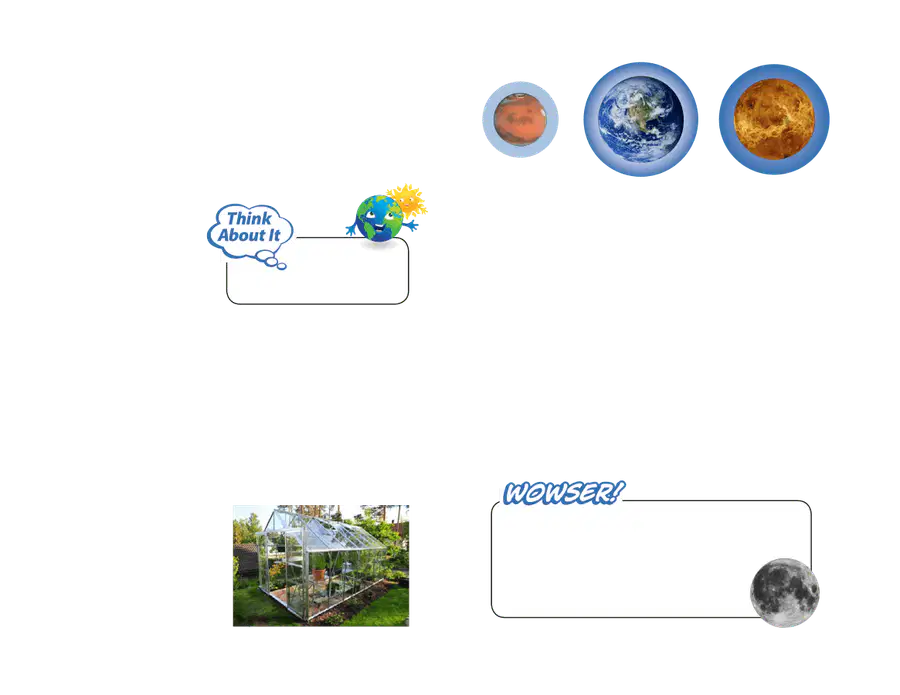
Mars
Earth
Venus
COMPARING ATMOSPHERIC TEMPERATURES
482ºC (900ºF)
–60ºC (–80ºF)
10˚C (50˚F)
Atmospheres not to scale
9
Multiple Select
Why does Earth have the ideal conditions to sustain life?
It is the right temperature
It has the right atmosphere
It has liquid water
3
4
Introduction
Look up into the sky. There’s a very thin,
invisible shield surrounding Earth. It’s called the
atmosphere. This invisible shield makes life on
Earth possible. It provides the air we breathe,
the weather we experience, and the conditions
needed for life on Earth. It protects us from the
Sun’s harmful rays. It controls the amount of
Earth’s heat that escapes into space.
In this book, you will learn about Earth’s
atmosphere, what it is made of, and how it makes
life possible. You will learn the difference between
weather over short and long periods of time.
You’ll also learn what makes up the atmosphere
and how it is changing.
Table of Contents
Introduction .............................................................. 4
Earth’s Invisible Shield ............................................ 5
Layers of Atmosphere ............................................. 8
Earth: Just Right for Life ......................................... 9
The Atmosphere and Weather .............................. 11
Wind’s Driving Force ............................................ 11
Water and Weather ............................................... 12
A Balancing Act .................................................... 14
The Atmosphere and Climate .............................. 15
Climate Zones ....................................................... 16
Climate Change ...................................................... 20
Consequences of Climate Change .......................... 22
Conclusion .............................................................. 24
Glossary ................................................................... 25
Index ........................................................................ 26
Show answer
Auto Play
Slide 1 / 9
SLIDE
Similar Resources on Wayground

8 questions
Amplify 2.3
Presentation
•
6th Grade
6 questions
March 15th Starter
Presentation
•
6th Grade
6 questions
IPA 6 SD Perkembangbiakan Tumbuhan
Presentation
•
6th Grade
8 questions
Body Systems Intro
Presentation
•
6th Grade
7 questions
Metals and Non-metals
Presentation
•
6th Grade
6 questions
Adaptasi Tumbuhan
Presentation
•
6th Grade
6 questions
Science 6 - Calculating Work and Power
Presentation
•
6th Grade
7 questions
Global Winds Labeling
Presentation
•
7th Grade
Popular Resources on Wayground
10 questions
How much do you know about our Portrait of an Eagle?

Quiz
•
10th Grade
10 questions
Fast Food Slogans
Quiz
•
6th - 8th Grade
21 questions
Continents and Oceans
Quiz
•
6th Grade
20 questions
Parts of Speech
Quiz
•
5th Grade
16 questions
Subject & Predicate
Quiz
•
5th Grade
25 questions
Multiplication Facts
Quiz
•
5th Grade
12 questions
Map Skills
Quiz
•
3rd Grade
22 questions
Continents and Oceans
Quiz
•
5th Grade
Discover more resources for Science
10 questions
6.6D - Relative Density Review
Quiz
•
6th Grade
20 questions
Claim, Evidence and Reasoning (CER)
Quiz
•
6th - 8th Grade
20 questions
Density
Quiz
•
6th Grade
10 questions
Exploring Chemical and Physical Changes

Interactive video
•
6th - 10th Grade
20 questions
Food Chains & Food Webs
Quiz
•
5th - 7th Grade
18 questions
Interpreting Distance/Time Graphs
Quiz
•
6th Grade
10 questions
Decoding the Periodic Table of Elements
Interactive video
•
6th - 10th Grade
15 questions
Potential and Kinetic Energy
Quiz
•
6th Grade