Search Header Logo
  1. Resource Library
  2. Science
  3. Earth & Space Science
  4. Sol Review: Earth And Space Systems
SOL Review: Earth and Space Systems

SOL Review: Earth and Space Systems

Assessment

Presentation

Science

6th - 8th Grade

Medium

NGSS
MS-ESS1-1, MS-ESS1-2, MS-ESS2-6

+15

Standards-aligned

Created by

Dana Wallach

Used 10+ times

FREE Resource

14 Slides • 38 Questions

1

You will use this Quizizz to review and assess your understanding of the following 6th grade science topics:

  • the solar system is organized and the various bodies in the solar system interact (6.2)

  • relationship between the Sun, Earth, and the Moon (6.3)

  • basic sources of energy and that energy can be transformed (6.4)

  • air has properties and that Earth’s atmosphere has structure and is dynamic (6.7)

  • humans impact the environment, and individuals can influence public policy decisions related to energy and the environment (6.9)

2

​Gravity and the Solar System

Gravity is a force of attraction between all objects in the universe. Objects with more mass have more gravity. The force of gravity is also stronger when two objects are closer to each other.

Gravity plays a very important role in our solar system. It keeps the planets in orbit around the Sun and the moons around each planet. Without gravity, our solar system would not exist.

Read the passage, and use the information to answer the next 2 questions.​

3

Multiple Choice

Which statement best describes the role of gravity in the formation of the solar system?

1

Gravity causes planets to move in straight lines away from the Sun.

2

Gravity pulled dust and gas together to form the planets.

3

Gravity keeps the planets orbiting the Moon.

4

Gravity does not affect planetary motion.

4

Drag and Drop

Gravitational force differs based on two factors: gravity increases with increasing ​
, and decreases with increasing ​
.
Drag these tiles and drop them in the correct blank above
mass
distance
orbit
planets

5

media

​Use the data table to answer the next question.

6

Match

Question image

Label A through D in the diagram with the correct planet name, based on their distance from the Sun.

A

B

C

D

Mars

Saturn

Uranus

Neptune

7

Multiple Choice

Question image

Which inner planet has the most moons?

1

Earth

2

Mars

3

Mercury

4

Venus

8

Multiple Choice

Question image

Why don't Mercury and Venus have a moon?

1

Because only outer planets have moons.

2

Because they are is so close to the Sun and its gravity, it wouldn't be able to hold on to their own moon.

3

Because they are too small to have a moon.

9

Multiple Choice

Question image
An irregular, rocky body that orbits the sun but is too small to be classified as a planet is known as a:
1
asteroid
2
meteor
3
comet
4
dwarf planet

10

Multiple Choice

Question image

Why do the planets orbit the Sun?

1

They don't, the planets orbit the Earth

2

Because Science

3

The Sun is so massive that it has a very large gravitational pull, which causes objects to orbit it.

11

Multiple Choice

Question image

Which of the following statements describes what is happening in the diagram?

1

Pollution causes the Earth’s surface to absorb solar radiation.

2

Energy from the Sun enters and leaves Earth’s atmosphere.

3

All incoming solar energy is absorbed by Earth’s surface.

4

All incoming solar energy is reflected by Earth’s surface.

12

Fill in the Blank

Question image

What percentage of all incoming solar radiation is reflected into space?

13

Match

Question image

The pie chart shows the proportions of various gases in the Earth’s atmosphere. Match the gas to its percentage.

1%

21%

78%

Argon, Carbon Dioxide, Water Vapor, Etc.

Oxygen

Nitrogen

14

Multiple Choice

Question image

The heat transferred from the Sun to the Earth by electromagnetic waves is called ________.

1

conduction

2

radiation

3

convection

15

Multiple Choice

Question image

The warm air rises and cold air sinks is an example of ---

1

conduction

2

convection

3

radiation

16

​Space Exploration Timeline

Analyze the timeline, and use details to answer the next 2 questions.​

media

17

Multiple Choice

How did technology and mathematics contribute to major developments in our understanding of the solar system?

1

They did not play a significant role.

2

They allowed us to make calculations and collect new information.

3

Only mathematics was important in building our knowledge.

4

Telescopes have not improved our understanding.

18

Multiple Choice

Question image

The USA has the first country to land a manned spacecraft on the Moon. Which the country was the first to launch a satellite into space?

1
Soviet Union (Russia)
2

Greece

3
China
4
USA

19

Multiple Select

Question image

Which of the following allows Earth to support life better than Venus or Mars? Select three correct answers. Use the planet characteristics table to help you answer the question.

1

Distance from the Sun

2

Time of Rotation

3

Time of Revolution

4

Magnetic Field

5

Surface Structure

20

media

21

Dropdown

It is Daytime when your part of Earth ​
the Sun, and Nighttime when your part of Earth ​
from the Sun.

22

Dropdown

A revolution takes one​
, but a rotation takes one ​​
.

23

Dropdown

Earth revolves around ​
, but rotates around ​
.

24

Multiple Choice

Question image

The table shows sunrise and sunset times for September 13 – 16 of 2023 in Manassas, Virginia. What causes these sunrise and sunset times to be regular and predictable?

1

the orbit and rotation of Earth

2

the phases of the Moon

3

the rise and fall of the tides of the ocean

4

the average distance from Earth to the Sun

25

media
  • the Earth's axial tilt

  • Earth's orbit (revolution) around the Sun


Image source: https://vitotechnology.com/

Understanding the causes of the seasons

26

Multiple Choice

Question image

What is the primary cause of season on Earth

1

axial tilt

2

distance from Sun

3

rotation of Earth

27

media
  1. read question closely - determine if you need to identify the season represented in the Northern or Southern Hemisphere

  2. look closely at the axial tilt - decide if the hemisphere is tilt toward (summer) or away (winter) from the Sun

Tips for Identifying Summer and Winter on a diagram:

We live in the Northern Hemisphere.

28

media
  1. using the axial tilt, identify Summer or Winter on the diagram

  2. label the seasons in order

Tips for Identifying Fall (Autumn) and Spring in a diagram:

Starting with summer:

Summer - Fall - Winter - Spring

Starting with winter:

Winter - Spring - Summer - Fall

29

Multiple Choice

Question image

What happens when the area, in which you live, is tilted away from the Sun?

1
It is summer.
2
It is spring.
3
It is winter.
4
It is fall.

30

Multiple Choice

Question image

Why does the area around the equator stay the same temperature all year?

1
The equator rotates slower than the poles.
2
The equator remains the same distance from the sun.
3
The equator always receives direct sunlight.
4
The equator has 18 hour days.

31

Multiple Choice

Question image

Which season is taking place in the Northern Hemisphere in Position 4?

1

Fall

2

Spring

3

Summer

4

Winter

32

Multiple Choice

Question image

The diagram shows the position of Earth relative to the Sun on

December 21st and June 21st. The “red person” on the diagram stands on the North American continent. What best explains why the North American continent experiences summer in June?

1

The North American continent is tilted towards the Sun.

2

The North American continent is titled away from the Sun.

3

Earth is closer to the Sun in December.

4

The Sun is tilted toward the Earth.

33

media

new - no illumination
full - total illumination
waxing - increasing in illumination or brightness
waning - decreasing in illumination or brightness
crescent - small sliver
quarter - from Earth looks half illuminated, but really half of a half (which is one quarter)
gibbous - more than half but not all illuminated

Identifying the Moon Phases

34

media

When the Moon is increasing in brightness, we see the illuminated Moon on the right side of the diagram.

Bright on the Right

​The Moon is increasing in brightness from New to Waxing Crescent to First Quarter to Waxing Gibbous to finally the brightest, a Full Moon.

media

35

Multiple Choice

Question image

What causes the Moon's phases?

1

location that you are standing on Earth

2

the amount of sunlight reflected onto the Moon from the Sun

3

the tilt of Earth

4

how fast the Moon is moving

36

Multiple Choice

Question image

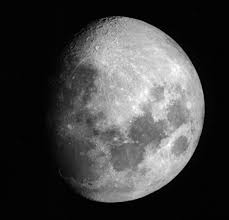
Select Moon phase is represented in the picture. 

Description: area illuminated is in the shape of a crescent, and is on the left

1

Waning Crescent

2

Waxing Crescent

3

Waning Gibbous

4

Waxing Gibbous

37

Multiple Choice

Question image

What is the missing phase?

1
2
3
4

38

Multiple Choice

Question image

Name the phase that would come AFTER this Moon.

1

Waning Crescent

2

Waxing Crescent

3

Waning Gibbous

4

Waxing Gibbous

39

Multiple Choice

Question image

Name the Moon phase.

1

Waning Crescent

2

Waxing Crescent

3

Waning Gibbous

4

Waxing Gibbous

40

Multiple Choice

Question image

Which statement correctly describes the relationship between the tides and the phases of the Moon?

1

Tide height is higher during quarter moons.

2

Tide height is higher during full and new moons.

3

There is no relationship between the tides and the phases of the moon.

4

New Jersey and California have different relationships between tides and moon phases.

41

Analyze the diagram.

Think about the main idea in this graphic.

media

42

Multiple Choice

Question image

What is the best title for the diagram?

1

Dangers of the Sun

2

Earth-Moon-Sun Relationships

3

Our Role in the Solar System

4

The Sun as a Source of Energy

43

Read the passage. Use the information to answer the next question.​

​The Ozone Layer

​The ozone layer is a region of Earth’s atmosphere, located in the stratosphere. It plays a crucial role in protecting life on Earth, as the stratosphere is the mass of protective gases clinging to our planet. While ozone is only a trace gas in the atmosphere, only about 3 molecules for every 10 million molecules, it does a very important job.

media

Unfortunately, the ozone layer is getting thinner due to pollutants, which can have negative health effects on humans, including skin cancers.

44

Multiple Choice

What does the ozone layer help shield Earth from?

1
Radioactive particles
2
Excessive carbon dioxide
3
Harmful infrared radiation
4
Harmful ultraviolet (UV) radiation

45

Multiple Choice

Question image

A high-speed wind, called a jet stream, is moving from the west to the east across the United States. Which characteristic of this jet stream is most important in predicting weather patterns?

1

The jet stream controls the speed of surface wind.

2

The jet stream controls the direction of surface wind.

3

The jet stream separates cold northern air from warm southern air.

4

The jet stream separates moist northern air from dry southern air.

46

Multiple Choice

Question image

Analyze the weather map.

Which state could expect cold and wet weather in the near future?

1

Mississippi (MS)

2

Utah (UT)

3

New York (NY)

4

Oklahoma (OK)

47

Multiple Select

Question image

Analyze the graph. Select the TWO statements that are true about energy use and world population.

1

In 1850, the world population was about 60 million.

2

Energy use increased rapidly starting around 1950.

3

The world population increased faster than energy use did.

4

As the world population increased, energy use also increased.

48

Multiple Choice

Question image

Why is natural gas classified as a nonrenewable resource rather than a renewable resource?

1

Natural gas is available underground but not in the atmosphere.

2

Natural gas can only be used during certain times of the year.

3

Natural gas takes millions of years to form.

4

Earth can never produce more natural gas.

49

Analyze the table to answer the next question.

media

50

Multiple Choice

Question image

Which statement about human and environmental health is correct?

1

Natural gas produces less greenhouse gases than biomass.

2

Nuclear, wind, and solar energy are the best types of energy for human and environmental health.

3

Oil and coal are the best types of energy for human and environmental health.

4

Biomass has the lowest death rate of all energy types.

51

Read the passage and analyze the data in the table to answer the next and FINAL question.

​A community is concerned about how a new housing development may affect organisms that live in a nearby pond. The community considers eliminating fertilizer use.

media

A computer program is used to model what would happen to the number of organisms in the pond in different situations. The results are in the table.

52

Multiple Choice

Question image

Which statement is the strongest argument to support elimination fertilizer use in the development?

1

Eliminating fertilizer has no effect on the number of organisms over time.

2

The population of organisms will fluctuate over time with or without development.

3

Eliminating fertilizer can help mitigate the negative impact on the ecosystem.

You will use this Quizizz to review and assess your understanding of the following 6th grade science topics:

  • the solar system is organized and the various bodies in the solar system interact (6.2)

  • relationship between the Sun, Earth, and the Moon (6.3)

  • basic sources of energy and that energy can be transformed (6.4)

  • air has properties and that Earth’s atmosphere has structure and is dynamic (6.7)

  • humans impact the environment, and individuals can influence public policy decisions related to energy and the environment (6.9)

Show answer

Auto Play

Slide 1 / 52

SLIDE