Intro Ecology food chains & webs
Presentation
•
Science
•
9th Grade
•
Hard
+4
Standards-aligned
Annette Barnes
FREE Resource
29 Slides • 34 Questions
1

Ecological Hierarchy - & the Hierarchy of Life
Review these slides an answer the questions. You can redo these questions for the best points.

2
3
The Hierarchy of Life - every level of organization and an example
most basic level of life:___
Some are bacteria and fungi
4
Examples of Levels
5
Life Processes Include:
Has cells
Metabolism
Reproduction
Homeostasis/Repair
Heredity
Respond to Stimuli
Grow/Develop
6
THE Most Basic Level of the Ecosystem - could be a cell like bacteria
7
8
Subspecies can interbreed and have fertile offspring but they each look physically unique
9
There are Weird Exceptions to the rule:
Horses and Donkeys are a different species but may mate and produce a Mule (dad donkey, mom horse), or Hinny (mom donkey, dad horse), and they are SOMETIMES fertile...
64 Chromosomes
62 Chromosomes
63 chromosomes which cannot evenly divide for Meiosis = not ideal
10
of a certain SPECIES
11
12
13
Multiple Choice
Which of these is an abiotic factor?
14
Multiple Choice
A limiting factor
is any biotic factor that restricts the existence of organisms
is any abiotic factor that restricts the existence of organisms
is any biotic or abiotic factor that restricts the existence of organisms
does not limit the carrying capacity of an ecosystem
15
The Next Level of Hierarchy is a COMMUNITY: ALL of the LIVING (Biotic) Organisms (Species) in an Area
16
Next Level of the Hierarchy of Life
17
18
Last & Highest Level of Organization in the Hierarchy of Life:
19
The Four Spheres of Planet Earth
20
Multiple Choice
21
Multiple Choice
species, population, community, ecosystem, ecosphere
22
Multiple Choice
HIGHEST level of organisms that can interbreed and produce fertile offspring (that can also have offspring)
population
organism
subspecies
species
community
23
Multiple Choice
All the Ash trees, grass, weeds, insects, birds, rhodents, foxes, and climate in an area represents what level of organization?
population
24
25
26
The arrows represent the flow of energy
Trophic Level 1 = producers
TL 2 = primary consumer
TL 3 = primary consumer
TL 4 = tertiary consumer
27
28
Multiple Choice
What do the arrows show in a food chain?
They point to the smallest animals
They point to the animal that tastes the best
They point to just the producers
They point in the direction that energy is flowing
29
Reorder
Put this food chain in the correct order from producer to apex predator
Grass
Rabbit
Snake
Hawk
30
Match
Match each organism with their correct trophic level
Producer
Primary Consumer
Secondary Consumer
Apex Predator
Decomposer
Tree
Squirrel
Insect Eating Bird
Mountain Lion
Bacteria
Tree
Squirrel
Insect Eating Bird
Mountain Lion
Bacteria
31
Humans on a Food Web
Depending on a human's diet they will fall on a different consumer level.
Trophic Levels Reading
"Humans, for example, are primary consumers when they eat plants such as vegetables. They are secondary consumers when they eat cows. They are tertiary consumers when they eat salmon."
32
Multiple Choice
Where does the energy start for all living things & in this food chain?
Plant
Sun
Deer
Wolf
33
Multiple Choice
How can the orca be a 5th level consumer?
phytoplankton --> krill --> ringed seal --> polar bear--> orca
phytoplankton --> krill --> arctic cod --> orca
phytoplankton --> krill --> arctic cod --> ringed seal --> polar bear--> orca
phytoplankton --> krill --> arctic cod --> polar bear--> orca
34
Multiple Choice
35
A Food Chain shows just one path of energy from feeding relationships in an specific ecosystem.
Each organism can be classified into a trophic level
Decomposers can consume dead organism matter at any level so we do not usually include them
Trophic level 1
level 5
Trophic level 2
level 3
level 4
36
Multiple Choice
Diatoms are algae that live in cell walls composed of transparent, opaline silica. On this food web, the Krill (zooplankton crustaceans) are shown as _____________
carnivores
herbivores
omnivores
decomposers
37
Multiple Choice
Diatoms are photosynthetic algae that live in cell walls composed of transparent, opaline silica. On this food web, the Krill (zooplankton crustaceans) are acting as as _____________
carnivores
herbivores
omnivores
decomposers
38
Multiple Choice
On this food web, the arctic cod are acting as _____________
carnivores
herbivores
omnivores
decomposers
39
Multiple Choice
What do fungi, mushrooms & bacteria do to dead plants and animals?
Leave them there
Decompose them
Wait for other animals to eat them
Move away
40
Multiple Choice
Which animals are considered apex predators?
Rabbit, fox and snake
Fox, hawk and owl
Frog, grasshopper and mouse
Bird, frog and owl
41
Multiple Choice
What would happen if the grasshoppers died-off according to this food web?
the number of birds would decrease
the number of frogs would increase
the number of birds would increase
the number of rabbits would decrease
42
43
Multiple Choice
Which of the following only contains organisms
that are secondary consumers in this food web?
snake, mouse, rabbit
frog, deer, rabbit
hawk, mountain lion, cricket
mountain lion, hawk, frog
44
Multiple Choice
Habitat or niche?
releases oxygen
habitat
niche
45
Multiple Choice
46
Multiple Choice
Habitat or niche?
eats insects
habitat
niche
47
Multiple Choice
48
Multiple Choice
Habitat or niche?
under a rock is a
habitat
niche
49
Multiple Choice
50
Competition between members of the same species
Food / Water / Nutrients
Shelter / Space / Territory
Mates
Intraspecies
Competition between members of different species
Food / water / nutrients
Shelter / Space / Territory
Interspecies
Competition between Species
51
Multiple Choice
The Mayfly is a food source for which 3 organisms?
52
Multiple Choice
Does this picture show intraspecies or interspecies interaction between ants.
Intraspecies
Interspecies
53
Multiple Choice
Does this picture show intraspecies or interspecies interaction between the buffalo and tickbird.
Intraspecies
Interspecies
54
55
56
Multiple Choice
57
Multiple Choice
58
Multiple Choice
Which organism in figure 1 contains the most available energy?
plants
hawks and owls
spiders
foxes
59
Multiple Choice
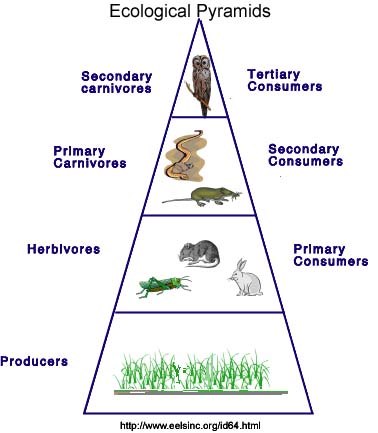
What makes an energy pyramid different than a food web or chain?
It shows energy flowing from the top of the chain and downward.
The tropic levels are the opposite
It shows the amount of energy in each trophic level
It shows specific predator/prey relationships
60
The best competitors are the ones who survive and get to pass on their genes.
Why is competition important?
61
62
Multiple Choice
Why is competition important?
because recessive genes then can be passed-on to offspring
survivors pass on favorable genes that help their offspring survive
it keeps disease out of ecosystems
energy wouldn't flow up the food pyramid
because dominant genes are always passed-on to offspring
63
Multiple Choice
The Competitive Exclusion Principle
Keeps 2 species from occupying the exact niche
Allows 2 species to occupy the same niche
Allows 2 species to occupy the same habitat
Ecological Hierarchy - & the Hierarchy of Life
Review these slides an answer the questions. You can redo these questions for the best points.

Show answer
Auto Play
Slide 1 / 63
SLIDE

Similar Resources on Wayground
60 questions
Electromagnetic Waves
Presentation
•
8th Grade
56 questions
The eye and vision problems
Presentation
•
9th Grade
56 questions
Earth's History
Presentation
•
8th Grade
56 questions
Mendelian Genetics Review
Presentation
•
9th Grade
55 questions
Linear Characteristics Review
Presentation
•
9th Grade
61 questions
Biomes of the World
Presentation
•
9th Grade
57 questions
10.4 Lesson - Two-Way Tables
Presentation
•
8th Grade
Popular Resources on Wayground
16 questions
Grade 3 Simulation Assessment 2
Quiz
•
3rd Grade
19 questions
HCS Grade 5 Simulation Assessment_1 2526sy
Quiz
•
5th Grade
10 questions
Cinco de Mayo Trivia Questions
Interactive video
•
3rd - 5th Grade
17 questions
HCS Grade 4 Simulation Assessment_2 2526sy
Quiz
•
4th Grade
24 questions
HCS Grade 5 Simulation Assessment_2 2526sy
Quiz
•
5th Grade
13 questions
Cinco de mayo
Interactive video
•
6th - 8th Grade
20 questions
Math Review
Quiz
•
3rd Grade
30 questions
GVMS House Trivia 2026
Quiz
•
6th - 8th Grade
Discover more resources for Science
100 questions
Biology EOC Review
Quiz
•
9th - 12th Grade
25 questions
Biology EOC review Quiz
Quiz
•
9th - 12th Grade
20 questions
Human Impact on the Environment Review #2
Quiz
•
9th Grade
20 questions
Balancing Chemical Equations
Quiz
•
9th Grade
11 questions
EOC Domain 1: Cells
Presentation
•
9th - 10th Grade
14 questions
EOC Domain 2: Genetics
Presentation
•
9th - 10th Grade
10 questions
Exploring the Human Respiratory System
Interactive video
•
6th - 10th Grade
10 questions
Exploring Newton's Laws of Motion
Interactive video
•
6th - 10th Grade