
Wave Behaviour

Presentation
•
Science
•
11th Grade
•
Practice Problem
•
Medium

Bing Zhang
Used 4+ times
FREE Resource
17 Slides • 15 Questions
1

Wave Behaviour
Inquiry question: How do waves behave?
Students:
● explain the behaviour of waves in a variety of situations by investigating the phenomena of:
– reflection
– refraction
– diffraction
– wave superposition (ACSPH071, ACSPH072)
● conduct an investigation to distinguish between progressive and standing waves
(ACSPH072)
● conduct an investigation to explore resonance in mechanical systems and the relationships
between:
– driving frequency
– natural frequency of the oscillating system
– amplitude of motion
– transfer/transformation of energy within the system (ACSPH073)
2
Open Ended

What is the frequency of this wave?
3

Wave Interactions
• Mechanical waves transfer energy
through a medium.
• When that medium physically ends or
changes the wave does not stop.
• The energy the wave is carrying
undergoes three processes:
• Some energy is reflected
• Some energy is absorbed
• Some energy is transmitted
4

Reflection
• When a transverse wave is reflected the amplitude of the reflected wave is not
quite the same as the original.
• Some of the energy of the wave is absorbed by the boundary and some will
travel through it.
• The more rigid and/or dense the boundary is the more the wave energy will
be reflected and the less it will be absorbed.
• However some energy will always be absorbed.
5
Multiple Select

A wave travels along a rope and reaches a fixed end. What occurs next?
the wave is reflected
the reflected pulse is inverted
No change to the amplitude
No change of phase
6

Reflected Wave Fronts
• 2D and 3D waves (e.g. water waves) travel
as wave fronts.
• When wave fronts are drawn, what is
drawn are the crests of the waves.
• When close to the source wave fronts can
have significant curvature, but a long
distance from the source are nearly
straight (this is called a plane wave).
• The direction of the wavefront is shown
by a line (called a ray) that is
perpendicular to the wave front and in
the direction that it is moving.
7
Multiple Choice
Which of the following properties of a wave can change when the wave is reflected:
frequency
amplitude
wavelength
speed
8

Reflected Wave Fronts
• When using rays to show a wave front
hitting a surface, we us an imaginary
line called the normal, that is
perpendicular to the surface.
• The angle from the normal that a wave
strikes the surface at (angle of
incidence) is the same as the angle
from the normal to the reflected wave
(angle of reflection).
• This is the law of reflection, stated as i = r
9
Labeling
Label the diagram
angle of incidence
incident ray
angle of reflection
reflected ray
Normal
10

11
Draw
Draw the reflected rays for the incident rays.
12
Multiple Choice

Is the last example of specular reflection or diffuse reflection?
specular
diffuse
13

Refraction
• Refraction is a change in the direction of a wave, caused
by a change of it’s speed.
• This occurs when a wave passes from one medium into
another.
• The direction of the refraction depends on whether the
wave speeds up or slows down as it enters the new
medium.
• Waves refract away from the normal when they speed
up .
• Waves refract towards the normal when they slow
down .
• (Remember that when a wave changes speed its
wavelength also changes, but not its frequency).
14
Multiple Choice
When light travels from the air into the water, which of following changes?
speed
amplitude
frequency
period
15

Diffraction
• When a plane wave passes through an
opening, or around an obstacle, it bends.
• This bending is known as diffraction.
• Diffraction is significant when the size of the
opening or obstacle is similar or smaller than
the wavelength of the wave.
• If the wavelength is much smaller the
diffraction is less.
16
Bending of light around the corners of door and windows.


Sun rays coming from the clouds.

Light peeping out through two blades, when they are places in the manner shown below .
17
Multiple Choice
which of the following is not the example of diffraction?
Colors on a CD/DVD
Electron microscope
Sound bending around corners
formation of shadow
18

Superposition
• Principle of Superposition: Superposition
occurs when multiple wave interact their
amplitudes are added together.
19

Superposition
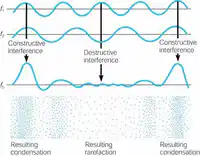
• This can be constructive (waves become
bigger) or destructive (waves become
smaller).
• When any two waves meet and combine
there are places where constructive
superposition occurs and places where
destructive superposition occurs.
• This concept is used in noise cancelling
headphones.
20
Multiple Choice

What will the superposition of these two pulses look like in 3s?
21
Open Ended
A ray strikes a flat surface at an angle of 38° measured from the surface. What is the angle of reflection of the ray?
22
Multiple Choice

The following diagram shows a wave before and after being reflected from an object. What is the shape of the object?
flat
concave
convex
parabolic
23
Multiple Choice

What phenomenon does the diagram below demonstrates?
diffraction
interference
reflection
refraction
24

Standing Waves
• A standing wave occurs when a new
wave interferes with the reflection of
the first wave in a way that the 2
superimposed waves create a single
larger amplitude wave.
• It is called this as it does not appear to
be travelling up and down, but
oscillating up and down in a fixed
pattern.
• i.e. the medium is just flipping up and
down in the same place.
25
Labeling
label the diagram
nodes
antinodes
26
Resonance is the phenomenon where a system is driven to oscillate with greater amplitude at certain frequencies than at others. This fundamental property of waves and systems plays a crucial role in various scientific fields, from physics to engineering.
27

Natural Frequency: All objects that can vibrate tend to do so at a specific frequency.
Resonance
28
Driving Frequency
External frequency applied to the system.
When driving frequency equals to natural frequency, amplitude of a system's oscillation increases.
29
driving frequency = natural frequency
energy of force is transferred efficiently to system
increase in amplitude
Resonance
30
31
Multiple Choice
Resonance occurs when the driving frequency of a vibration exactly equals the natural frequency of vibration of an object.
the amplitude of vibration will decrease
the amplitude of vibration will increase
the frequency of vibration will decrease
the frequency of vibration will increase
32
Multiple Choice

in the graph, two of the wave forms superimpose to create the third wave form. which wave is the result of the superposition of the other two?
red
green
blue
Wave Behaviour
Inquiry question: How do waves behave?
Students:
● explain the behaviour of waves in a variety of situations by investigating the phenomena of:
– reflection
– refraction
– diffraction
– wave superposition (ACSPH071, ACSPH072)
● conduct an investigation to distinguish between progressive and standing waves
(ACSPH072)
● conduct an investigation to explore resonance in mechanical systems and the relationships
between:
– driving frequency
– natural frequency of the oscillating system
– amplitude of motion
– transfer/transformation of energy within the system (ACSPH073)
Show answer
Auto Play
Slide 1 / 32
SLIDE
Similar Resources on Wayground

25 questions
Physical and Chemical Changes Review
Presentation
•
8th Grade
24 questions
Government Response to the Great Depression
Presentation
•
11th Grade
22 questions
Free Body Diagrams
Presentation
•
11th Grade
26 questions
Unit 4: Appendicular Skeleton, Part 1
Presentation
•
11th - 12th Grade
25 questions
Parallelism
Presentation
•
11th Grade
23 questions
Water Resources
Presentation
•
10th - 12th Grade
26 questions
Introduction to the Cold War
Presentation
•
11th Grade
26 questions
Subject Verb Agreement SAT
Presentation
•
11th Grade
Popular Resources on Wayground
10 questions
How much do you know about our Portrait of an Eagle?

Quiz
•
10th Grade
10 questions
Fast Food Slogans
Quiz
•
6th - 8th Grade
21 questions
Continents and Oceans
Quiz
•
6th Grade
20 questions
Parts of Speech
Quiz
•
5th Grade
16 questions
Subject & Predicate
Quiz
•
5th Grade
25 questions
Multiplication Facts
Quiz
•
5th Grade
12 questions
Map Skills
Quiz
•
3rd Grade
22 questions
Continents and Oceans
Quiz
•
5th Grade
Discover more resources for Science
22 questions
Periodic Table Review
Quiz
•
9th - 12th Grade
14 questions
Periodic Trends

Interactive video
•
11th Grade
7 questions
Newton's Laws Video Quiz
Interactive video
•
9th - 12th Grade
10 questions
Electron configuration and Orbital Notation
Quiz
•
11th Grade
17 questions
Unit 3A: Cells Vocab
Quiz
•
9th - 12th Grade
89 questions
Unit 1 (Ch 2 & 3) Test Review - Water/Ocean Currents
Quiz
•
9th - 12th Grade
58 questions
Biomolecule Test Corrections
Quiz
•
9th - 12th Grade
20 questions
Unit 2: Cell Energy Review
Quiz
•
9th - 12th Grade