Search Header Logo
TEAS Test Study Guide - Circulatory System

TEAS Test Study Guide - Circulatory System

Assessment

Presentation

Biology

University

Easy

NGSS
MS-LS1-3, HS-LS1-3, HS-PS2-5

+6

Standards-aligned

Created by

SN Goebel

Used 3+ times

FREE Resource

20 Slides • 124 Questions

1

TEAS Test Study Guide - Circulatory System

2

Multiple Choice

Question image

What is the purpose of the circulatory system?

1

The purpose of the circulatory system is to transport oxygen, nutrients, hormones, and waste products throughout the body.

2

The purpose of the circulatory system is to aid in digestion.

3

The purpose of the circulatory system is to produce energy.

4

The purpose of the circulatory system is to control body temperature.

3

Functions of the Circulatory System

  • Controlling the movement of blood and lymph through the body.

  • Exchanging gases (oxygen and carbon dioxide) with other cells and tissues in the body.

  • Exchanging nutrients (such as amino acids and electrolytes) with other cells and tissues.

  • Helping with immune responses.

  • Helping with clotting.

  • Helping in the maintenance of body temperature and pH (maintaining homeostasis).

4

Multiple Choice

Question image

What are the main components of the circulatory system?

1

Stomach, intestines, and esophagus

2

Heart, blood vessels, and blood

3

Lungs, pancreas, and liver

4

Brain, spinal cord, and nerves

5

Multiple Choice

Question image

What is the main purpose of the heart?

1

The main purpose of the heart is to aid in digestion.

2

The main purpose of the heart is to pump oxygen-rich blood to all parts of the body.

3

The main purpose of the heart is to produce hormones.

4

The main purpose of the heart is to control body temperature.

6

Multiple Choice

Question image

Which of the following is the correct route of blood through the heart?

1

Right atrium, left ventricle, pulmonary artery, lungs, pulmonary veins, left atrium, right ventricle, aorta

2

Left atrium, right ventricle, aorta, lungs, pulmonary veins, right atrium, left ventricle, pulmonary artery

3

Right atrium, right ventricle, pulmonary artery, lungs, pulmonary veins, left atrium, left ventricle, aorta

4

Left atrium, left ventricle, pulmonary artery, lungs, pulmonary veins, right atrium, right ventricle, aorta

7

8

Match

Question image

Match the following components of the heart with their correct descriptions:

Carries oxygenated blood away from the heart to the rest of the body

Carries deoxygenated blood from the heart to the lungs

Carries oxygenated blood from the lungs to the heart

Carries deoxygenated blood from the body back to the heart

Aorta

Pulmonary artery

Pulmonary vein

Vena cava

9

Match

Question image

Match the chamber of the heart to its function:

Pumps oxygenated blood to the entire body

Pumps deoxygenated blood to the lungs

Receives oxygenated blood from the lungs

Receives deoxygenated blood from the body

Left ventricle

Right ventricle

Left atrium

Right atrium

10

Match

Question image

Match the valve of the heart with its location.

Between the left ventricle and the ascending aorta

Between the right ventricle and the pulmonary artery

Between the right atrium and the right ventricle

Between the left atrium and the left ventricle

Aortic valve

Pulmonary valve

Tricuspid valve

Mitral valve

11

Match

Question image

Match the layers of the heart wall to their description.

Outermost layer of the heart; protects and lubricates the heart

Middle layer of the heart; responsible for heart contractions

Innermost layer of the heart; provides smooth surface for blood flow

Epicardium

Myocardium

Endocardium

12

Multiple Choice

Question image

What is the pericardium?

1

The pericardium is the outermost layer of the skin.

2

The pericardium is a bone in the human body.

3

The pericardium is the double-layered sac that encloses the heart.

4

The pericardium is a nerve in the brain.

13

Multiple Choice

Question image

Which of the following is NOT a function of the pericardium?

1

Protection of the heart against friction

2

Production of red blood cells

3

Anchoring the heart in the chest cavity

4

Serving as a lubricant for the movement of the heart

14

Match

Question image

Match the following types of blood vessels with their descriptions.

Carry oxygenated blood away from the heart.

Facilitate exchange of substances between blood and body tissues.

Small blood vessels that collect deoxygenated blood from capillaries.

Carry deoxygenated blood towards the heart.

Smaller branches of arteries.

Arteries

Capillaries

Venules

Veins

Arterioles

15

Multiple Choice

Question image

Which of the following is NOT a function of arteries?

1

To regulate blood flow

2

To carry waste materials

3

To maintain blood pressure

4

To carry oxygenated blood away from the heart

16

Match

Question image

Match the following

Outermost layer of a blood vessel, made up of connective tissue

Middle layer of a blood vessel, made up of smooth muscle and elastic fibers

Innermost layer of a blood vessel, made up of endothelium

Tunica externa (adventitia)

Tunica media

Tunica intima

17

Multiple Choice

Question image

Which of the following is a characteristic of arteries?

1

Arteries carry deoxygenated blood

2

Arteries are thin and fragile

3

Arteries have a pulse

18

Multiple Choice

Question image

Which layer of arteries is responsible for vasoconstriction and vasodilation?

1

Tunica externa

2

Tunica media

3

Tunica interna

19

Multiple Choice

Question image

What is the purpose of the tunica externa in arteries?

1

To provide support and protection

2

To allow for gas exchange

3

To regulate blood pressure

20

Multiple Choice

Question image

What happens to arteries as they move further away from the heart?

1

Arteries get larger and merge into veins

2

Arteries become thinner and more fragile

3

Arteries get smaller and branch into arterioles

21

Multiple Choice

Question image

What is the major artery that carries oxygenated blood from the heart to the rest of the body?

1

Aorta

2

Coronary artery

3

Pulmonary artery

22

Multiple Choice

Question image

What is the main function of veins in the human body?

1

To carry deoxygenated blood back to the heart

2

To filter waste products from the blood

3

To carry oxygen to the body

4

To transport nutrients to the cells

23

Multiple Choice

Question image

Which of the following is NOT true about veins?

1

Veins carry blood away from the heart.

2

Veins can be superficial or deep.

3

Veins can be found throughout the body.

4

Veins have one-way valves.

24

Multiple Choice

Question image

Which statement best describes the structure of veins?

1

Veins have thinner walls and larger lumens compared to arteries.

2

Veins have a thick tunica media layer which helps with vasoconstriction

3

Veins are only present in the upper body.

4

Veins have thicker walls and smaller lumens compared to arteries.

25

Match

Question image

Match the veins with their functions:

Vein that brings deoxygenated blood from head, arms, and upper body

Vein that brings deoxygenated blood from lower body

Vein that brings oxygenated blood from lungs to heart

Vein the returns blood from your brain back toward your heart

Vein that collects deoxygenated blood from tissues in your lower leg and helps move it to your heart

Superior Vena Cava

Inferior Vena Cava

Pulmonary Vein

Jugular Vein

Femoral Vein

26

Multiple Choice

Question image

What is the main difference between systemic circulation and pulmonary circulation?

1

Systemic circulation carries oxygenated blood to the body tissues, while pulmonary circulation carries deoxygenated blood to the lungs.

2

Systemic circulation carries deoxygenated blood to the lungs, while pulmonary circulation carries oxygenated blood to the body tissues.

3

Systemic circulation carries oxygenated blood to the lungs, while pulmonary circulation carries deoxygenated blood to the body tissues.

4

Systemic circulation carries deoxygenated blood to the body tissues, while pulmonary circulation carries oxygenated blood to the lungs.

27

Multiple Choice

Question image

What is the pathway of blood supply to the heart muscle?

1

Renal circulation

2

Coronary circulation

3

Systemic circulation

4

Pulmonary circulation

28

Multiple Choice

Question image

What does an EKG measure?

1

Kidney function

2

Electrical activity of the heart

3

Blood pressure

4

Oxygen saturation in the blood

29

Multiple Choice

Question image

What is the correct sequence of events in the electrical conduction pathway of the heart?

1

SA node -> bundle of His -> AV node -> Purkinje fibers

2

AV node -> SA node -> bundle of His -> Purkinje fibers

3

Bundle of His -> SA node -> AV node -> Purkinje fibers

4

SA node -> AV node -> bundle of His -> Purkinje fibers

30

Match

Question image

Match the following components of the electrical conduction system to their respective functions:

Initiates each heartbeat

Delays the electrical impulses to allow for atrial contraction before ventricular contraction

Transmits the electrical impulses from the atrioventricular (AV) node to the ventricles

Distributes the electrical impulses to the muscle cells of the ventricles

SA node

AV node

Bundle of His

Purkinje fibers

31

Match

Question image

Match the following cardiac electrical events with their descriptions.

Atrial depolarization

Ventricular depolarization

Ventricular repolarization

P wave

QRS complex

T wave

32

Multiple Choice

Question image

What is the cardiac cycle?

1

The sequence of events that occur during a single heartbeat

2

The process of transporting oxygenated blood to the body

3

The contraction and relaxation of the heart muscles

4

The pathway of blood through the circulatory system

33

media

The heart beat starts top down - It starts in the upper chambers (atria) then goes down to the lower chambers (ventricles)

  1. The SA node initiates the heartbeat in the atria
    Depolarization always comes before repolarization, therefore, the top chambers (both left and right atria) will start the heartbeat by depolarizing. On the EKG, it is the P wave

  2. After the atria depolarizes, the ventricles (both left and right ventricles) will now have their chance to depolarize. On the EKG, it is the QRS complex
    While the lower chambers (ventricles) are depolarizing, the upper chambers are finishing the process by repolarizing.

  3. Now, the upper chambers are finished with the process, the lower chambers have to finish the process by repolarizing. On the EKG, it is the T wave

Events in a EKG Tracing

34

media

P wave

  • Depolarization of atria in response to SA node triggering

  • Atrial systole - the heart is relaxed and both ventricles are filling with blood

    QRS Complex

  • Depolarization of ventricles

  • Repolarization of atria

  • Ventricular systole - the ventricles are contracting and pushing the blood out of the heart

    T wave

  • Repolarization of ventricles

​Review

35

Multiple Choice

Question image

What happens during the 'lub' part of a heart beat?

1

The atrioventricular (AV) valves close.

2

The semilunar valves open.

3

The semilunar valves close.

4

The atrioventricular (AV) valves open.

36

Multiple Choice

Question image

What happens during the dub part of a heart beat?

1

Opening of the atrioventricular valves

2

Closure of the semilunar valves

3

Relaxation of the ventricles

4

Contraction of the atria

37

38

39

Multiple Choice

Question image

What is the difference between pacemaker potential and cardiac action potential?

1

Pacemaker potential is the electrical activity that spreads throughout the heart causing it to contract, while cardiac action potential refers to the spontaneous electrical activity in specialized cells that initiate heart contractions.

2

Pacemaker potential and cardiac action potential are the same and can be used interchangeably.

3

Pacemaker potential refers to the spontaneous electrical activity in specialized cells that initiate heart contractions, while cardiac action potential refers to the electrical activity that spreads throughout the heart causing it to contract.

4

Pacemaker potential is responsible for heart contractions, while cardiac action potential is responsible for initiating electrical activity in the heart.

40

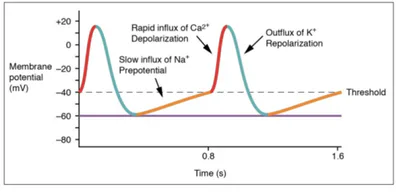
​Pacemaker Potential

41

Resting Membrane Potential

  • Pacemaker cells have a resting membrane potential that is less negative than other cardiac cells (around -60 to -70 mV).

  • This resting potential is maintained by the movement of potassium (K+) and calcium (Ca2+) ions across the cell membrane through specific channels.

Pacemaker Potential Steps

media

42

Slow Depolarization

  • After repolarization from the previous action potential, the membrane potential of pacemaker cells begins to slowly depolarize.

  • This depolarization occurs due to a small inward current of sodium ions (Na+) known as the "funny current" (If).

  • The funny current is carried by HCN (hyperpolarization-activated cyclic nucleotide-gated) channels that open gradually as the membrane potential becomes more negative after repolarization.

Pacemaker Potential Steps

media

43

Threshold Potential

  • As the membrane potential of the pacemaker cell reaches a threshold (typically around -40 to -50 mV), voltage-gated calcium channels (Ca2+) begin to open.

  • These calcium channels allow an influx of calcium ions (Ca2+) into the cell.

Pacemaker Potential Steps

media

44

Rapid Depolarization

  • The influx of calcium ions (Ca2+) triggers a rapid depolarization phase, similar to the action potential in other cardiac cells.

  • This rapid depolarization phase leads to the upstroke of the action potential, generating the electrical signal that propagates through the heart muscle.

Pacemaker Potential Steps

media

45

Repolarization

  • After reaching peak depolarization, calcium channels close and potassium channels open, allowing potassium ions (K+) to flow out of the cell.

  • This efflux of potassium ions causes repolarization of the cell membrane, restoring it to its resting membrane potential and preparing it for the next pacemaker potential.

Pacemaker Potential Steps

media

46

Recovery/Re-establishment of Ion Gradients:

  • Following repolarization, ion gradients are restored through the action of sodium-potassium pumps and other ion transport mechanisms.

  • The cell returns to its resting state, ready to undergo another cycle of the pacemaker potential and initiate the next action potential.

Pacemaker Potential Steps

media

47

Multiple Choice

Question image

What are the steps of pacemaker potential?

1

Depolarization, Repolarization, Hyperpolarization, Resting potential, Return to resting potential

2

Hyperpolarization, Resting potential, Depolarization, Repolarization, Return to resting potential

3

Depolarization, Hyperpolarization, Resting potential, Repolarization, Return to resting potential

4

Resting potential, Depolarization, Repolarization, Hyperpolarization, Return to resting potential

48

Multiple Choice

Question image

Which step of pacemaker potential allows the pacemaker cell to reach the threshold and initiate an action potential?

1

Hyperpolarization

2

Resting potential

3

Repolarization

4

Depolarization

49

Multiple Choice

Question image

When do the fast calcium channels open during the pacemaker potential?

1

At the peak of the action potential

2

At the end of the slow sodium influx

3

At the start of the slow sodium influx

4

Before the slow sodium influx begins

50

Multiple Choice

Question image

What happens during repolarization in the pacemaker potential?

1

The potassium channels open, allowing potassium ions to exit the cell.

2

The chloride channels open, allowing chloride ions to exit the cell.

3

The sodium channels open, allowing sodium ions to enter the cell.

4

The sodium channels open, allowing sodium ions to enter the cell.

51

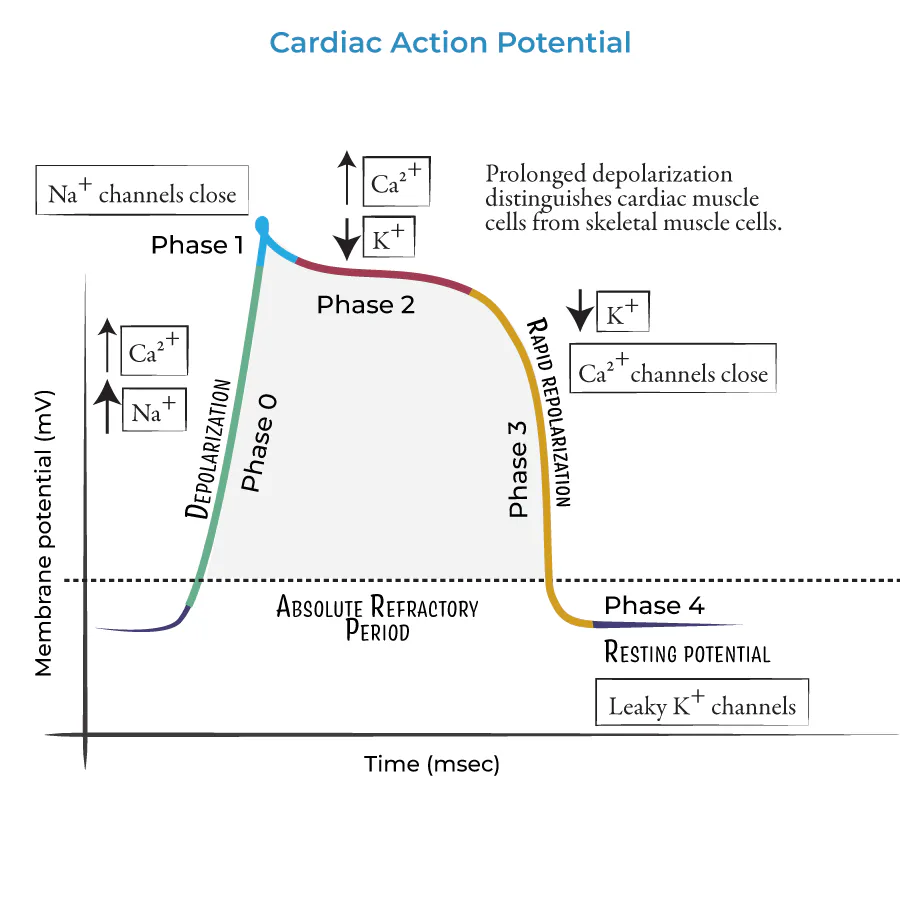
​Cardiac Action Potential

52

Resting phase

  • At rest, the inside of the cardiac cell (myocyte) is negatively charged relative to the outside due to an uneven distribution of ions.

  • Sodium (Na+) ions are more concentrated outside the cell, while potassium (K+) and chloride (Cl-) ions are more concentrated inside.

  • The cell membrane is relatively impermeable to these ions due to closed ion channels.

Cardiac Action Potential Steps

media

53

Depolarization phase

  • When the heart receives an electrical signal (from the sinoatrial node), voltage-gated sodium channels in the cell membrane open.

  • Sodium (Na+) ions arush into the cell, down their concentration gradient, causing a rapid influx of positive charge.

  • This influx of positive charge depolarizes the cell membrane, making the inside less negative (more positive).

Cardiac Action Potential Steps

media

54

Plateau phase

  • Shortly after depolarization, voltage-gated calcium channels open, allowing Ca2+ ions to enter the cell.

  • Ca2+ influx prolongs the depolarization phase, contributing to sustained contraction of the cardiac muscle.

Cardiac Action Potential Steps

media

55

Repolarization phase

  • Potassium channels open, allowing K+ ions to leave the cell, repolarizing the membrane (making it negative inside again).

  • This outflow of positive charge restores the negative charge inside the cell and prepares it for the next heartbeat.

Cardiac Action Potential Steps

media

56

Restoration phase (Refractory phase)

  • After repolarization, ion concentrations are restored to their resting state through the action of sodium-potassium pumps and other mechanisms.

  • The cell cannot respond to another stimulus until it has fully repolarized, ensuring the heart beats in a coordinated manner.

Cardiac Action Potential Steps

media

57

Multiple Choice

Question image

What does the cardiac action potential ultimately lead to?

1

Contraction of the heart muscle

2

Relaxation of blood vessels

3

Relaxation of the heart muscle

4

Inhibition of nerve impulses

58

Multiple Choice

Question image

What are the steps of the cardiac action potential?

1

Depolarization, repolarization, plateau

2

Depolarization, plateau, repolarization

3

Repolarization, plateau, depolarization

4

Hyperpolarization, depolarization, repolarization

59

Multiple Choice

Question image

Which of the following describes the depolarization phase of the cardiac action potential?

1

Influx of calcium ions

2

Rapid influx of sodium ions

3

Efflux of potassium ions

4

Influx of chloride ions

60

Multiple Choice

Question image

Which ion channels are responsible for the plateau phase of the cardiac action potential?

1

Fast sodium channels

2

Potassium channels

3

Slow calcium channels

4

Chloride channels

61

Multiple Choice

Question image

Why is the plateau phase important in the cardiac action potential?

1

It allows for the rapid depolarization of the cardiac cells.

2

It speeds up the repolarization of the cardiac cells.

3

It coordinates the electrical signals between the atria and ventricles.

4

It allows for the sustained contraction of the heart muscles.

62

Multiple Choice

Question image

What happens during the repolarization phase of the cardiac action potential?

1

Efflux of potassium ions

2

Influx of calcium ions

3

Efflux of chloride ions

4

Influx of sodium ions

63

Match

Match the following

A slow heart rate, usually fewer than 60 beats per minute

A fast heart rate, usually more than 100 beats per minute

Irregular heartbeat

Skipped or extra heartbeats

Normal heartbeat

Bradycardia

Tachycardia

Atrial Fibrillation

Premature Ventricular Contraction (PVC)

Sinus Rhythm

64

Multiple Choice

Question image

What does blood pressure measure?

1

The force exerted by blood against the walls of blood vessels.

2

The amount of blood pumped by the heart per minute.

3

The concentration of red blood cells in the blood.

4

The speed at which blood circulates in the body.

65

Multiple Choice

Question image

What instrument is used to measure blood pressure?

1

Sphygmomanometer

2

Pulse oximeter

3

Stethoscope

4

Thermometer

66

Multiple Choice

Question image

What is the difference between systolic and diastolic blood pressure?

1

Systolic blood pressure is the pressure in the veins, while diastolic blood pressure is the pressure in the arteries.

2

Systolic blood pressure is the pressure in the heart chambers, while diastolic blood pressure is the pressure in the blood vessels.

3

Systolic blood pressure is the pressure in the arteries during contraction of the heart, while diastolic blood pressure is the pressure in the arteries when the heart is at rest between beats.

4

Systolic blood pressure is measured in mmHg, while diastolic blood pressure is measured in cmHg.

67

Multiple Choice

Question image

What units are used to measure blood pressure?

1

Blood pressure is measured in millimeters of mercury (mmHg).

2

Blood pressure is measured in centimeters of mercury (cmHg).

3

Blood pressure is measured in beats per minute (bpm).

4

Blood pressure is measured in liters per minute (L/min).

68

Multiple Choice

Question image

What is the normal range for blood pressure in adults?

1

The normal range for blood pressure in adults is typically around 80/60 mmHg.

2

The normal range for blood pressure in adults is typically around 140/90 mmHg.

3

The normal range for blood pressure in adults is typically around 120/80 mmHg.

4

The normal range for blood pressure in adults is typically around 160/100 mmHg.

69

Multiple Choice

Question image

What is hypertension?

1

Hypertension is a condition where blood pressure drops too low.

2

Hypertension is a condition where blood pressure fluctuates rapidly.

3

Hypertension is a condition where blood pressure is always within the normal range.

4

Hypertension, or high blood pressure, is a medical condition characterized by consistently elevated blood pressure levels.

70

Multiple Choice

Question image

What is hypotension?

1

Hypotension is a condition where blood pressure fluctuates rapidly.

2

Hypotension is a condition where blood pressure remains at a consistently elevated level.

3

Hypotension, or low blood pressure, is a medical condition characterized by blood pressure that is lower than normal.

4

Hypotension is a condition where blood pressure is always within the normal range.

71

Multiple Choice

Question image

Which of the following is a risk factor for high blood pressure?

1

Eating chocolate

2

BP increases with age

3

Drinking coffee

4

Listening to loud music

72

Multiple Choice

Question image

What happens when blood vessels lose elasticity?

1

Blood volume increases

2

Blood pressure increases

3

Blood pressure decreases

4

Heart rate decreases

73

Multiple Choice

Question image

What type of tissue is blood?

1

Nervous tissue

2

Muscle tissue

3

Epithelial tissue

4

Connective tissue

74

Match

Question image

Match the following blood cells with their correct descriptions:

Red blood cells that transport oxygen throughout the body

White blood cells that fight against infection and foreign substances

Also known as platelets, they help in blood clotting

Erythrocytes (Red blood cells)

Leukocytes (White blood cells)

Thrombocytes (Platelets)

75

Multiple Choice

Question image

How much blood does the average adult human have?

1

1 liter

2

10 liters

3

3 liters

4

5 liters

76

Multiple Choice

Question image

What are the percentages of the components of blood?

1

Plasma: 55%, Red blood cells: 45%

2

Plasma: 35%, Red blood cells: 50%

3

Plasma: 45%, Red blood cells: 55%

4

Plasma: 40%, Red blood cells: 60%

77

Multiple Choice

Question image

What is hematocrit?

1

The percentage of white blood cells (WBCs) in the total blood volume

2

The total amount of blood in the body

3

The average lifespan of red blood cells (RBCs)

4

The percentage of red blood cells (RBCs) in the total blood volume

78

Multiple Choice

Question image

Which type of blood cell is the most abundant in the human body?

1

Plasma

2

White blood cell

3

Red blood cell

4

Platelet

79

Multiple Choice

Question image

What are the main characteristics of the anatomy of red blood cells?

1

They have a nucleus and biconcave shape.

2

They have a nucleus and irregular shape.

3

They lack a nucleus and have a biconcave shape.

4

They lack a nucleus and irregular shape.

80

Multiple Choice

Question image

What is the main component of hemoglobin?

1

Protein

2

Carbohydrate

3

Lipid

4

Vitamin

81

Multiple Choice

Question image

What is the iron-containing molecule in hemoglobin called?

1

Heme

2

Protein

3

Globin

4

Hyaluronic acid

82

Multiple Choice

Question image

What type of molecule is globin in hemoglobin?

1

Protein

2

Nucleic acid

3

Carbohydrate

4

Lipid

83

Multiple Choice

Question image

What is the function of the heme part of hemoglobin?

1

Helps regulate blood pressure

2

Provides energy for the body

3

Carries oxygen

4

Transports carbon dioxide

84

Multiple Choice

Question image

How many globulin molecules are in each hemoglobin?

1

1

2

2

3

3

4

4

85

Multiple Select

Where are red blood cells (RBCs) formed in an infant? Hint: Pick two answers!

1

In the kidneys

2

In the spleen

3

In the bone marrow

4

In the liver

86

Multiple Select

Where are red blood cells (RBCs) formed in a young child (up to about 5 years of age)? Hint: pick one answer

1

In the kidneys

2

In the spleen

3

In the bone marrow of long bones

4

In the bone marrow of all bones

87

Multiple Select

Where are red blood cells (RBCs) formed in adults (over 5 years of age)? Hint: pick one answer

1

In the kidneys

2

In the spleen

3

In the bone marrow of long bones

4

In the bone marrow of all bones

88

Multiple Choice

Question image

What is the average lifespan of a red blood cell (RBC)?

1

Approximately 30 days

2

Approximately 120 days

3

Approximately 365 days

4

Approximately 1 year

89

Multiple Choice

Question image

Which organ plays a major role in the destruction of old red blood cells and acts like a recycling center of the components of red blood cells?

1

intestines

2

adrenal glands

3

bladder

4

spleen

90

Multiple Choice

Question image

What is the primary role of white blood cells (leukocytes)?

1

Transport oxygen through the body

2

Produce antibodies for immunity

3

Regulate the body's temperature

4

Protect the body against pathogens and foreign substances

91

Multiple Choice

Question image

Which of the following is NOT a characteristic of white blood cells?

1

Engulf and destroy pathogens

2

Carry oxygen in the blood

3

Produce antibodies

4

Defend against foreign invaders

92

Multiple Choice

Question image

What is the purpose of white blood cells having a nucleus?

1

To store oxygen

2

To generate energy

3

To produce proteins needed for immune responses

4

To transport nutrients

93

Match

Question image

Match the following white blood cells:

Release histamines and other substances involved in allergic reactions

Most abundant type of white blood cell that helps fight bacterial infections

Play a key role in the immune response by producing antibodies

Play a role in defending the body against parasitic infections

Largest type of white blood cell that helps remove dead cells and debris from the body

Basophil

Neutrophil

Lymphocyte

Eosinophil

Monocyte

94

Multiple Choice

Question image

What are the four blood types?

1

O, A, B, AB

2

B, O, AB, A

3

A, AB, 0, B

4

A, B, AB, O

95

Match

Question image

Match the blood type with the antigens and the antibodies they produce.

Antigen A, Antibody B

Antigen B, Antibody A

Antigens A and B, No Antibodies

No Antigens, Antibodies A and B

Type A

Type B

Type AB

Type O

96

Multiple Choice

Question image

What is the Rh factor?

1

A vitamin essential for blood clotting

2

A hormone that regulates blood pressure

3

A type of white blood cell

4

A protein found on the surface of red blood cells

97

Multiple Select

Question image

Rh factor can be _____________ or ______________. Pick two answers!

1

positive

2

neutral

3

negative

4

invisible

98

Multiple Choice

Question image

What is the blood type for this test?

1

A+

2

B+

3

AB+

4

O+

99

Multiple Choice

Question image

What is the blood type for this test?

1

A-

2

B-

3

AB-

4

O-

100

Multiple Choice

Question image

What is the blood type for this test?

1

A-

2

B-

3

AB-

4

O-

101

Multiple Choice

Question image

What does CBC stand for in the context of human anatomy and physiology?

1

Central Brain Control

2

Cardiovascular Blood Circulation

3

Cellular Body Composition

4

Complete Blood Count

102

Multiple Choice

What is the purpose of a complete blood count (CBC) test?

1

To determine blood type

2

To evaluate overall health and detect a wide range of disorders

3

To assess kidney function

4

To measure blood sugar levels

103

Multiple Choice

Question image

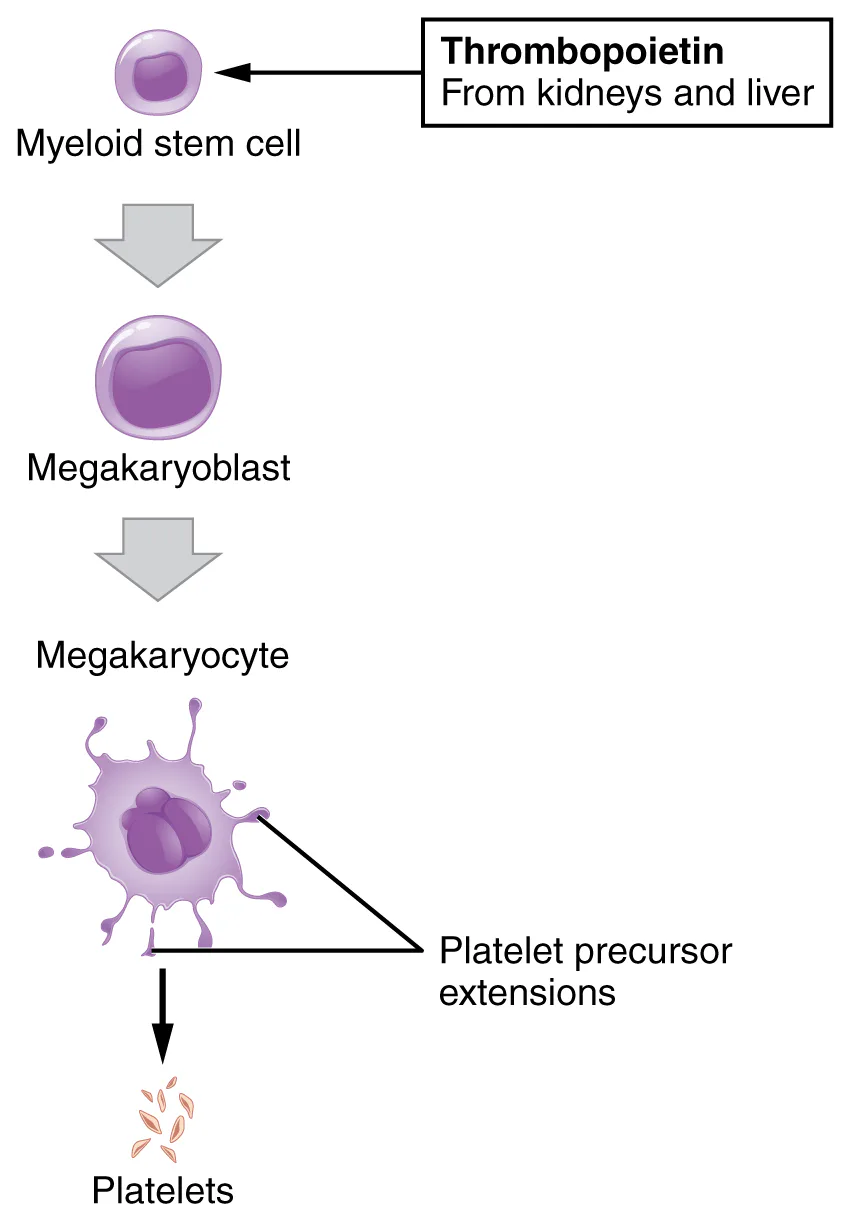
How are platelets formed?

1

They are formed in the spleen.

2

They are formed from certain cells in the bone marrow called megakaryocytes.

3

They are formed in the lungs.

4

They are formed in the kidneys.

104

Multiple Choice

Question image

Platelets are primarily involved in?

1

Respiration

2

Digestion

3

Blood clotting

4

Muscle contraction

105

Multiple Choice

Question image

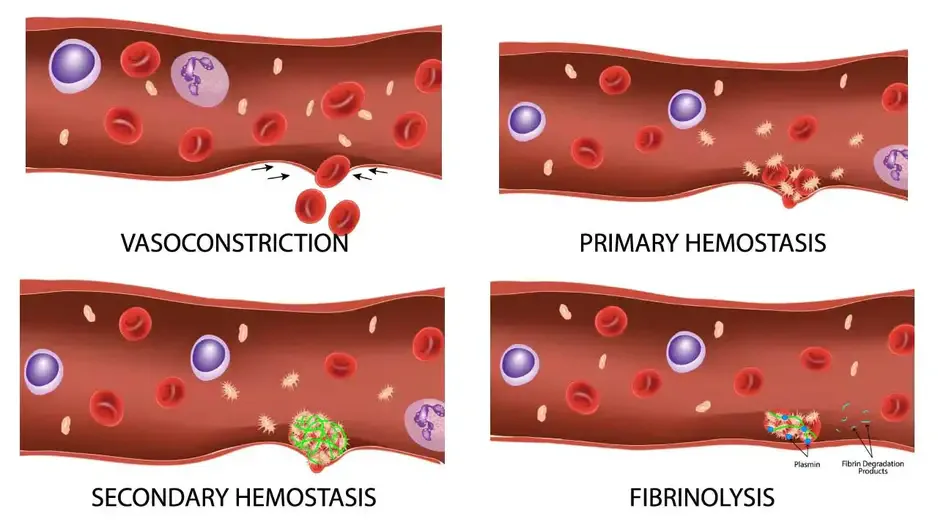
What is hemostasis?

1

The process of breaking down food in the stomach

2

The process of stopping bleeding or blood flow

3

The process of breathing in oxygen

4

The process of sending signals from the brain to the muscles

106

Multiple Choice

Question image

Which type of blood cells are involved in clotting during hemostasis?

1

Platelets

2

Red blood cells

3

White blood cells

4

Plasma

107

Multiple Choice

Question image

In which order do the steps of hemostasis typically occur?

1

Vascular spasm, coagulation, platelet plug formation

2

Vascular spasm, platelet plug formation, coagulation

3

Coagulation, vascular spasm, platelet plug formation

4

Platelet plug formation, coagulation, vascular spasm

108

Multiple Choice

Question image

What happens during vascular spasm?

1

Activation of clotting factors

2

Constriction of blood vessels

3

Formation of a platelet plug

4

Dilation of blood vessels

109

Multiple Choice

Question image

What triggers the formation of a platelet plug in hemostasis?

1

Excessive blood pressure

2

Activation of red blood cells

3

Exposed collagen fibers

4

Presence of pathogens

110

Multiple Choice

Question image

During platelet plug formation, what is the first step?

1

The platelet plug becomes stabilized

2

Platelets release chemical signals

3

Activated platelets aggregate together

4

Platelets adhere to the damaged blood vessel wall

111

Multiple Choice

Question image

What happens during the process of coagulation in hemostasis?

1

Platelets form a plug to stop bleeding and a network of fibrin strands is created to form a blood clot.

2

Blood vessels dilate to increase blood flow and platelets break apart to prevent blood clotting.

3

Red blood cells aggregate to stop bleeding and blood clotting is prevented.

4

White blood cells form a plug to stop bleeding and blood vessels constrict to prevent blood loss.

112

Multiple Choice

Question image

What is the scientific term for the process of red blood cell production?

1

Thrombopoiesis

2

Leukopoiesis

3

Hematopoiesis

4

Erythropoiesis

113

Multiple Choice

Question image

What is the main difference between a thrombus and an embolus?

1

A thrombus is a blood clot that forms and stays in a blood vessel, while an embolus is a blood clot that breaks free and travels through the bloodstream.

2

A thrombus is a blood clot that forms in the arteries, while an embolus is a blood clot that forms in the veins.

3

A thrombus is a blood clot that forms in the heart, while an embolus is a blood clot that forms in the lungs.

4

A thrombus is a blood clot that forms anywhere in the body, while an embolus is a blood clot that forms specifically in the brain.

114

Multiple Choice

Question image

Which of the following best defines anemia?

1

A condition characterized by a higher-than-normal number of red blood cells or an increase in the quality or quantity of hemoglobin

2

A condition characterized by a higher-than-normal number of red blood cells or an increase in the quality or quantity of hemoglobin

3

A condition characterized by low blood pressure and insufficient blood flow to the body organs

4

A condition characterized by a lower-than-normal number of red blood cells or a decrease in the quality or quantity of hemoglobin

115

Multiple Choice

Question image

What is sickle cell anemia?

1

A bacterial infection affecting the lungs

2

A genetic blood disorder characterized by abnormal red blood cells that are crescent-shaped

3

A contagious disease caused by a virus

4

A type of cancer affecting the bone marrow

116

Multiple Choice

Question image

What are some complications associated with sickle cell anemia?

1

Memory loss and cognitive decline

2

Broken bones and sprains

3

Stroke, infections, organ damage, and chronic pain

4

Hearing loss and vision problems

117

Multiple Choice

Question image

What is Atherosclerosis?

1

A type of muscle tissue

2

A process of breaking down food in the stomach

3

A condition where fatty deposits called plaques build up inside the arteries

4

An infectious disease caused by bacteria

118

Multiple Choice

Question image

What is ischemia?

1

A condition characterized by inadequate blood supply to an organ or tissue

2

A condition characterized by inflammation of an organ or tissue

3

A condition characterized by abnormal growth of cells in an organ or tissue

4

A condition characterized by excessive blood supply to an organ or tissue

119

Multiple Choice

Question image

Which of the following is a common cause of ischemia?

1

Pneumonia

2

Gastritis

3

Atherosclerosis

4

Arthritis

120

Multiple Choice

Question image

What is congestive heart failure?

1

A viral infection that affects the heart muscle.

2

A condition where the heart cannot pump enough blood to meet the body's needs.

3

A blockage in one or more of the coronary arteries.

4

An abnormal heart rhythm.

121

Multiple Choice

Question image

What is angina?

1

A condition where the kidneys stop functioning properly

2

A chest pain or discomfort that occurs when the heart muscle doesn't receive enough blood flow

3

A genetic disorder that affects the immune system

4

A mental health disorder characterized by excessive worrying

122

Multiple Choice

Question image

What is cardiac arrest?

1

A sudden loss of heart function, causing a cessation of blood flow

2

A condition where the heart beats too fast

3

A type of heart attack

4

A heart condition characterized by abnormal heart rhythms

123

Multiple Choice

Question image

What is coronary heart disease?

1

A condition where the arteries that supply blood to the heart become narrow or blocked

2

A condition where the brain does not receive enough blood flow

3

A condition where the kidneys fail to filter blood properly

4

A condition where the lungs receive insufficient oxygen

124

Multiple Choice

Question image

What is myocardial infarction?

1

A heart attack caused by blockage of blood flow to the heart muscle.

2

A sudden spasm of the heart muscle.

3

An inflammation of the lining of the heart and its valves.

4

A condition in which the heart muscle is weakened and cannot pump blood effectively.

125

Multiple Choice

Question image

What is phlebitis?

1

Inflammation of an artery

2

Swelling of a muscle

3

Infection of a nerve

4

Inflammation of a vein

126

Multiple Choice

Question image

What are varicose veins?

1

Enlarged and twisted veins, usually in the legs

2

Abnormal growths in the colon

3

Inflammation of the gallbladder

4

Tiny blood vessels in the lungs

127

Multiple Choice

What is another name for heart rate?

1

Pulse rate

2

Respiratory rate

3

Blood pressure

4

Metabolic rate

128

Multiple Choice

Question image

Which of the following is the correct unit used to measure pulse rate?

1

Feet per second (fps)

2

Kelvin (K)

3

Liters (L)

4

Beats per minute (BPM)

129

Multiple Choice

Question image

What is epistaxis?

1

Nosebleed

2

Headache

3

Earache

4

Toothache

130

Multiple Choice

Question image

What is a bruise?

1

A bruise is a type of skin infection caused by bacteria.

2

A bruise is a bone fracture that causes bleeding within the body.

3

A bruise is a type of allergic reaction that results in skin discoloration.

4

A bruise is a type of injury that occurs when small blood vessels near the skin's surface rupture and leak blood into the surrounding tissues.

131

Multiple Choice

Question image

What is another name for a bruise?

1

Abrasion

2

Contusion

3

Laceration

4

Fracture

132

Multiple Choice

Question image

What is an incision?

1

A type of bone found in the forearm.

2

A vital organ responsible for filtering blood in the body.

3

A cut made in the body during surgery or medical procedures.

4

A condition characterized by the inflammation of the airways.

133

Multiple Choice

Question image

What is a laceration?

1

A broken bone.

2

A type of joint in the human body.

3

A deep cut or tear in the skin or flesh.

4

An infection of the respiratory system.

134

Multiple Choice

Question image

What is a scrape injury?

1

A shallow wound that occurs when the skin is rubbed or scratched against a rough surface.

2

A deep cut through the layers of the skin.

3

A bone break or crack caused by excessive force or pressure.

4

A bruise that happens when blood vessels under the skin rupture.

135

Multiple Choice

Question image

What is the definition of throbbing?

1

A temporary loss of consciousness or awareness, often accompanied by a sudden fall.

2

A sudden, sharp, and severe pain in a localized area of the body.

3

The process of breaking down food into simpler substances that can be absorbed and used by the body.

4

A rhythmic pulsation or vibrating sensation, especially one caused by the rapid expansion and contraction of blood vessels. This sensation is usually accompanied with pain.

136

Multiple Choice

Question image

What is a blood blister?

1

A pocket of fluid that forms under the skin due to friction or injury.

2

A skin condition caused by an allergic reaction to blood.

3

A medical condition that causes excessive bleeding under the skin.

4

A type of blister that is filled with blood cells.

137

Multiple Choice

Question image

How does a blood blister form?

1

A buildup of blood vessels beneath the skin leads to the formation of a blister.

2

Friction or injury causes the top layer of skin to separate from the lower layers, trapping blood and forming a blister.

3

Excessive sun exposure leads to the development of blood blisters on the skin.

4

Exposure to cold temperatures causes blood vessels to constrict, leading to blister formation.

138

Multiple Choice

Question image

What is a crush injury?

1

An injury caused by a forceful compression of body tissues, resulting in damage to muscles, bones, or other structures.

2

An injury caused by a sharp object penetrating the body.

3

An injury caused by a fall from a height.

4

An injury caused by excessive stretching or tearing of muscles or tendons.

139

Multiple Choice

Question image

Which of the following is NOT a symptom of a crush injury?

1

Sudden visual disturbance

2

Swelling

3

Bruising

4

Pain

140

Multiple Choice

Question image

What is hemangioma (red/purple birthmark) ?

1

A non-cancerous (benign) tumor caused by abnormal growth of blood vessels.

2

An autoimmune disease targeting the liver

3

A genetic disorder affecting lung function

4

A type of skin infection caused by bacteria

141

Multiple Choice

Question image

What is occult blood?

1

Blood that is only visible under a microscope

2

Blood that is hidden, cannot be seen with the naked eye.

3

Blood that is found in the arteries

4

Blood that is bright red in color

142

Multiple Choice

Question image

What are heart palpitations?

1

Fast-beating, fluttering or pounding heart

2

Blocked arteries

3

Enlarged heart

4

High blood pressure

143

Multiple Choice

Question image

What are tarry stools?

1

Stools that are green in color and odorless

2

Stools that are brown in color and have a solid consistency

3

Stools that are light in color and have a watery consistency

4

Stools that are dark in color and have a sticky, tar-like consistency indicating blood present in the digestive tract

144

Multiple Choice

Question image

What is a transfusion?

1

A method used to transfer oxygen from one person to another.

2

A technique used to transfer organs from one person to another.

3

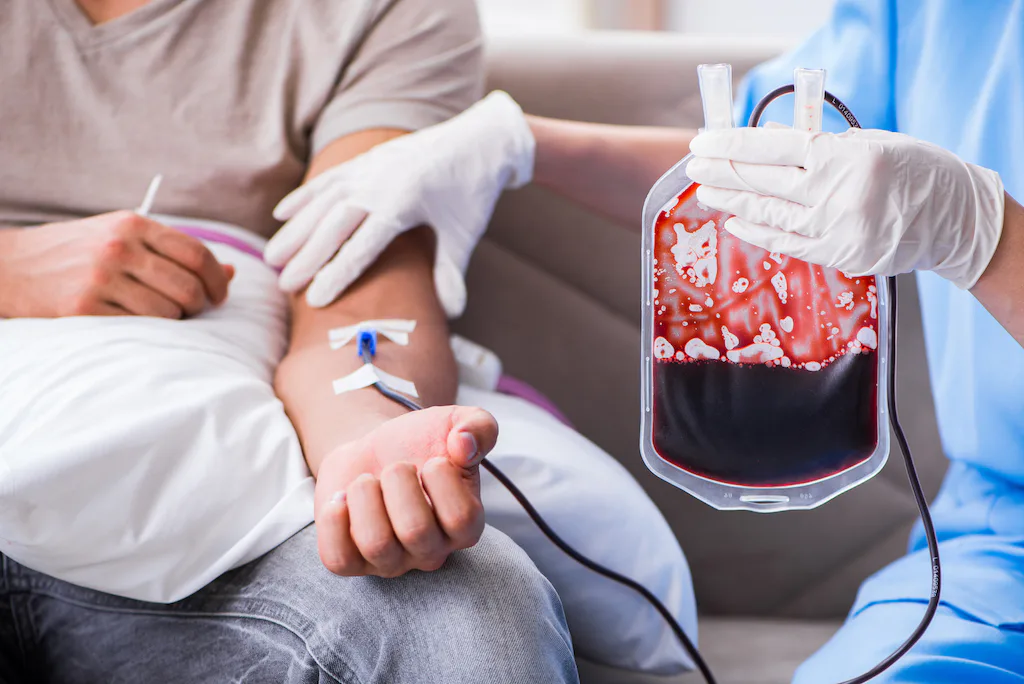
The process of transferring blood or blood products from one person (the donor) to another person (the recipient).

4

The process of transferring medications from one person to another.

TEAS Test Study Guide - Circulatory System

Show answer

Auto Play

Slide 1 / 144

SLIDE