Features of erosion
Presentation
•
Geography
•
KG - Professional Development
•
Practice Problem
•
Easy
Aimee Cooper
Used 1+ times
FREE Resource
51 Slides • 19 Questions
1
Open Ended
Wassh (the movement of water up the beach)
Nglo erohs rifdt (the movement of sediment along a beach)
Rosenio (the wearing away of rock)
Brasnioa (sand and pebbles are flung against the rock wearing it away like sandpaper)
Dyrhuacil niocta (the wave forces air into the cracks and over time the cracks become weaker)
Niotisopde (when the wave doesn’t have the energy to carry the sediment no longer)
Noitsoul (when the water dissolves the rock)
Porttransnioa (the movement of sediment)
Eahbc (an area of sand or shingle)
Tchfe (the length of water the wind has travelled)
2
Lesson Objectives
To know what a landform is.
To explain how headlands and bays are formed.
To understand how differential erosion can be caused by differences in rock type.
To discover What discordant and concordant coastlines are and where they are found
3
4
Open Ended
What factors effect the rate of erosion?
5
6
Landforms
Landforms are features of the landscape that have been formed or sculpted by the processes of:- erosion, transportation, deposition.
Some rocks are tougher than others. Rocks such as granite, limestone and chalk form impressive cliffs and headlands because they are much more resistant to erosion.
7
Erosion
Softer rocks are much more easily eroded. They are more prone to collapse and slumping and therefore not as steep as cliffs made of more resistant rocks. Examples of soft rock include sands, clays and shale. This difference in the rate of erosion is known as differential erosion.
8
Headland
A narrow piece of more resistant rock which projects outwards from the coast. It is surrounded by the sea on three sides.
9
Bay
A crescent-shaped indentation in the coastline found between two headlands. It usually has a beach, which may be composed of sand or shingle.
10
1.What is the name of the feature that juts out to sea?
2.What material is a bay made up of sand?
3.Which coastline do they form on?
4.Why does a headland stick out?
11
1.What is the name of the feature that juts out to sea?
•Headland
2.What material is a bay made up of sand?
•Sand
3.Which coastline do they form on?
•Discordant
4.Why does a headland stick out?
•Rock is more resistant
12
13
14
15
16
Labelling
Add labels to the diagram
bay
differential erosion
Soft rock e.g clay
hard rock e.g. limestone
headland
17
Open Ended
Have a look at this coastline. This is an area of the Dorset coast which includes Swanage which we will be looking at in more detail later. Consider the questions
18
Here is the same coastline, with the geology (rock types) mapped
19
Open Ended
Why are these coastlines different?
20
21
Match
Match the following
Rocks are parallel to the wave front and therefore rates of erosion are similar along the coastline.
Differential erosion may occur, where bands of hard and soft rock outcrop at right angles to the sea.
Soft rocks are eroded at a faster rate than hard rocks, this forms bays sheltered by headlands
Concordant
Discordant
Differential erosion
Concordant
Discordant
Differential erosion
22
Labelling
Label the coastlines
Discordant
Concordant
23
24
Categorize
Hard rock such as limestone jutting out into the sea
Near vertical cliff face
High-energy area affected by destructive waves
Crescent shaped indentation on the coastline
Usually has a beach
Soft rock such as sand and shingle
Low energy constructive waves
Organise these options into the right categories
25
Answers
26
Open Ended
Explain the formation of headlands and bays (6 marks)
27
Mark Scheme
28
Example Answer
Headlands and bays are formed at discordant coastlines where there are alternating bands of hard and soft rock at 90’ to the coast. The waves hit the coastline and erode the softer rock such as clay and sand faster as it is less resistant to erosion. This creates a bay which is an indentation of the land. The headlands are hard rock made from chalk and limestone and they jut out as they are more resistant to erosion and therefore are eroded at a slower rate. This change in the coast line causes the wave to refract (bend) and therefore amplifies this process as the wave energy converges at the headland so when the waves reaches the bay the energy has dissipated and therefore beach material is deposited because the bay has calm waters.
29
Lesson Objectives
To know what a landform is.
To explain how headlands and bays are formed.
To understand how differential erosion can be caused by differences in rock type.
To discover What discordant and concordant coastlines are and where they are found
30
31
32
33
Lesson Objectives
To know what a landform is.
To explain how headlands and bays are formed.
To understand how differential erosion can be caused by differences in rock type.
To discover What discordant and concordant coastlines are and where they are found
34
Open Ended
Look at the photo and try and answer the questions
35
Wavecut notch
36
Open Ended
Describe the features of this coastline
37
38
Open Ended
How do you think this feature is formed?
39
Wave cut platform
A wave cut platform is an area of bedrock visible at the base of some cliffs. It slopes to the sea at a very gentle angle, and is generally only visible at low tide.
40
Wavecut notch and wavecut platform
41

Formation of a wave-cut (shore) platform
You can open this webpage in a new tab.
42
43
44
Labelling
1) Between high and low tide, rocks are hurled at the base of the cliff
2) Sub-aerial processes such as freeze thaw weaken the top of the cliff
3) Erosion cannot occur under the water level so a wave-cut platform is left
4) The top of the cliff becomes unstable
5) This has created an undercut in the cliff, a wave-cut notch.
6)The cliff has now retreated but erosion will continue.
7)The cliff will collapse providing more material for attrition and corrasion at the base of the cliff
3
1
5
7
2
4
6
45
Labelling
Explain the formation of a wave cut platform
5
1
2
4
3
46
47
Open Ended
Explain the formation of a wave-cut platform (6 marks)
Structure of answer
Describe what a wave-cut platform is
Use key terms such as abrasion, hydraulic action (explain what these mean), undercut, cliff retreat, high tide, low tide, unsupported, wave-cut notch
48
Example Answer
A wave cut platform is an area of bedrock visible at the base of some cliffs. It slopes to the sea at a very gentle angle, and is generally only visible at low tide.
The cliff line used to protrude out to sea to where the wave-cut platform extends to now. It is created through processes of erosion at the base of the cliff between the areas of high tide and low tide. In this area the waves attack and erode it away through processes of abrasion which is the rubbing of rocks against the cliff and hydraulic action which is the force of water and air into the cracks which increases the pressure and is released in mini explosions. This causes the rock to wear away and form an indentation at the base of the cliff. This is called a wave-cut notch. The process continues and the wave-cut notch widens. The weight of the rock above the wave-cut notch is unsupported and becomes weaker and eventually falls into the sea. This process continues to happen leading to the cliff retreated and leaves a wave-cut platform visible at low tide.
49
Open Ended
50
Open Ended
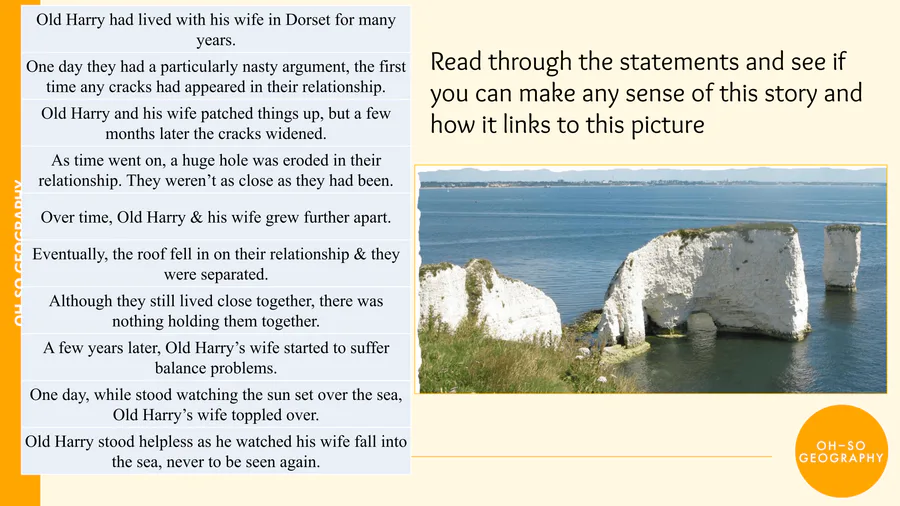
What does this story have to do with coastal landforms?
51
52
53
54
55
56
57
58
59
60
61
62
63
64
65
66
Open Ended
Describe and explain the formation of caves, arches, stacks and stumps
67
68
69
Labelling
Label the features of erosion
cave
arch
stack
headland
stump
wavecut platform
70
Homework
Wassh (the movement of water up the beach)
Nglo erohs rifdt (the movement of sediment along a beach)
Rosenio (the wearing away of rock)
Brasnioa (sand and pebbles are flung against the rock wearing it away like sandpaper)
Dyrhuacil niocta (the wave forces air into the cracks and over time the cracks become weaker)
Niotisopde (when the wave doesn’t have the energy to carry the sediment no longer)
Noitsoul (when the water dissolves the rock)
Porttransnioa (the movement of sediment)
Eahbc (an area of sand or shingle)
Tchfe (the length of water the wind has travelled)
Show answer
Auto Play
Slide 1 / 70
OPEN ENDED

Similar Resources on Wayground
66 questions
Animal Science-Dairy Judging Review Lesson
Presentation
•
10th - 12th Grade
66 questions
Biomes on Earth Lesson
Presentation
•
9th - 12th Grade
63 questions
Geography Handbook
Presentation
•
7th Grade
65 questions
Exposure and Vulnerability (Cycles 2 and 3)
Presentation
•
12th Grade
67 questions
The Griot's Challenge: The Gift in the Storm
Presentation
•
2nd Grade
68 questions
Compounds or mixtures(2020)
Presentation
•
6th Grade
65 questions
Download pg 87 passive voice
Presentation
•
9th - 11th Grade
69 questions
Cells & Classification Review
Presentation
•
6th Grade
Popular Resources on Wayground
20 questions
STAAR Review Quiz #3
Quiz
•
8th Grade
20 questions
Equivalent Fractions
Quiz
•
3rd Grade
6 questions
Marshmallow Farm Quiz
Quiz
•
2nd - 5th Grade
20 questions
Main Idea and Details
Quiz
•
5th Grade
20 questions
Context Clues
Quiz
•
6th Grade
20 questions
Inferences
Quiz
•
4th Grade
19 questions
Classifying Quadrilaterals
Quiz
•
3rd Grade
12 questions
What makes Nebraska's government unique?
Quiz
•
4th - 5th Grade
Discover more resources for Geography
50 questions
South Asia Test Review
Quiz
•
9th Grade
6 questions
WG Post Test Review Day 2
Presentation
•
9th Grade
22 questions
Causes of Imperialism
Quiz
•
9th - 10th Grade
60 questions
3rd Marking Period Geography Review
Quiz
•
9th Grade
13 questions
WG Post Test Review Day 1
Presentation
•
9th Grade
28 questions
Healthcare and Societal Issues Quiz
Quiz
•
9th Grade
21 questions
Continents and Oceans
Quiz
•
6th Grade
41 questions
Unit 7 - Asia Geography
Quiz
•
7th Grade