

A&P I Chapter 10 Review

Presentation
•
Biology
•
University
•
Hard
+2
Standards-aligned

Christina Talley
FREE Resource
53 Slides • 101 Questions
1
2

3
Multiple Choice
Muscle tissue is derived from the
mesoderm
endoderm
ectoderm
epiderm
4
Multiple Choice
Which of the following is false concerning muscle tissue?
highly vascularized
spans joints and attaches to bones at origin and insertion
derived from the mesoderm
stimulated by hormones to control contrations
5
Multiple Choice
When the epimysium of the muscle is fused to the periosteum of bone, perichondrium of cartilage, or connective tissue and dermis of skin it is known as a
tendon
aponeurosis
ligament
fascicle
6
Multiple Choice
When the muscle fascia extends beyond the muscle tissue and anchors to bone or fascia of another muscle
tendon
aponeurosis
ligament
fascicle
7

8
Match
Match the following functions that are shared among all three types of muscle tissue:
responds to stimulation by nerves and/or hormones and local stimuli
capacity of muscle to contract or shorten forcefully
can be stretched beyond normal resting length
can recoil to original resting length, if stretched
excitability
contractility
extensibility
elasticity
excitability
contractility
extensibility
elasticity
9
Multiple Select
Which of the following types of muscle tissue respond to nervous and hormonal/local stimulation?
skeletal
cardiac
smooth
10
Multiple Choice
Which of the following types of muscle tissue respond to nervous stimulation ONLY?
skeletal
cardiac
smooth
11

12
Multiple Select
Which of the following are functions of skeletal muscle tissue?
produce skeletal movements, maintain posture, and body position
support soft tissues
guard body entrances and exits
maintain body temperature
provide nutrient reserves
13

14
Categorize
voluntary
long, cylindrical, striated
attached to skeleton
controls swallowing, urination, defecation
multinucleate
short, spindled, uninucleate
non-striated
walls of hollow organs, vessels, and tracts
eyes
skin
short, striated, uninucleate
branched
pacemaker cells
intercalated discs
syncytium
EMPTY
15
Multiple Choice
Specialized cells that control heart contraction are known as
myocyte
muscle fiber
pacemaker cells
intercalated discs
syncytium
16
Multiple Choice
__________ achors cells that control heart contraction.
myocyte
muscle fiber
pacemaker cells
intercalated discs
syncytium
17
Multiple Choice
Electric coupling alloes the heart to function as a functional unit of contraction known as
myocyte
muscle fiber
pacemaker cells
intercalated discs
syncytium
18

19
Reorder
Reorder the following from largest to smallest
skeletal muscle
muscle fascicles
muscle fibers
myofibrils
myofilaments
20

21
Match
Match the following connective tissue sheaths of skeletal muscle tissue:
surrounds the entire muscle; maintains structural integrity and protects from friction
middle layer that surrounds each fascicle
innermost layer that surrounds each muscle fiber
epimysium
perimysium
endomysium
epimysium
perimysium
endomysium
22
Multiple Choice
Muscle cells are supplied by blood vessels in the perimysium.
true
false
23

24
Multiple Choice
Another name for muscle fiber is
myocyte
peacemaker cells
chondrocytes
fascicle
25
Multiple Choice
Myocytes arise from
myoblasts
fibroblasts
myocytic stem cells
myogeniter cells
26
Multiple Choice
Contractile threads composed of myofilaments that are the primary component of the myocyte are
myofibrils
fascicles
myoblasts
myofibers
27
Multiple Choice
Myofilaments that are arranged in repeating subunits along the length of myfibrils is known as
sarcomeres
sarcoplasm
sarcolemma
sarcoplasmic reticulum
myofibrils
28

29
Match
Match the following structures
functional unit of muscle fiber
plasma membrane
cytoplasm
specialized smooth ER involved in storage, release, and retrieval of calcium; surrounds myofibrils
red protein that carries oxygen
sarcomere
sarcolemma
sarcoplasm
sarcoplasmic reticulum
myoglobin
sarcomere
sarcolemma
sarcoplasm
sarcoplasmic reticulum
myoglobin
30

31
Match
Match the following parts of the sarcomere
overlapping thin and thick filaments
actin only
myosin only
anchor point for myosin filaments
anchor point for thin filaments
A bands
I bands
H zone
M line
Z-disc
A bands
I bands
H zone
M line
Z-disc
32
Labeling
Label the regions of the sarcomere
Z-disc
M line
A band
I band
H zone
33

34
Multiple Choice
Which part of thin filaments consists of molecules with active sites (monomer)?
G-actin
F-actin
tropomyosin
troponin
35
Multiple Choice
Which part of thin filaments is linked to form double strands (polymer)?
G-actin
F-actin
tropomyosin
troponin
36
Multiple Choice
Which part of thin filaments is the coiled-coil protein that covers the active sites?
G-actin
F-actin
tropomyosin
troponin
37
Multiple Choice
Which part of thin filaments binds tropomyosin over the active sites?
G-actin
F-actin
tropomyosin
troponin
38

39
Multiple Choice
Which of the following is FALSE concerning thick filaments?
composed of numerous actin proteins
ATP-dependent motor proteins
twisted with tails toward M line and two globular heads
heads interact with active sites on thin filaments
40

41
Multiple Choice
When sarcolemma invaginates that transmit electrical signals deep into the sarcoplasm exciting the SR to release calcium causing a muscle contraction it is known as a
transverse tubule
terminal cisternae
triad
sarcolemma
sarcoplasmic reticulum
42
Multiple Choice
The longitudinal cross-channels of SR that occur in pairs adjacent to t-tubules is known a
transverse tubule
terminal cisternae
triad
sarcolemma
sarcoplasmic reticulum
43
Multiple Choice
terminal cisterna: t-tubule: terminal cisterna =
transverse tubule
terminal cisternae
triad
sarcolemma
sarcoplasmic reticulum
44

45
Hotspot
Which of the following is the sarcolemma?
46
Hotspot
Which of the following synaptic cleft that separates axon from the sarcolemma?
47
Hotspot
Which of the following is the molecules that are released at the axon terminal to bind to receptors leading to depolarization of the sarcolemma?
48
Hotspot
Which of the following is the motor end plate?
49
Hotspot
Which of the following is the t-tubule?
50
Hotspot
Which of the following is the terminal cisternae?
51
Multiple Choice
There are many NMJs per muscle fiber.
true
false
52
Multiple Choice
Which of the following is an enzyme in the synaptic cleft that breaks down ACh after a contraction?
acetylcholine
acetylcholinesterase
acetylcholinephosphorase
acetylcholinekinase
53

54
Multiple Choice
The plasma membrane at resting membrane potential is
polarized
neutral
unpolarized
positively charged
55
Multiple Choice
The plasma membrane has what charge at resting membrane potential?
-70
0
70
30
-30
56
Dropdown
57
Multiple Choice
The unequal distribution of charges at the membrane is established through diffusion and maintained by?
vesicular transport
facilitated diffusion
osmosis
sodium-potassium pumps
58
Drag and Drop
59
Reorder
Reorder the following steps starting with a muscle at rest
resting membrane potential
local depolarization
propagation of action potential
intracellular calcium is released triggering contraction
repolarization
60

61
Multiple Choice
Which of the following is FALSE concening action potentials?
it is a change in voltage of a cell membrane in response to a stimulus that results in a transmission of an electrical signal
unique to neurons and muscle fibers
in muscle cells, the stimulus is local depolarization
an electrical signal will always generate an action potential
62
Multiple Choice
The voltage that must be reached to generate an action potential is known as the
threshold
stimulus
refractory
depolarization
repolarization
63

64
Multiple Choice
What steps that must be taken for a muscle to contract?
muscle fiber must be stimulated by a nerve ending so that a change in membrane potentional occurs
generation of an action potential that iss propagated along the sarcolemma
a short-lived rise in intracellular calcium ions to trigger the contraction
all of these are required for a muscle to contract
65

66
Multiple Choice
When there is a local change in membrane voltage at the end plate potential it is known as
depolarization
repolarization
resting membrane potential
propagation of action potential
intracellular calcium triggers contraction
67

68
Multiple Choice
When there is a local change in membrane voltage spreads from the NMJ across the sarcolemma it is known as
depolarization
repolarization
resting membrane potential
propagation of action potential
intracellular calcium triggers contraction
69
Multiple Choice
Which of the following is FALSE concerning the propagation of action potential?
voltage gated ion channels in adjacent sarcolemma opens in response to change in membrane voltage
once the membrane reaches threshold, the action potential is initiated
when the action potential is initiated it is spread as a wave of depolarization that travels across the sarcolemma
local depolarization spreads from the t-tubules to the NMJ
70

71
Multiple Choice
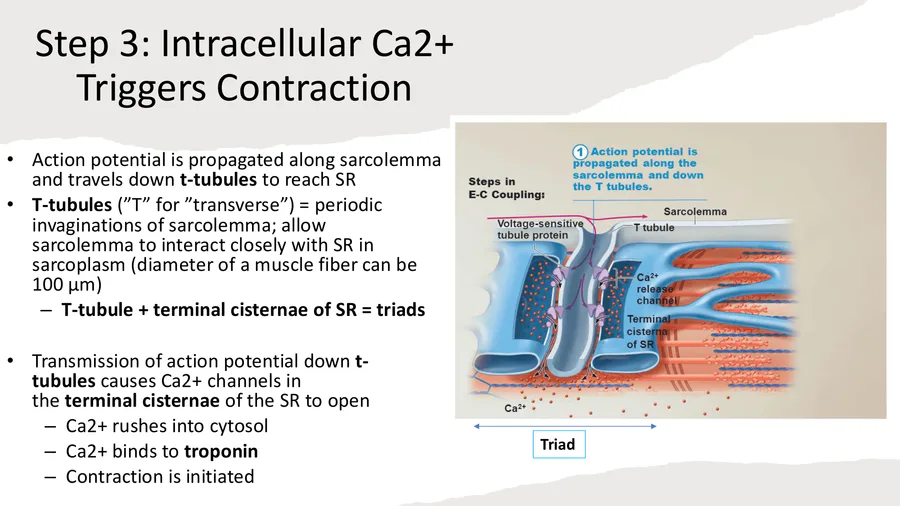
When the action potential is propagated along the sarcolemma, travels down the ttubules, and causes calcium channels in the terminal cisternae of the SR to open it is known as
depolarization
repolarization
resting membrane potential
propagation of action potential
intracellular calcium triggers contraction
72
Drag and Drop
73
74
Reorder
Reorder the following steps of excitation-contraction coupling
AP at NMJ signals ACh release
ACh opens sodium channels (depolarization)
AP spreads through sarcolemma
T-tubules spread AP into each sarcomere
Calcium release signals muscle contraction
75

76
Multiple Choice
Which of the following is FALSE concerning repolarization?
ACh is removed from the synaptic cleft by diffusion or broken down by AchE
sodium channels close and voltage gated potassium channels open
potassium ions rapidly diffuse out and membrane potential returns to polarized state
clacium ions move into the cell
77
Multiple Choice
During repolarization, muscle fibers are in a refractory period.
true
false
78

79
Multiple Choice
Myofilaments slide with a contraction/relaxation.
true
false
80
Multiple Choice
What is the name for how the sarcomere regions change during a muscle contraction/relaxation?
sliding filament model
excitation-coupling contraction
contraction coupling model
sliding sarcomere model
81

82
Multiple Choice
Which of the following is true of the changes in the sarcomere according to the sliding filament model when a sarcomere contracts?
Z lines move closer together
I band becomes smaller
H zone becomes smaller
A band stays the same
A band becomes smaller
83

84
Reorder
Reorder the following steps of the sliding filament model
calcium binds to troponin and exposes active sites
cross-bridge is formed
power stroke
cross-bridge detaches
myosin returns to cocked position
85
Match
Match the following steps of the sliding filament model
calcium binds to troponin and exposes the active site on actin
myosin binds to actin forming the cross-bridge
phosphate and ADP are released from the myosin head and the head pivots toward the center of the sarcomere (power stroke)
a new molecule of ATP attaches to the myosin head causing the cross-bridge to detach
myosin head hydrolyzes ATP to ADP and P and myosin returns to the cocked position
1
2
3
4
5
1
2
3
4
5
86

87
Multiple Choice
Rigor mortis occurs because there is an abundance of ATP but it can no longer attach to myosin causing sustained cross-bridges and muscle stiffness.
true
false
88
Multiple Choice
Which of the following is FALSE?
muscle contractions continur as long as calcium and ATP are available
calcium ions are quickly retrieved by calcium pumps in the sarcolemma
calcium must be maintained at low levels in cytosol except during muscle contaction
free calcium would bind with Pi released during the power stroke to form hydroxyapatite
89

90
Multiple Choice
Which of the following is true concerning cardiac muscle?
intercalated discs allow cardiac muscle cells to function as a syncytium
cardiac cells have sustained periods of depolarization and calcium entry into cells
shorter contractions are produced than those in skeletal muscles
have autorhythmicity becuase they can depolarize and fire action potentials without neural stimulation
91

92
Multiple Choice
Which of the following is not an instance of when ATP is used during muscle contractions?
exocytosis of ACh from axon terminal
calcium ion pump in the SR
Na/K pump
detaching and cocking of myosin head
diffusion of ACh out of the synaptic cleft
93

94
Multiple Choice
When neurons fire, all muscle fibers will contract to their maximum potential.
true
false
95

96
Multiple Choice
A single contraction in the mucle fibers of a motor unit is known as a
muscle contraction
muscle twitch
muscle relaxation
latent muscle
97
Multiple Choice
An instrument that measures the amount of muscle tension produced over time is known as
echocardiogram
myogram
tensiogram
contratogram
98

99
Multiple Choice
Which of the following is NOT a phase of a muscle twitch?
latent period
contraction phase
relaxation phase
tetanus
100
Match
Match the following phases of a muscle twitch
begins at stimulation and lasts ~2 msec; an action potential sweeps across the sarcolemma, and SR releases calcium
tension rises to a peak; calcium ions are binding to troponin, active sites on thin filaments are being exposed, and cross-bridge interactions are occurring
lasts about 25 msec; calcium levels are falling, active sites are being covered by tropomyosin, and the number of active cross-bridges is declining
latent period
contraction phase
relaxation phase
latent period
contraction phase
relaxation phase
101

102
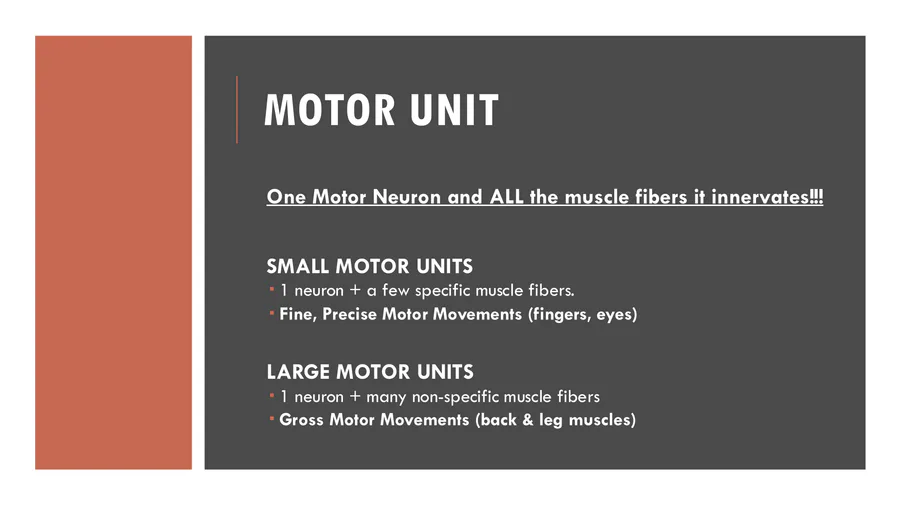
Multiple Select
Which of the following is true concerning small motor units?
1 neuron + a few specific muscle fibers
used for fine, precise motor movements
1 neuron + many non-specific muscle fibers
used for gross motor movements
103
Multiple Select
Which of the following is true concerning large motor units?
1 neuron + a few specific muscle fibers
used for fine, precise motor movements
1 neuron + many non-specific muscle fibers
used for gross motor movements
104
105
Multiple Select
How do we vary the degree of contraction?
change the number of muscle fibers stimulated
recruit more active motor units to increase muscle tension
change the force of the contraction
decrease the number of active motor units to increase muscle tension
106
Multiple Choice
The resting tension in a skeletal muscle is known as
muscle tone
contractile force
muscle twitch
rigor mortis
107
Multiple Choice
All motor units are always active, although the whole muscle is not contracting. This keeps muscles tense and firm instead of limp.
true
false
108

109
Multiple Select
How does the frequency of motor neuron stimulation affect muscle tension?
force of contraction is increased
higher muscle tension
lower muscle tension
force of contraction is decreased due to refractory period
110

111
Dropdown
112

113
Multiple Choice
When the muscle does not relax completely before the arrival of a second stimulus causing the force os each twitch to build leading to greater force of contraction it is known as
wave summation
muscle twitch
muscle tone
treppe
114
Multiple Choice
When there is NO relaxation between stimuli it is known as
treppe
tetanus
tone
twitch
115
Multiple Choice
Tetanus is influenced by the availability of acetylcholine ions.
true
false
116

117
Match
Match the following types of muscle contraction
the muscle length changes as a load is moved, but the muscle tension remains constant
the muscle shortens to move a load
the muscle lengthens and muscle tension decreases
muscle tension is produced without changing the angle of the skeletal joint
isotonic
concentric contraction
eccentric contraction
isometric
isotonic
concentric contraction
eccentric contraction
isometric
118
Match
Match the following examples with the type of muscle contraction
flexion of the elbow while lifting a dumbell
extension of the elbow while lifting a dumbell
maintaing posture, bone, and joint stability
concentric contraction
eccentric contraction
isometric
concentric contraction
eccentric contraction
isometric
119

120
Multiple Choice
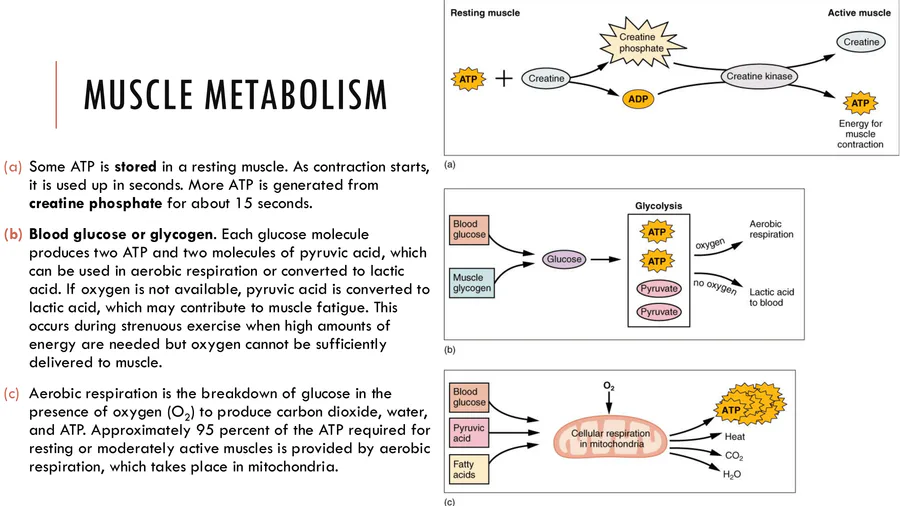
The muscles have numerous ways in obtaining ATP to meet its needs.
true
false
121

122
Multiple Select
Which of the following are anaerobic pathways used to obtain ATP when needed?
creatine phosphate
aerobic respiration
anaerobic respiration
stored glycogen
123

124
Dropdown
125

126
Multiple Choice
Creatine phosphate breakdown is catalyzed by _______________ to produce one ATP.
creatine kinase
creatine phosporase
creatine cyclase
ATP synthase
127

128
Dropdown
129
Multiple Choice
The anaerobic pathway only lasts ~ 10-15 seconds.
true
false
130
Multiple Choice
Which of the following are true for the anaerobic pathway?
for quick powerful contractions
muscles fatigue quickly
useful for sprinters and body builders
oxygen is required
131

132
Multiple Choice
Most of the aerobic pathway takes place in the
sarcoplasmic reticulum
sarcoplasm
mitochondria
nucleus
ribosomes
133
Multiple Choice
________ is in the sarcoplasm storing oxygen.
hemoglobin
iron
myoglobin
myooxygen
134

135
Multiple Choice
Glucose + Oxygen → Carbon Dioxide + Water + ATP + heat
aerobic pathway
anaerobic pathway
glycolysis
creatine phosphate
lactic acid fermentation
136
Multiple Select
Which of the following is true to get enough oxygen to muscle cells?
lots of myoglobin in muscle tissue
lots of mitochondria
increased blood flow to the muscles
gives muscles its blue color
137
Dropdown
138
Multiple Select
Which of the following are true for the aerobic pathway?
used for longer periods of contraction
useful for long distance runners and swimmers
used for quick powerful contractions
useful for sprinters and body builders
139

140
141
Multiple Choice
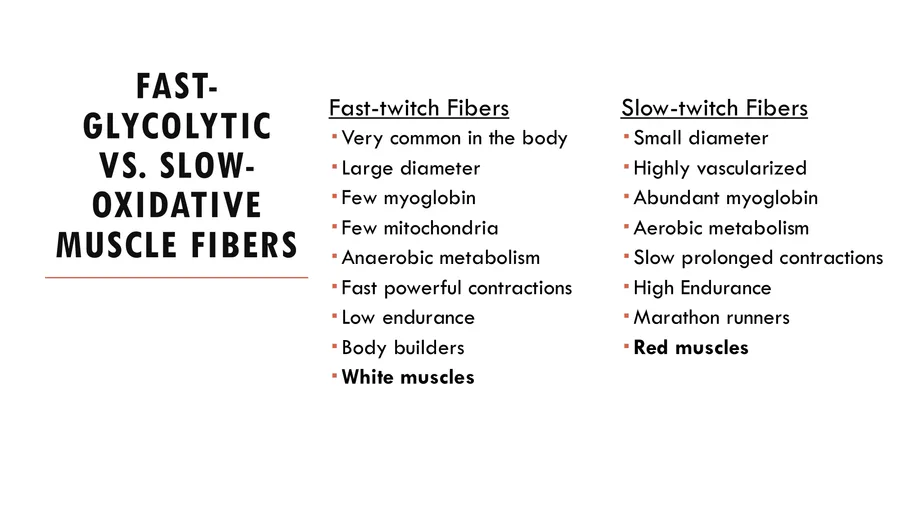
Which type of skeletal muscle fibers are designed for sustained contractions and resistant to fatigue?
slow-oxidative muscle fibers
fast-glycolytic muscle fibers
142
Multiple Choice
Which type of skeletal muscle fibers are designed for rapid, powerful contractions?
slow-oxidative muscle fibers
fast-glycolytic muscle fibers
143
Multiple Choice
Which type of skeletal muscle fibers fatigue rapidly?
slow-oxidative muscle fibers
fast-glycolytic muscle fibers
144
Multiple Choice
Which type of skeletal muscle fibers are highly vascularized, abundant in myoglobin and mitochondria, and generate ATP via aerobic metabolism?
slow-oxidative muscle fibers
fast-glycolytic muscle fibers
145
Multiple Choice
Which type of skeletal muscle fibers have fewer mitochondria and myoglobin, and rely on aerobic metabolism for ATP?
slow-oxidative muscle fibers
fast-glycolytic muscle fibers
146

147
148
Match
Match the following diseases and disorders
commonly called a pulled muscle and is the result of excessive stretching and possible tearing of a muscle and or tendons
when ATP is depleted from cells, actin and myosin become irreversibly cross-linked, producing stiffness; general muscle contraction following death
muscle fibers enlarge due to an increased numebr of myofibrils
smaller muscle cells due to loss of myofibrils due to lack of use, innervation, myofibrils
strain
rigor mortis
hypertrophy
atrophy
strain
rigor mortis
hypertrophy
atrophy
149
Match
Match the following
virus affects motor neurons in the spinal cord and brain, causing muscle atrophy and paralysis
the bacterium Clostridium tetani releases a toxin that suppresses the mechanism that inhibits motor neuron activity, leading to sustained powerful contractions
ingestion of toxin from the bacterium Clostridium botulinum that paralyzes skeletal muscles by preventing ACh release at NMJ
autoimmune disease results in loss of ACh receptors at NMJ results in pregrssive muscular weakness
lack of dystrophin which would streghten muscle fibers and protect them from injury during contraction/relaxation
polio
tetanus
botulism
myasthenia gravis
Duchene's muscular dystrophy
polio
tetanus
botulism
myasthenia gravis
Duchene's muscular dystrophy
150

151

152

153

154

Show answer
Auto Play
Slide 1 / 154
SLIDE
Similar Resources on Wayground

143 questions
Review: Developmental Math 2020
Presentation
•
University
142 questions
Number Size & Rounding
Presentation
•
KG - University
155 questions
System Overview and Navigation
Presentation
•
Professional Development
151 questions
Ch. 16 Haircoloring
Presentation
•
11th Grade
157 questions
El poder de la imagen (ORIGEN)
Presentation
•
Professional Development
155 questions
Metabolism and Enzymes
Presentation
•
11th Grade
152 questions
Untitled Presentation
Presentation
•
Professional Development
148 questions
Coba mengajar
Presentation
•
KG
Popular Resources on Wayground
10 questions
Safety Day 2026 – Student Review

Quiz
•
9th Grade
21 questions
Continents and Oceans
Quiz
•
6th Grade
20 questions
Parts of Speech
Quiz
•
5th Grade
16 questions
Subject & Predicate
Quiz
•
5th Grade
25 questions
Multiplication Facts
Quiz
•
5th Grade
12 questions
Map Skills
Quiz
•
3rd Grade
22 questions
Continents and Oceans
Quiz
•
5th Grade
15 questions
Rounding Decimals
Quiz
•
5th Grade