
Reading comprehension: Oppression and War at Home

Presentation
•
English
•
10th Grade
•
Practice Problem
•
Medium
+19
Standards-aligned

LILY FERNÁNDEZ
Used 8+ times
FREE Resource
8 Slides • 9 Questions
1
2
Open Ended

In the scale of "Inside out 2" how are you feeling today?
3

Objective: today we are going to comprehend a written text about two young North Koreans scaping from their country.
4

But first, we are going to check some vocabulary.
5
Multiple Choice
Crept (past of creep)
crearon
treparon
cortaron
6
Multiple Choice
fled (past of flee)
Faltó
huyó
voló
7
Multiple Choice
hiding
escondiéndose
subiendo
alcanzando
8
Multiple Choice
starvation
hambruna
extradición
acumulación
9
Multiple Choice
Even though
por otro lado
sin embargo
aunque
10
Multiple Choice
neighbors
vecinos
ninguneados
compañeros
11
Multiple Choice
hut
refugio
hotel
departamento
12
Multiple Choice
Despite
sin embargo
incluso
a pesar de
13
The brothers, Young Hoon* and Young Jun, and their family members walked, rode in cars, and flew on an airplane to reach South Korea. Their journey took about a year.
They were lucky. There are about 200,000 to 300,000 North Koreans now hiding in China. But only about 2,000 of them are expected to make it to South Korea this year.
A Long Journey
Two brothers crept carefully through the mountains in China. The boys, along with their mother, sister, and aunt, had fled their home in North Korea. They hoped to find a better life in South Korea.
Like China, North and South Korea are countries in Asia. If the Chinese police had found the family, they would have sent them back to their country to be punished or even killed.
A Chance for Freedom
14
A New Life
Young Hoon, Young Jun, and their family members risked their lives to reach South Korea. Why? If they had stayed in North Korea, they faced starvation. Many North Korean children are hungry because their families cannot find food. In fact, over the past ten years, about 2 million people in North Korea have starved to death.
About a year after their arrival, the brothers tell me they are happy in Seoul, the busy capital city of South Korea. I visited Young Hoon and Young Jun at the Hannuri School, an after-school program for teens who have left North Korea and come to South Korea to start new lives.
Teachers at Hannuri help the North Koreans with their schoolwork. Many of the teens did not go to school regularly in North Korea, so they are behind in their lessons.
15
Worlds Apart
Even though North and South Korea are neighbors, the two countries are very different. North Korea is very poor. Its leader spends most of the country's money on the army, not on food for the people.
Unlike North Korea, South Korea has enough food for everyone, and most people drive cars, go to work, and eat at restaurants.
Young Hoon, 18, and Young Jun, 15, say that in North Korea they lived in a hut and ate mostly corn and potatoes. In South Korea, their lives are much different. The brothers live in an apartment and eat well. They love movies and video games.
16
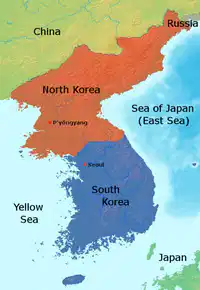
North and South Korea are countries in eastern Asia. Korea used to be one country. It was divided in half after World War II (1939--1945). In 1950, North Korea invaded South Korea, starting the Korean War (1950--1953). After the Korean War, the Demilitarized Zone, or DMZ, was set up to divide the two countries. I visited the South Korean side of the DMZ. Everywhere I looked there were soldiers. I wasn't allowed to talk to them because they were on duty.
A Divided Region
The brothers tell me about their plans for the future. Young Hoon wants to be a pilot. Young Jun wants to help people. They also hope to do something they never could have even dreamed of while living in North Korea--they want to visit the United States.
Young Jun is already prepared to visit. An American he met on his way to South Korea gave him a U.S. dollar. Despite plenty of opportunities to spend the money in South Korea, Young Jun has kept it. After all, he tells me, he's going to need it when he gets to the United States.
Hope for the Future
17

Now answer the google form in classroom
Show answer
Auto Play
Slide 1 / 17
SLIDE
Similar Resources on Wayground

16 questions
Nelson Mandela-Q1
Presentation
•
10th Grade
18 questions
Author's Purpose
Presentation
•
9th - 10th Grade
12 questions
The American West
Presentation
•
10th Grade
17 questions
Sir Gawain and the Green Knight: Part One with Colons
Presentation
•
10th Grade
11 questions
Reading 1 ITP
Presentation
•
9th - 11th Grade
16 questions
RELATIVE CLAUSES
Presentation
•
10th - 11th Grade
14 questions
The War in Europe and D-Day!
Presentation
•
10th Grade
16 questions
The Things They Carried
Presentation
•
10th Grade
Popular Resources on Wayground
10 questions
Safety Day 2026 – Student Review

Quiz
•
9th Grade
21 questions
Continents and Oceans
Quiz
•
6th Grade
20 questions
Parts of Speech
Quiz
•
5th Grade
16 questions
Subject & Predicate
Quiz
•
5th Grade
25 questions
Multiplication Facts
Quiz
•
5th Grade
12 questions
Map Skills
Quiz
•
3rd Grade
22 questions
Continents and Oceans
Quiz
•
5th Grade
15 questions
Rounding Decimals
Quiz
•
5th Grade
Discover more resources for English
20 questions
Context clues
Quiz
•
10th Grade
10 questions
Exploring the Role of Setting in Storytelling

Interactive video
•
6th - 10th Grade
10 questions
Differentiating the 3 Types of Irony
Interactive video
•
6th - 10th Grade
10 questions
Unlocking English Vocabulary through Latin and Greek Roots
Interactive video
•
6th - 10th Grade
16 questions
Complete Sentences vs Fragments and Run-Ons
Presentation
•
5th - 12th Grade
28 questions
AP Vocab Group 7
Quiz
•
9th - 12th Grade
20 questions
Review for Vocab Quiz 7
Quiz
•
10th Grade
10 questions
Citing Text Evidence in the RACE Strategy
Interactive video
•
6th - 10th Grade