Search Header Logo
SFP124 HE WK21 Physical Activity and Health

SFP124 HE WK21 Physical Activity and Health

Assessment

Presentation

Other

12th Grade

Practice Problem

Easy

Created by

Aleisha Bliesner

Used 17+ times

FREE Resource

35 Slides • 23 Questions

1

media

2

Poll

What percentage of Australian adults meet the physical activity guidelines?

10%

20%

50%

80%

3

Word Cloud

What are some benefits of physical activity?

4

media

5

Multiple Choice

WHAT DO YOU ALREADY KNOW?

What is the difference between physical activity and exercise?

1
Physical activity is only done indoors, while exercise is done outdoors.
2

Physical activity is any movement that expends energy, while exercise is a subcategory of physical activity that is planned and structured

3

The terms 'physical activity' and 'exercise' are interchangeable

4

Exercise is any movement that expends energy, while physical activity is a subcategory of exercise that is planned and structured

6

Multiple Select

WHAT DO YOU ALREADY KNOW?

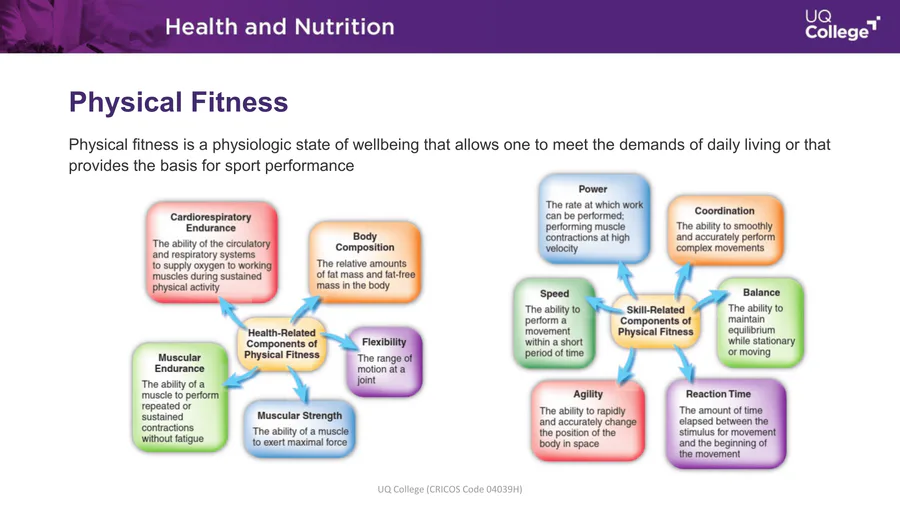
Which of the following are components of physical fitness? Select all that apply.

1

Body composition, flexibility

2

Power, speed, agility

3

Coordination, balance, reaction time

4

Cardiorespiratory endurance, muscular strength, muscular endurance

7

Multiple Choice

WHAT DO YOU ALREADY KNOW?

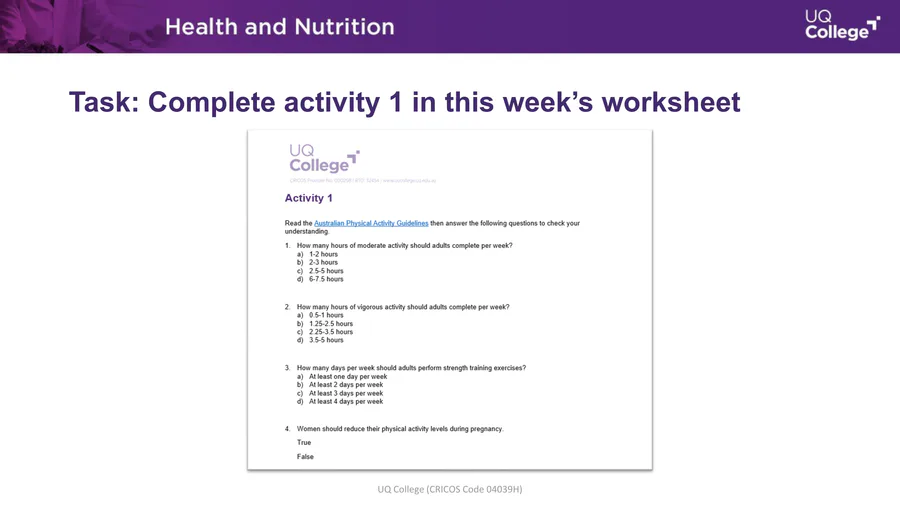
What are the Australian Physical Activity Guidelines for adults?

1

At least 60 minutes of moderate to vigorous physical activity every day, including muscle-strengthening activities on at least two days each week.

2

At least 150 to 300 minutes of moderate intensity physical activity, or 75 to 150 minutes of vigorous intensity physical activity each week, including muscle-strengthening activities on at least two days each week.

3

At least 30 minutes of moderate to vigorous physical activity every day, including flexibility exercises on at least two days each week.

4

At least 200 minutes of light physical activity every week, including balance exercises on at least three days each week.

8

media

9

media

10

media

11

Multiple Choice

What is the difference between physical activity and exercise?

1
Physical activity is only done indoors, while exercise is done outdoors.
2

Physical activity is any movement that expends energy, while exercise is a subcategory of physical activity that is planned and structured

3

The terms 'physical activity' and 'exercise' are interchangeable

4

Exercise is any movement that expends energy, while physical activity is a subcategory of exercise that is planned and structured

12

media

13

media

14

media

15

Match

Match the component of physical fitness with its definition.

The ability of the circulatory and respiratory systems to supply oxygen to working muscles during sustained physical activity

The ability to perform repeated or sustained muscle contractions without fatigue

The ability to move a joint through its full range of motion

The ability of a muscle to exert maximal force

The ability to maintain equilibrium while stationary or moving

Cardiorespiratory endurance

Muscular endurance

Flexibility

Muscular strength

Balance

16

media

17

media

18

Multiple Choice

Question image

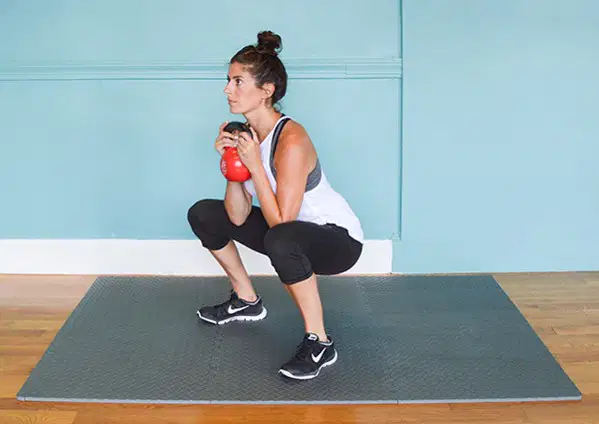
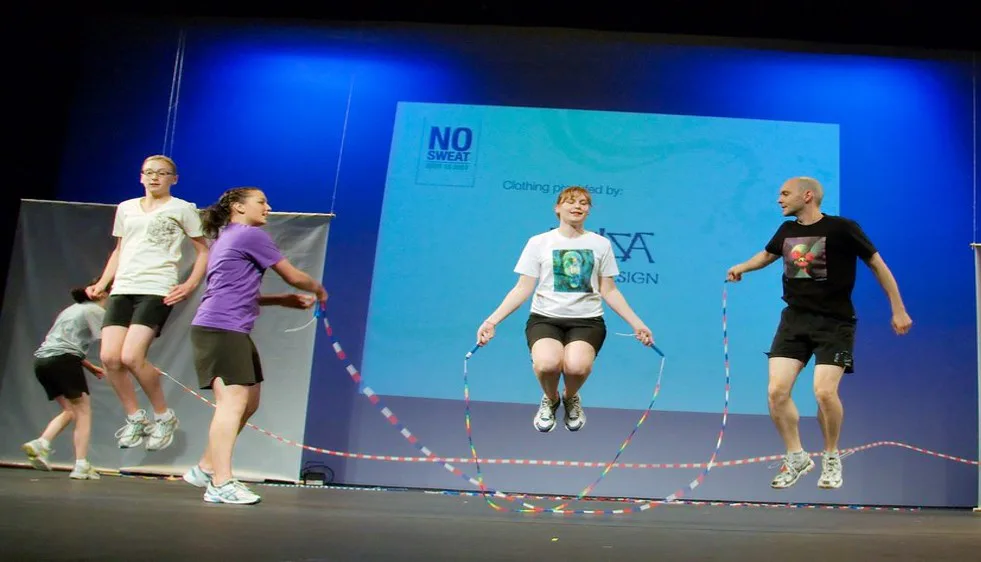
What type of exercise is this?

1

Cardiorespiratory

2

Resistance

3

Flexibility

4

Balance

19

Multiple Choice

Question image

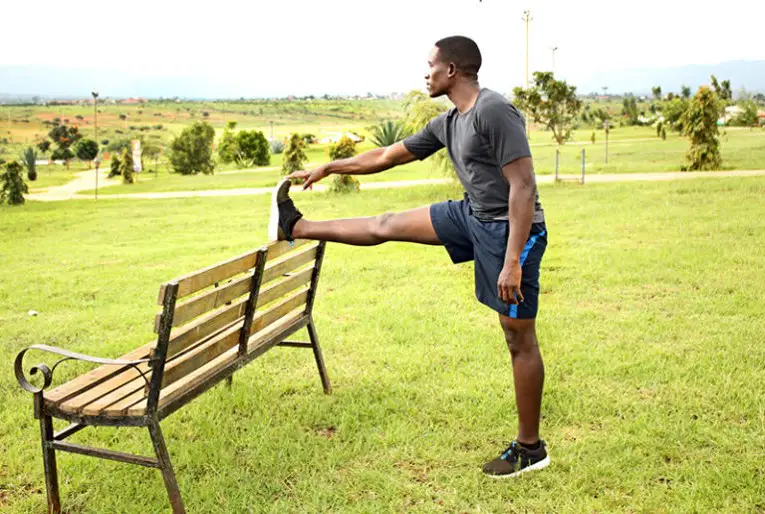
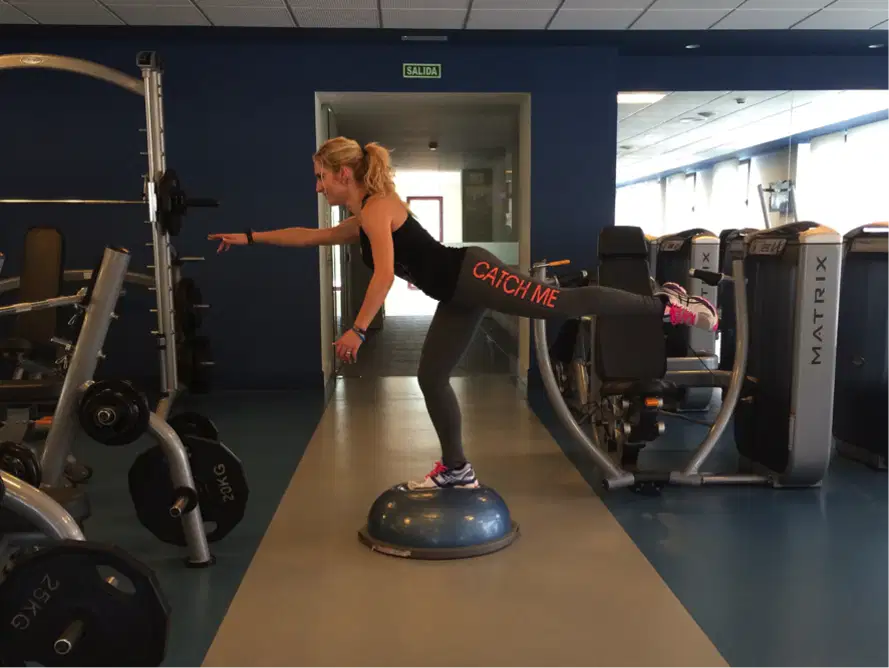
What type of exercise is this?

1

Cardiorespiratory

2

Resistance

3

Flexibility

4

Balance

20

Multiple Choice

Question image

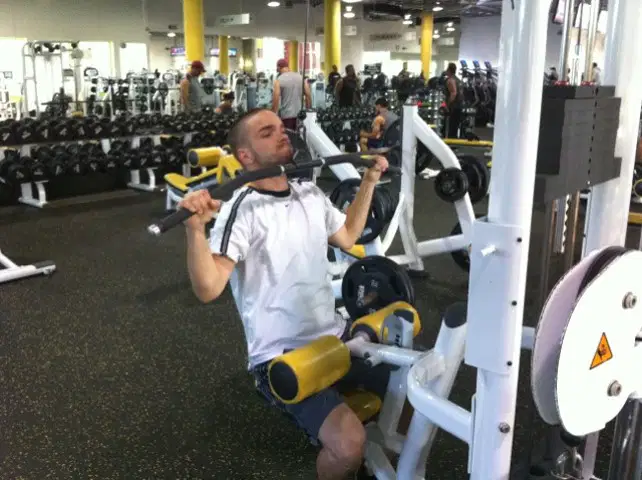
What type of exercise is this?

1

Cardiorespiratory

2

Resistance

3

Flexibility

4

Balance

21

Multiple Choice

Question image

What type of exercise is this?

1

Cardiorespiratory

2

Resistance

3

Flexibility

4

Balance

22

Multiple Choice

Question image

What type of exercise is this?

1

Cardiorespiratory

2

Resistance

3

Flexibility

4

Balance

23

media

24

media

25

media

26

media

27

media

28

media

29

Open Ended

Question image

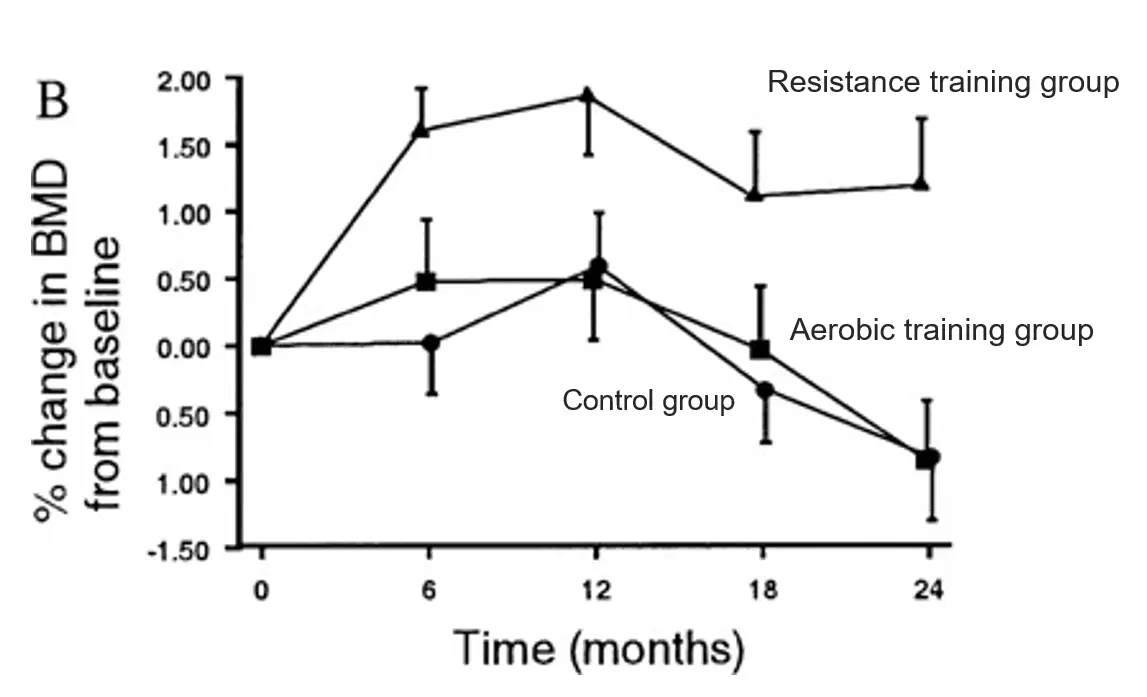
A study examined the effect of a 2-year exercise intervention on bone mineral density (BMD) in 126 postmenopausal women. Participants were randomised into one of three groups: resistance training, aerobic training, or nonexercise control. The two exercise groups exercised 3 times per week and BMD was measured at the hip site every 6 months. The results are shown in the graph.

Outline a trend in the graph.

30

Open Ended

Question image

A study examined the effect of a 2-year exercise intervention on bone mineral density (BMD) in 126 postmenopausal women. Participants were randomised into one of three groups: resistance training, aerobic training, or nonexercise control. The two exercise groups exercised 3 times per week and BMD was measured at the hip site every 6 months. The results are shown in the graph.

Compare the change in bone mineral density between the resistance training group and the aerobic training group.

31

Open Ended

Question image

A study examined the effect of a 2-year exercise intervention on bone mineral density (BMD) in 126 postmenopausal women. Participants were randomised into one of three groups: resistance training, aerobic training, or nonexercise control. The two exercise groups exercised 3 times per week and BMD was measured at the hip site every 6 months. The results are shown in the graph.

Identify a conclusion that you can make based on the data in the graph.

32

media

33

media

34

media

35

media

36

media

37

Multiple Choice

What are the Australian Physical Activity Guidelines for adults?

1

At least 60 minutes of moderate to vigorous physical activity every day, including muscle-strengthening activities on at least two days each week.

2

At least 150 to 300 minutes of moderate intensity physical activity, or 75 to 150 minutes of vigorous intensity physical activity, or an equivalent combination of both each week, including muscle-strengthening activities on at least two days each week.

3

At least 30 minutes of moderate to vigorous physical activity every day, including flexibility exercises on at least two days each week.

4

At least 200 minutes of light physical activity every week, including balance exercises on at least three days each week.

38

media

39

media

40

media

41

media

42

media

43

media

44

Open Ended

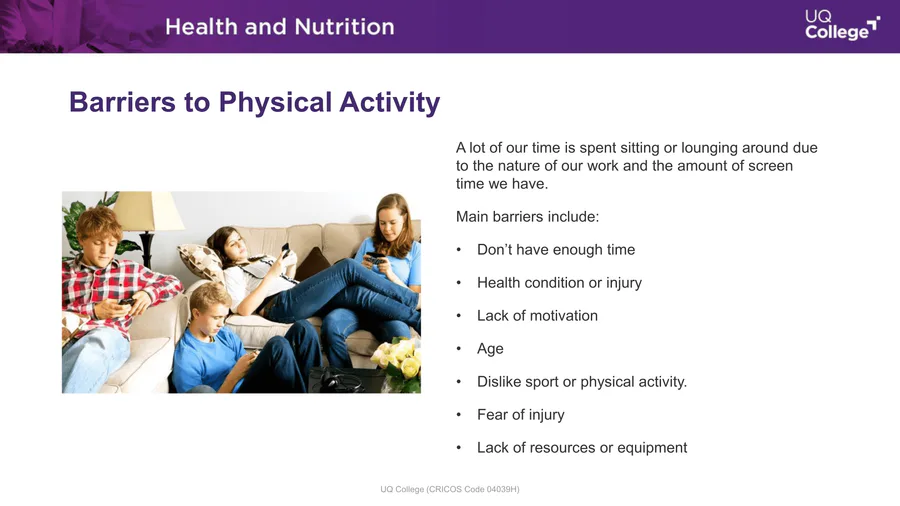
What are your main barriers to physical activity?

45

media

46

Open Ended

What are some strategies you could implement to increase your physical activity?

47

media

48

media

49

media

50

media

51

Open Ended

Will doing push-ups improve your lower body strength?

Will swimming laps improve your 5km running pace?

Justify your response.

52

media

53

Open Ended

How might a powerlifter utilise the Overload Principle to increase their squat 1RM from 100kg to 120kg?

54

media

55

Open Ended

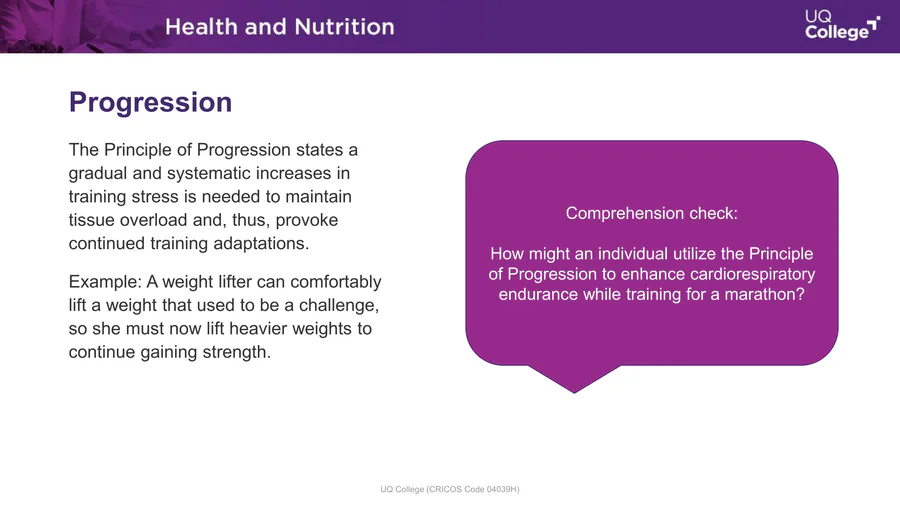
How might an individual utilize the Principle of Progression to enhance cardiorespiratory endurance while training for a marathon?

56

media

57

Open Ended

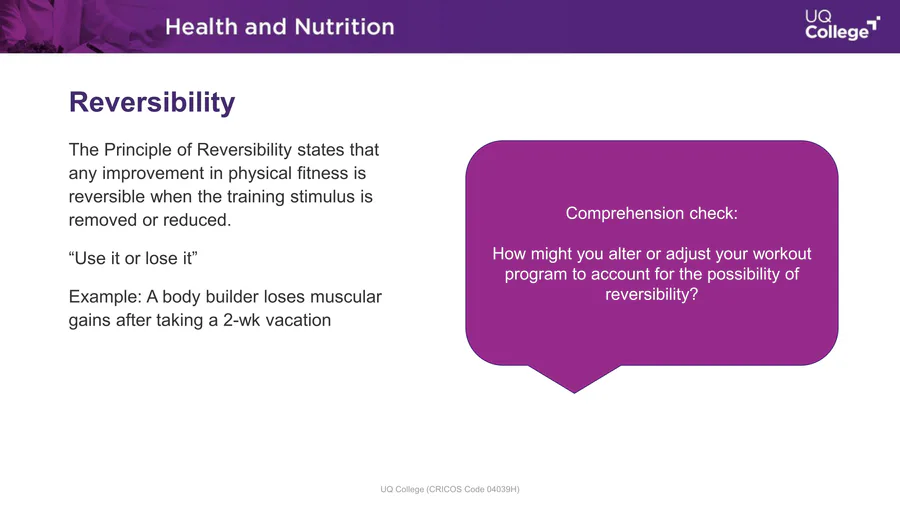
How might you alter or adjust your workout program to account for the possibility of reversibility?

58

Multiple Select

Question image

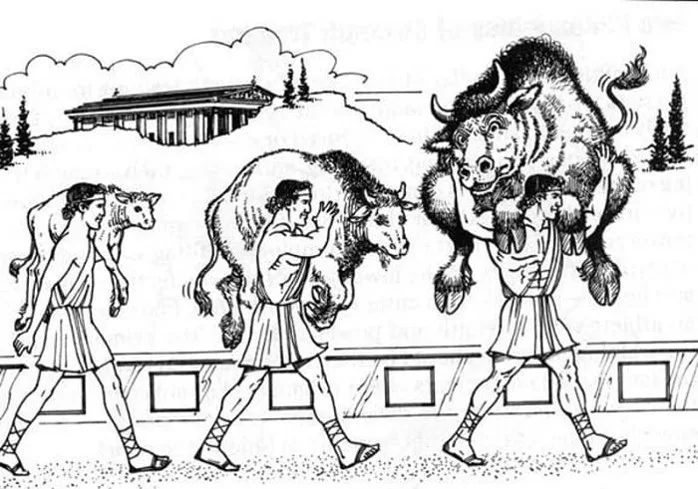
The Ancient Greek wrestler Milo of Croton, was renowned as the strongest person of his time. Milo's incredible strength was attributed to a simple strategy. He began by lifting a newborn calf and carrying it on his shoulders. Each day, Milo repeated this action as the calf grew, gradually increasing the weight he lifted. Over the course of four years, the calf grew into a full-grown bull, which Milo continued to lift daily.

Which principle of training does this demonstrate?

1

Specificity

2

Overload

3

Progression

4

Reversibility

media

Show answer

Auto Play

Slide 1 / 58

SLIDE