

Simple present & Adjective Clause

Presentation
•
English
•
11th Grade
•
Practice Problem
•
Hard

Tiara Tsalis
Used 4+ times
FREE Resource
11 Slides • 0 Questions
1
LANGUAGE
FEATURES
IN DESCRIPTIVE TEXT
2



By the end of this lesson:
Students are able to recognize the
use of simple present tense
correctly.
Students are able to identify the
use of relative pronouns in adjective
clauses correctly.
LEARNING OBJECTIVES
3

Simple present expresses
general truths (facts) or habitual
events in everyday life.
SIMPLE PRESENT TENSE
4

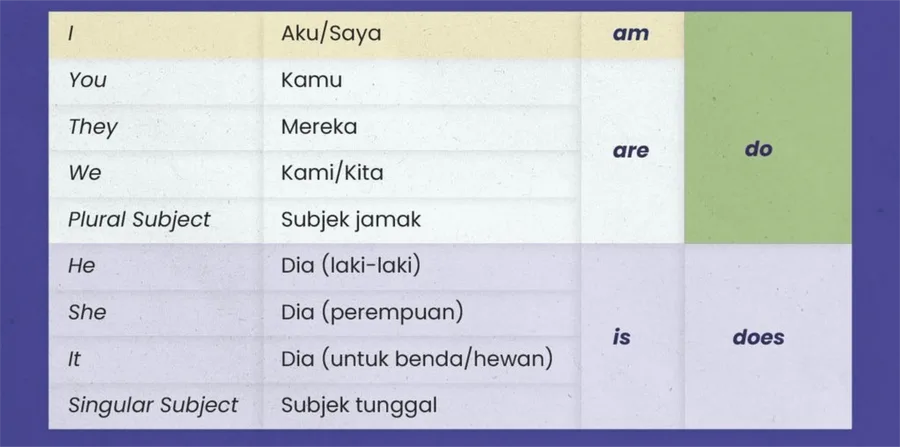
Simple Present
Tense (Nominal
sentence)
Simple Present
Formula (Verbal
sentence)
5

Example of nominal sentence:
I am a teacher
Bromo is a beautiful place
Those books are bestseller now
Example of verbal sentence:
I write a letter
He goes to school
6

Adjective clauses are dependent clauses that give
information about nouns. They allow you to combine
two sentences into one by using relative pronouns
(who, whom, whose, where, when, which, that, and
why) as connectors.
ADJECTIVE CLAUSE
7

Relative
Pronoun
Example of the Adjective Clause
Explanation
Who
(used to modify the subject - person)
1) I thanked the woman
2) She helped me
I thanked the woman who helped me.
Adjective clause:
“who” describes the person
as the subject “she”
Whom (used to modify the object - person)
1) The man was Mr. Jones.
2) I saw him.
The man whom I saw was Mr. Jones
Adjective clause :
“Whom” describes the
person as the object “him”
Whose (possession)
1) Do you know the girl?
2) Her shoes were red last night.
Do you know the girl whose shoes were red
last night?
Adjective clause :
“Whose” describes the
possession of something,
“her shoes”
8

Relative Pronoun
Where (modify a place)
1) Malang is a city.
2) I was born in Malang.
Malang is a city where I was
born
Adjective clause:
“where I was born” describes
noun ”Malang”
Which
(as an object - non person)
1) Mom bought the toy.
2) You love it very much.
Mom bought the toy which you
love very much
Adjective clause :
“which you love very much”
describes “the toy”
Which
(as a subject - non person)
1) The book is mine
2) The book is on the table
The book, which is on the table, is mine
Adjective clause :
“which is on the table” describes "the book"
Example of the
Adjective Clause
Explanation
9

Let's Work
Together
10
11


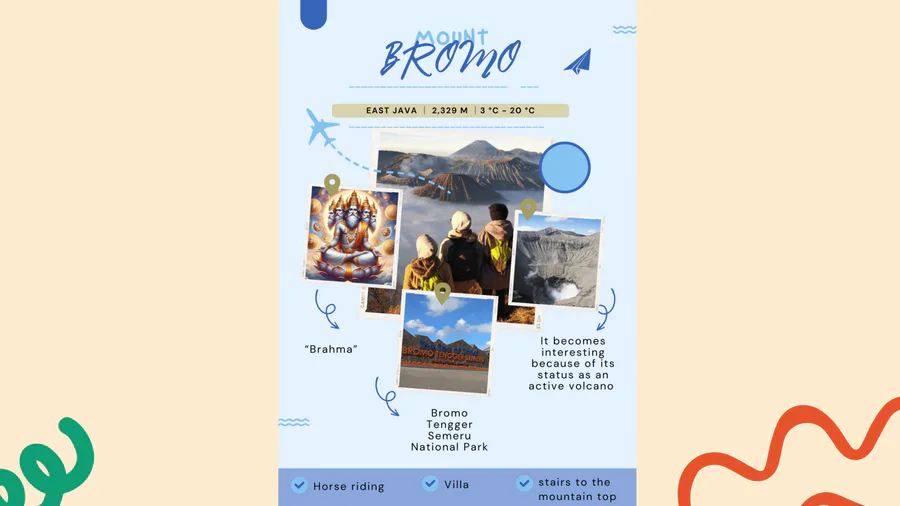
1) In one group choose one of the descriptive texts that you
worked on in Padlet last week. Each group should not be on the
same topic.
2) Then, make a poster like the example. The theme is “Your
favorite place to visit.” The poster can be digital or non-digital.
3) Based on the poster, create a dialog for each group.
4) Next week, each group will present their dialog based on the
poster.
EXAMPLE:
https://docs.google.com/document/d/12v01v_XurtyWCkurfrEm
T130nIf5eVV8-4aWAs0czTQ/edit?usp=sharing
LANGUAGE
FEATURES
IN DESCRIPTIVE TEXT
Show answer
Auto Play
Slide 1 / 11
SLIDE
Similar Resources on Wayground

12 questions
Anne Frank Character Change
Presentation
•
6th - 9th Grade
7 questions
Comparison
Presentation
•
11th Grade
8 questions
Procedural text
Presentation
•
11th Grade
8 questions
Kelas 6
Presentation
•
11th Grade
9 questions
MUET Reading 1
Presentation
•
11th Grade
8 questions
Passive Voice
Presentation
•
11th Grade
9 questions
Reported Speech
Presentation
•
10th - 11th Grade
8 questions
Rhetorical Appeals Review TKAM
Presentation
•
11th Grade
Popular Resources on Wayground
6 questions
PRIDE Always and Everywhere
Presentation
•
12th Grade
20 questions
Lab Safety Quiz

Quiz
•
6th Grade
26 questions
KOR Review Kahoot Questions
Quiz
•
8th Grade
21 questions
Continents and Oceans
Quiz
•
6th Grade
12 questions
Unit Zero lesson 2 cafeteria
Presentation
•
9th - 12th Grade
20 questions
Parts of Speech
Quiz
•
5th Grade
10 questions
Riddles Riddles fun Riddles
Quiz
•
6th - 12th Grade
16 questions
Subject & Predicate
Quiz
•
5th Grade
Discover more resources for English
34 questions
Parts of Speech Review
Quiz
•
9th - 12th Grade
10 questions
Four Types of Sentences
Quiz
•
KG - 12th Grade
23 questions
Subject Verb Agreement
Quiz
•
9th Grade - University
25 questions
PJH Types of Nouns
Presentation
•
4th - 12th Grade
20 questions
Ethos Pathos Logos
Quiz
•
9th - 12th Grade
15 questions
Chronological Order of Events (7-14) The House of the Scorpion
Quiz
•
9th - 12th Grade
20 questions
Capitalization and Punctuation Review
Quiz
•
9th - 12th Grade
20 questions
Vocab Group 2 Review
Quiz
•
11th Grade