Search Header Logo
Final M4 Chapter III (Chemical Bonding)

Final M4 Chapter III (Chemical Bonding)

Assessment

Presentation

Chemistry

10th Grade

Practice Problem

Medium

Created by

Lady Alias

Used 4+ times

FREE Resource

46 Slides • 36 Questions

1

Chemical Bonding

2

Learning Objectives

Describe the formation of ions by electron loss/gain in order to obtain the electronic configuration of a noble gas.

3

What are ions?

Ions are formed when atoms gain or lose electrons.

4

Why do atoms form ions???

Question

media

5

media
media

3

6

media
media

Characteristics

• Belong to Group 18 of the periodic table.
• Stable and unreactive
• Exist as single atoms

4

7

media
media

5

Why are noble gases

unreactive?

8

media
media

6

What do you notice about the
valence shell?

2 2,8 2,8,8 2,8,8,8 2,8,8,8,8

9

Open Ended

Question image

What do you notice about the valence shell?

10

media
media

6

What do you notice about the
valence shell?

2 2,8 2,8,8 2,8,8,8 2,8,8,8,8

Ans: They have a full valence shell
🡪 noble gas configuration

11

media
media
media
media
media

7

How about other elements?

2,1

2,5

media
media
media

​2,2

​2,3

​2,4

​2,6

​2,7

12

media

7

How about other elements?

​Sadly, they do not have a full valence shell...

media

13

So how can other elements become like noble gases?

media

14

Multiple Choice

How can other elements become like noble gases?

1

They gain or lose protons to form ions.

2

They gain or lose electrons to form ions.

3

They gain or lose neutrons to form ions.

4

They gain or lose nucleons to form ions.

15

media
media

8

They form ions by gaining or losing electrons

They form ions by gaining or losing electrons

in order to achieve noble gas configuration.

16

Multiple Choice

Can noble gases form ions?

1

Yes

2

No

17

Multiple Choice

How do we know if an atom has a noble gas configuration?

1

They have a charge.

2

They gain or lose electrons to form an ion.

3

They are neutral.

4

They have a full valence electron shell

18

media
media

10

19

Ions

  • An ion is an atom that has gained or lost an electron or electrons.

  • An atom that loses an electron or electrons will have more protons than electrons, it will become an ion with a positive charge.

  • An atom that gains an electron or electrons will have more electrons than protons, it will become an ion with a negative charge.

  • Atoms that have a charge can only gain or lose electrons they cannot gain or lose protons.

20

Multiple Choice

An ion is an atom that has gained or lost _______.

1

protons

2

neutrons

3

electrons

21

Multiple Choice

An atom that gains electrons will have a ___ charge.

1

negative

2

positive

22

Multiple Choice

An atom that loses electrons has a ____ charge.

1

negative

2

positive

23

Cations and Anions

  • Cations- pronounced cat-ion- is an ion with a positive (+) charge (it will be an ion that lost electrons). It has more protons than electrons.

  • Anions- pronounced an-ion- is an ion with a negative (-) charge (it will be an ion that gained electrons). It has more electrons than protons.

24

Multiple Choice

Cations have a positive charge, which means they have _____ electrons.

1

gained

2

lost

25

Multiple Choice

An ion that has negative charge has gained electrons, it is called a________.

1

anion

2

cation

26

Valence Electrons and Ions

  • Atoms gain or lose electrons from the highest energy level.

  • The atoms in the highest energy level are called valence electrons.

  • Elements in group 1 like Lithium [Li] have 1 valence electron.

  • Elements in group 2 like Berylium [Be] have 2 valence electrons.

  • Elements in group 13 like Boron [B] have 3 valence electrons.

  • Elements in group 14 like Carbon [C] have 4 valence electrons.

  • Elements in group 15 like Nitrogen [N] have 5 valence electrons.

  • Elements in group 16 like Oxygen [O] have 6 valence electrons.

  • Elements in group 17 like Flourine [F] have 7 valence electrons.

27

Multiple Choice

Valence electrons are atoms of the outer most energy level, there is a maximum number of eight.

1

True

2

False

28

Multiple Choice

How many valence electrons does an atom of silicon have?

1

3

2

4

3

5

4

6

29

Multiple Choice

Be, Mg, and Ca have ___ valence electrons.

1

1

2

2

3

3

4

4

30

Octet Rule

  • The octet rule determines if an atom will gain or lose electrons.

  • The outer level of an atom has eight electrons.

  • An atom will gain or lose electrons to have a full outer energy level.

  • Atoms of metals tend to lose their valence electrons.

  • Nonmetals tend to gain or share electrons to achieve a full octet.

31

Multiple Choice

Atoms will gain or lose electrons in order to have a full outer energy level this is called the _____ rule.

1

valence

2

cation

3

octet

4

anion

32

Will an atom gain or lose an electron?

  • Atoms in group 1, 2, and 13 lose electrons. Remember the atom want a full outer energy level.

  • For atoms that lose electrons, they empty the outer most energy level.

  • For groups 1, 2 and 13 - atoms lose electrons forming a positive ion.

  • For groups 15, 16 and 17 - atoms gain electrons forming a negative ion.

  • For group 14- atoms can gain or lose electrons forming a positive or negative ion.

33

Multiple Choice

Group 2 will _____ electrons, forming an ion with a positive charge.

1

gain

2

lose

34

Multiple Choice

Group 17 elements _____ electrons, forming a negative charge.

1

gain

2

lose

35

Elements that lose electrons form CATION

  • Atoms that lose electrons have more protons than electrons, the ion that forms has a positive charge and is a cation.

  • They are part of representative groups 1 , 2 , 13 and 14 in the periodic table.

  • For example sodium [Na] atom is in group 1, it will lose 1 electron and will have the +1 charge to make it a sodium ion [Na+].

  • For example magnesium [Mg] atom is in group 2, it will lose 2 electron and will have the +2 charge to make it a magnesium ion [Mg+2].

    CONTINUE COPYING THE EXAMPLES IN THE WHITEBOARD

36

Multiple Choice

What is the charge on an ion of sodium (Na)?

1

+1

2

+2

3

+3

4

+4

37

Multiple Choice

Aluminum forms an ion with +3 charge, what group is it in?

1

1

2

2

3

13

4

14

38

Elements that gain electrons form ANION

  • Nonmetals tend to gain or share electrons forming negative ions or anions.

  • When an atom gains an electron or electrons it forms an ion with more electrons than protons. It forms a negative ion (an anion).

  • To determine the charge of a negative ion (anion) subtract 8 (to obey with the octet rule)

  • Example- Flourine atom is in group 17. Group 17 has 7 valence electrons subtract 8 (to obey with the octet rule) so that would be (7-8= -1) . That makes a Flourine ion [F-].


CONTINUE COPYING THE EXAMPLES IN THE WHITEBOARD

39

Multiple Choice

An atom of Br will form an anion. What will the charge of the anion be?

1

+1

2

+2

3

-1

4

-2

40

Multiple Choice

Phosphorous forms an anion with a charge of -3 what representative group is it part of?

1

13

2

14

3

15

4

16

41

media

42

​Ionic, covalent and metallic bonds

43

media

44

media

45

media

46

media

47

media

48

media

49

Multiple Choice

Question image

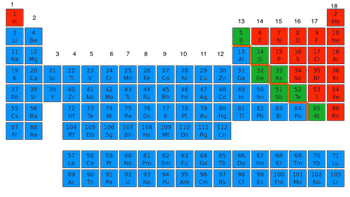
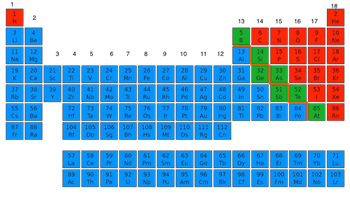
Where are metals located on the periodic table?

1

Blue

2

Green

3

Red

50

Multiple Choice

Question image

Where are the nonmetals located on the periodic table?

1

Blue

2

Red

3

Green

51

media

52

media

53

media

54

media

55

media

56

Multiple Choice

A bond between a metal and a nonmetal is called a __________.

1

covalent bond

2

ionic bond

3

metallic bond

4

transfer bond

57

media

58

media

59

media

60

media

61

media

62

media

63

media

64

media

65

media

66

Multiple Choice

What makes up a covalent bond?
1
Metal and a Metal
2
Metal and a nonmetal
3
nonmetal and a nonmetal
4
metal and a metallid

67

media

68

media

69

media

70

Multiple Choice

Question image

NO2

1

Ionic Bond

2

Covalent Bond

3

Both bonds

4

Neither bond

71

Multiple Choice

Question image

MgBr2

1

Ionic Bond

2

Covalent Bond

3

Both bonds

4

Neither bond

72

Multiple Choice

Question image

Predict the bond that will form between Be and F.

1

Ionic

2

Covalent

73

Multiple Choice

What type of bond involves the sharing of electrons between atoms?

1

ionic bond

2

covalent bond

3

metallic bond

74

Multiple Choice

Question image

Identify the following compound as ionic or covalent: Na2SO4

1

ionic

2

covalent

75

Multiple Choice

A bond between a nonmetal and a nonmetal is called a

1

ionic bond

2

covalent bond

3

metallic bond

76

Multiple Choice

A bond between a metal and a nonmetal is called

1

ionic bond

2

covalent bond

3

metallic bond

77

Multiple Choice

Question image

Identify the following compound as ionic or covalent: CF4

1

ionic bond

2

covalent bond

3

metallic bond

78

Multiple Choice

Question image

Identify the following compound as ionic or covalent: MgO

1

ionic bond

2

covalent bond

3

metallic bond

79

Multiple Choice

Question image

Identify the following compound as ionic or covalent: SO2

1

ionic bond

2

covalent bond

3

metallic bond

80

Multiple Choice

Question image

Identify the following compound as ionic or covalent: Na2SO4

1

ionic bond

2

covalent bond

3

metallic bond

81

Multiple Choice

Question image

H2O, Ionic or Covalent?

1

ionic bond

2

covalent bond

3

metallic bond

82

Multiple Choice

Question image

NaBr, Ionic or Covalent?

1

ionic bond

2

covalent bond

3

metallic bond

Chemical Bonding

Show answer

Auto Play

Slide 1 / 82

SLIDE