Search Header Logo
Earthquakes

Earthquakes

Assessment

Presentation

•

Science

•

6th Grade

•

Practice Problem

•

Hard

Created by

Rudi Setyawan

FREE Resource

13 Slides • 103 Questions

1

How do earthquakes happen?

  • Tectonic plates move and release energy

  • The focus is the place where the energy is released

  • Epicenter - location on surface directly above the focus

  • Energy travels as seismic waves out from the focus

media

2

media

3

media

4

media

5

Convergent Boundaries

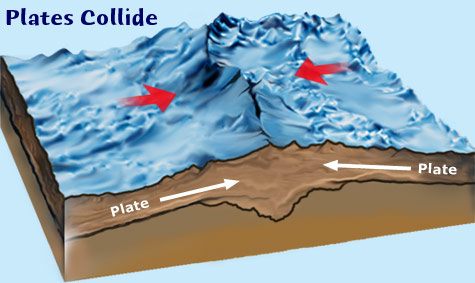
Convergent boundaries are boundaries where two plates are pushing into each other. They are formed when two plates collide, either crumpling up and forming mountains or pushing one of the plates under the other and back into the mantle to melt.

media

6

Convergent Boundaries

Convergent boundaries form strong earthquakes, as well as volcanic mountains or islands, when the sinking oceanic plate melts.

media

7

Transform Boundaries

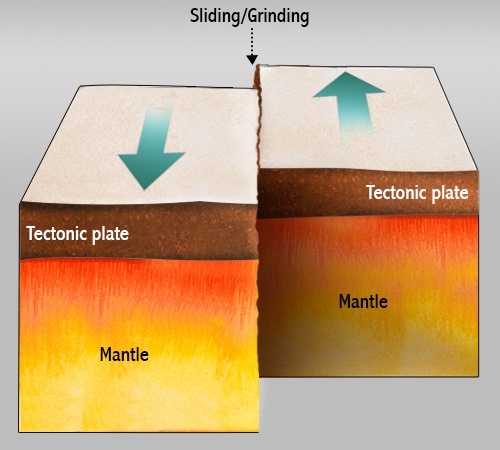
The third type is transform boundaries, or boundaries where plates slide past each other, forming strong earthquakes. All of this crashing, banging, and erupting are one reason why the surface of the earth has such a variety of landforms and features.

media

8

What are earthquakes?

  • Earthquakes are caused by plate movement

  • The waves that carry energy in a earthquake are call seismic waves

media

9

Parts of an earthquake

  • The point below the surface where the rock breaks is called the earthquake focus

  •  As soon as the rock breaks, there is movement along the broken surface causing a split in the surface called a fault

  • The epicenter is the point on the surface right above the focus

media

10

  • P-waves travel through solids and liquids, compressing and expanding the materials they pass through.

  • S-waves only travel through solids and temporarly change the shape.

  •  Surface waves reach the surface. They are slower than body waves, but they are the waves that cause the most damage.

media

11

Where do earthquakes occur?

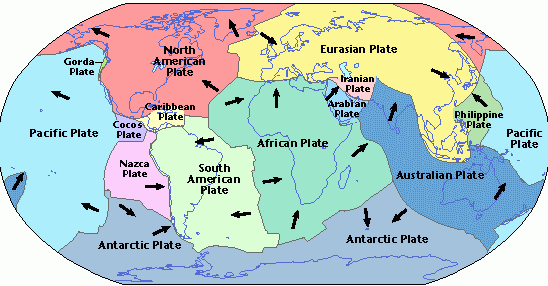
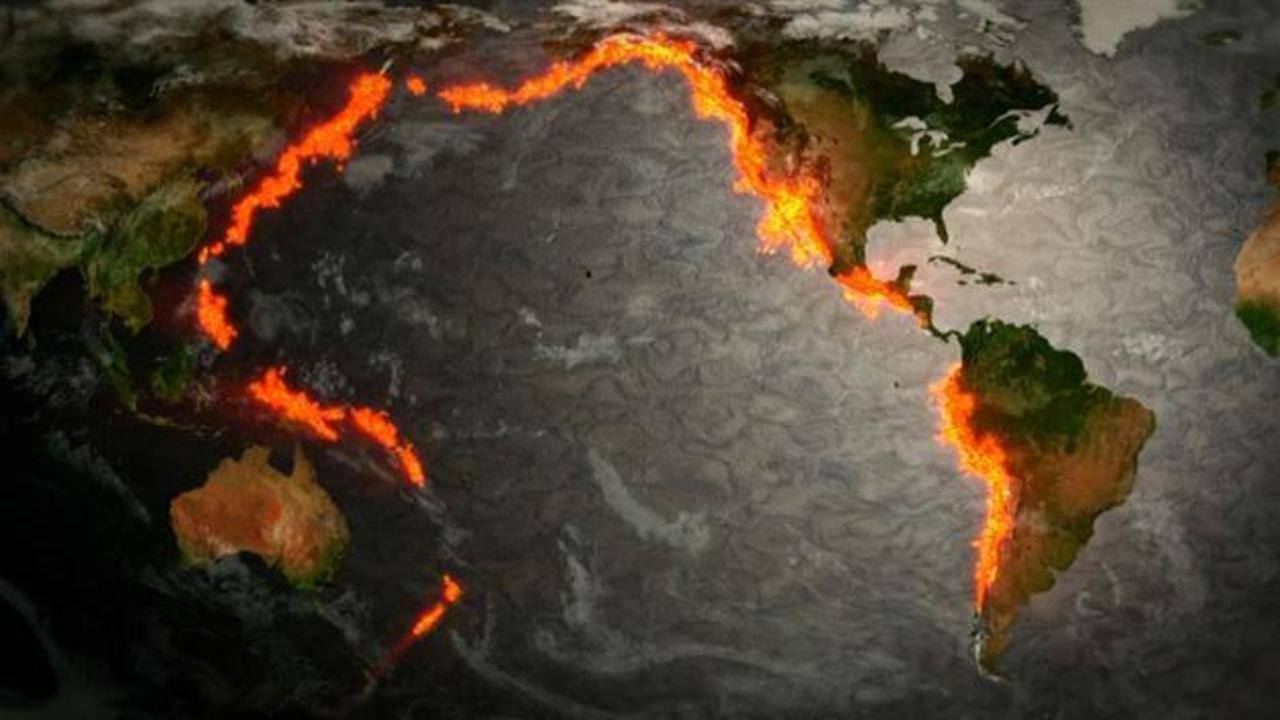
  • Earthquakes commonly occur at the boundaries of lithospheric plates. Earthquakes occur less commonly at faults that are inside plate boundaries

  • Millions of earthquakes happen every year. Not all of them are recorded because most are too weak to be felt.

media

12

Measuring earthquakes

  • Seismometer - device that measures intensity of earthquakes. Intensity is the strength of the shaking motion

  • There are two related measurements taken during and after an earthquake—the energy released and the damage caused.

media

13

  •  The Richter scale rates earthquakes according to the size of the seismic waves recorded on a seismograph

  • Aproximately 15 earthquakes in the magnitude 7 range and one earthquake magnitude 8.0 or greater are expected each year

media

14

Multiple Choice

Question image
Many earthquakes happen along the borders of...
1
Countries
2
Tectonic Plates
3
Climate Zones
4
None of the above.

15

Multiple Choice

The Richter scale measures:
1
the amount of radon gas released
2
the movement of plates
3
the strength of an earthquake
4
the weight of tectonic plates

16

Multiple Choice

Question image
The first wave of an earthquake is . . . . 
1
tsunami
2
surface wave
3
p wave
4
s wave

17

Multiple Choice

Question image
The epicenter of an earthquake shows up where?
1
Below the surface of the earth.
2
On the surface of the earth.
3
Next to the P Wave.
4
At the end of a Surface Wave

18

Multiple Choice

Question image
Which ocean in the world is also known as the "Ring of Fire"
1
Atlantic
2
Indian
3
Arctic
4
Pacific

19

Multiple Choice

Which of these seismic waves creates the most damage during an earthquake?
1
primary
2
secondary
3
surface

20

Multiple Choice

Liquefaction is when...
1
the soil behaves like liquid
2
the ground becomes liquid
3
magma rises to the surface
4
buildings are damaged, crumbling like liquid

21

Multiple Choice

What is the epicenter of an earthquake
1
the location along a fault where the first motion of an earthquake occurs
2
a seismic wave tht travels along the surface of Earth
3
the point on Earth's surface directly above the earthquake's focus
4
the last place that motion in an earthquake is detected

22

Multiple Choice

An instrument that detects and measures earthquakes is a 
1
seismogram
2
focus seismic map
3
focus
4
seismograph 

23

Multiple Choice

How much bigger is a magnitude 8 earthquake compared to magnitude 7 one on the Richter Scale?
1
1 time bigger
2
10 times bigger
3
100 times bigger
4
1000 times bigger

24

Multiple Choice

Earthquakes under the water can cause _________________________________.
1
tornadoes
2
tsunamis
3
lightening
4
hailstorms

25

Multiple Choice

The focus of an earthquake is
1
The point below Earth's surface where rock first breaks
2
The closest seismic station
3
The place where the greatest damage occurs
4
A fault

26

Multiple Choice

A break in the lithosphere along which movement has occurred is called a(n)
1
fault
2
earthquake
3
epicenter
4
volcano

27

Multiple Choice

At what location does the first motion of an earthquake occur
1
the focus
2
the seismic gap
3
the mantle
4
the epicenter

28

Multiple Choice

Question image
Earthquakes happen every day. Most are too small for humans to notice.
1
True
2
False

29

Multiple Choice

Question image
This is the area beneath the Earth's surface where the earthquake begins
1
epicenter
2
hypocenter
3
fault line
4
tectonic plate

30

Multiple Choice

The record of a seismic wave is the 
1
Seismogram
2
Seismograph
3
Seismometer
4
Richter scale

31

Multiple Choice

Question image
The outside layer of the earth is called ______________________.
1
core
2
crust
3
mantle
4
outer core

32

Multiple Choice

The epicenter of an earthquake is
1
The point below the surface where rock begins to break and the first motion occurs
2
The seismic station closest to the earthquake
3
The place where the greatest damage occurs
4
The point on the surface directly above the focus

33

Multiple Choice

What is the minimum number of seismograph stations needed to locate an earthquake epicenter?
1
1
2
2
3
3
4
1 billion

34

Multiple Choice

Seismographs detect and record_______ waves
1
sound
2
light
3
seismic
4
radio

35

Multiple Choice

Question image
What does the arrows point to?
1
Triangulation
2
Seismograph
3
Seismic waves
4
epicenter

36

Multiple Choice

The earth's ________ is broken up into pieces just like a jigsaw puzzle.
1
Inner Core
2
Lithosphere
3
Mantle
4
Outer Core

37

Multiple Choice

Question image
Which Plate Boundary does the picture illustrate?
1
Spreading Boundary
2
Fault Boundary
3
Colliding Boundary
4
Seismic Boundary

38

Multiple Choice

Question image
This picture shows which kind of Plate Boundary?
1
Colliding Boundary
2
Fault Boundary
3
Spreading Boundary
4
Seismic Boundary

39

Multiple Choice

Question image
Which Plate Boundary does the picture illustrate?
1
Spreading Boundary
2
Fault Boundary
3
Colliding Boundary
4
Volcanic Boundary

40

Multiple Choice

Question image
What Geologic Activity is occurring in this picture?
1
Sea-floor Spreading
2
Volcano forming
3
Earthquake
4
Mountain building

41

Multiple Choice

Question image
What is the name of the geologic process when one plate slips underneath another plate?
1
Subduction
2
Subway
3
Convergence
4
Slip

42

Multiple Choice

The fastest Seismic waves that can go through any of Earth's layers are...
1
Secondary Waves
2
Surface Waves
3
Primary Waves

43

Multiple Choice

The area around the Pacific Ocean where lots of earthquakes and volcanoes happen is called the ____________.
1
Ring of Earth
2
Ring of Fire
3
Ring of Stone
4
Ring of Diamond

44

Multiple Choice

Which crust is thicker?
1
Oceanic Crust
2
Continental Crust

45

Multiple Choice

The sudden shaking of the Earths Crust is...

1

A Full Moon

2

An Earthquake

3

An Igneous Rock

4

A Meandering River

46

Multiple Choice

Question image

What is this geologic feature?

1

Fold

2

Tilt

3

Anticline

4

Fault

47

Multiple Choice

Question image

What is the location called at the surface where the earthquake is felt?

1

Focus

2

Epicenter

48

Multiple Choice

Question image

What is the spot called, deep inside the earth, where earthquakes start?

1

Focus

2

Epicenter

49

Multiple Choice

True or False: The deeper the focus of the earthquake, generally the stronger the earthquake is going to be

1

True

2

False

50

Multiple Choice

The prefix "seis" means what?

1

Astronomy

2

Geology

3

Earthquake

4

Deep water

51

Multiple Choice

Question image

What is a seismograph or a seismometer?

1

Printout of the Earth shaking

2

The machine that records the Earths shaking

3

The scientist who studies earthquakes

4

The location where earthquakes are studied

52

Multiple Choice

Question image

What is a seismogram?

1

The printout of the Earth shaking

2

The scientist that studies earthquakes

3

The location where earthquakes are studied

4

The machine that records the shaking

53

Multiple Choice

What is a seismologist?

1

The machine that records earthquake shaking

2

The printout of the Earth shaking

3

The scientist that studies earthquake waves

4

The location where earthquakes are studied

54

Multiple Choice

What is a seismic station?

1

The machine that records earthquake vibrations

2

The printout of the Earths vibration

3

The scientist that studies earthquakes

4

The location where the earthquake is studied

55

Multiple Choice

Question image

Which wave shows up first?

1

P Wave

2

S Wave

56

Multiple Choice

Question image

Which wave arrives second?

1

P wave

2

S wave

57

Multiple Choice

Question image

Which wave is faster?

1

P wave

2

S wave

58

Multiple Choice

Question image

Which wave is slower?

1

P wave

2

S wave

59

Multiple Choice

Question image

Which wave is a compressional wave?

1

P wave

2

S wave

60

Multiple Choice

Question image

Which wave is a shear wave?

1

P wave

2

S wave

61

Multiple Choice

Question image

How many seismic stations do you need to figure out where the earthquake epicenter is?

1

1

2

2

3

3

4

4

62

Multiple Choice

Question image

How do you determine where the earthquake epicenter is when looking at the epicenter circles?

1

Where seismogram 1 touches seismogram 2

2

Where seismogram 2 touches seismogram 3

3

Where seismogram 1 touches seismogram 3

4

Where all 3 seismograms touch and intersect

63

Multiple Choice

Question image

Which seismogram is closest to the epicenter?

1

Seismogram 1 because its the smallest circle

2

Seismogram 2 because its the medium circle

3

Seismogram 3 because its the biggest circle

64

Multiple Choice

Question image

Which seismogram is farthest from the epicenter?

1

Seismogram 1 because its the smallest circle

2

Seismogram 2 because its the medium circle

3

Seismogram 3 because its the largest circle

65

Multiple Choice

Question image

Which station is the closest to the epicenter?

1

1

2

2

3

3

4

4

66

Multiple Choice

Question image

Which station is farthest from the epicenter?

1

1

2

2

3

3

4

4

67

Multiple Choice

Question image

Which scale measures the strength of an earthquake?

1

Richter Scale

2

Mercalli Scale

68

Multiple Choice

Question image

Which scale measures the amount of damage an earthquake produces?

1

Richter Scale

2

Mercalli Scale

69

Multiple Choice

Question image

This wave can go through the entire planet. As it travels from the mantle to the outer core to the inner core, the wave bends and refracts. Due to the bending, it misses the intended target on the other side of the planet. Which wave is this?

1

P wave

2

S wave

70

Multiple Choice

Question image

This wave cannot pass through the liquid outer core. This wave gets absorbed by the liquid layer and half of the planet will not receive this wave. Which wave is this?

1

P wave

2

S wave

71

Multiple Choice

Question image

An S wave shadow zone is produced because...

1

It bends moving from one layer to the next

2

It gets absorbed by the liquid outer core

3

It gets absorbed by the solid outer core

4

It gets absorbed by the liquid inner core

72

Multiple Choice

Question image

The P wave shadow zone is produced because...

1

It gets absorbed by the mantle

2

It gets absorbed by the liquid outer core

3

It bends (refracts) due to density differences from one layer to the next

4

It gets absorbed by the solid inner core

73

Multiple Choice

A massive underwater earthquake could produce a deadly ocean wave. This wave is called a....

1

Torpedo

2

Tsunami

3

Avalanche

4

Rock slide

74

Multiple Choice

The strength or amount of energy produced by an earthquake is called....

1

Magnitude

2

Luminosity

3

Neap

4

Subduction

75

Multiple Choice

The time a P or S wave arrives at a seismic station is called...

1

Arrival Time

2

Travel Time

3

Lag Time

4

Origin Time

76

Multiple Choice

The time it takes a P or S wave to travel a certain distance from the epicenter is called...

1

Arrival Time

2

Travel Time

3

Lag Time

4

Origin Time

77

Multiple Choice

The time difference between the arrival of the P wave and the arrival of the S wave is called....

1

Arrival Time

2

Travel Time

3

Lag Time

4

Origin Time

78

Multiple Choice

The time the earthquake starts or originates is called...

1

Arrival Time

2

Travel Time

3

Lag Time

4

Origin Time

79

Multiple Choice

Question image
On the fault diagram the rock to the left is called the ____ and the one to the right is called the _____.
1
hanging wall;footwall
2
footwall; hanging wall
3
subduction zone;fault zone
4
compression plate; tension plate

80

Multiple Choice

Question image
What type of fault is being shown?
1
reverse fault
2
ring fault
3
normal fault
4
strike-slip fault

81

Multiple Choice

Question image
What type of fault is being shown?
1
ring fault
2
reverse fault
3
normal fault
4
strike-slip fault

82

Multiple Choice

Question image
What type of fault is being shown?
1
ring fault
2
reverse fault
3
normal fault
4
strike-slip fault

83

Multiple Choice

Question image
The diagram is showing what type of plate boundary?
1
convergent plate boundary
2
divergent plate boundary
3
transform boundary

84

Multiple Choice

Question image
Which type of plate boundary is being shown?
1
convergent boundary
2
divergent boundary
3
transform boundary

85

Multiple Choice

Question image
Which type of plate boundary is being shown?
1
convergent boundary
2
divergent boundary
3
transform boundary

86

Multiple Choice

The point where an earthquake begins below the surface and seismic waves move out in all directions away from is called the.....
1
footwall
2
P wave
3
epicenter
4
focus

87

Multiple Choice

The spot directly above the spot where the Earthquake begins.  It is on the surface of the Earth
1
hanging wall
2
S wave
3
epicenter
4
focus

88

Multiple Choice

The fastest traveling earthquake waves are called....
1
P waves
2
S waves
3
R waves 
4
T waves

89

Multiple Choice

What causes the tectonic places to shift and move?
1
radiation
2
subduction
3
conduction
4
convection

90

Multiple Choice

How many times bigger is a 8 magnitude earthquake than a 6 magnitude earthquake on the Richter scale?
1
2
10
3
100
4
1000

91

Multiple Choice

The instrument that records earthquakes is called a......
1
seismologist
2
seismogram
3
seismograph
4
seismology

92

Multiple Choice

What type of fault is associated with compressional (pushing together) forces?
1
Normal
2
Reverse
3
Strike-Slip

93

Multiple Choice

What type of fault is associated with tensional (pulling apart) forces?
1
Normal
2
Reverse
3
Strike-Slip

94

Multiple Choice

Question image
Point B on the diagram is.....
1
the footwall
2
the epicenter of an earthquake
3
the focus of an earthquake
4
a fault line

95

Multiple Choice

Which of the following measures an earthquake's intensity based on the observed effects on people and structures?  
1
Richter Scale
2
Modified Mercalli Scale
3
Centigrade Scale
4
Moment Magnitude scale

96

Multiple Choice

This earthquake measurement scale is based on the size (amplitude) of seismic waves  as measured on a seismograph.
1
Richter Scale
2
Modified Mercalli scale
3
Centigrade scale
4
The Moment Magnitude Scale

97

Multiple Choice

This earthquake scale measures the total energy released by an earthquake by taking into consideration the size of the area covered by the fault, the strength of the rocks being displaced at the fault, and the amount of movement along the fault.
1
Richter Scale
2
Mercalli Scale
3
Moment Magnitude Scale
4
Centigrade Scale

98

Multiple Choice

A wave carries...?
1
energy only
2
matter only
3
the matter carries the energy
4
neither

99

Multiple Choice

These travel on Earth's surface and are slower and more destructive 
1
fault waves
2
focus waves
3
surface waves
4
seismic waves

100

Multiple Choice

A wave of energy that travels through the Earth, away from an earthquake in all directions
1
fault
2
seismic waves
3
epicenter 
4
focus

101

Multiple Choice

What type of seismic wave travels parallel to the direction of particle motion? It's called a compression wave or push pull wave.
1
P wave
2
S wave
3
Surface
4
None

102

Multiple Choice

What type of wave travels perpendicular to the motion of the disturbed particles?  It is called a transverse wave. 
1
P wave
2
S wave
3
T wave
4
R wave

103

Multiple Choice

What type of body wave cannot travel through the liquid out core of our Earth and is instead deflected to the sides of the Earth?
1
P wave
2
S wave
3
surface waves
4
love waves

104

Multiple Choice

An earthquake scored high on the Richter scale but low on the Mercalli scale. Why?
1
it probably happened in an area with no people
2
it was a fast earthquake
3
because it damaged a lot
4
impossible to tell

105

Multiple Choice

A type of fault where the hanging wall slides downward.  Caused by tension in the crust.
1
Reverse Fault
2
Normal Fault
3
Strike-slip Fault
4
Earthquakes

106

Multiple Choice

Type of seismic wave that compresses and expands the ground.  Arrives first
1
Primary Wave  (P Wave)
2
Surface Wave  (S Wave)
3
Secondary Wave
4
Seismic Wave

107

Multiple Choice

Type of seismic wave that forms when P waves and S waves reach Earth's surface
1
Primary wave (P Wave)
2
Secondary wave (S Wave)
3
Surface Wave
4
Seismic Wave

108

Multiple Choice

Earthquake that occurs after a larger earthquake in the same area.
1
Earthquake
2
Aftershock
3
Magnitude
4
Richter Scale

109

Multiple Choice

Question image
Many earthquakes happen along the borders of...
1
Countries
2
Tetonic Plates
3
Climate Zones
4
None of the above.

110

Multiple Choice

Question image
This area is responsible for 90% of all earthquakes in  the world and contains numerous faults:
1
Japan
2
San Andreas Fault
3
The Ring of Fire
4
Mid-Atlantic Ridge

111

Multiple Choice

Question image
This famous transform fault is located in the western United States creates significant earthquake activity for California
1
New Madrid
2
Denali Fault
3
Ramapo Seismic Zone
4
San Andreas

112

Multiple Choice

Question image
A tsunami is caused by______
1
lots of rain
2
a meteorite 
3
a tornado
4
an earthquake

113

Multiple Choice

Question image
The huge pieces of the earth's crust are called ____________________________. 
1
crust
2
plates
3
directions
4
seismos

114

Multiple Choice

Question image
This scale rates the total energy an earthquake releases; each increase of one has 32 X more energy:
1
Modified Mercalli Scale
2
Richter Scale
3
Moment Magnitude Scale
4
Triple Beam Scale

115

Multiple Choice

Question image
The magnitude of an earthquake is measured on a seismograph noting  the recordings on the seismogram using this:
1
Modified Mercalli Scale
2
Richter Scale
3
Moment Magnitude Scale
4
Triple Beam Scale

116

Multiple Choice

Question image
These seismic waves compress and expand the ground like an accordion:
1
p-waves
2
s-waves
3
surface waves
4
z-waves

How do earthquakes happen?

  • Tectonic plates move and release energy

  • The focus is the place where the energy is released

  • Epicenter - location on surface directly above the focus

  • Energy travels as seismic waves out from the focus

media

Show answer

Auto Play

Slide 1 / 116

SLIDE