Search Header Logo
9/10 Cell membrane and transport 24-25

9/10 Cell membrane and transport 24-25

Assessment

Presentation

•

Biology

•

9th Grade

•

Easy

•
NGSS
HS-LS1-3

Standards-aligned

Created by

Aleyah Lyles

Used 7+ times

FREE Resource

29 Slides • 18 Questions

1

media

2

media

3

media

4

media

5

media

6

media

7

Multiple Choice

Which type of biological macromolecule is the main component of the plasma membrane?

1

carbohydrate

2

lipid

3

protein

4

nucleic acid

8

Multiple Choice

Question image

Define plasma membrane

1

lipid that helps minimize effects of temperature

2

only on the outer surface of the plasma membrane and are attached to proteins or lipids; form distinctive cellular markers

3

flexible boundary of a cell that separates a cell from its surroundings

4

may extend partway into the plasma membrane, cross the membrane entirely, or be loosely attached to its inside or outside face

9

Multiple Choice

What forms the channels and pumps in the phospholipid bilayer?
1
carbohydrates
2
proteins
3
hydrophilic heads 
4
lipids

10

Multiple Choice

What is a substance called if it speeds up a chemical reaction?
1
reusable
2
catalyst
3
specific
4
fragile

11

Multiple Choice

Enzymes are an example of

1

Lipids

2

Carbohydrate

3

Protein

4

Nucleic Acid

12

Multiple Choice

Each enzyme only has 1 substrate that will fit its active site.  What is this called?
1
reusable
2
catalyst
3
specific
4
fragile

13

media

14

media

15

media

16

media

17

media

18

media

19

media

20

media

21

Multiple Choice

which of the following terms means the movement of water from high concentration to low concentration
1
diffusion
2

facilitated diffusion

3
osmosis
4

exocytosis

22

Multiple Choice

Which transport does not require energy?
1
Passive
2
Active 

23

Multiple Choice

Question image

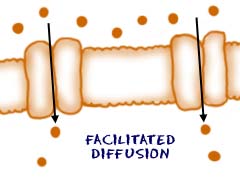
What type of transport is facilitated diffusion?

1
Passive Transport
2
Active Transport

24

Match

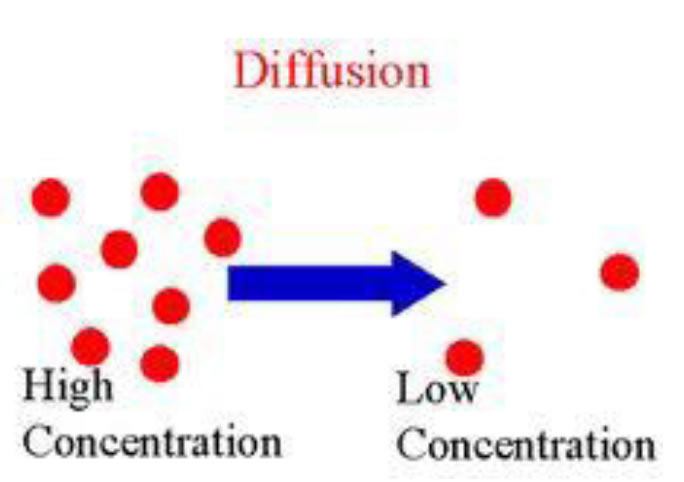
Match the following processes to the illustration:

Diffusion

facilitated diffusion

osmosis

25

Multiple Choice

Solutes move with the concentration gradient, therefore no energy is used. 
1
Passive Transport
2
Active Transport

26

media

27

media

28

media

29

media

30

media

31

media

32

media

33

media

34

media

35

media

36

media

37

media

38

media

39

media

40

Multiple Choice

Question image
Movement of particles from high to low concentration. 
1
Passive Transport
2
Active Transport

41

Multiple Choice

What is a solute?
1
The substance that does the dissolving in a solution.
2
The substance that is dissolved into the solution.
3
The mixing of different substances.
4
The process in which neutral molecules lose or gain electrons

42

Multiple Choice

Osmosis is a form of ______________. 
1
Passive Transport
2
Active Transport

43

Multiple Choice

What is diffusion?
1
when molecules move 
2
when molecules move from a high concentration to a low.
3
no movement 
4
molecules move everywhere

44

Multiple Choice

When there is the same solute concentration inside the cell as there is outside the cell, that is an ________ solution.

1
isotonic
2

Hypotonic

3

Hypertonic

45

Multiple Choice

Question image
In this situation, where the solute is illustrated by red dots, predict if will WATER move into or out of the cell, and how that will affect the cell.
1
Water will move into the cell and the cell will expand.
2
Water will move into the cell and the cell will shrink.
3
Water will move out of the cell and the cell will expand.
4
Water will move out of the cell and the cell will shrink.

46

Multiple Choice

Question image

The cell shows water moving in and out equally, which means it was placed in a ___ solution.

1

Isotonic

2

Hypertonic

3

Hypotonic

47

media
media

Show answer

Auto Play

Slide 1 / 47

SLIDE