

Unit 1.3 Biogeochemical Cycles

Presentation
•
Biology, Science
•
7th - 10th Grade
•
Practice Problem
•
Medium

Samah Al-hamadi
Used 1+ times
FREE Resource
26 Slides • 49 Questions
1

2

3

4

5
6

7
Multiple Choice
8

9
Multiple Choice
10

11

12
Labelling
Label the Biomolecule chart
insulation
Nucleic Acid
Proteins
Carbohydrates
builds and repairs cells
main source of energy
Lipids
genes that determine your traits
13

14

15

16
17
Labelling
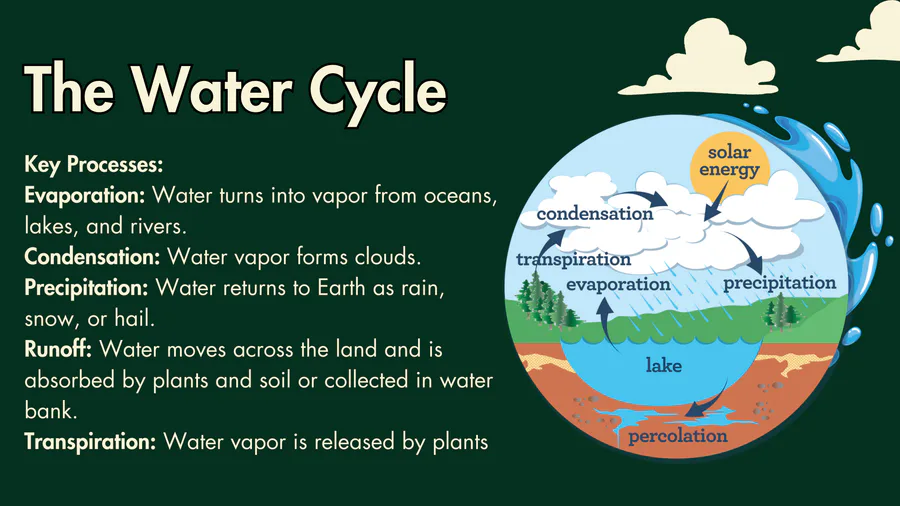
Label the parts of the water cycle
Runoff
Groundwater
Transpiration
Evaporation
Condensation
Precipitation
18
Multiple Choice
19
Multiple Choice
What happens during evapotranspiration?
Plants absorb water through their roots
Water evaporates from the surface of the ocean
Water condenses into clouds
Water freezes into ice
20
Multiple Choice

What is it called when water evaporates through plants' leaves?
condensation
evaporation
sublimation
transpiration
21
Multiple Choice

22

23
Multiple Choice
What is the hydrologic cycle?
The movement of water on, above, and below the Earth's surface
The process of evaporation and condensation of water
The cycle of water turning into ice and melting
The movement of water through plants and animals
24

25

26

27
Multiple Choice
Process where phosphorus is removed from the rocks through rain, temperature, etc.
Weathering
Uplift
Leaching
Assimilation
28
Multiple Choice
Process where phosphorus runs off into the water from the soil.
Decomposition
Excretion
Assimilation
Leaching
29
Multiple Choice
Humans have impacted the phosphorus cycle by burning fossil fuels, which has increased the amount of phosphorus in the air.
True
False
30

31

32

33
Labelling
Label the parts of the Carbon Cycle
Photosynthesis
Respiration
Fossil Fuel Formation
Burning Fossil Fuel
34
Multiple Choice

Which one of these does not add CO2 to the atmosphere?
cooking with gas
planting trees
burning wood
riding in a bus
35
Multiple Choice
Process by which fossil fuels are burned and CO2 is released back into the atmosphere.
Decomposition
Ammonification
Combustion
Photosynthesis
36
Multiple Choice
Process where plants and animals release CO2 back into the atmosphere through exhaling.
Photosynthesis
Decomposition
Respiration
Uplift
37
Multiple Choice
Process by which animals obtain and digest nutrients by consuming plants or other animals.
Assimilation
Excretion
Decomposition
Respiration
38
Multiple Choice
Process where plants take in CO2 from the atmosphere to make their own food.
Respiration
Combustion
Nitrification
Photosynthesis
39

40

41

42
Open Ended
What are diatoms and why are they important?
43

44

45

46
Match
Ammonification
Assimilation
Denitrification
Nitrification
Nitrogen Fixation
production of ammonia during the decay of organic matter
absorbtion and incorportaion of nitrogen into plant and animal compounds
conversion of nitrate into nitrogen gas
production of nitrates from ammonia
converts nitrogen gas into ammonia & nitrates
production of ammonia during the decay of organic matter
absorbtion and incorportaion of nitrogen into plant and animal compounds
conversion of nitrate into nitrogen gas
production of nitrates from ammonia
converts nitrogen gas into ammonia & nitrates
47
Multiple Choice

48
Multiple Choice
49
Multiple Choice
___________ is the most abundant gas in our atmosphere at 78%.
Oxygen
Carbon Dioxide
Phosphorus
Nitrogen
50
Multiple Choice
Process in which nitrogen can be fixed by lightning, bacteria, or industries.
Nitrogen Fixation
Denitrification
Photosynthesis
Weathering
51
Multiple Choice
52
Fill in the Blanks
53
Multiple Choice
Nitrogen can't be used directly from the atmosphere.
True
False
54
Multiple Choice
Process by which decomposers break down dead plants and animals and return the nutrients to the soil.
Respiration
Decomposition
Assimilation
Leaching
55
Multiple Choice
Process by which nitrogen is returned to the soil as ammonia after decomposition.
Denitrification
Nitrification
Leaching
Ammonification
56
Multiple Select
How have humans impacted the nitrogen cycle?
Fertilizers
Livestock farming
Deforestation
Mining
57
Multiple Choice
Biogeochemical cycles allow nutrients to be recycled and used over and over again.
True
False
58
Multiple Choice
Animals obtain nitrogen when they eat plants or other animals through the process called assimilation.
True
False
59
Multiple Choice
60
Multiple Choice
During ________________ stage, water attempts to return to rivers, lakes, or the ocean.
evaporation
condensation
precipitation
runoff
61
Multiple Choice
Animals inhale oxygen and exhale....
CH4
CO2
NH3
N2O
62
Multiple Choice
Soil bacteria can take N2 gas and break apart its triple covalent bond. This is called...
Ammonification
Nitrification
Nitrogen fixation
Denitrification
63
Multiple Choice
What is the main driving force behind the hydrologic cycle?
Gravity
Wind
Sunlight
Temperature
64
Multiple Choice
What is the role of clouds in the hydrologic cycle?
They store water in the atmosphere
They release water into the atmosphere
They transport water from the ocean to land
They absorb water from the ground
65
Multiple Choice
What happens to carbon dioxide dissolved in the ocean?
It is used by phytoplankton for photosynthesis
It is released into the atmosphere
It forms calcium carbonate shells
It becomes trapped in permafrost
66
Multiple Choice
What is the impact of burning fossil fuels on the carbon cycle?
It releases stored carbon into the atmosphere
It increases the amount of carbon in the ocean
It causes carbon to be trapped in permafrost
It decreases the amount of carbon dioxide in the atmosphere
67
Multiple Select
Decomposition is found during which of the following cycles?
Choose all the apply.
Phosphorus
Cycle
Carbon
Cycle
Nitrogen
Cycle
Water Cycle
68
Multiple Select
Nitrogen is found in which of the following:
Fats
(lipids)
Nucleic Acids
(DNA + RNA)
Proteins
Carbohydrates
(Sugar + Starch)
69
Multiple Choice

According to the diagram, geologic activity, such as volcanoes,
Increases the levels of CO2 in the atmosphere.
Decreases the levels of CO2 in the atmosphere.
70
Multiple Choice

71
Multiple Select

Which of the following help convert nitrogen into usable forms? Check all that apply.
blue-green algae/cyanobacteria
burning fossil fuels
72
Multiple Choice
73
Multiple Choice
How does land use cause a reduction in biodiversity?
74
Multiple Choice
Humans are responsible for many negative changes in the natural environment. Which of the following best describes why humans have a profound impact on their environment?
Humans are able to preserve scarce resources.
Humans are able to modify habitats more than any other species.
Humans have made attempts to preserve the environment.
Humans have encouraged the development of wildlife refuges and parks.
75
Multiple Choice
Show answer
Auto Play
Slide 1 / 75
SLIDE
Similar Resources on Wayground

71 questions
Law of Demand
Presentation
•
11th - 12th Grade
71 questions
Endocrine system
Presentation
•
10th - 12th Grade
71 questions
Ecology Review
Presentation
•
9th - 12th Grade
69 questions
Chemical Reaction with Pictures
Presentation
•
9th - 12th Grade
69 questions
SES1a Formation of the Solar System
Presentation
•
9th - 12th Grade
72 questions
Ekosistem dan Quiz
Presentation
•
9th - 12th Grade
70 questions
Q1W5 ES Energy Sources
Presentation
•
11th Grade
72 questions
Speciation and Natural Selection
Presentation
•
9th - 12th Grade
Popular Resources on Wayground
20 questions
"What is the question asking??" Grades 3-5

Quiz
•
1st - 5th Grade
20 questions
“What is the question asking??” Grades 6-8
Quiz
•
6th - 8th Grade
10 questions
Fire Safety Quiz
Quiz
•
12th Grade
20 questions
Equivalent Fractions
Quiz
•
3rd Grade
34 questions
STAAR Review 6th - 8th grade Reading Part 1
Quiz
•
6th - 8th Grade
20 questions
“What is the question asking??” English I-II
Quiz
•
9th - 12th Grade
20 questions
Main Idea and Details
Quiz
•
5th Grade
47 questions
8th Grade Reading STAAR Ultimate Review!
Quiz
•
8th Grade
Discover more resources for Biology
20 questions
Food Chains and Food Webs
Quiz
•
7th - 12th Grade
10 questions
Exploring Evidence of Evolution

Interactive video
•
6th - 10th Grade
10 questions
Comparing Mitosis and Meiosis: Key Differences and Stages
Interactive video
•
6th - 10th Grade
10 questions
Exploring the Impact of Genetic Mutations
Interactive video
•
6th - 10th Grade
15 questions
Symbiosis
Quiz
•
6th - 10th Grade
44 questions
Food Webs and Energy Flow
Quiz
•
6th - 10th Grade
10 questions
Comparing Photosynthesis and Cellular Respiration
Interactive video
•
6th - 10th Grade
10 questions
Exploring Trophic Structures in Ecosystem Ecology
Interactive video
•
6th - 10th Grade