Ecology Review
Presentation
•
Science
•
9th - 12th Grade
•
Medium
+10
Standards-aligned
Kaitlyn Cochran
Used 1+ times
FREE Resource
38 Slides • 33 Questions
1
2
3
4
Multiple Choice
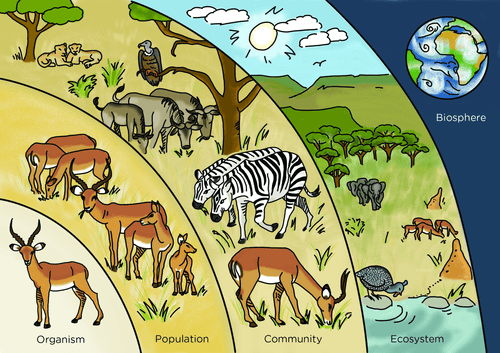
The living world is organized in levels. Biotic and abiotic factors also can be arranged into levels of biological organization. Put the words below in order from the least complex to the most complex
Community, Organism, Biome, Population, Biosphere, Ecosystem
Organism, Population, Community, Ecosystem, Biome, Biosphere
Organism, Biome, Population, Community Biosphere, Ecosystem
5
6
7
8
Dropdown
9
Labelling
Label the diagram with the correct labels
Ecosystem
Population
Organism
Community
Biosphere
10
Match
Match the following
cow
cow and egret
cow, egret, and pond
herd of cattle
organism
community
ecosystem
population
organism
community
ecosystem
population
11
12
Categorize
duck
butterfly
fish
deer
trees
water
soil
rocks
wind
sun
Classify as either biotic or abiotic factors
13
14
15
Multiple Choice
What is the difference between a habitat and a niche in ecology?
A habitat is a role in the community, while a niche is a specific area.
A habitat is a specific area, while a niche is the role in the community.
Both terms mean the same thing.
A habitat is only for animals, while a niche is for plants.
16
17
18
Multiple Choice
19
Hotspot
Click on the section that represents pioneer species.
20
Multiple Choice
21
Multiple Choice
During a forest fire most vegetation (plants) burn. Which ecological succession will take place after a forest fire?
Primary
Secondary
22
Multiple Select
What do you notice about this climate graph?
temperature is warm year round
temperature is cold year round
dry summers
most rain in the winter
23
24
25
Multiple Choice
What do the arrows in the food chain indicate about the flow of energy in an ecosystem?
Energy is continuously recycled by the organisms in an ecosystem.
Energy flows in one direction in an ecosystem, from producers to consumers.
More of the available energy in an ecosystem is given to large animals than to small animals.
Organisms at the end of the food chain receive more energy than those at the beginning.
26
Multiple Choice
How would a reduction in the snail population effect this ecosystem?
It would cause decreased competition between spiders and owls.
It would cause decreased competition between spiders and wood mice.
It would cause increased competition between grasshoppers and beetles.
It would cause increased competition between wood mice and shrews.
27
Reorder
Put this food chain in the correct order
Grass
Rabbit
Snake
Hawk
28
Match
Match the following:
Producer/Autotroph
Secondary Consumer
Tertiary Consumer
Apex Predator
Herbivore
Plant
Bird
Snake
Owl
Grasshopper
Plant
Bird
Snake
Owl
Grasshopper
29
30
31
32
33
Reorder
Put in order from MOST to LEAST amount of energy.
Producer
Primary consumer
Secondary consumer
Tertiary consumer
Apex predator
34
Fill in the Blank
Type answer...
35
36
Multiple Choice
What are the inputs of photosynthesis?
Glucose & Oxygen
Glucose & Carbon Dioxide
Light & Chlorophyll
Carbon Dioxide, Water, & Light.
37
38
Multiple Choice
How does energy flow through an ecosystem?
Through producers and consumers
Only through producers
Only through consumers
Through decomposers
39
40
Multiple Choice
In a food web, which type of consumer is at the top of the food chain?
Primary consumer
Secondary consumer
Tertiary consumer
Quaternary consumer
41
42
Multiple Choice
How are heterotrophs classified based on what they eat?
By their habitat
By their diet
By their size
By their color
43
44
45
46
Multiple Select
How does carbon get from animals and back into the atmosphere? (CHOOSE ALL THAT APPLY)
Respiration (breathing)
After they die, they are broken down by decomposers
Photosynthesis
None of these
47
48
Hotspot
Point to the box in the Carbon cycle showing the process of photosynthesis
49
Multiple Choice
diagram?
50
51
52
53
Multiple Choice
During a field study, a group of students are analyzing a soil sample to understand its nutrient cycle. Which of the following processes they observed is NOT a step in the nitrogen cycle?
Nitrification
Carbon fixation
Denitrification
Assimilation
54
55
56
Multiple Choice
When the birthrate in a population becomes higher that the death rate, the population growth
increases.
decreases.
levels off.
decreases, then levels off.
57
58
59
60
Multiple Choice
In the graph to the right, what is the population of deer at the carrying capacity of the environment?
3
7
70
40
61
62
Drag and Drop
63
64
65
Drag and Drop
66
Hotspot
Long ago people would leave trash in remote areas. Some of these old trash dumps are still producing pollutants. The diagram shows rock layers, aquifers, and wells near an old trash dump. Which 2 areas are most likely to become contaminated with pollutants from the trash dump? ( CHOOSE 2 CORRECT ANSWERS)
67
Multiple Choice
How does climate change primarily affect the habitats of living organisms?
By increasing the availability of food
By altering temperature and weather patterns
By reducing the amount of sunlight
By increasing soil fertility
68
Drag and Drop
Nitrogen in the soil.
The number of trees in a forest.
The amount of oxygen in the air.
69
Match
Match the following problem with its impact on an ecosystem
Global Warming
Ozone Depletion
Loss of Biodiversity
Bio-Magnification
Ice Caps Melt, Water levels rise
Increase incidences of skin cancer
Loss of medical + agricultural products
Disruption in the top of the food chain
Ice Caps Melt, Water levels rise
Increase incidences of skin cancer
Loss of medical + agricultural products
Disruption in the top of the food chain
70
71
Show answer
Auto Play
Slide 1 / 71
SLIDE

Similar Resources on Wayground
64 questions
Proportional Parts in Triangles
Presentation
•
9th - 12th Grade
68 questions
Rocks and The Rock Cycle
Presentation
•
9th - 12th Grade
65 questions
AP Biology FRQ Friday Tips and Tricks
Presentation
•
9th - 12th Grade
70 questions
Phylum Mollusca Notes
Presentation
•
10th - 12th Grade
69 questions
5.1.5 Life Science Practice
Presentation
•
9th - 12th Grade
67 questions
Unit 2: Chemistry Review
Presentation
•
9th Grade - University
69 questions
Physical and Chemical Properties
Presentation
•
9th - 12th Grade
69 questions
Properties of a Substance and Chemical Reaction
Presentation
•
9th - 12th Grade
Popular Resources on Wayground
10 questions
5.P.1.3 Distance/Time Graphs
Quiz
•
5th Grade
10 questions
Fire Drill
Quiz
•
2nd - 5th Grade
20 questions
Equivalent Fractions
Quiz
•
3rd Grade
22 questions
School Wide Vocab Group 1 Master
Quiz
•
6th - 8th Grade
20 questions
Main Idea and Details
Quiz
•
5th Grade
20 questions
Context Clues
Quiz
•
6th Grade
20 questions
Inferences
Quiz
•
4th Grade
12 questions
What makes Nebraska's government unique?
Quiz
•
4th - 5th Grade
Discover more resources for Science
10 questions
Exploring the Layers of the Earth
Interactive video
•
6th - 10th Grade
25 questions
Naming Ionic and Covalent Compounds
Quiz
•
9th Grade
20 questions
Balancing Chemical Equations
Quiz
•
9th Grade
15 questions
Protein synthesis
Quiz
•
9th Grade
20 questions
Human Impact on the Environment Review #2
Quiz
•
9th Grade
20 questions
Newton's Laws of Motion
Quiz
•
9th Grade
20 questions
Mendelian Genetics Review
Quiz
•
9th Grade
16 questions
Balancing Chemical Equations and Types of Reactions
Quiz
•
9th - 10th Grade