

Week 5: Anatomical Considerations, Vessel Sites and Selections

Presentation
•
Science
•
University
•
Hard

Tina Belt
FREE Resource
51 Slides • 0 Questions
1
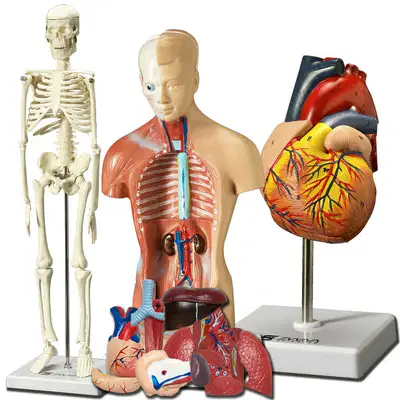
Anatomical Considerations, Embalming Vessel Sites and Selections
Week 5:
2
Accessibility
Is the vessel superficial or deep?
What surrounding structures may complicate access?
How close is it to the aorta?
These factors determine condition and usability.
Size (Diameter)
Influences fluid volume and distribution.
Impacts effectiveness of embalming and body positioning.
3
Location & Exposure
Will the incision be visible or need to be concealed?
How does the vessel’s location relate to exposed body areas?
Practicality
Is drainage feasible through the corresponding veins?
4
Key Considerations
Organ and Tissue Procurement
Multiple Injection Sites: Several access points may be required
Vessel Exposure: Many vessels may be exposed during the procurement process
5
Key Considerations
Invasive Medical Devices
Devices such as ports, catheters, or medication pumps may limit or prevent the use of certain vessels
Medico-Legal Factors
Must adhere to autopsy protocols
Follow requirements set by the Medical Examiner or Coroner
Cause and manner of death may affect vessel selection and procedure
6
Definitions
Linear Guide: A line drawn or visualized on the skin to indicate the approximate location of an underlying structure
Anatomical Guide: Descriptive reference using identifiable anatomical structures to locate arteries and veins
Anatomical Limits: Points of origin and termination of a vessel, defined in relation to adjacent structures
7
Prepare the Area
Shave the area as needed.
Select appropriate instruments and prepare the ligature.
Locate Incision Site
Identify the proper location for the incision using anatomical landmarks.
Make the Incision
Carefully incise through the skin, superficial fascia, and deep fascia.
8
Dissect to Expose Vessels
Perform blunt dissection through the superficial fascia, fat, and deep fascia.
Use anatomical guides to locate the vessels.
Prepare Vessels for Ligation
Clean the vessels using blunt dissection.
Loosely ligate the vessels as needed.
9
Incision Types for Vessel Access
Transverse
Diagonal
Longitudinal
T-incision
Wedge (triangular)
10
Types of vessel incisions:


11
Common Arteries Used in Embalming
Common carotid artery
Femoral artery (or external iliac at the inguinal ligament)
Axillary artery (or brachial artery)
12
Arteries of the head and neck
Common Carotid Artery (Right & Left)
Linear Guide
Visualize a line from the sternoclavicular articulation
→ to the anterior surface of the base of the earlobe


13
Anatomical Guide
Located posterior to the medial border of the sternocleidomastoid (SCM) on each side of the neck
Anatomical Limits
Right Common Carotid: Extends from the right sternoclavicular articulation → superior border of the thyroid cartilage
Left Common Carotid: Extends from the level of the second costal cartilage → superior border of the thyroid cartilage
14
Places of Incision
Supraclavicular (anterior-lateral)
Anterior vertical (parallel)
Posterior vertical (parallel)
Anterior horizontal
Semilunar (flap incision)
Strap line

15
Proximity & Distance Considerations
Direct distribution to the face
Close to the center of arterial solution distribution
Close to the center of venous drainage
Branches of the Carotid Arteries
External Carotid: Ascending pharyngeal, superior thyroid, lingual, facial, occipital, posterior auricular, maxillary, superficial temporal
Internal Carotid: Carotid canal, ophthalmic, anterior cerebral, middle cerebral, posterior communicating, choroidal
16
Precautions
Incision may be visible after dressing
Tubes may leave mark on face
Face may be over-injected
because you will need to inject the left and right separately.
Accompanying vein - internal jugular, relative location
Superficial to the Common Carotid
17
Alternative vessel for embalming the frontal structures of the face
Especially useful for lips and superficial tissues
Incision: Along the inferior border of the mandible, just anterior to the angle of the jaw

18
Subclavian Artery
Right: Begins at the right sternoclavicular articulation → lateral border of the first rib
Left: Begins at the level of the second left costal cartilage → lateral border of the first rib
Commonly used in autopsy cases
Brachiocephalic Artery
One of three branches from the aorta
Divides into the right subclavian and right common carotid arteries
19
Aorta
Ascending Aorta: Originates from the left ventricle of the heart
Arch of the Aorta: Curved portion giving rise to major arteries supplying the head, neck, and upper limbs
Descending Aorta: Continues from the arch into the thorax and abdomen
Thoracic Aorta: Portion within the thoracic cavity
Abdominal Aorta: Portion within the abdominal cavity, terminating at the common iliac arteries
20
Accompanying Veins for Drainage
Superior Vena Cava: Drains blood from the head, neck, and upper extremities into the right atrium
Inferior Vena Cava: Drains blood from the lower extremities, pelvis, and abdomen into the right atrium
21
You can open this webpage in a new tab.
22
Common Iliac Artery
Terminal branches of the abdominal aorta
Divides into:
External Iliac Artery
Anatomical Guide: Follows the pelvic brim toward the inguinal ligament
Accompanying Vein: External iliac vein
Internal Iliac Artery
Supplies the pelvic organs, gluteal region, and perineum
23
Considerations
Close proximity to the face can affect distribution of arterial solution
Near the center of arterial solution distribution
Close to the center of venous drainage
Vessels are relatively superficial, making them accessible for injection
Numerous branches increase the complexity of injection
24
Precautions
Risk of over-injecting the face if left and right sides are injected separately
Anatomical variations and anomalies of both arteries and veins are common
Proper positioning of the upper extremity is important to ensure uniform distribution
25
Axillary Artery
Linear Guide
Follow the center of the lateral border of the axillary space (armpit)


26
Anatomical Guide
Located just behind the medial border of the coracobrachialis muscle
Anatomical Limits
Extends from the lateral border of the first rib → inferior border of the teres major tendon
27
Axillary Artery – Place of Incision
Midaxillary incision along the anterior margin of the axillary hairline
Perform with the arm abducted for better access

28
Axillary Artery – Accompanying Vein
Vein: Axillary vein
Relative Location: Axillary artery lies lateral and deep to the axillary vein

29
Brachial Artery
Linear Guide
From the center of the lateral border of the axillary space
To a point approximately 1 inch below and anterior to the elbow joint


30
Brachial Artery
Anatomical Guide
Located in the bicipital groove, along the posterior margin of the medial border of the biceps brachii muscle
Anatomical Limits
Extends from the inferior border of the teres major tendon → a point just below the antecubital fossa
31
Brachial Artery – Place of Incision
Incision may be made anywhere along the upper half of the linear guide
Preferred site: Proximal third, approximately 1 inch above and parallel to the linear guide

32
Brachial Artery – Accompanying Vein
Vein for Drainage: Basilic vein
Relative Location: Medial and superficial to the brachial artery
Note: Brachial vein exists but is smaller and has multiple branches

33
Radial Artery
Linear Guide
From the center of the antecubital fossa
To the center of the base of the index finger


34
Radial Artery
Anatomical Guide
Lies lateral to the tendon of the flexor carpi radialis
Lies medial to the tendon of the brachioradialis
Place of Incision
Made parallel to the artery along the linear guide
Preferred site: Approximately 1 inch above the base of the thumb
35
Radial Artery – Place of Incision
Incision parallel to the artery along the linear guide
Location: About 1 inch above the base of the thumb

36
Ulnar Artery
Linear Guide
From the center of the antecubital fossa
To a point between the fourth and fifth fingers


37
Ulnar Artery
Anatomical Guide
Located just lateral to the tendon of the flexor carpi ulnaris
Place of Incision
Made parallel to the artery directly over the linear guide

38
Femoral Artery
Linear Guide
From the center of the inguinal ligament
To the center of the medial prominence of the knee (medial condyle of the femur)


39
Femoral Artery
Anatomical Guide
Passes through the center of the femoral triangle
Boundaries:
Lateral: Medial border of the sartorius muscle
Medial: Adductor longus muscle
Anatomical Limits
Extends from behind the center of the inguinal ligament → opening of the adductor magnus muscle
40
Femoral Artery – Place of Incision
Incision made along the medial edge of the linear guide
Relative location: Femoral artery lies lateral and slightly superficial to the femoral vein
Helpful mnemonic – VAN: From medial to lateral → Vein, Artery, Nerve

41
Considerations
Large diameter, allowing for greater solution flow
Potential for even distribution to both sides of the face
Incisions are easier to conceal
Many embalmers prefer the femoral artery over the carotid for these reasons
42
Precautions
Vessels may be deep-seated in obese individuals
Condition of the vessel: Femoral artery is commonly sclerotic
Drainage may be difficult to establish and maintain
43
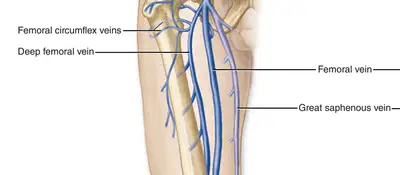
Femoral Artery – Accompanying Vein
Vein: Femoral vein
Relative Position: Femoral artery lies lateral and superficial to the femoral vein
44
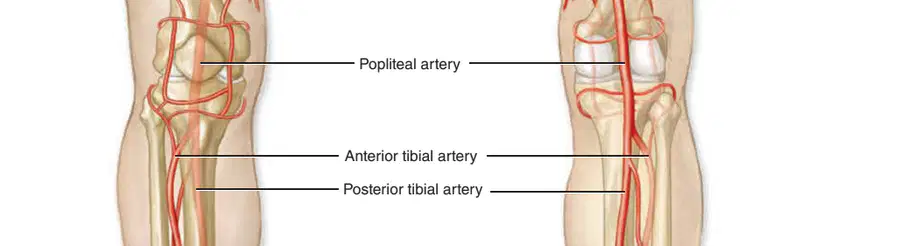
Popliteal Artery
45
Popliteal Artery – Linear Guide
From the center of the superior border of the popliteal space
Parallel to the long axis of the lower extremity
To the center of the inferior border of the popliteal space
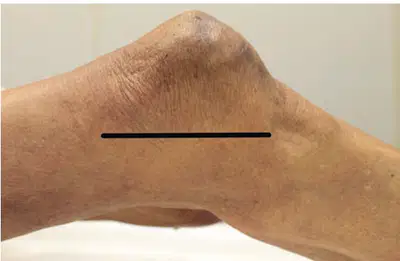
46
Anatomical Limits
Located between the popliteal surface of the femur and the oblique popliteal ligament
Continuation of the femoral artery
Place of Incision
Option 1: Roll the decedent to one side and make an incision down the center of the popliteal space, parallel to the artery
Option 2: Flex the knee slightly and make a longitudinal incision along the posterior-medial aspect of the lower third of the thigh, just superior to the popliteal space
47
Anterior Tibial Artery – Linear Guide
Draw or visualize a line from the lateral border of the patella → anterior surface of the ankle joint
Posterior Tibial Artery – Linear Guide
Draw or visualize a line from the center of the popliteal space → midway between the medial malleolus and calcaneus
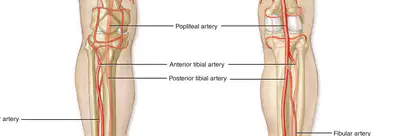
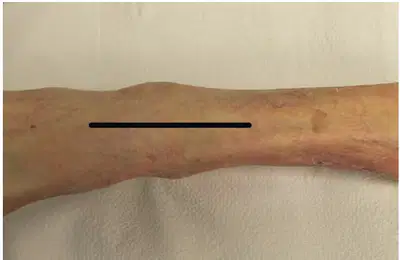
48
Anterior Tibial Artery – Place of Incision
Incision made along the lateral margin of the inferior third of the tibial crest
In the distal leg, the artery lies at the superficial margin of the tibia
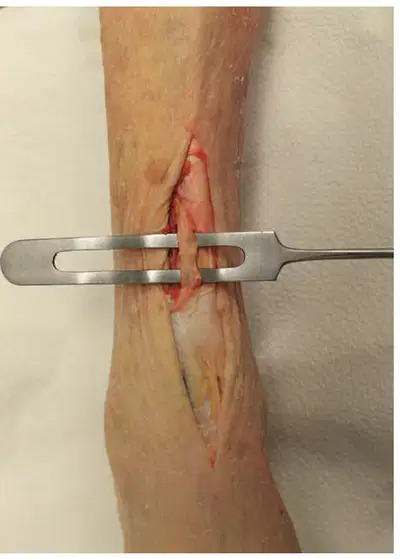
49
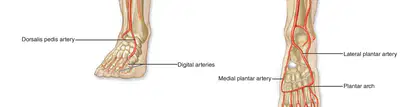
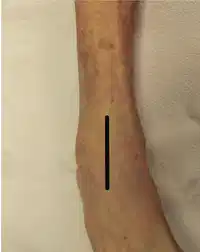
Dorsalis Pedis Artery – Linear Guide
Draw or visualize a line from the center of the anterior surface of the ankle joint → a point between the first and second toes
50
Dorsalis Pedis Artery – Place of Incision
Incision made from a point midway between the medial and lateral malleoli → interosseous space
Note: May require supplemental hypodermic fluid injection
51
Anatomical Considerations, Embalming Vessel Sites and Selections
Week 5:
Show answer
Auto Play
Slide 1 / 51
SLIDE
Similar Resources on Wayground

48 questions
Ch 15 part 2
Presentation
•
University
46 questions
10.7 Comparing Functions
Presentation
•
KG - University
44 questions
Simple Present Lesson
Presentation
•
KG
46 questions
Information Systems Security
Presentation
•
University
46 questions
1. fase I PGYD
Presentation
•
University
43 questions
How to Treat Diabetic Emergencies
Presentation
•
University
42 questions
ANAT2 Exam 2 Review
Presentation
•
University
45 questions
cardiovascular system
Presentation
•
12th Grade
Popular Resources on Wayground
10 questions
Safety Day 2026 – Student Review

Quiz
•
9th Grade
21 questions
Continents and Oceans
Quiz
•
6th Grade
20 questions
Parts of Speech
Quiz
•
5th Grade
16 questions
Subject & Predicate
Quiz
•
5th Grade
25 questions
Multiplication Facts
Quiz
•
5th Grade
12 questions
Map Skills
Quiz
•
3rd Grade
22 questions
Continents and Oceans
Quiz
•
5th Grade
15 questions
Rounding Decimals
Quiz
•
5th Grade
Discover more resources for Science
20 questions
Disney Trivia
Quiz
•
University
10 questions
Spanish Greetings and Goodbyes!
Presentation
•
6th Grade - University
20 questions
Physical or Chemical Change/Phases
Quiz
•
8th Grade - University
39 questions
Unit 7 Key Terms
Quiz
•
11th Grade - University
25 questions
SER and Subject Pronouns
Quiz
•
8th Grade - University
38 questions
Unit 6 Key Terms
Quiz
•
11th Grade - University
19 questions
Key Concepts in Buddhism
Quiz
•
University
0 questions
Cell Domain Basic Review (Biology)
Quiz
•
University