
ATOMIC THEORY TIMELINE

Presentation
•
Chemistry
•
11th Grade
•
Medium
+1
Standards-aligned

Christiana Amadi
Used 9+ times
FREE Resource
40 Slides • 15 Questions
1
Timeline and Scientists

2
Mr. Mendoza

3
Timeline: 1780's
Law of Conservation Mass: mass is neither created nor destroyed in chemical reactions

4
Timeline: 1800s
The first to adapt to Democritus’ theory into the first modern atomic model.

5
1. All matter consists of tiny particles called atoms
2. Atoms are indestructible and unchangeable
3. Elements are characterized by the weight of their atoms
4. When elements react, it is their atoms that have combined to form new compound

6
Open Ended
What are the four essential points of Dalton’s atomic theory?
7
Open Ended
Describe the contribution of Democritus to modern atomic theory.
8
Timeline: 1800's
J.J Thomson was a physicist who is credited for discovering the electron. He used his research on cathode ray tube technology in this discovery.
9
Thomson's prediction what an atom should look likpe.
"Plum, Pudding"

10
Each atom is a sphere filled with positively charged ‘fluid’. This resembles the sticky jam part of a pudding.
Corpuscles (later called electrons), are the negatively charged particles suspended in this ‘fluid’. This resembles the plums in the pudding.
He did not predict the movement of these electrons
11
Multiple Choice
What did Thomson discover?
electron
proton
neutron
electron cloud
12
Multiple Choice
JJ Thomson's theory was nicknamed _______.
Billiard Ball Theory
Solar System Theory
Electron Cloud
Plum Pudding
13
Timeline: 1910's
What do you think he thought about Thomson's Model?
14
was not convinced about the model of the atom proposed by Thomson.
"Gold Foil Experiment"
15
He fired alpha particles (positively charged) at a gold foil.
2. He measured the deflection as the particles came out the other side.
3. Most of the particles did not deflect at all. Every now and then a particle would deflect all the way back.
4. He said that there must be a positive centre of the foil. He called this centre the nucleus.

16
1. The nucleus of the atom is a dense mass of positively charged particles.
2. The electrons orbit the nucleus

17
3. A problem raised was: Why are the negatively charged particles not attracted by the positively charged nucleus
4. Rutherford stated that the atom was like a mini solar system and that the electrons orbited the nucleus in a wide orbit. That is why it is known as the planetary model.

18
Timeline: 1910's
Niels Bohr agreed with the planetary model of the atom...for the most part.
(quantum physics)He was able to perfect Rutherford’s model.
Why the electrons did not collapse into the nucleus?

19
1. Electrons orbit the nucleus in orbits that have a set size and energy.
2. The lower the energy of the electron, the lower the orbit.
3. This means that as electrons fill up the orbitals, they will fill the lower energy level first.

20
4. If that energy level is fill (or at capacity), a new energy level will begin.
5. Radiation is when an electron moves from one level to another.

21
Problem:
Electrons do not travel on a specific orbit or path.

22
Used Heisenberg’s uncertainty principle to come up with the atomic model that we still use today.

23
1. An electron does not travel in an exact orbit
2. We can predict where it will probably be
3. We cannot say for certain where it is, but only where it ought to be.
4. The type of probability orbit is dependent on the energy level described by Bohr

24
The smallest part of an element is called an atom
Each atom (of an element) is different in structure from other atoms (of other elements)
An atom can be divided in smaller subatomic particles: Protons, Electrons and Neutrons
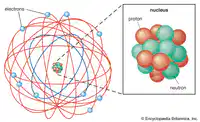
The nucleus is the centre of an atom. It contains protons and neutrons.

25
The smallest part of an element is called an atom
Each atom (of an element) is different in structure from other atoms (of other elements)
An atom can be divided in smaller subatomic particles: Protons, Electrons and Neutrons
The nucleus is the centre of an atom. It contains protons and neutrons.
26
Electrons orbit the nucleus
Electrons occupy a certain energy level (of a certain size)
Once the energy level is full, a new level begins
Within each of these levels are specials types of orbitals. These depend on the energy level
Each orbital can contain up to two electrons

27

28

Atomic Model Through the Years
29

Indivisible
Electron
Nucleus
Orbit
Electron
Cloud
Greek
X
Dalton
X
Thomson
X
Rutherford
X
X
Bohr
X
X
X
Wave
X
X
X
30
Multiple Choice
John Dalton stated:
Atoms are tiny, invisible particles.
Atoms of one element are all the same.
Atoms of different elements are different.
Compounds form by combining atoms.
All of the statements listed.
31
Multiple Choice

32
Multiple Choice

33
Multiple Choice

34
Multiple Choice

35
Multiple Choice
Which subatomic particle has a neutral charge and is found inside the nucleus?
Electrons
Protons
Neutrons
Nucleus
36
Multiple Choice
True or False: Electrons are found in the nucleus.
True
False
37
Multiple Choice
What is the smallest unit of matter that still has the properties of an element?
Atom
Proton
Neutron
Electron
38
Multiple Choice

Which scientist developed this model?
Dalton
Thomson
Rutherford
Bohr
39
Multiple Choice
Which scientist developed this model?
Dalton
Thomson
Rutherford
Bohr
40
Democritus (400 B.C. / Greece)
Known For: naming the atom
Atomos: means uncuttable in Greek
Experiment: Guessed (no scientific data)
Visual Representation
41
Thought that all materials on Earth were not made of atoms, but of the four elements, Earth, Fire, Water, and Air.
His theory held true for the next 2000 years.

42
Open Ended
Why do you think Aristotle's theory of the atom was more accepted than Democritus' theory?
43
John Dalton (1808 / England)
Known For: Atoms were indivisible (cannot be divided)
The Laws
1. Law of Conservation
2. Law of Definite Proportions
3. Law of Multiple Proportions
Visual Representation

44
Summarize in your own words

45
J.J. Thomson (1897 / England)
Known For: electrons were smaller particles of an atom and were negatively charged.
Experiment:
Cathode Ray Tube Experiment
Visual Representation


46
47
Ernest Rutherford (1911 / England)
Known For: Protons (positive charged) and atoms were mostly empty space
Experiment:
Gold Foil Experiment
Visual Representation


48
Alpha particles (a)
are composite particles consisting of two protons and two neutrons tightly bound together
49
50
Niels Bohr (1913 / England)
Known For: Energy levels of electrons
Electrons can jump across energy levels
Experiment:
Emissions Spectrum (color of light)
Visual Representation
"Planetary model"


51
52
Erwin Schrödinger (1926 / Austria)
A.K.A.: Modern Model of the Atom
Known For: Quantum mechanics
electrons can only exist in specified energy states
Experiment:
mathematical equations
Visual Representation
"Electron Cloud model"

53
James Chadwick (1932 / England)
Known For: Discovered neutrons
neutral particles in the nucleus of an atom
Experiment:
mathematical equations (atom was too heavy with just protons)
Visual Representation
"Quantum model"


54
Summary of what is known about the current model of the atom:
Subatomic Particles | Symbol | Relative charge | Relative mass (amu) | Actual mass |
|---|---|---|---|---|
electrons | e | -1 | 1/1840 | 9.11 X 10⁻²⁸ |
protons | p | +1 | 1 | 1.67 X 10⁻²⁴ |
neutrons | o | 0 | 1 | 1.67 X 10⁻²⁴ |
55
Theories
Dalton’s Atomic Theory: Dalton
All matter is composed of atoms.
Atoms of a given element are identical
Today: Not true - there are isotopes
Atoms cannot be divided, created, or destroyed
Technically, no, but there are smaller parts (p, n, and e)
Atoms of different elements combine in simple whole number ratios to form chemical compounds.
In chemical reactions, atoms are separated, rearranged, or combined.
Quantum Theory
1. Atoms are made of smaller particles
2. Atoms of the same element (isotopes) can vary in mass (neutrons)
Timeline and Scientists
Show answer
Auto Play
Slide 1 / 55
SLIDE
Similar Resources on Wayground

52 questions
FIRE HAZARDS
Presentation
•
11th Grade
47 questions
Earth Subsystem
Presentation
•
11th Grade
50 questions
HYBRIDIZATION
Presentation
•
10th Grade
48 questions
Unit 4 Lesson 1 Bohr's Models and Lewis Dot Structures
Presentation
•
10th - 12th Grade
47 questions
Valence electrons
Presentation
•
10th - 12th Grade
48 questions
Structure Of Atom
Presentation
•
11th Grade
47 questions
Chemical Bonding - Chp. 12
Presentation
•
11th Grade
47 questions
Chemistry Chapter 9 Section 2
Presentation
•
11th Grade
Popular Resources on Wayground
10 questions
Safety Day 2026 – Student Review

Quiz
•
9th Grade
21 questions
Continents and Oceans
Quiz
•
6th Grade
20 questions
Parts of Speech
Quiz
•
5th Grade
16 questions
Subject & Predicate
Quiz
•
5th Grade
25 questions
Multiplication Facts
Quiz
•
5th Grade
12 questions
Map Skills
Quiz
•
3rd Grade
22 questions
Continents and Oceans
Quiz
•
5th Grade
15 questions
Rounding Decimals
Quiz
•
5th Grade
Discover more resources for Chemistry
20 questions
electron configurations and orbital notation
Quiz
•
9th - 12th Grade
20 questions
Periodic Table Trends
Quiz
•
11th Grade
50 questions
Unit 3: Atomic Assault Summative Review
Quiz
•
11th Grade
20 questions
Physical or Chemical Change/Phases
Quiz
•
8th Grade - University
15 questions
Periodicity Module Exam Practice Quiz
Quiz
•
9th - 12th Grade
15 questions
Electron Configurations and Orbital Notation
Quiz
•
11th Grade
8 questions
Label Energy Diagram
Quiz
•
9th - 12th Grade
20 questions
Naming Covalent Compounds
Quiz
•
11th Grade