
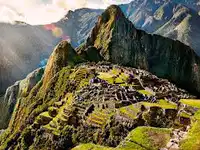
Introduction to Heights of Macchu Picchu

Presentation
•
English
•
12th Grade
•
Practice Problem
•
Easy
+14
Standards-aligned

Maria Baltsas
Used 3+ times
FREE Resource
13 Slides • 13 Questions
1
Time, Place, Space
The Heights of Macchu Picchu

We are learning to understand how time, place, and space shape the themes and global issues in Neruda’s The Heights of Macchu Picchu.
2
Global Influence and Impact of Neruda
Chile (1904–1973) – Born in Parral; his homeland remained the heart of his poetry, rooted in nature, justice, and human connection.
Burma / Myanmar (1927–1929) – Served as consul in Rangoon; exposure to Asian culture and solitude deepened his introspection and poetic voice.
India (1929–1931) – Diplomatic post in Calcutta; inspired by Eastern spirituality and contrasts of wealth and poverty.

3
Global Influence and Impact of Neruda
Spain (1934–1937) – Consul in Madrid during the Spanish Civil War; formed friendships with Lorca and Alberti, strengthening his political and artistic convictions.
Mexico (1938–1951) – Consul in Mexico City; also write "Canto General" here.
Collaborated with Rivera and Kahlo, merging art, activism, and Latin American identity.
France (1951–1952, 1969–1972) – Exiled during Chile’s political repression; later returned as ambassador, symbolizing global recognition and poetic diplomacy.
4
Open Ended
After watching the video, explain the power and ingenuity of the Incas and Macchu Picchu (2-3 sentences)
5
Match
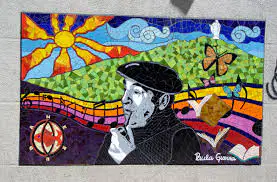
Matching Activity: Neruda’s Global Journey
Chile
Spain
Mexico
France
Burma (Myanmar)
Born here and inspired by nature
involved Civil War against Fascism
Wrote "Canto General" in this country
Exiled; became an ambassador for peace
Discovered Eastern spirituality
Born here and inspired by nature
involved Civil War against Fascism
Wrote "Canto General" in this country
Exiled; became an ambassador for peace
Discovered Eastern spirituality
6
Time: Ancient Civilization
"Canto General" was written in 1945–1949, during Neruda’s political exile and spiritual crisis.
Looks back to the Incan era as a symbol of unity, spirituality, and collective labor.
Reflects 20th-century modern disillusionment with industrial progress and loss of humanity.
Moves cyclically through time...from the poet’s present despair to the eternal past and back to renewal.
Suggests that history is not linear (straight), but a living continuum connecting the dead and the living

7
Time: Ancient Civilization and Surrealism
Surrealism mixes past, present, and future as the poet “travels” through centuries in a dreamlike flow.
Time becomes fluid and cyclical, not historical; the Incan dead coexist with the modern speaker.
The surreal imagery (e.g., “a corpse rose from the earth”) blurs the boundary between living and dead time.
This distortion allows Neruda to transcend chronological history and experience universal, eternal time.
It transforms memory into a visionary experience, where time feels emotional, not measurable.

8
Open Ended
Write a 3-5 sentence response to the following quetsion:
What does surrealism explore or reveal?
9
Surrealism
Definition: Surrealism is a literary and artistic movement that blends dream, imagination, and reality to explore the unconscious mind and reveal deeper emotional or spiritual truths.
Neruda uses dreamlike imagery (e.g., speaking stones, rising corpses, living mountains) to blur the line between the real and the imagined.

10
Surrealism
Surrealism allows the poet to transcend time and space, moving freely between life, death, and rebirth.
Everyday elements of nature — water, stone, wind — are transformed into mystical forces that speak and remember.
Through surreal vision, Neruda awakens the buried voices of the dead, giving mythic and cosmic meaning to human history.
11
Multiple Choice

Which ancient civilization inspired Neruda in The Heights of Macchu Picchu?
Incan civilization
Mayan civilization
Aztec civilization
Greek civilization
12
Multiple Choice
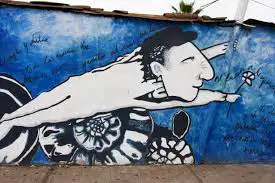
What does Neruda suggest about time in the "The Heights of Macchu Picchu"
Time is a straight, historical line
Time only exists in the past
Time is cyclical and connects the dead and the living
Time ends with modern progress
13
Multiple Choice
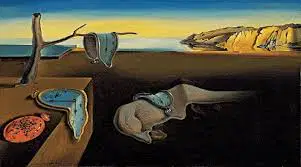
How does Surrealism affect Neruda’s concept of time?
It focuses only on realism and logic
It blends past, present, and future in a dreamlike flow
It removes emotion from time
It separates memory from imagination
14
Multiple Choice
What does Surrealism transform time into?
A. Scientific measurement
B. Historical record
Visionary, emotional experience
Chronological sequence
15
Open Ended
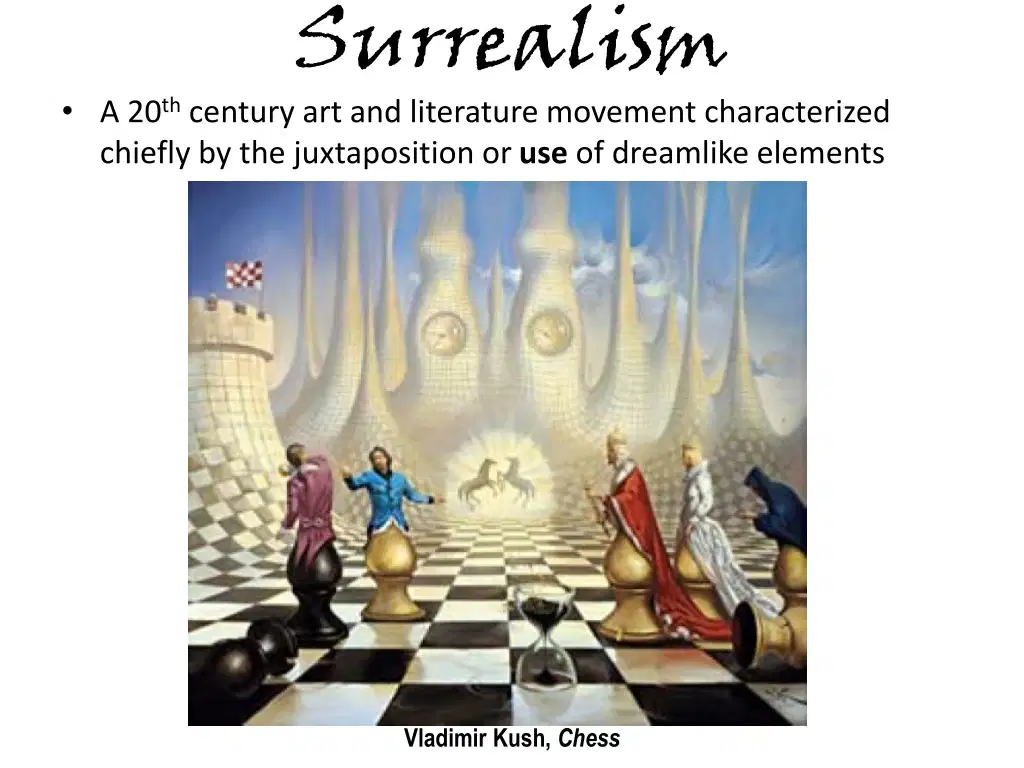
In 3-5 sentences, explain the dreamlike elements in this image. You may use metaphors, similes, juxtaposition...
16
Place:Macchu Picchu
"The Heights of Macchu Picchu" is set in Macchu Picchu, the ancient Incan citadel high in the Andes of Peru.
A place of awe, mystery, and ancestral memory — a bridge between earth and sky.
Represents both physical height (the climb up the mountain) and spiritual elevation.
Contrasts modern civilization’s emptiness with the harmony of the ancient world.
Functions as a sacred site of revelation, where the poet discovers his human and poetic purpose.
17
Place:Macchu Picchu
Machu Picchu becomes a mythic rather than geographic place, existing between dream and reality.
Surrealism transforms the ruins into a living organism — walls breathe, stones speak, mountains remember.
The physical site turns into an inner landscape of the poet’s soul, fusing mind and matter.
It highlights how imagination re-creates place, suggesting that spiritual truth outlasts physical decay.
The mountain becomes both a real summit and a psychological ascent toward enlightenment.
18
Space:Macchu Picchu
Expands from personal isolation to the collective human experience of the oppressed.
Moves between earthly space (mountains, stones, ruins) and metaphysical space (memory, soul, spirit).
Suggests that space holds the echoes of history — the dead still “speak” through the ruins.
Uses vertical imagery (ascent, descent) to symbolize spiritual awakening and connection to ancestors.
Blurs boundaries between nature, history, and humanity, creating a unified cosmic space.
19
Space:Macchu Picchu
Surrealism dissolves boundaries between earth, sky, body, and spirit — creating a cosmic space.
The poet moves through dreamlike dimensions, where natural and supernatural coexist.
Space becomes elastic and symbolic, representing the vast interior world of human consciousness.
The ruins open a gateway between worlds — human and divine, mortal and eternal.
Surreal space allows the poet to reconnect with humanity’s collective soul, beyond p
20
Multiple Choice

How does Surrealism transform Machu Picchu?
It turns it into a battlefield
It confines it to a single time period
It erases its historical importance
It becomes a living organism — walls breathe, stones speak
21
Multiple Choice

What does the poet’s climb up the mountain represent?
A spiritual and psychological ascent toward enlightenment
An escape from society
A physical competition
A dream without meaning
22
Multiple Choice

Why is the setting of Macchu Picchu significant in Pablo Neruda’s poem "The Heights of Macchu Picchu"?
It is located in the middle of a bustling city, reflecting modern civilization.
The city is primarily depicted as an industrial hub with no relation to nature.
It is used to highlight the technological advancements of modern Peru.
The ruins represent the grandeur of the Incan civilization and a spiritual connection to the earth.
23
Multiple Choice
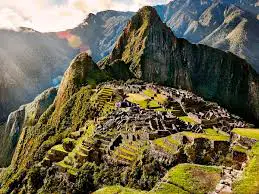
How does Pablo Neruda’s poem describe the natural landscape surrounding Macchu Picchu?
The poem emphasizes only the human-made structures, ignoring the natural environment.
Neruda focuses on the urban development near Macchu Picchu and its modern infrastructure.
The surrounding Andes Mountains are described as a rugged, surreal landscape that adds to the isolation and majesty of the ruins.
The natural landscape is portrayed as insignificant compared to the ruins.
24
Themes
Rebirth – Renewal through spiritual awakening
Memory – Remembering the forgotten dead
Nature – Harmony between earth and man
Time – Past and present intertwined
Transcendence – Rising beyond earthly limits
Isolation – Loneliness before connection found
Labor – Honoring hands that built
Identity – Discovering self through ancestry
25
Global Issues
Exploitation – Injustice toward indigenous laborers
Injustice- unequal treatment and suffering of marginalized people, especially the indigenous and the poor, whose labor and lives are overlooked by those in power.
Colonialism – Conquest destroying native civilizations
Cultural Erasure – Loss of ancestral heritage
Power & Oppression – Voice of the silenced masses
26
Open Ended

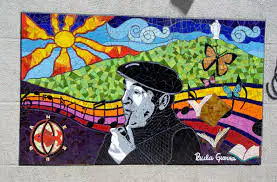
This mural, painted by Diego Rivera, celebrates the history, labor, and spirit of Latin America—much like Neruda’s poetry. Both artists explore how the land, people, and past are interconnected.
What do you notice about the relationship between humans and nature in this artwork? (3-5 sentences)
Time, Place, Space
The Heights of Macchu Picchu
We are learning to understand how time, place, and space shape the themes and global issues in Neruda’s The Heights of Macchu Picchu.
Show answer
Auto Play
Slide 1 / 26
SLIDE
Similar Resources on Wayground

20 questions
SUBJECT/OBJECT QUESTIONS
Presentation
•
University
20 questions
Adverbial clause
Presentation
•
12th Grade
20 questions
ENG301 Reading-Y/N/NG & T/F/NG
Presentation
•
12th Grade
21 questions
Passive Voice
Presentation
•
11th Grade
19 questions
Dangling and misplaced modifiers
Presentation
•
University
19 questions
Future – Will and Going to
Presentation
•
University
20 questions
Get Smart Plus 3 Topic 8 was/were
Presentation
•
1st - 4th Grade
20 questions
like/love/hate + ing
Presentation
•
12th Grade
Popular Resources on Wayground
20 questions
Math Review

Quiz
•
3rd Grade
15 questions
Fast food
Quiz
•
7th Grade
20 questions
Context Clues
Quiz
•
6th Grade
20 questions
Inferences
Quiz
•
4th Grade
19 questions
Classifying Quadrilaterals
Quiz
•
3rd Grade
20 questions
Figurative Language Review
Quiz
•
6th Grade
20 questions
Equivalent Fractions
Quiz
•
3rd Grade
10 questions
Identify Fractions, Mixed Numbers & Improper Fractions
Quiz
•
3rd - 4th Grade
Discover more resources for English
30 questions
K/H Final Review Part 1
Quiz
•
9th - 12th Grade
22 questions
Revise and Edit Final Review 3
Quiz
•
8th - 12th Grade
50 questions
Romeo and Juliet Prologue & Acts 1-5 Test

Flashcard
•
9th - 12th Grade
15 questions
After Twenty Years
Quiz
•
KG - University
50 questions
Romeo and Juliet Prologue & Acts 1-5 Test
Quiz
•
9th - 12th Grade
8 questions
G2U6W1 - The Golden Flower: A Taino Myth from Puerto Rico
Quiz
•
2nd Grade - University
40 questions
Of Mice & Men Major Test Ch. 1-6
Quiz
•
9th - 12th Grade
10 questions
Fix the sentence/Grammar
Quiz
•
KG - University