

Membrane Transport

Presentation
•
Biology
•
8th Grade
•
Practice Problem
•
Easy
Standards-aligned

JEREMY ROHRBACH
Used 6+ times
FREE Resource
17 Slides • 4 Questions
1

Unit 2, Lesson 2
Exploration 4
Membrane Transport
How does the cell membrane work to maintain
homeostasis?
2

The Cell Membrane:
Bilipid layer with cholesterol embedded
and protein channels of specific sizes and shapes to transport nutrients and waste.
On your note packet, draw a section of a cell membrane
Collaborate with your partner.
3
4
Draw
Draw a cell membrane
5
Multiple Choice
Marinating stable internal conditions is called ?
Lipids
Eukaryote
Homeostasis
polarity
6


Cell Membrane Structure
●Phospholipid bilayer
○Hydrophilic heads
○Hydrophobic tails
●Carbohydrates- ID tags, adhere cell to other cells
●Proteins- transport materials, act as enzymes to speed up reactions, or receptors
●Cholesterol- strength,
temperature regulation
●Selectively permeable- it allows
some but not all materials to
cross
○Maintains cell’s homeostasis
7

Passive Transport
●Movement of materials across membrane sometimes requires energy and sometimes it does not.
●Passive transport: the movement of molecules into or out of cells without using energy
●Diffusion: movement of
molecules from area of higher concentration (more molecules) to area of lower concentration (less molecules)
●Facilitated diffusion: molecules move through a channel protein in membrane
○Uses small charged ions
8
Multiple Choice

What is diffusion?
Moving from low to high concentration w/out using energy
Moving from low to high concentration using energy
Moving from high to low concentration w/out using energy
Moving from high to low concentration using energy
9

Osmosis
●The movement of water across membrane from higher water concentration to lower water concentration
○Water also moves from area
of lower solute concentration
to higher solute concentration
Higher concentration of solutes= lower concentration of water
10

Diffusion
BOTH
Facilitated
Diffusion
11


Osmosis in extreme situations:
Why do dehydrated
patients receive normal saline
solution rather than
pure water?
What might happen
to blood cells placed
in pure water?
12


Active transport
requires energy from ATP to cause the protein channel to an area of lower concentration to an area of higher concentration
(HIGH TO LOW)
13
Categorize
No energy used
Nutrients diffuse through the lipids (O2, CO2) or through protein channels
Nutrients only move from high concentration to low
Types: Diffusion, Facilitated Diffusion, Osmosis (water only)
Needs energy (ATP)
Nutrients move through protein transport channels
Nutrients can be moved from low concentration to high concentration
Match the statements to Active or Passive Transport
14

Compare Passive v. Active Transport
Passive Transport
Active Transport
●No energy used
●Nutrients diffuse through the lipids
(O2, CO2) or through protein
channels (facilitated diffusion)
●Nutrients only move from high
concentration to low, down the
concentration gradient
●Types: Diffusion, Facilitated
Diffusion, Osmosis (water only)
●Needs energy (ATP)
●Nutrients move through protein transport channels
●Nutrients can be moved from low
concentration to high concentration (against or up the concentration gradient)
15


16


Endocytosis (within)
and exocytosis
(outside) move
substances across
membrane using
A
T
P
17

What happens when a person’s blood sugar is extremely high?
(How does a high glucose environment affect the cells?)
18
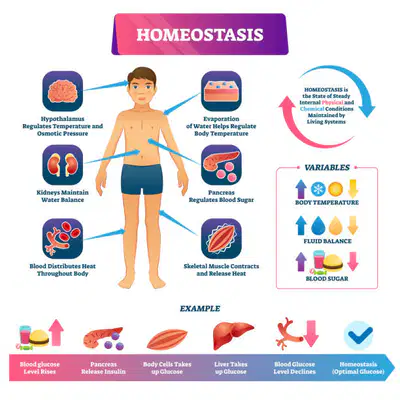
Membrane transport is the movement of substances across a cell membrane. It plays a crucial role in maintaining homeostasis, which is the state of internal stability that organisms maintain.
How does Membrane Transport help with homeostasis?
19
How does Membrane Transport help with homeostasis?
1. Nutrient Uptake:
Selective permeability: Cell membranes are selectively permeable, allowing only certain substances to pass through.
Facilitated diffusion: Nutrients like glucose and amino acids are transported into cells against their concentration gradient using facilitated diffusion, requiring proteins like channel proteins or carrier proteins.
Active transport: For nutrients that need to be transported against their concentration gradient, active transport is used. This process requires energy (ATP) to move substances from a region of lower concentration to a region of higher concentration.
20
How does Membrane Transport help with homeostasis?
Waste Removal:
Exocytosis: Waste products, such as carbon dioxide and cellular debris, are packaged into vesicles within the cell and then expelled outside the cell through exocytosis.
Diffusion: Some waste products, like carbon dioxide, can diffuse directly across the cell membrane.
21
How does Membrane Transport help with homeostasis?
Osmotic Balance:
Osmosis: The movement of water across a membrane in response to differences in solute concentration.
Osmoregulation: Membrane transport mechanisms help regulate the movement of water and solutes to maintain the proper osmotic balance within cells and the extracellular environment.
In summary, membrane transport processes ensure that cells receive the necessary nutrients, eliminate waste products, maintain proper ion concentrations, participate in cell signaling, and regulate osmotic balance, all of which are essential for maintaining homeostasis.
Unit 2, Lesson 2
Exploration 4
Membrane Transport
How does the cell membrane work to maintain
homeostasis?
Show answer
Auto Play
Slide 1 / 21
SLIDE
Similar Resources on Wayground

20 questions
G9 Chap 2.2 - Flow of Energy in an Ecosystem
Presentation
•
9th Grade
20 questions
13.1 Identifying the Substance of the Gene
Presentation
•
9th Grade
20 questions
6E: Mutations
Presentation
•
9th Grade
17 questions
G9 Chap 9.1 Cellular Growth
Presentation
•
9th Grade
16 questions
Body Systems Review 2
Presentation
•
7th Grade
15 questions
Circulatory and Respiratory Systems - Gas Exchange
Presentation
•
9th Grade
16 questions
A) Characteristics of Life--- QUIZIZZ
Presentation
•
7th Grade
19 questions
Karyotypes
Presentation
•
9th Grade
Popular Resources on Wayground
24 questions
PBIS-HGMS Day 10

Quiz
•
6th - 8th Grade
10 questions
HCS SCI 03 Summer School Review 3
Quiz
•
3rd Grade
11 questions
Home Scope
Quiz
•
7th - 8th Grade
15 questions
HCS SCI 05 Summer School Assessment 3 Review
Quiz
•
5th Grade
35 questions
Lufkin Road Middle School Student Handbook & Policies Assessment
Quiz
•
7th Grade
18 questions
Geo 11.3 Area of Circles and Sectors
Quiz
•
9th - 11th Grade