

Reading Benchmark Review

Presentation
•
English
•
7th Grade
•
Easy
+28
Standards-aligned

Mariah Trejo
Used 5+ times
FREE Resource
20 Slides • 21 Questions
1

Elements of Literature Review
2
Text Structure
Used to organize information
Description
Compare / Contrast
Sequence of Events / Chronological
Cause / Effect
Problem / Solution
3
Multiple Choice
- for example
- is like
- including
4
Multiple Choice
-first
-now
-later
-(actual dates)
5
Multiple Choice
-if/ then
-therefore
-becasue
6
Multiple Choice
-both
-alike
-different
-yet
7
Text Features
Informational/Nonfiction

8
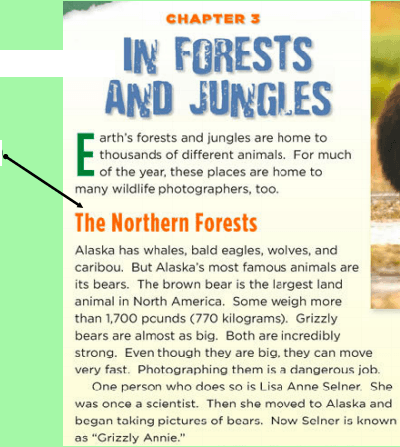
Subheading
A subheading is a smaller title that breaks up headings into even smaller categories

9
Multiple Choice
10
Caption
Words that are usually next to or below an image, graph, or chart and describes it
Gives the reader important information about the image or chart

11
Multiple Choice
This feature explains what the illustration/photograph is. It tells you what you see in the picture.
Glossary
Index
Table of contents
Caption
12
Chart/Table
A chart or table is an organized way to show information using rows and columns

13
Multiple Choice
illustrates specific points or presents information from the text in a visual way (boxes, etc)
glossary
charts or graphs
title
heading
14
PLOT: A series of events that make up a story

15
Most Plots have 5 Stages:
1. EXPOSITION: Is the first stage of plot-- the author provides important background information and introduces the setting, characters, and conflict.
16
Multiple Choice
What is the exposition of a story's plot?
the most exciting part
when problems are solved
the beginning; characters & setting are introduced
the problem that starts the story's action
17
2. RISING ACTION: is the 2nd stage of plot. In this stage, events occur that make the story’s conflict more complicated. These events develop and intensify a story’s conflict
18
Multiple Choice
19
3. CLIMAX: is the 3rd stage of plot. This is the story’s most exciting part and a turning point for the main character.
20
Multiple Choice

21
4. FALLING ACTION: is the 4th stage of plot. This is where the tension is eased and events start to unfold as a result of the climax.
22
Multiple Choice
After the climax, when problems are starting to be wrapped up...
falling action
rising action
climax
exposition
23
5. RESOLUTION: is the 5th and last stage of plot. It reveals how the story’s problem or conflict gets solved.
24
Multiple Choice
The ending when the major conflict has been wrapped up and the reader understands the theme...
falling action
rising action
climax
resolution
25
Multiple Choice
An inciting incident in literature is the event that sets the story in motion.
True
False
26
Figurative Language
27
Simile
compares to things that are unalike using like or as
EX: They were as happy as a dog camping

28
Fill in the Blanks
29
Alliteration
the repetition of usually initial consonant sounds in two or more neighboring words or syllables
EX: Sally sold sea shells by the sea shore
30
Multiple Choice
Which one is NOT an example of alliteration? (Just for fun, try saying each one 5 times fast. Can you do it?)
Black bug's blood
Rubber baby buggy bumpers
Toy boat
31
Onomatopoeia
naming a thing or an action by imitating the sound associated with it

32
Multiple Choice
Which of these is an example of onomatopoeia?
bark
fire
boom
33
Personification
giving an inanimate object human qualities
EX: The stars danced in the sky

34
Multiple Select

Which ones are examples of personification?
See the line where the sky meets the sea? It calls me
And no one knows, how far it goes
If the wind in my sail on the sea stays behind me
One day I’ll know, if I go there’s just no telling how far I’ll go
35
Multiple Choice
"I ain't the sharpest tool in the shed."
Simile
Metaphor
36
Multiple Choice
"And I think to myself
What a wonderful world"
Alliteration
Hyperbole
37
ECR Review
38
QUESTION PROMPT

Questions to ponder:
1. What needs to be read?
2. What do we need to explain?
3. What must be remembered while writing the response?
39
WRITING THE INTRODUCTION AND THESIS STATEMENT
When you write an introduction, you need to start with:
a hook that grabs readers attention. It could be a form of question, or a bold statement,
and a thesis statement that states your main argument or point.
40
Multiple Choice
The most important sentence in your introduction is the thesis statement that gives the topic + R1 and R2
True
False
41
Multiple Choice
Tomorrow is your Reading Benchmark.
True
False
Elements of Literature Review
Show answer
Auto Play
Slide 1 / 41
SLIDE
Similar Resources on Wayground

37 questions
The verb "to be" in present tense
Presentation
•
7th Grade
33 questions
Jobs
Presentation
•
6th Grade
37 questions
Grade 7 unit 6 lesson 1
Presentation
•
7th Grade
36 questions
Biotic and Abiotic Factors
Presentation
•
7th Grade
34 questions
Simple Tenses
Presentation
•
7th Grade
37 questions
Ohm's Law
Presentation
•
7th Grade
36 questions
The Flight of Icarus
Presentation
•
7th Grade
39 questions
Research Vocabulary
Presentation
•
7th Grade
Popular Resources on Wayground
6 questions
Secondary Safety Quiz
Presentation
•
9th - 12th Grade
10 questions
MyPath Diagnostic Overview
Presentation
•
6th - 8th Grade
20 questions
Lab Safety Quiz

Quiz
•
6th Grade
21 questions
Continents and Oceans
Quiz
•
6th Grade
20 questions
Adding and Subtracting Decimals
Quiz
•
5th Grade
20 questions
Parts of Speech
Quiz
•
5th Grade
16 questions
Subject & Predicate
Quiz
•
5th Grade
21 questions
Lab Safety
Quiz
•
10th Grade
Discover more resources for English
10 questions
MyPath Diagnostic Overview
Presentation
•
6th - 8th Grade
13 questions
Parts of Speech
Quiz
•
7th Grade
18 questions
ADJECTIVES and ADVERBS
Presentation
•
5th - 7th Grade
10 questions
Differentiating Primary and Secondary Sources in History

Interactive video
•
6th - 10th Grade
25 questions
Making Inferences
Quiz
•
6th - 8th Grade
15 questions
Complete Subject and Predicate Quiz
Quiz
•
4th - 8th Grade
11 questions
Figurative Language
Presentation
•
5th - 7th Grade
17 questions
Figurative Language
Quiz
•
7th Grade