

Adjuncts - Disassociative + Inhalants

Presentation
•
Instructional Technology
•
University
•
Easy

Katharine Rusk
Used 4+ times
FREE Resource
55 Slides • 16 Questions
1

2

3

4

5

Review!
6
Multiple Choice
What is "wind-up" pain?
Pain that occurs only in the joints of the hip, shoulder, knee, and elbow.
Pain that intensifies with repeated stimulation of the nervous system.
A psychological condition unrelated to nerve stimulation.
7

8
9
Review!
10
Multiple Choice
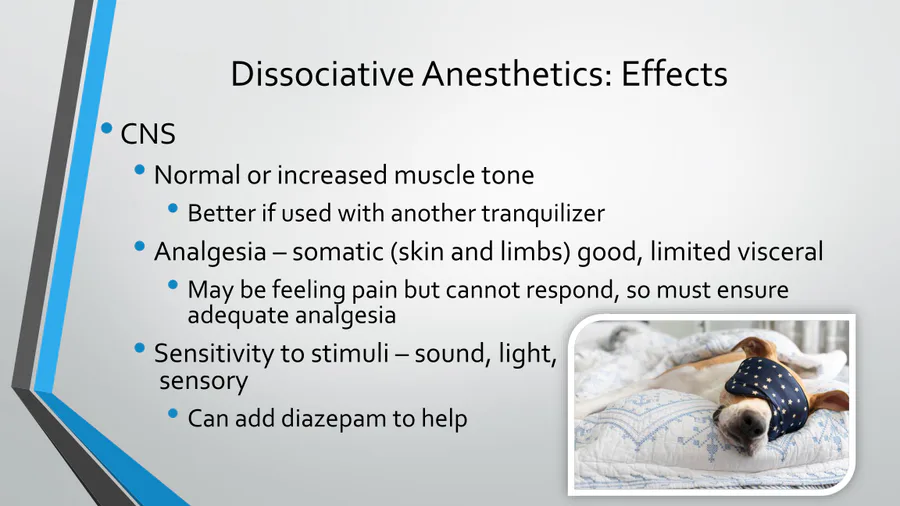
Do dissociative anesthetics provide good pain control?
They are only used for sedation, not pain control
No, they do not affect pain perception.
Yes, good for somatic, but limited for visceral.
11
Open Ended
What are our patient's eyes like on Ketamine?
What do we need to do?
12

13

14

15

16
Review!
17
Open Ended
What is one Adverse effect of dissociative anesthetics?
18

19

20
Review!
21
Multiple Choice
What is the reversal agent for Ketamine?
Naloxone
Flumazenil
There is no specific reversal agent for Ketamine.
Atropine is used to counteract Ketamine effects.
22
Multiple Choice
Why might Ketamine be a poor choice for an animal with a history of seizures?
It can produce seizure-like activity on recovery.
Ketamine is a common treatment for seizures.
It actually helps prevent seizures.
23

24

25

26

27

28

29

30
Review?
31
Multiple Choice
Which of the following is the vaporizer on an anesthetic machine?
32

33
Knowledge Check!
34
Multiple Choice
What does "equilibrium" mean?
A state in which opposing forces or influences are balanced.
A form of artistic expression in dance and painting.
35

36

37

38
Review
39
Multiple Choice
Which of those anesthetic gases have a higher vapor pressure?
Isoflurane - concentration 30% at 20°C
Methoxyflurane -concentration 4% at 20°C
40
Multiple Choice
What would happen to a person if the contents of a bottle of isoflurane were spilled in an enclosed room?
The person would experience a mild headache and fatigue, as well as sneezing/coughing.
The person would feel energized and alert with an increased appetite and improved mood.
The person could experience respiratory depression, loss of consciousness, and potentially fatal outcomes.
41
Blood/Gas Partition Coefficient - Page 88
Defines the solubility of a gas in blood and the rate of induction and recovery.
It compares the amount of drug in 1 mL of blood to the amount of drug in 1 mL of alveolar gas.
The lower the blood solubility the more rapid induction and recovery.
42

43
🧪 Understanding the Blood-Gas Partition Coefficient: A Sponge vs. Balloon Analogy
Imagine you’re filling two containers with water:
One is a sponge.
The other is a balloon.
When you pour water into the sponge, it absorbs a lot and holds onto it. It takes time to saturate and even longer to dry out.
When you pour water into the balloon, it fills quickly and releases water easily when squeezed.


44
🧪 Understanding the Blood-Gas Partition Coefficient: A Sponge vs. Balloon Analogy
Now, think of the sponge as an anesthetic with a high blood-gas partition coefficient — like methoxyflurane. It dissolves well in blood, so it takes longer to build up enough in the brain to cause anesthesia, and longer to leave the body during recovery.
The balloon represents a low blood-gas partition coefficient — like sevoflurane. It doesn’t dissolve much in blood, so it quickly moves from the lungs to the brain and back again, leading to fast induction and recovery.
45
Key Takeaways:
High coefficient (sponge) = slow in, slow out (longer onset and recovery). The higher the number, the slower the recovery
Low coefficient (balloon) = fast in, fast out (quick anesthesia and recovery). The lower the number, the faster the recovery
It’s all about how much the anesthetic “likes” to stay in the blood vs. moving into the lungs or brain.
46
Review
47
Multiple Choice
Looking at the blood/gas partition coefficient of the following inhalant drugs, which would have a more rapid induction and recovery?
Isoflurane
Blood/Gas Partition Coefficient: 1.4
Halothane
Blood/Gas Partition Coefficient: 2.4
Desflurane
Blood/Gas Partition Coefficient: 0.42
Sevoflurane
Blood/Gas Partition Coefficient: 0.65
48

49

50
Review
51
Multiple Choice
How would we define "Minimum Alveolar Concentration" ?
Highest concentration of an anesthetic where 50% of patients respond to a painful stimulus.
Lowest concentration of an anesthetic where 50% of patients show no response to a painful stimulus.
52

53
Review
54
Multiple Choice
Which tissues in the body get the most blood supply?
55

56

57

58

59
Review
60
Multiple Choice
What effect would increasing the percentage of Isoflurane delivered have on our patient's blood pressue?
No effect on the patient's blood pressure.
Decrease the patient's blood pressure.
Increase the patient's blood pressure.
Stabilize the patient's blood pressure.
61

62

63

64
Review
65
Categorize
Safe for epileptic patients
Not tested on animals
High in sugar content
Can cause hypothermia
Requires significant metabolism in the liver
Can cause hypotension
Dangerous increase in intracradian pressure in head trauma patients
Recommended for head trauma patients
Can be given IV
Requires precision vaporizer
High blood/gas partition coefficient (2.47)
Most patients can be maintained at 1.5-2.5%
Fewest adverse cardiac effects of available inhalants
Not recommended for neonates or geriatric patients
No analgesic effect
Low blood/gas partition coefficient (1.46)
Evaporates quickly at room temperature
Remains a liquid at room temperature
Categorize the following as True or False for Isoflurane
66
67

68

69

70
Review
71
Categorize
Fewest adverse cardiac effects of available inhalants
More likely to see arrhythmias
Malignant hyperthermia
Replaced by Isoflurane
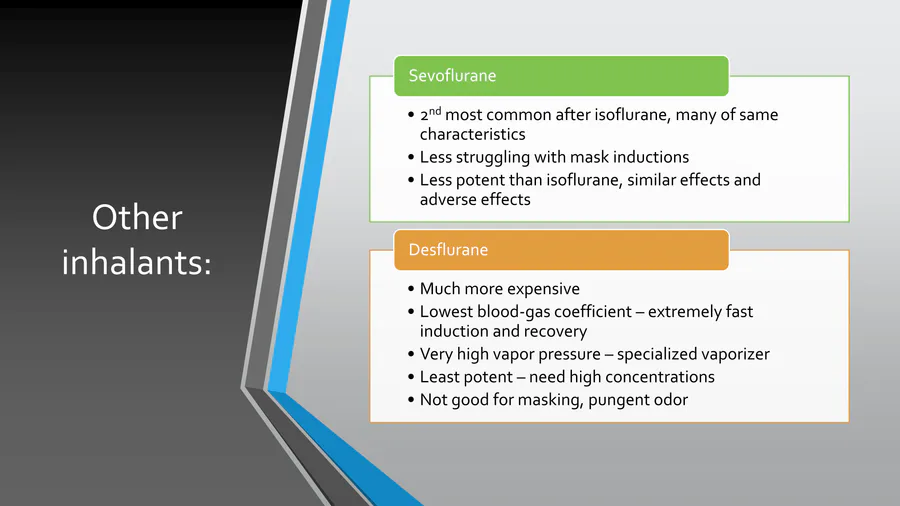
Expensive!
Lowest blood/gas coefficient - extremely fast induction and recovery.
Pungent! Not good for masking.
2nd most common inhalant after isoflurane.
What we use here at Oulton College
Good muscle relaxation
Metabolized by liver and kidneys, more storage in fat
Categorize the facts according to the veterinary inhalants listed below.
Not all categories will have equal number of points!
Show answer
Auto Play
Slide 1 / 71
SLIDE
Similar Resources on Wayground

64 questions
Unit 4 (Reading and Writing )
Presentation
•
University
64 questions
mobile lesson
Presentation
•
University
64 questions
Préposition
Presentation
•
University
64 questions
Copy of G3_U7_L1_22-23
Presentation
•
KG - Professional Dev...
65 questions
Membrane transport
Presentation
•
University
66 questions
CE 123 Kejahatan Siber dan Informasi
Presentation
•
University
65 questions
Exposure and Vulnerability (Cycles 2 and 3)
Presentation
•
12th Grade
67 questions
GECC103-1D-REINFORCEMENT-UNIT2-LESSON4-LOGIC AND ITS FORMALITY
Presentation
•
University
Popular Resources on Wayground
10 questions
HCS SCI 03 Summer School Assessment 1

Quiz
•
3rd Grade
15 questions
HCS SCI 05 Summer School Assessment 1 Review
Quiz
•
5th Grade
22 questions
Day 9 Equations and Inequalities Review
Quiz
•
9th Grade
10 questions
Writing and Identifying Ratios Practice
Quiz
•
5th - 6th Grade
7 questions
PYRAMID PERSPECTIVES part 1
Presentation
•
9th - 12th Grade
12 questions
Understanding the Fourth of July
Quiz
•
9th Grade
15 questions
Soccer World Cup Quiz Questions
Quiz
•
7th Grade