
Electricity and Magnetism Day 3

Presentation
•
Science
•
7th Grade
•
Practice Problem
•
Medium
+3
Standards-aligned

Boaz Rottet
Used 4+ times
FREE Resource
13 Slides • 3 Questions
1

Today we will focus on building parallel circuits and understanding the benefits of having parallel circuits in a house!
2
Gather these materials from your electricity and magnetism kit.

3
Yesterday we built a series circuit with two loads. Here is an image of what we did yesterday.

4
To start off today. Create this circuit.

What do you notice about the brightness of the lights?
Keep this circuit as we will reference it later in class!
5
Parallel Circuits
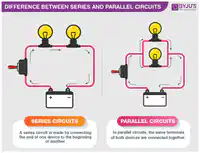
In a previous lesson, you learned about series circuits, which carry electric current in a single path. A parallel circuit carries electric current along two or more paths.


6

In a parallel circuit, each path receives the full amount of electrical current the power source can produce. Move on to the next slide to convert a series circuit to a parallel circuit with two loads.
7
Parallel Circuit with Two Loads
Now you will convert the series circuit you built at the beginning of the lesson to a parallel circuit. You will create a circuit with two paths. One light will be on each path. Follow the instructions in the video below to convert your circuit to a parallel circuit.
Let's check out this video!
8
Multiple Choice
Which of the following statements best describes how the bulb brightness differs between a series circuit and a parallel circuit, each with two lights?
Both bulbs in the parallel circuit are dimmer than the bulbs in the series circuit.
Both bulbs in the parallel circuit are brighter than the bulbs in the series circuit.
9


The bulbs in the parallel circuit remained brighter because each path of the circuit receives the full voltage of the battery. In a series circuit, the bulbs have to share the voltage, producing two dimmer bulbs.
10

On the next slide, we will be using the symbols in the bottom right of this slide to complete a circuit diagram of the parallel circuit that we created.
11
Draw
Draw a circuit diagram of the above parallel circuit using the key below.
12
Parallel Circuit with Two Loads and a Switch
Now, you will create a parallel circuit that includes a switch that will control which path the electric current flows through. Modify the parallel circuit you built on the previous page to match the circuit shown here.

Note that the location of the switch allows you to choose one path or the other for electric current to flow around. In this configuration, both lights cannot turn on at the same time. You could change this feature by moving the switch to a different location in the circuit. Continue on to build a parallel circuit that offers different options.
13
Multiple Choice

Which of the circuit diagrams best represents the circuit you just built?
14
Parallel Circuit with One Load and Two Switches
Now, build a parallel circuit that contains one light and two switches. Arrange the components so that each switch is on a separate path. Use the circuit diagram shown here as a model.
I will have a picture of the completed circuit on the next slide.

15


Your circuit should have looked like this!
Experiment with moving the switches into different combinations of toggle positions. Which arrangements turn the light on? Which arrangements turn the light off? Record your observations in the table in Electrical Circuits Day 3 Notes.

Today we will focus on building parallel circuits and understanding the benefits of having parallel circuits in a house!
Show answer
Auto Play
Slide 1 / 16
SLIDE
Similar Resources on Wayground

13 questions
ALL ABOUT ME
Presentation
•
7th Grade
9 questions
soil
Presentation
•
7th Grade
14 questions
Circulatory and Respiratory Systems
Presentation
•
7th Grade
13 questions
Speed v. Velocity
Presentation
•
8th Grade
11 questions
Photosynthesis
Presentation
•
7th Grade
11 questions
Dichotomous Keys & Taxonomy
Presentation
•
7th Grade
10 questions
7.8C Impact of Human Activity on Watersheds
Presentation
•
7th Grade
12 questions
Skeletomuscular System
Presentation
•
7th Grade
Popular Resources on Wayground
21 questions
Continents and Oceans

Quiz
•
6th Grade
20 questions
Parts of Speech
Quiz
•
5th Grade
16 questions
Subject & Predicate
Quiz
•
5th Grade
25 questions
Multiplication Facts
Quiz
•
5th Grade
12 questions
Map Skills
Quiz
•
3rd Grade
22 questions
Continents and Oceans
Quiz
•
5th Grade
15 questions
Rounding Decimals
Quiz
•
5th Grade
20 questions
Brand Labels
Quiz
•
5th - 12th Grade
Discover more resources for Science
17 questions
7.6D Aqueous Solutions
Quiz
•
7th Grade
20 questions
Claim, Evidence and Reasoning (CER)
Quiz
•
6th - 8th Grade
10 questions
Exploring Chemical and Physical Changes

Interactive video
•
6th - 10th Grade
16 questions
Photosynthesis and Cellular Respiration Review
Quiz
•
7th Grade
20 questions
Food Webs + Energy Pyramids
Quiz
•
7th Grade
24 questions
Cell Organelles
Quiz
•
7th Grade
20 questions
Human Body Systems
Quiz
•
7th Grade
10 questions
Exploring the Periodic Table
Interactive video
•
6th - 10th Grade