

To Crusades to New Muslim Empire

Presentation
•
History
•
7th Grade
•
Practice Problem
•
Medium

Josefine Pettit
Used 44+ times
FREE Resource
8 Slides • 7 Questions
1
From the Crusades to the New Muslim Empires
How did the Crusades affect the lives of Christians, Muslims, and Jews?
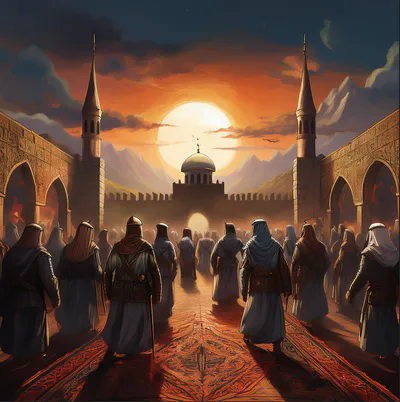
2
What religions are represented in the different quarters?
What important landmarks do you see? With which religion is each affiliated?
What do you think makes this an important or special city?
Why might people fight over this city?

Discussion with partner
3
This is a modern-day map of the historical part of Jerusalem known as “the Old City.”
Today, Jerusalem is located in the nation of Israel in the Middle East. Historically, Jerusalem has been fought over by followers of the Christian, Muslim, and Jewish faiths because of its historical and religious significance to each group.
During the 7th century, Jerusalem became part of the expanding Muslim empire.For centuries, Jews and Christians were still allowed to live there and practice their faiths.
However, growing tension between Muslims and Christians in the 11th century led Christian Crusaders to attempt to seize control of the Holy Land, including Jerusalem.

4
Match
Match the Vocab
Crusades
Anti-Semitism
Holy Land
Segregation
a series of religious and political wars
hostility or discrimination against Jews
the region of the Middle East significant to multiple religions
the forced separation of one group from
a series of religious and political wars
hostility or discrimination against Jews
the region of the Middle East significant to multiple religions
the forced separation of one group from
5
The Crusades & The Reconquista: Key Events and Impacts
First Crusade (1095-1099)
Pope Urban II’s Call: Goal to reclaim Jerusalem from Muslim control.
Motivations: Religious devotion, forgiveness of sins, adventure, wealth.
Outcome: Jerusalem captured; four Crusader kingdoms established.
Second Crusade (1146-1148)
Triggered by Edessa's fall (1144), led by European monarchs.
Outcome: Failed to reclaim Edessa.
Third Crusade (1189-1192)
Sparked by the loss of Jerusalem (1187) to Salah al-Din.
Key Leader: King Richard I "the Lionheart."
Outcome: Crusaders retained coastal cities; pilgrimage access to Jerusalem allowed; peace treaty (1192).


6
The Crusades & The Reconquista: Key Events and Impacts
Impact of the Crusades
Cultural Exchange: Between Europe and the Middle East.
European Changes: Weakening of feudalism, rise of Italian maritime states, stronger monarchies.
Negative Effects: High casualties, property destruction, increased religious tensions.
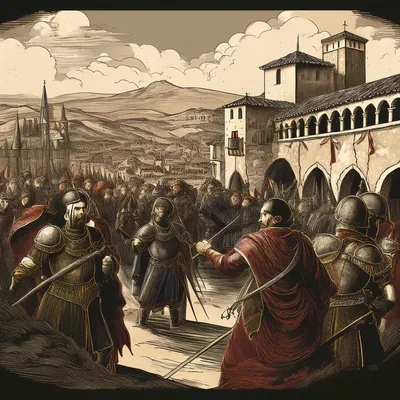
The Reconquista (c. 1085-1492)
Goal: Christian kingdoms reclaim Iberia from Muslim rule.
Key Events: Capture of Toledo (1085), Portugal’s independence (1139), fall of Granada (1492).
Consequences: Expulsion of Jews (1492), forced conversion/expulsion of Muslims (1609), end of religious coexistence in Spain.
7
Audio Response
How were Muslims, Christians and Jews affected by the Reconquista

8
Christians and the Crusades: A Summary
Religious Motivations & Costs: Crusaders embarked on these religious wars with promises of eternal rewards, though they faced severe hardships, including injuries, death, disease, and travel-related suffering.
Economic & Social Changes in Europe:
Economic Impact: Crusades spurred a shift toward a money-based economy. Crusaders’ need for supplies led knights into banking roles (loans, investments), and monarchs implemented tax systems to fund campaigns.
Feudalism Weakened: Monarchs gained power as many nobles and knights left for the Crusades, weakening feudal structures.
Cultural Exchange: Contact with the Middle East introduced Europeans to new foods (melons, apricots, sesame seeds), spices (pepper), and textiles (muslin), fueling profitable trade.


9
Dropdown
10
Muslims and the Crusades: A Summary
Limited Benefits and Losses: While Muslims eventually expelled the Crusaders, they lost territories in the Iberian Peninsula. As an advanced society, Muslims had little to gain from Christian contact.
Impact on Muslim Society:
Destruction and Loss: Many Muslims lost their lives and property in battles, with extensive damage in cities like Jerusalem.
Military and Economic Shifts: Muslims adopted new military ideas, including permanent armies. Trade with Europe enriched Muslim merchants, funding mosques, schools, and other projects.
Political Unification: Facing a common enemy, Muslims united politically, leading to the rise of the Ayyubid dynasty under Salah al-Din.

11
Multiple Choice
Which statement is FALSE about Muslims and the Crusades?
Muslims had less to gain than Christians from the Crusades.
Muslims lost land in the Iberian Peninsula.
Muslim merchants suffered during the Crusades.
Muslims gained exposure to new military techniques.
The Crusades aligned many Muslims politically.
12
Jews and the Crusades: A Summary
Persecution and Intolerance: Jews suffered severe violence and discrimination during the Crusades, becoming frequent targets. Some Church leaders opposed these actions, but overall, the Crusades worsened conditions for Jews in Europe.
Impact on Jewish Communities:
Violence and Anti-Semitism: In the First Crusade, Crusaders destroyed synagogues, looted homes, and even forced conversions. Anti-Semitic attitudes spread widely, leading to riots, massacres, and deepening prejudice.
Loss of Rights and Expulsions: By the end of the Crusades, Jews faced legal restrictions, exclusion from public office, and loss of businesses. England expelled Jews in 1290, followed by France in 1394, forcing many Jews to migrate to Eastern Europe.
Forced Segregation: From the 14th century, Jews were segregated into crowded ghettos, isolated by walls and gates from the rest of society.

13
Fill in the Blanks
Finish the sentence: Anti-Semitism during the Crusades
Type answer...
14
Categorize
Learned about new food and other goods.
Ignited interest in trade for spices and cloth from the Middle East.
Earned riches from trade with Europe.
Formed a dynasty as they fought against a common foe.
Suffered violent persecutions and anti-semitism.
Many were segregated and forced to leave their homes.
Organize these options into the right categories. Two ways that the Crusades affected Muslims, Jews, and Christians
15
Open Ended
How did the Crusades affect Jews, Christians, and Muslims in Europe and the Middle East?
From the Crusades to the New Muslim Empires
How did the Crusades affect the lives of Christians, Muslims, and Jews?
Show answer
Auto Play
Slide 1 / 15
SLIDE
Similar Resources on Wayground

10 questions
7.8C Impact of Human Activity on Watersheds
Presentation
•
7th Grade
12 questions
Life in Medieval Europe: An Intro
Presentation
•
7th Grade
12 questions
History
Presentation
•
7th Grade
10 questions
DEVOTIONAL PATH TO DIVINE
Presentation
•
7th Grade
14 questions
Cuban Missile Crisis
Presentation
•
7th Grade
10 questions
Yorktown and Treaty of Paris of 1783
Presentation
•
8th Grade
14 questions
XYZ Affair
Presentation
•
7th Grade
Popular Resources on Wayground
6 questions
PRIDE Always and Everywhere
Presentation
•
12th Grade
20 questions
Lab Safety Quiz

Quiz
•
6th Grade
26 questions
KOR Review Kahoot Questions
Quiz
•
8th Grade
21 questions
Continents and Oceans
Quiz
•
6th Grade
12 questions
Unit Zero lesson 2 cafeteria
Presentation
•
9th - 12th Grade
20 questions
Parts of Speech
Quiz
•
5th Grade
10 questions
Riddles Riddles fun Riddles
Quiz
•
6th - 12th Grade
16 questions
Subject & Predicate
Quiz
•
5th Grade
Discover more resources for History
10 questions
Exploring the Journey of Early Humans

Interactive video
•
6th - 10th Grade
10 questions
Exploring the Gilded Age: Key Events and Figures
Interactive video
•
6th - 10th Grade
28 questions
Primary and Secondary Source: Test Your Knowledge
Quiz
•
6th - 8th Grade
19 questions
Texas Geography
Quiz
•
7th Grade
2 questions
9.03.26 DOL TEKS 7.2B
Quiz
•
7th Grade
10 questions
Exploring the Life of Early Humans
Interactive video
•
6th - 10th Grade
10 questions
The Journey Through Atomic Theory
Interactive video
•
6th - 10th Grade
10 questions
Exploring Types of Government
Interactive video
•
6th - 10th Grade