

NE41102-Topic 5

Presentation
•
Science
•
12th Grade
•
Practice Problem
•
Hard

Norazlina Ridhwan
Used 1+ times
FREE Resource
87 Slides • 0 Questions
1


NE41102- Fats and Oil Technology
Semester 1 Session 2023/24
Fats Modification:
Hydrogenation
2


To know the principles and the application of
major technologies and processes in edible
fats and oils production.
3


4


5


6


Hydrogenation process..
•
During hydrogenation, vegetable oils are reacted
with hydrogen gas at about 60ºC.
•
A nickel catalyst is used to speed up the reaction.
•
The double bonds are converted to single bonds in
the reaction. In this way unsaturated fats can be
made into saturated fats – they are hardened.
7


Why Hydrogenation?
• Convert vegetable oils into plastic fat forms
• Two reasons:
1. Change into physical forms with consistency and
handling characteristics required
2. Increase oxidative stability
•
Depends on conditions used, the starting
oils, degree of saturation or isomerization!
8

Hydrogenation Process
• Hydrogenated products = very complex
mixture of simultaneous reactions occur:
– Saturation of double bonds
– cis-/trans-isomerization of double bonds
➢Changes from low-melting cis form to higher melting
trans form
– Shifts of double bond locations
➢Affects melting point
9


10


1. Iodine value – Wij Iodine reach with double bond
where there was direct relation with iodine value and
degree of saturation
2. Bromine water test. Unsaturated vegetable oils
contain double carbon-carbon bonds. These can be
detected using bromine water (just as alkenes can be
detected). Bromine water becomes colourless when
shaken with an unsaturated vegetable oil, but it stays
orange-brown when shaken with a saturated vegetable
fat
Testing of double bond
11


12


• 2 types of unsaturated fatty acid
– cis configuration — "on the same side" in Latin
– trans configuration — "across" in Latin
Substrate for Hydrogenation
13


14

Hydrogenation Process
Hydrogen Gas
+
Nickel Catalyst
160 - 200 0C
Unsaturated and cis-unsaturated
fatty acid
IV of RBD Soya Bean Oil = 125
Double bond
partial
Double bond
trans-unsaturated fatty acid
Single bond
full
Saturated
IV of Hydrogenated Soya Bean Oil = 70
15


Hydrogenation Process
• How?
Unsaturated fatty acids
contain one or more double bonds
[liquid, lower melting point]
Chemically react hydrogen gas with double bond
More saturated fatty acid
Shifting to new position / twisting to trans configuration
[increase melting point]
16


Hydrogenation Process
• How? Three Reactants:
1. Unsaturated oil
2. Catalyst
3. Hydrogen gas
–
Dissolved in liquid oil
17

Hydrogenation Process
• How?
18

Hydrogenation Process
• Operating variables
– Oil, hydrogen, catalyst
– sufficient supplied of
hydrogen will increase
reaction rate > trans-
isomer decrease, flatter
SFI curve
19

Hydrogenation Process
• Operating variables
– any condition affects the catalyst surface or
controls the supply of gas to catalyst surface ~
1. Temperature
•
Rate
•
Solubility of hydrogen gas
•
Selectivity
•
Fatty acid configuration
20

Hydrogenation Process
• Operating variables
2. Hydrogen Pressure
•
Availability of hydrogen gas
•
Selectivity
•
Fatty acid configuration
21

Hydrogenation Process
• Operating variables
3. Agitation
•
Solubility of hydrogen gas
•
Selectivity
•
Fatty acid configuration
22

Hydrogenation Process
• Operating variables
4. Catalyst
o
Level / concentration
➢
Rate
o
Type
➢
Nickel, sulfur-poisoned/treated catalyst, copper
chromite catalysts, precious metals (palladium)
o
Poisons (from refined oils and hydrogen gas)
➢
Sulfur, phosphorus, water, FFA
o
Reuse
23

How the catalyst work…
24

Hydrogenation Process
• Operating variables
5. Source oils
•
Type of unsaturated fatty acids
•
Number of unsaturated fatty acid per triacylglyceride
Fatty Acid
Relative Reactivity
C-18:3 Linolenic
40
C-18:2 Linoleic
20
C-18:1 Oleic
1
25

Hydrogenation Process
• Systems
– Batch (simplicity, flexibility)
• Two different designs
1.
Recirculation
»
Filled with hydrogen under pressure in
recirculation system
2.
Dead-end
»
Hydrogen is added and vented when endpoint
reached
»
Safer, more versatile, lesser oxidation and
hydrolysis
26


Recirculation System
The reaction mixture (oil, H2
and catalyst) is continuously
re-circulated by an external
pump through an external
heat exchanger and a venturi
jet that is located inside the
autoclave, where fresh H2 is
added (see figure 2). These
reactors are generally
referred to as ‘loop-reactors’
27


Dead-end System
28

Hydrogenation Process
• Systems
– Continuous
•
Limited, due to variety of products to be
hydrogenated
29

Hydrogenation Process
• Control / endpoint?
– SFI
– IV
– Refractive Index
– Melting point
– Quick titer (refractometer)
30

Hydrogenation
• Product modification
– Softness, plasticity, organoleptic
– More selective hydrogenation process with higher
temperature, lower hydrogen pressure, lower
hydrogen gas solubility, higher catalyst selectivity
➢Product with steeper SFI (more trans- formed)
31

Hydrogenation
• Product modification
– Less selective hydrogenation process with lower
temperature, higher pressure, lower catalyst
selectivity level
➢Product with flatter SFI (less trans- formed)
32

Source: http://blog.fooducate.com/tag/hydrogenation/
33

34


35

36


37

38

Hydrogenated Fats Consumption
Source: http://www.purplemedicalblog.com/2005/12/what-trans-fat-labels-meanread-them.html
Major Food Sources of Trans Fat for American Adults
(Average Daily Trans Fat Intake is 5.8 Grams or 2.6 Percent of Calories)
39

Hydrogenated Fats in Food Product
40

41

42

43


44


Thank You
45


To know the principles and the application of
major technologies and processes in edible
fats and oils production.
46


47


48


49


Hydrogenation process..
•
During hydrogenation, vegetable oils are reacted
with hydrogen gas at about 60ºC.
•
A nickel catalyst is used to speed up the reaction.
•
The double bonds are converted to single bonds in
the reaction. In this way unsaturated fats can be
made into saturated fats – they are hardened.
50


Why Hydrogenation?
• Convert vegetable oils into plastic fat forms
• Two reasons:
1. Change into physical forms with consistency and
handling characteristics required
2. Increase oxidative stability
•
Depends on conditions used, the starting
oils, degree of saturation or isomerization!
51

Hydrogenation Process
• Hydrogenated products = very complex
mixture of simultaneous reactions occur:
– Saturation of double bonds
– cis-/trans-isomerization of double bonds
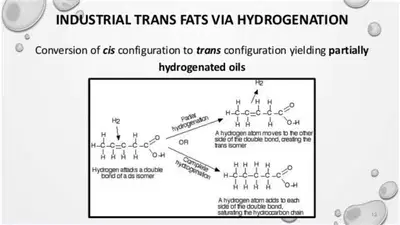
➢Changes from low-melting cis form to higher melting
trans form
– Shifts of double bond locations
➢Affects melting point
52


53


1. Iodine value – Wij Iodine reach with double bond
where there was direct relation with iodine value and
degree of saturation
2. Bromine water test. Unsaturated vegetable oils
contain double carbon-carbon bonds. These can be
detected using bromine water (just as alkenes can be
detected). Bromine water becomes colourless when
shaken with an unsaturated vegetable oil, but it stays
orange-brown when shaken with a saturated vegetable
fat
Testing of double bond
54


55


• 2 types of unsaturated fatty acid
– cis configuration — "on the same side" in Latin
– trans configuration — "across" in Latin
Substrate for Hydrogenation
56


57

Hydrogenation Process
Hydrogen Gas
+
Nickel Catalyst
160 - 200 0C
Unsaturated and cis-unsaturated
fatty acid
IV of RBD Soya Bean Oil = 125
Double bond
partial
Double bond
trans-unsaturated fatty acid
Single bond
full
Saturated
IV of Hydrogenated Soya Bean Oil = 70
58

Hydrogenation Process
• How?
Unsaturated fatty acids
contain one or more double bonds
[liquid, lower melting point]
Chemically react hydrogen gas with double bond
More saturated fatty acid
Shifting to new position / twisting to trans configuration
[increase melting point]
59


Hydrogenation Process
• How? Three Reactants:
1. Unsaturated oil
2. Catalyst
3. Hydrogen gas
–
Dissolved in liquid oil
60

Hydrogenation Process
• How?
61

Hydrogenation Process
• Operating variables
– Oil, hydrogen, catalyst
– sufficient supplied of
hydrogen will increase
reaction rate > trans-
isomer decrease, flatter
SFI curve
62

Hydrogenation Process
• Operating variables
– any condition affects the catalyst surface or
controls the supply of gas to catalyst surface ~
1. Temperature
•
Rate
•
Solubility of hydrogen gas
•
Selectivity
•
Fatty acid configuration
63

Hydrogenation Process
• Operating variables
2. Hydrogen Pressure
•
Availability of hydrogen gas
•
Selectivity
•
Fatty acid configuration
64

Hydrogenation Process
• Operating variables
3. Agitation
•
Solubility of hydrogen gas
•
Selectivity
•
Fatty acid configuration
65

Hydrogenation Process
• Operating variables
4. Catalyst
o
Level / concentration
➢
Rate
o
Type
➢
Nickel, sulfur-poisoned/treated catalyst, copper
chromite catalysts, precious metals (palladium)
o
Poisons (from refined oils and hydrogen gas)
➢
Sulfur, phosphorus, water, FFA
o
Reuse
66

How the catalyst work…
67

Hydrogenation Process
• Operating variables
5. Source oils
•
Type of unsaturated fatty acids
•
Number of unsaturated fatty acid per triacylglyceride
Fatty Acid
Relative Reactivity
C-18:3 Linolenic
40
C-18:2 Linoleic
20
C-18:1 Oleic
1
68

Hydrogenation Process
• Systems
– Batch (simplicity, flexibility)
• Two different designs
1.
Recirculation
»
Filled with hydrogen under pressure in
recirculation system
2.
Dead-end
»
Hydrogen is added and vented when endpoint
reached
»
Safer, more versatile, lesser oxidation and
hydrolysis
69


Recirculation System
The reaction mixture (oil, H2
and catalyst) is continuously
re-circulated by an external
pump through an external
heat exchanger and a venturi
jet that is located inside the
autoclave, where fresh H2 is
added (see figure 2). These
reactors are generally
referred to as ‘loop-reactors’
70


Dead-end System
71

Hydrogenation Process
• Systems
– Continuous
•
Limited, due to variety of products to be
hydrogenated
72

Hydrogenation Process
• Control / endpoint?
– SFI
– IV
– Refractive Index
– Melting point
– Quick titer (refractometer)
73

Hydrogenation
• Product modification
– Softness, plasticity, organoleptic
– More selective hydrogenation process with higher
temperature, lower hydrogen pressure, lower
hydrogen gas solubility, higher catalyst selectivity
➢Product with steeper SFI (more trans- formed)
74

Hydrogenation
• Product modification
– Less selective hydrogenation process with lower
temperature, higher pressure, lower catalyst
selectivity level
➢Product with flatter SFI (less trans- formed)
75

Source: http://blog.fooducate.com/tag/hydrogenation/
76

77


78

79

80

81

Hydrogenated Fats Consumption
Source: http://www.purplemedicalblog.com/2005/12/what-trans-fat-labels-meanread-them.html
Major Food Sources of Trans Fat for American Adults
(Average Daily Trans Fat Intake is 5.8 Grams or 2.6 Percent of Calories)
82

Hydrogenated Fats in Food Product
83

84

85

86


87
Thank you

NE41102- Fats and Oil Technology
Semester 1 Session 2023/24
Fats Modification:
Hydrogenation
Show answer
Auto Play
Slide 1 / 87
SLIDE
Similar Resources on Wayground

77 questions
Solubility
Presentation
•
12th Grade
87 questions
Unit 1: Macromolecules and Enzymes
Presentation
•
9th - 12th Grade
77 questions
220423 Astro 3
Presentation
•
10th - 12th Grade
74 questions
Lesson on Lewis Dot Structures Covalent and Ionic
Presentation
•
11th Grade
73 questions
Mixtures and Solutions - (INVESTIGATION 3: States of Matter)
Presentation
•
KG - University
80 questions
Cell Signaling, Cell Cycle, Cancer, DNA Wayground 2026
Presentation
•
9th - 12th Grade
84 questions
KIMIA PAS Ganjil XI IPA
Presentation
•
11th Grade
Popular Resources on Wayground
10 questions
Safety Day 2026 – Student Review

Quiz
•
9th Grade
21 questions
Continents and Oceans
Quiz
•
6th Grade
20 questions
Parts of Speech
Quiz
•
5th Grade
16 questions
Subject & Predicate
Quiz
•
5th Grade
25 questions
Multiplication Facts
Quiz
•
5th Grade
12 questions
Map Skills
Quiz
•
3rd Grade
22 questions
Continents and Oceans
Quiz
•
5th Grade
15 questions
Rounding Decimals
Quiz
•
5th Grade
Discover more resources for Science
7 questions
Newton's Laws Video Quiz

Interactive video
•
9th - 12th Grade
35 questions
Cell Transport/Enzyme/Cell/Macro Review
Quiz
•
9th - 12th Grade
13 questions
Explore Enzyme Functions and Interactions
Quiz
•
9th - 12th Grade
10 questions
Fact or Fiction: Microbes
Quiz
•
9th - 12th Grade
10 questions
Understand Cell Functions and Organelles
Quiz
•
9th - 12th Grade
19 questions
Explore Macromolecules in Living Organisms
Quiz
•
9th - 12th Grade
15 questions
Layers of Atmosphere passage

Passage
•
9th - 12th Grade
22 questions
Quiz Review Day 5 Water and Macromolecules
Quiz
•
9th - 12th Grade