
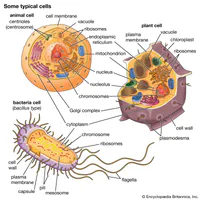
Cells

Presentation
•
Science
•
10th Grade
•
Hard

Anthony Jones
Used 1+ times
FREE Resource
20 Slides • 85 Questions
1

2

3

4
Multiple Choice
What was the conclusion drawn from Redi's experiment in 1668?
A) Maggots spontaneously appeared
B) Flies laid eggs in meat
C) Microorganisms appeared
D) Nothing grew
5
Multiple Choice
In Needham's experiment in 1745, what was observed in the unsealed flask?
Nothing grew
Maggots appeared
Microorganisms appeared
Flies laid eggs
6
Multiple Choice
Spallanzani repeated Needham's experiment but with sealed flasks. What was the result?
A) Microorganisms appeared
B) Nothing grew
C) Maggots appeared
D) Flies laid eggs.
7
Multiple Choice
In Pasteur's experiment, what was the purpose of using an S-shape neck flask?
To allow air and microorganisms
To allow air but not microorganisms
To allow microorganisms but not air
To prevent both air and microorganisms
8
Multiple Choice
The belief that a 'life force' caused nonliving things to 'birth' living things is known as ______.
Evolution
Spontaneous generation
Natural selection
Germ theory
9

10
Multiple Choice
Which of the following statements is part of the cell theory?
A) All living things are made up of cells.
B) Cells can be created from non-living matter.
C) The cell is the largest unit of life.
D) Cells do not come from pre-existing cells.
11
Multiple Choice
What type of system is a cell?
Open
Closed
Isolated
12
Multiple Choice
Fill in the blank: The cell is the _______ unit of life.
largest
smallest
medium-sized
13
Multiple Choice
Which organ system is responsible for gas exchange in humans?
A) Digestive
B) Musculoskeletal
C) Respiratory, circulatory
D) Nervous
14
Multiple Choice
Fill in the blank: Cells have tiny organs called _______ to perform functions on a smaller scale.
tissues
organelles
systems
15

16
Multiple Choice
Which organelle acts as the protective barrier of the cell and controls what comes in and goes out?
Nucleus
Cell membrane
Mitochondria
Golgi apparatus
17
Multiple Choice
The _______ is responsible for making proteins out of amino acids.
Ribosomes
Lysosomes
Nucleus
Centrioles
18
Multiple Choice
What is the function of the mitochondria in an animal cell?
Contains the cell’s DNA
Makes proteins
Cellular respiration
Involved in cell division.
19
Multiple Choice
The gel-like substance that suspends all the organelles and has nutrients is called _______.
Cytoplasm
Nucleus
Lysosomes
Smooth endoplasmic reticulum
20
Multiple Choice
Which organelle is involved in cell division?
Golgi apparatus
Centrioles
Rough endoplasmic reticulum
Mitochondria
21

22
Multiple Choice
Which organelle is present in animal cells but not in plant cells?
Chloroplast
Centrioles
Cell wall
Large central vacuole
23
Multiple Choice
Fill in the blank: The _______ is responsible for photosynthesis in plant cells.
Mitochondria
Chloroplast
Nucleus
Ribosomes
24
Multiple Choice
What is the function of the large central vacuole in plant cells?
Stores water and nutrients
Provides energy
Synthesises proteins
Contains genetic material
25
Multiple Choice
Which structure provides strength and support to plant cells?
Cell membrane
Nucleus
Cell wall
Lysosomes
26
Multiple Choice
Fill in the blank: In plant cells, energy is stored as _______.
Fat
Oil/Starch
Protein
Sugar
27

28
Multiple Choice
Which organelle is responsible for protein synthesis?
Nucleus
Ribosome
Mitochondria
Lysosome
29
Multiple Choice
The _______ is the site of cellular respiration.
Nucleus
Mitochondria
Chloroplast
Golgi apparatus
30
Multiple Choice
What is the function of the cell membrane?
Stores water and nutrients
Controls what comes in/out
Site of photosynthesis
Digestion and defence.
31
Multiple Choice
Which organelle contains chlorophyll and is the site of photosynthesis?
Mitochondria
Chloroplast
Nucleus
Lysosome
32
Multiple Choice
The _______ packages materials from the ER for transport.
Golgi apparatus
Ribosome
Lysosome
Vacuole
33


34
Multiple Choice
What is the model for the structure of the cell membrane called?
Solid mosaic model
Fluid mosaic model
Rigid mosaic model
Flexible mosaic model
35
Multiple Choice
The cell membrane separates the inside of the cell (intracellular fluid/ICF) with its outside environment (______).
Extracellular fluid/ECF
Intercellular fluid/ICF
External fluid/EF
Internal fluid/IF
36
Multiple Choice
Which of the following is true about the phospholipid bilayer?
It has three layers of phospholipids
It is hydrophobic
It has two layers of phospholipids
It is rigid.
37
Multiple Choice
Channel proteins in the cell membrane function as:
Tunnels to let big molecules pass through
Barriers to block molecules
Pumps to push molecules out
Filters to clean molecules
38
Multiple Choice
Lipids in the cell membrane have hydrophilic heads that are:
Away from the ECF/ICF
Next to the ECF/ICF
Inside the phospholipid bilayer
Outside the cell
39

40
Multiple Choice
Which statement is true about matter?
All matter is made up of particles.
Only solids are made up of particles.
Liquids are not made up of particles.
Gases are not made up of particles.
41
Multiple Choice
Particles are always moving. In which state of matter do they move the fastest?
A) Solids
B) Liquids
C) Gases
D) Plasma
42
Multiple Choice
Particles are attracted to each other. True or False?
True
False
43
Multiple Choice
Particles have spaces between them. In which state of matter is this space the most?
Solids
Liquids
Gases
Plasma
44
Multiple Choice
Fill in the blank: Particles have spaces between them, with the most space in ______.
A) Solids
B) Liquids
C) Gases
D) Plasma
45

46
Multiple Choice
What is the ratio of solute to solvent in a solution called?
Concentration
Solubility
Diffusion
Permeability
47
Multiple Choice
Which of the following is an example of a solute?
Water
Kool-Aid crystals
Air
Oil
48
Multiple Choice
A concentration gradient exists when there’s a different concentration on either side of a ____.
membrane
solution
solvent
solute
49
Multiple Choice
Which type of membrane allows nothing through?
A) Permeable
B) Semi-permeable
C) Impermeable
D) Selectively permeable
50
Multiple Choice
Solutes naturally want to balance out by moving from ____ to ____ concentration.
low to high
high to low
equal to unequal
none to some
51

52
Multiple Choice
Which type of transport does NOT require energy?
Active Transport
Passive Transport
Both A and B
Neither A nor B
53
Multiple Choice
In passive transport, molecules move from _______ concentration to _______ concentration.
A) Low to High
B) High to Low
C) Equal to Equal
D) Low to Low
54
Multiple Choice
What factor does NOT affect the rate of diffusion?
Size of particles
Concentration difference
Colour of particles
Temperature
55
Multiple Choice
Active transport requires energy to move molecules _______ the concentration gradient.
A) Along
B) Against
C) Across
D) With
56
Multiple Choice
Which of the following is an analogy for diffusion?
Climbing uphill
Floating downstream
Running a marathon
Building a wall.
57

58
Multiple Choice
What does 'facilitate' mean in the context of passive transport?
A) To hinder
B) To help
C) To stop
D) To slow down
59
Multiple Choice
Which type of protein is shaped like tubes or tunnels and allows solute to go straight through?
Carrier protein
Channel protein
Enzyme
Receptor protein
60
Multiple Choice
Facilitated diffusion happens with molecules that are ______ to fit through the membrane.
too small
too big
just right
too fast
61
Multiple Choice
What is the analogy used for facilitated diffusion?
Like climbing uphill
Like floating downstream, on a raft
Like running a marathon
Like swimming upstream
62
Multiple Choice
Carrier proteins are designed to fit around ______.
any molecule
one specific molecule
multiple molecules
no molecule
63

64
Multiple Choice
What is osmosis?
Movement of solutes
Movement of water
Movement of air
Movement of light
65
Multiple Choice
In osmosis, water moves from an area of ______ water concentration to an area of ______ water concentration.
higher, lower
lower, higher
equal, equal
higher, higher
66
Multiple Choice
What happens to a cell in a solution with 10% salt and 90% water?
It shrivels
It swells
It remains unchanged
It bursts
67
Multiple Choice
What is the role of a semi-permeable membrane in osmosis?
Allows all molecules to pass
Blocks all molecules
Allows only water to pass
Allows only solutes to pass
68
Multiple Choice
In the practice scenario, what will happen to a cell in a solution with 30% salt and 70% water?
It will swell
It will shrivel
It will burst
It will remain unchanged.
69

70
Multiple Choice
What does the prefix 'hyper' mean in the context of tonicity?
Low
Equal
High
None of the above
71
Multiple Choice
In a hypertonic solution, the concentration of solutes is ______ than that of the cell.
Lower
Higher
Equal
None of the above
72
Multiple Choice
What is the effect on animal cells in a hypertonic solution?
Appear normal
Appear swollen, may burst
Appear shriveled, may die
Appear turgid.
73
Multiple Choice
In an isotonic solution, the concentration of the cell and the solution are ______.
Higher
Lower
Equal
None of the above
74
Multiple Choice
What happens to plant cells in a hypotonic solution?
Appear wilted and limp
Appear slightly limp due to lack of turgor pressure
Appear turgid, plant appears healthy
Appear shriveled, may die.
75

76
Multiple Choice
What is used to pump molecules from low to high concentrations in active transport?
Carbohydrates
Proteins
Lipids
Nucleic acids
77
Multiple Choice
In active transport, molecules move from _______ concentration to _______ concentration.
low, high
high, low
equal, equal
none of the above
78
Multiple Choice
What is needed to pump molecules against the concentration gradient in active transport?
Water
Oxygen
Energy (ATP)
Carbon dioxide
79
Multiple Choice
Exocytosis moves things _______ of the cell.
into
out
around
through
80
Multiple Choice
Endocytosis involves the formation of a vesicle around the solute to move things _______ the cell.
into
out of
around
through
81

82
Multiple Choice
What is the definition of concentration?
Ratio of solute to solvent in a solution
Difference in concentration on either side of a membrane
Movement of molecules from high to low concentration
Use of energy to move molecules.
83
Multiple Choice
Which type of transport requires ATP (energy)?
Diffusion
Facilitated Diffusion
Osmosis
Active Transport
84
Multiple Choice
Fill in the blank: In a hypertonic solution, the cell will ____.
A) Swell
B) Shrivel
C) Stay the same
D) Burst
85
Multiple Choice
What is one advantage of using a liposome in medication delivery?
It is made of different material than the cell membrane
It can merge with the cell membrane and release medicine quickly
It prevents the medicine from entering the cell
It requires energy to release medicine.
86
Multiple Choice
Which of the following is NOT a point of the particle model of matter?
A) All matter is made up of particles
B) Particles are always moving
C) Particles are not attracted to each other
D) Particles have spaces between them.
87

88
Multiple Choice
What is the formula for calculating the surface area of a cube?
2(lw + hw + lh)
6(length x width)
length x width x height
4πr²
89
Multiple Choice
Which of the following is an advantage of small cells?
Requires more nutrients
Produces more waste
Requires less nutrients
More area for pulling in nutrients.
90
Multiple Choice
Fill in the blank: The volume of a cube can be calculated using the formula ______.
length x width x height
6(length x width)
2(lw + hw + lh)
4πr²
91
Multiple Choice
What is the surface area to volume ratio (SA:V) for Cell 1?
4:1
2.4:1
3:1
5:1
92
Multiple Choice
Which cell is better suited for survival based on the SA:V ratio?
Cell 1
Cell 2
93

94
Multiple Choice
What is the function of the nucleus in a cell?
Contains DNA, controls cell
Site of cellular respiration
Protein synthesis
Fat/oil synthesis
95
Multiple Choice
Which organelle is responsible for protein synthesis?
Golgi apparatus
Rough ER
Smooth ER
Chloroplast
96
Multiple Choice
Fill in the blank: The _______ is the site of photosynthesis in plant cells.
Mitochondria
Chloroplast
Nucleus
Ribosomes
97
Multiple Choice
In the Venn diagram comparing plant and animal cells, which feature is unique to plant cells?
A) Centrioles
B) Many small vacuoles
C) Cell wall & chloroplasts
D) Store energy as fat.
98
Multiple Choice
Which cell is best suited for survival based on the SA:V ratio?
Cell 1
Cell 2
Cell 3
99

100
Multiple Choice
Which type of transport moves molecules across a membrane without using energy?
Simple Diffusion
Facilitated Diffusion
Osmosis
Active Transport
101
Multiple Choice
In the context of cell transport, which process requires energy?
Simple Diffusion
Facilitated Diffusion
Osmosis
Active Transport
102
Multiple Choice
The pale red Kool-Aid is the more dilute glass because it has a lower concentration. What is the solute in this scenario?
Water
Kool-Aid crystals
Sugar
Salt
103
Multiple Choice
A phospholipid bilayer is called so because it is made up of two layers of ______.
Proteins
Carbohydrates
Phospholipids
Nucleic acids
104
Multiple Choice
Which type of transport involves the movement of water across a membrane?
Simple Diffusion
Facilitated Diffusion
Osmosis
Active Transport
105

Show answer
Auto Play
Slide 1 / 105
SLIDE
Similar Resources on Wayground

103 questions
C1.2 Cellular Respiration Notes- IB Biology 1
Presentation
•
11th Grade
101 questions
Biology Final Exam Review
Presentation
•
9th Grade
99 questions
Unit 5 Employability Skills_PHS
Presentation
•
10th Grade
99 questions
Developmental Psych
Presentation
•
10th - 11th Grade
96 questions
Manual Mode: Using the Exposure Triangle
Presentation
•
10th Grade
99 questions
U.S. Imperialism
Presentation
•
11th Grade
100 questions
Unit 3: Ecosystems
Presentation
•
9th - 12th Grade
98 questions
The Muscular System PPT
Presentation
•
9th - 12th Grade
Popular Resources on Wayground
10 questions
Safety Day 2026 – Student Review

Quiz
•
9th Grade
21 questions
Continents and Oceans
Quiz
•
6th Grade
20 questions
Parts of Speech
Quiz
•
5th Grade
16 questions
Subject & Predicate
Quiz
•
5th Grade
25 questions
Multiplication Facts
Quiz
•
5th Grade
12 questions
Map Skills
Quiz
•
3rd Grade
22 questions
Continents and Oceans
Quiz
•
5th Grade
15 questions
Rounding Decimals
Quiz
•
5th Grade
Discover more resources for Science
10 questions
Exploring Chemical and Physical Changes

Interactive video
•
6th - 10th Grade
10 questions
Exploring the Electromagnetic Spectrum for Middle School Science
Interactive video
•
6th - 10th Grade
10 questions
Exploring Force and Motion Concepts
Interactive video
•
6th - 10th Grade
10 questions
Exploring Air Masses and Weather Fronts
Interactive video
•
6th - 10th Grade
10 questions
Exploring the States of Matter
Interactive video
•
6th - 10th Grade
10 questions
Exploring Forces: Net Force, Normal Force, Gravity, and Friction
Interactive video
•
6th - 10th Grade
10 questions
Differentiating Thermal Energy and Temperature
Interactive video
•
6th - 10th Grade
10 questions
Exploring the States of Matter and Thermal Energy
Interactive video
•
6th - 10th Grade