Search Header Logo
Chemical Bonds

Chemical Bonds

Assessment

Presentation

Chemistry

10th Grade

Medium

Created by

Janice Taylor

Used 8+ times

FREE Resource

12 Slides • 84 Questions

1

media

CHEMICAL BONDS

2

media
media

1.Why do atoms form bonds?

2.What are the three types of chemical bonds?

3.Which group of elements do not form bonds?

3

media

1.Why do atoms form bonds? Atoms form chemical bonds

to become stable and have a full outer shell.

2.What are the three types of chemical bonds?

Ionic, covalent and metallic.

3.Which group of elements do not form bonds?

Group zero - the noble gases

media

4

Multiple Choice

Why do elements bond?
1
To be friends
2
To create a new element
3
To become stable

5

Multiple Choice

Which of these is not a real bond in chemistry?
1
James
2
Ionic
3
Covalent

6

Multiple Choice

Why do atoms bond?

1

to find a date

2

to become bigger

3

to go to dog jam

4

to become stable

7

Multiple Choice

When atoms bond it is called a ___________________ because they make a new substance.

1

chemical reaction

2

physical reaction

8

media

9

media

10

media

11

Multiple Choice

Ionic bonds form between two ions that have...
1
ionic compounds
2
negative charges
3
positive charges
4
opposite charges

12

Multiple Choice

Which is most likely to form a negative ion...
1

an element from Group 7

2
a metal
3
an element from Group 1
4

an element with atoms that have eight electrons in its outer shell

13

Multiple Choice

A(n) _____________ is an atom or group of atoms that has an electric charge. 
1
ion
2
electron

14

Multiple Choice

The attraction between oppositely charged ions is called a(n) _______________.
1
ionic bond
2
polyatomic ion

15

Multiple Choice

Question image

Positive ions are formed when atoms _____________ electrons.

1

lose

2

gain

16

Multiple Choice

Question image

Negative ions are formed when atoms _____________ electrons.

1

lose

2

gain

17

Multiple Choice

When an atom loses an electron, it becomes a

1

positive ion

2

negative ion

3

neutral ion

4

neutral atom

18

Multiple Choice

Why do all bonds form?

1

so the number of protons equals the number of electrons

2

so an atom can become unstable

3

to fill the outermost energy level

19

Multiple Choice

Ionic bonds are between...
1
Metal and Non-metal
2
Non-metal and Non-metal
3
Metal and Metal

20

Multiple Choice

How are ionic bonds formed?
1
Transfer of electrons
2
Sharing of electrons

21

Multiple Choice

Question image
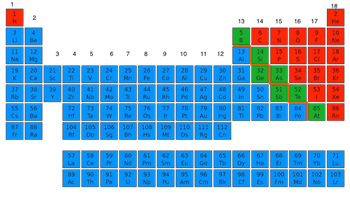
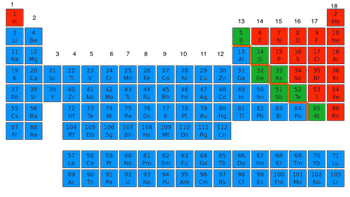
Where are the nonmetals located on the periodic table? 
1
Blue
2
Red
3
Green

22

Multiple Choice

Question image
Where are metals located on the periodic table?
1
Blue
2
Green
3
Red

23

Multiple Choice

Question image

What type of elements form cations?

1

metals

2

nonmetals

3

metalloids?

24

Multiple Choice

Anions

1

Gain electrons, has an overall positive charge

2

Lose electrons, has an overall positive charge

3

Lose electrons, has an overall negative charge

4

Gain electrons, has an overall negative charge

25

Multiple Choice

How does calcium become an calcium ion?

1

it loses 2 electrons

2

it gains 2 electrons

26

Multiple Choice

How does magnesium become an magnesium ion?

1

it loses 2 electrons

2

it gains 2 electrons

27

Multiple Choice

How does oxygen become an oxide ion?

1

it loses 2 electrons

2

it gains 2 electrons

28

Multiple Choice

An electron has what kind of charge?
1
no charge
2
positive 
3
negative
4
it depends

29

media

30

media

31

Multiple Choice

The chemical bond formed when two atoms share electrons  is called a(an) IONIC bond. 
1
True
2
False

32

Multiple Choice

Covalent bonds usually form when a nonmetal combines with a(an) METAL.
1
True
2
False

33

Multiple Choice

Question image
What two types of atoms make a covalent bond?
1
2 Nonmetals
2
1 Nonmetal and 1 Metal
3
2 Metals
4
2 Noble Gases

34

Multiple Choice

Covalent bonds are between...
1
Metal and Non-metal
2
Non-metal and Non-metal
3
Metal and Metal

35

Multiple Choice

How are covalent bonds formed?
1
Sharing of electrons
2
Transfer of electrons

36

Multiple Choice

Group numbers on the periodic table help us determine 
1
The number of valence electrons
2
Color of the elements

37

Multiple Choice

H2O
1
Ionic Bond
2
Covalent Bond
3
Both bonds
4
Neither bond

38

Multiple Choice

Low melting point
1
Ionic Bonds
2
Covalent Bonds
3
Both bonds
4
Neither bond

39

Multiple Choice

Why do atoms share electrons?

1

to increase their atomic number

2

to become ions

3

to obtain noble gas electron configuration

4

to become less polar

40

Multiple Choice

In covalent bonds electrons are:

1

shared

2

transferred

3

mobile

41

Multiple Choice

Which bond type is more likely to be liquids or gases at room temperature?

1

ionic bonds

2

covalent bonds

3

metallic bonds

42

Multiple Choice

Which of the following compounds is considered a covalent compound?

1

NH3

2

NaCl

3

MgO

4

K2S

43

Multiple Choice

Ice, H2O(s), is classified as

1

an ionic compound

2

a molecular compound

3

a homogeneous mixture

4

a heterogeneous mixture

44

Poll

Question image

In Carbon Dioxide, the bond between the carbon and oxygen is,

single bond

double bond

triple bond

45

Multiple Choice

Question image

This is the displayed formula for what covalent compound?

1

Water

2

Hydrogen peroxide

3

Hydrogen oxide

4

Ethanol

46

Multiple Choice

Question image

This is the displayed formula for what covalent molecule?

1

Water

2

Chlorine

3

Chloride

4

Ethanol

47

Multiple Select

Question image

What does this picture illustrate? (Select all that apply)

1

Sharing valence electrons

2

Covalent bonding

3

transferring valence electrons

4

ionic bonding

5

two nonmetals

48

Multiple Choice

Question image

How many covalent bonds are created in a single water molecule?

1

0

2

1

3

2

4

3

5

4

49

Multiple Choice

Question image

How many covalent bonds are created in a single ammonia molecule?

1

0

2

1

3

2

4

3

5

4

50

Multiple Choice

What type of elements share electrons and form covalent bonds?

1

Nonmetals

2

Metals

3

Metalloids

4

A Metal & A Nonmetal

51

Multiple Choice

Question image

What type of bond will this compound likely form H-Cl?

1

Ionic compound

2

Covalent compound

3

Metallic compound

52

media

Metallic bonding is the electrostatic
attraction between positive metal
ions and delocalised electrons.

The organisation of the metal ions
and the free-moving electrons give
metals certain properties, such as
malleability and ability to conduct
heat and electricity.

METALLIC BONDING

53

media

54

Multiple Choice

What is the basis of a metallic bond?
1
the attraction of neutral metal atoms.
2
the attraction between protons and neutrons.
3
the attraction between positive metal ions and interlocking electrons.
4
the attraction between positive metal ions and free floating electrons.

55

Multiple Choice

There are more metals than non metals in the periodic table.
1
True
2
False

56

Multiple Choice

At room temperature, most metals are
1
liquid
2
solid
3
gas
4
an alloy

57

Multiple Choice

What does malleable mean?
1
able to be shaped
2
will break easily
3
can be used for wire
4
is shiny

58

Multiple Choice

Electrons that are free to move in metals
1
delocalized electrons
2
oxidation number
3
chemical bond
4
salts

59

Multiple Choice

What is the ability of a substance to be pulled into a thin strand?
1
Malleability
2
Ductility 
3
Conductivity
4
Solubility

60

Multiple Choice

Why do metals have high melting points?
1
They don't
2
The negatively charged electrons act as a glue to hold the positively charged ions together.
3
All the electrons become delocalised

61

Multiple Choice

Why do metals conduct heat and electricity

1
They are shiny
2
The electrons are held tightly within the lattice
3
The electrons are delocalised and able to move
4
The electrons are shared between two metal ions

62

Multiple Choice

Metallic bonding is...
1
a type of covalent bond.
2
a type of ionic bond.
3
an attraction between positive ions and electrons.

63

Multiple Choice

What is the ability of a substance to allow heat, sound, or electricity to flow through it?
1
Malleability
2
Ductility
3
Solubility
4
Conductivity

64

Multiple Choice

Why are metals malleable?

1

They are shiny

2

The electrons are held tightly within the lattice structure making it strong

3

The electrons are delocalized and able to move between the atoms

4

The electrons are shared between two metal ions and this holds the atoms together

65

Multiple Select

Which of these are considered properties of metals? (choose ALL that apply)

1

brittleness

2

low melting point

3

luster (shininess)

4

malleability

5

ductility

66

Multiple Choice

Why do metallic compounds conduct electricity as solids?

1

core electrons are mobile, allowing electricity to flow through the metal

2

valence electrons are mobile, allowing electricity to flow through the metal

3

protons are mobile, allowing electricity to flow through the metal

4

the metal cations are mobile, allowing electricity to flow through the metal

67

Multiple Choice

I can hit a metal with a hammer without the metal shattering because of its __________.
1
Ductility
2
Malleability
3
Conductivity
4
Lustrousness

68

Multiple Choice

In metals, the _______ electrons form a shared sea of electrons.
1
Metallic
2
Inner
3
Outer
4
Ionic

69

Multiple Choice

What do metals conduct?
1
heat
2
electricity
3
both
4
neither

70

media

71

media

72

Multiple Choice

Why are alloys generally used to make everyday objects?
1
Alloys are often stronger and less active than pure metals.
2
Alloys have higher melting point than pure metals.
3
Alloys are less expensive to produce than pure metals.
4
Alloys have ionic bonds instead of metallic bonds.

73

Multiple Choice

Which of the following is NOT a property of a metal?
1
ductile
2
good electrical conductor
3
good thermal insulator
4
malleable

74

Multiple Choice

An attraction between a positive metal ion and surrounding electrons is a(n) ____________bond.
1
metallic
2
ionic

75

Multiple Choice

Metals typically have ____________melting points.
1
High
2
Low

76

Multiple Choice

Metals are often used to make wire because they are 
1
malleable
2
ductile

77

Multiple Choice

Metals are used in electrical wires because they have a high ____________conductivity. 
1
 electrical
2
thermal

78

Multiple Choice

Why do jewelers not create jewelry with pure gold, silver, or copper?

1

It is a soft metal, so it will rub or scratch away over time.

2

It will not be shiny.

3

It is impossible to find a pure form of these metals.

4

It is too hard to shape into a design.

79

Multiple Choice

All alloys are mixtures.

1

True

2

False

80

Multiple Choice

Steel generally speaking is made of

1

iron and carbon

2

copper and iron

3

tin and carbon

4

aluminum and nickel

81

Multiple Choice

Brass is an alloy made of

1

copper and zinc

2

copper and tin

3

copper and nickel

4

copper and aluminum

82

Multiple Choice

Bronze is an alloy made of

1

aluminum and magnesium

2

copper and tin

3

lead and tin

4

copper and nickel

83

Multiple Choice

Steel can become stainless when alloyed with _____.

1

chromium and nickel

2

copper and zinc

3

tin and lead

4

iron aand carbon

84

Fill in the Blanks

85

Multiple Choice

Many alloys are softer than the elements that are in them.

1

True

2

False

86

Fill in the Blanks

87

Multiple Choice

In steel, iron is mixed with small amounts of non-metal, _______ .

1

Copper

2

Carbon

3

Diamonds

4

Wood

88

Fill in the Blanks

89

Multiple Choice

Pure iron is _________________ .

1

soft and weak

2

hard and stong

3

bendy and brittle

90

Multiple Select

Which of the following are alloys? (choose 3)

1

Lead

2

Bronze

3

Brass

4

Aluminium

5

Stainless Steel

91

Multiple Choice

Iron is a good conductor, malleable and magnetic. What type of element is Iron?

1

metal

2

non-metal

3

metalloid

4

alloy

92

Multiple Choice

Which substances do you find on the left of the Periodic Table?

1

metalloid

2

non-metals

3

metals

4

alloy

93

Multiple Choice

Alloys are much stronger because...

1

the particles from the different metals help the arrangement to stay in fixed positions

2

the different metals bond well

3

the particles from the different metals mix and disrupt the pattern making it hard for them to slide

94

Multiple Choice

Which metal is the best conductor of electricity?

1

steel

2

copper

3

zinc

4

brass

95

Multiple Choice

‘Bronze is harder than copper’. Which of the following is the best to explain the statement?

1

Atoms in bronze are arranged closely packed and less empty spaces.

2

Layers of atoms in bronze are not easily slide over each other.

3

Atomic size of copper and tin is different.

4

Bronze is a mixture of copper and tin

96

Multiple Choice

Which of these pictures shows the particles in a solid, pure metal?

1
2
3
4
media

CHEMICAL BONDS

Show answer

Auto Play

Slide 1 / 96

SLIDE