Search Header Logo
Fall Final - Day 2 Review - 2024

Fall Final - Day 2 Review - 2024

Assessment

Presentation

Biology

9th - 12th Grade

Medium

NGSS
HS-PS1-4, HS-PS1-5

Standards-aligned

Created by

Gerald Mabele

Used 10+ times

FREE Resource

18 Slides • 22 Questions

1

media

2

Poll

Question image

Who would you like to meet?

meet Frosty

meet Rudolph

meet Olaf

3

Poll

Question image

When do you like opening Christmas presents?

on Christmas eve

on Christmas morning

4

media

5

Multiple Choice

Question image

If you are cold, what does your body do?

1

shiver/get goose bumps

2

sweat

3

stare blankly

4

nothing

6

media

7

Multiple Choice

Question image

True or False:

Enzymes can work in only specific conditions. For example, get them too hot or acidic and they denature.

1

True, enzymes are picky and only work in specific ideal conditions.

2

False, enzymes can function under any conditions.

8

media

9

media

10

media

11

media

12

Multiple Choice

Osmosis is the movement of _____ across a membrane.
1
food
2
energy
3
oxygen
4
water

13

Multiple Choice

Osmosis is a type of ____ transport; meaning it ____ require energy from the cell.

1

active; does

2
passive; does not
3

passive; does

4

active; does not

14

Multiple Choice

HYPO means...
1

Less solutes

2

High solutes

3

Equal solutes

4

Fat solutes

15

Multiple Choice

ISO means...
1
Low
2
A lot
3
Equal
4
Mammal

16

Match

Match each condition with its picture.

Plant cell in hypertonic solution

Plant cell in hypotonic solution

Animal cell in hypertonic solution

Animal cell in hypotonic solution

Plant & Animal cell in isotonic solution

17

Multiple Choice

What cell structure helps a cell maintain homeostasis by being semi-permeable?

1
Nucleus
2
Ribosome
3
Mitochondria
4
Cell membrane

18

media

19

media

20

Multiple Choice

Question image

A student fills a beaker with a 5% salt solution. The student places a dialysis bag containing a 15% salt solution into the beaker. Then the student measures the salinity of the salt solution in the beaker after 5 minutes. The dialysis tubing is permeable to salt and water.

What is the net direction in which water moves immediately after placing the dialysis tubing in the beaker?

1

Water will move into the tubing.

2

Water will move out of the tubing.

3

Water will not move at all.

4

There will be no net movement of water.

21

media

22

media

23

media

24

Multiple Choice

How do molecules move in passive transport?

1
Molecules move from high to low concentration without energy.
2
Molecules move in a circular motion regardless of concentration.
3
Molecules move randomly without any concentration gradient.
4
Molecules move from low to high concentration using energy.

25

Multiple Choice

How do molecules move in active transport?

1
Molecules move randomly in all directions without any proteins.
2

Molecules move against their concentration gradient (low to high) using energy and transport proteins.

3

Molecules move with their concentration gradient (high to low) without using energy.

4
Molecules move only through passive diffusion without energy.

26

Multiple Select

All the following require energy (ATP), EXCEPT which processes?

Note: TWO (2) ANSWER CHOICES ARE CORRECT.

1

Simple diffusion like osmosis of water

2

Exocytosis

3

Facilitated diffusion

4
Endocytosis
5

Active transport

27

Match

Match each type of transport with its description.

Osmosis

Simple diffusion

Exocytosis

Facilitated diffusion

Endocytosis

diffusion of water

moves gas molecules like O2 & CO2

uses a vesicle to take molecules outside

diffusion through a protein channel

uses a vesicle to bring molecules inside

28

media

29

media

30

Labelling

Drag the labels to the correct spots A-E

Drag labels to their correct position on the image

products

enzyme

substrate

unchanged enzyme

enzyme substrate complex

31

media

32

media

33

media

34

media

35

Multiple Choice

Question image

An enzyme speeds up a reaction by...

1
lowering the activation energy.
2
raising the activation energy.
3
releasing energy.
4
absorbing energy.

36

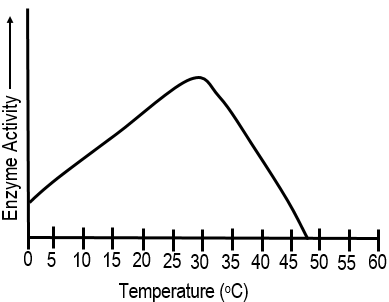
Multiple Choice

Question image
Based on the graph, what is the optimal temperature for this enzyme? 
1
15oC
2
40oC
3
30oC
4
35oC

37

Multiple Choice

What happens when enzymes are heated to a high temperature?
1
The enzymes die.
2
The shapes of the enzyme are altered denature
3
The enzymes' amino acid sequence changes.
4
The enzymes remain the same

38

Multiple Choice

What is a substance called if it speeds up a chemical reaction?
1
reusable
2
catalyst
3
specific
4
fragile

39

Multiple Choice

Every enzyme has a optimal temperature and pH. True or False?
1
True 
2
False

40

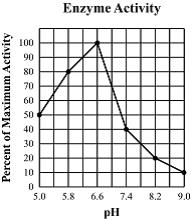
Multiple Choice

Question image
Which of the following conclusions can be drawn from this graph?
1
The optimum pH of the enzyme is 6.6.
2
The optimum pH of the enzyme is 5.8
3
The enzyme’s activity increases as pH increases 5.0 to 9.0
4
The enzyme’s activity is greater around pH of 8.0 .
media

Show answer

Auto Play

Slide 1 / 40

SLIDE