

DNA practice

Presentation
•
Biology
•
KG - Professional Development
•
Easy
Standards-aligned

Megan Wallace
Used 2+ times
FREE Resource
8 Slides • 30 Questions
1
DNA!
By Jodi Edge

Identify components of DNA, identify how information for specifying the traits of an organism is carried in the DNA, and examine scientific explanations for the origin of DNA
and
recognize that components that make up the genetic code are common to all organisms
2
Deoxyrhybonucleic Acid
Made of:
Phosphae groups
Deoxyrhybose sugars
Nitrogenous Bases
Series of nucleotides creating a long stranded molecule
Code for ALL life; from us to the bacteria that make us sick!
Molecule resides in the nucleus of eukaryotic cells and freely floats in prokaryotic cells
What is DNA?
3

Each nucleotide contains a Phosphate, sugar, and nitrogenous base.
Some text here about the topic of discussion.
What is a nucleotide?
4
Multiple Select
What molecules are in nucleotides?
Phosphate group
Protein
Sugar
lipid
Nitrogenous base
5
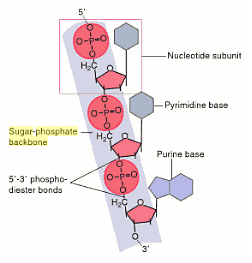
These alternate to form the ladder-like backbone of DNA
What does the sugar and phosphate group do?
6

Nitrogenous bases are the "code" part of DNA and/or RNA. Their order is what tells the cell what to make and how to do it. 4 bases found in DNA; in RNA U replaces T.
BASES include:
Cytosine
Thymine (DNA ONLY!)
Guanine
Adenine
Uracil (RNA ONLY!!)
What is a nitrogenous base?
7
Multiple Select
Which molecules make up the "backbone" of DNA and RNA?
Sugar
Phosphate group
Nucleotide base
8
Multiple Choice
Why are the nucleotides so gosh darn important? (Careful, all statements are true! Make sure you are picking what makes them IMPORTANT!!!!)
They hold the DNA together.
They live in the nucleus.
This is the chemical part that CODES for life.
There are 5 different kinds.
9
Rosalind Franklin, in full Rosalind Elsie Franklin (1920-1958) was a British scientist best known for her contributions to the discovery of the structure of deoxyribonucleic acid (DNA), a constituent of chromosomes that serves to encode genetic information. Franklin also contributed new insight on the structure of viruses, helping to lay the foundation for the field of structural virology.
10
Multiple Choice
Rosalind Franklin is famous for...
her work toward discovering DNA
her work toward discovering the shape of DNA
her work toward curing cancer
11
While researching the structure of DNA in 1953, her supervisor gave pictures she had taken of the structure of DNA to other scientists without her permission. Eventually, James Watson and Francis Crick published a paper, using Franklin's pictures to visualize the famous double helix model of DNA.
The new model for how DNA is shaped, allowed scientists to understand how life works and led to many discoveries and inventions, such as DNA testing, cloning, and GMOs.
12
Multiple Choice
Watson and Crick would go on to get the Nobel Prize, thanks in part to...
their work in World War Two.
Rosalind Franklin recommending them.
using Rosalind Franklin's work without giving her credit.
13
Multiple Choice

14

15
Match
Match the following nitrogen bases together.
A
C
T
G
T
G
A
C
T
G
A
C
16
Multiple Choice
What is the complementary strand of this DNA strand?
ATC GAA TTC CGC
TAG GAA AAG GCG
AGC AAC TTG CAC
TAG CTT AAG GCG
GCG GAA TTC GAT
17
Multiple Choice
Thymine will bond with...
Guanine
Cytosine
Adenine
Uracil
18
Multiple Select
Which bases are only found in DNA?
Thymine
Cytosine
Adenine
Uracil
Guanine
19
Multiple Choice
Guanine will bond with...
Thymine
Cytosine
Adenine
Uracil
20
Multiple Choice
If in a sample of DNA there is 12% guanine, what percent would be adenine?
12%
88%
38%
76%
21
Multiple Choice
If a sample has 40% thymine, what percent would be adenine?
60%
40%
20%
10%
22
Multiple Choice
True or False: Cytosine always pairs with Adenine
True
False
23
Multiple Choice
35% of the bases in a DNA sequence are guanine. What percentage would be adenine?
35%
25%
15%
10%
24
Multiple Choice
Instructions in DNA are used to make __________.
RNA
Protein
Fat
DNA
25
Multiple Choice
DNA is located inside what organelle (for eukaryotes)?
Cytoplasm
Nucleus
Ribosome
Lysosome
26
Multiple Choice
A _________________ consists of a sugar, a phosphate group and a nitrogen base
nucleosider
nucleotrident
nuclear membrane
nucleotide
27
Multiple Choice
What part of a nucleotide is interchangeable? (Hint: there are four varieties)
Deoxyribose Sugar
Phosphate Group
Nitrogenous Base
None of these
28
Multiple Choice
The sugar found in DNA is _______________.
deoxyribose
ribose
glucose
sucrose
29
Multiple Choice
True or False: Hydrogen Bonds hold nitrogenous bases together.
True
False
30
Multiple Choice
True or False: DNA structure is a double helix
True
False
31
Multiple Choice
32
Multiple Choice
DNA is made of ______ strands.
1
2
3
4
33
Multiple Choice
3' A A A T T T C 5'
The matching strand would read...
34
Multiple Choice
ATG TGA CAG
35
Multiple Choice
36
Multiple Choice
The bases are connected by what type of bond?
Oxygen
Hydrogen
Water
37
Multiple Choice
Who came up with the BASE PAIRING rules?
Watson and Crick
Meischer
Chargaff
38
Multiple Choice
Who took the picture named "Photo 51?"
Watson and Crick
Levene
Franklin
DNA!
By Jodi Edge
Identify components of DNA, identify how information for specifying the traits of an organism is carried in the DNA, and examine scientific explanations for the origin of DNA
and
recognize that components that make up the genetic code are common to all organisms
Show answer
Auto Play
Slide 1 / 38
SLIDE
Similar Resources on Wayground

37 questions
Ecological relationship terms part 1
Presentation
•
9th - 12th Grade
32 questions
Energy Transfer in Ecosystems
Presentation
•
9th - 10th Grade
34 questions
Macromolecules
Presentation
•
9th - 12th Grade
35 questions
Charles Darwin and Evolution Lesson
Presentation
•
9th - 12th Grade
36 questions
Classification Terms part 2
Presentation
•
9th - 12th Grade
36 questions
Cell Terms Part 3
Presentation
•
9th - 11th Grade
30 questions
Mitosis vs. Meiosis
Presentation
•
9th - 10th Grade
32 questions
2.2 Photosynthesis
Presentation
•
9th Grade
Popular Resources on Wayground
15 questions
Grade 3 Simulation Assessment 1

Quiz
•
3rd Grade
22 questions
HCS Grade 4 Simulation Assessment_1 2526sy
Quiz
•
4th Grade
16 questions
Grade 3 Simulation Assessment 2
Quiz
•
3rd Grade
19 questions
HCS Grade 5 Simulation Assessment_1 2526sy
Quiz
•
5th Grade
17 questions
HCS Grade 4 Simulation Assessment_2 2526sy
Quiz
•
4th Grade
20 questions
Equivalent Fractions
Quiz
•
3rd Grade
24 questions
HCS Grade 5 Simulation Assessment_2 2526sy
Quiz
•
5th Grade
20 questions
Math Review
Quiz
•
3rd Grade
Discover more resources for Biology
35 questions
Biology EOC Review
Quiz
•
9th Grade
16 questions
AP Biology: Unit 1 Review (CED)
Quiz
•
9th - 12th Grade
50 questions
Biology EOC Review
Quiz
•
9th Grade
20 questions
Cladogram Practice
Quiz
•
10th Grade
20 questions
AP Biology: Unit 3 Review (CED)
Quiz
•
9th - 12th Grade
21 questions
AP Biology: Unit 6 Review (CED)
Quiz
•
9th - 12th Grade
14 questions
AP Biology: Unit 4 Review (CED)
Quiz
•
9th - 12th Grade
15 questions
Biology EOC Review P2
Quiz
•
10th Grade