
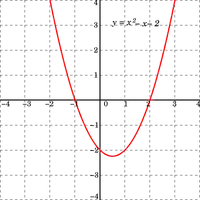
Topic 1 Quadratic Function

Presentation
•
Mathematics
•
11th Grade
•
Practice Problem
•
Hard

NUR SHAHIRAH BINTI EMRAN YUSLI STUDENT
Used 2+ times
FREE Resource
33 Slides • 0 Questions
1

2

Introduction
This Chapter focuses on Quadratic Equations
We will be looking at Drawing and Sketching
graphs of these
We are also going to be solving them using
various methods
As with Chapter 1, some of this material will
have been covered at GCSE level
3

Teachings for Exercise 2A
4


Quadratic Functions
Plotting Graphs
You need to be able to accurately plot graphs of
Quadratic Functions.
The general form of a Quadratic Equation is;
y = ax2 + bx + c
Where a, b and c are constants and a ≠ 0.
This can sometimes be written as;
f(x) = ax2 + bx + c
→ f(x) means ‘the function of x’
2A
5


Quadratic Functions
Plotting Graphs
You need to be able to accurately plot graphs
of Quadratic Functions.
2A
Example
a) Draw the graph with equation
y = x2 – 3x – 4 for values of x from
-2 to +5
b) Write down the minimum value
of y at this point
c) Label the line of symmetry
6
0
-4
-6
-6
-4
0
6
y
10
4
0
-2
-2
0
4
10
x2 -
3x
15
12
9
6
3
0
-3
-6
3x
25
16
9
4
1
0
1
4
x2
5
4
3
2
1
0
-1
-2
x
y = x2 – 3x - 4
BE CAREFUL! Subtract what is in the
‘3x’ box, from the ‘x2’ box.
And subtract 4 at the end…
6


The minimum value occurs at the x
value halfway between 4 and -1
Quadratic Functions
Plotting Graphs
You need to be able to accurately plot graphs
of Quadratic Functions.
-1
2A
Example
a) Draw the graph with equation
y = x2 – 3x – 4 for values of x from
-2 to +5
b) Write down the minimum value
of y
c) Label the line of symmetry
y = x2 – 3x - 4
x
-2
-1
0
1
2
3
4
5
y
6
0
-4
-6
-6
-4
0
6
y = x2 – 3x - 4
4
1.5
Substitute this value into the
equation:
y = x2 – 3x - 4
y = 1.52 – (3 x 1.5) - 4
y = -6.25
7


Quadratic Functions
Plotting Graphs
You need to be able to accurately plot graphs
of Quadratic Functions.
2A
Example
a) Draw the graph with equation
y = x2 – 3x – 4 for values of x from
-2 to +5
b) Write down the minimum value
of y
c) Label the line of symmetry
y = x2 – 3x - 4
x
-2
-1
0
1
2
3
4
5
y
6
0
-4
-6
-6
-4
0
6
y = x2 – 3x - 4
x = 1.5
y = -6.25
8

Teachings for Exercise 2B
9


Quadratic Functions
Solving by Factorisation
You need to be able to solve Quadratic Equations
by factorising them.
A Quadratic Equation will have 0, 1 or 2 solutions,
known as ‘roots’
If there is 1 solution it is known as a ‘repeated
root’
2B
Example
Solve the equation…
a)
29
x
x=
29
0
x
x−
=
(
9)
0
x x −
=
0x =
90
x −=
9x =
Subtract 9x
Factorise
Either ‘x’ or ‘x-9’
must be equal to
0
10


Quadratic Functions
Solving by Factorisation
You need to be able to solve Quadratic Equations
by factorising them.
A Quadratic Equation will have 0, 1 or 2 solutions,
known as ‘roots’
If there is 1 solution it is known as a ‘repeated
root’
2B
Example
Solve the equation…
b)
22
15
0
x
x−
−
=
Factorise
(
3)(
5)
0
x
x
+
−
=
30
x +=
50
x −=
3
x = −
5x =
11


Quadratic Functions
Solving by Factorisation
You need to be able to solve Quadratic Equations
by factorising them.
A Quadratic Equation will have 0, 1 or 2 solutions,
known as ‘roots’
If there is 1 solution it is known as a ‘repeated
root’
2B
Example
Solve the equation…
c)
22
9
50
x
x−
−=
Factorise
(2 )( )
0
x
x
=
Factorising this is slightly different.
→There must be a ‘2x’ at the start of a
bracket
→ The numbers in the brackets must still
multiply to give ‘-5’
→ The number in the second bracket will be
doubled when they are expanded though, so
the numbers must add to give ‘-9’ WHEN
ONE HAS BEEN DOUBLED
Using -5 and +1
→They multiply to give -5
→ If we double the -5, they add to give -9
→ So the -5 goes opposite the ‘2x’ term
(2
1)(
5)
0
x
x
+
−
=
1
2
x = −
5x =
or
12


Quadratic Functions
Solving by Factorisation
You need to be able to solve Quadratic Equations
by factorising them.
A Quadratic Equation will have 0, 1 or 2 solutions,
known as ‘roots’
If there is 1 solution it is known as a ‘repeated
root’
2B
Example
Solve the equation…
d)
26
13
50
x
x
+
−=
Factorise
Factorising this is even more difficult
→ The brackets could start with 6x and x,
or 2x and 3x (either of these would give the
6x2 needed)
→ So the numbers must multiply to give -5
→ And add to give 13 when either;
→One is made 6 times bigger
→One is made twice as big, and the
other 3 times bigger
Using 3x and 2x at the starts of the
brackets
And -1 and +5 inside the brackets…
→ They multiply to give -5
→ They will add to give 13 if the +5 is
tripled, and the -1 is doubled
→ So +5 goes opposite the 3x, and -1
opposite the 2x
(3 )(2 )
0
x
x
=
(3
1)(2
5)
0
x
x
−
+
=
3
10
x − =
2
50
x +=
13
x =
52
x = −
13


Quadratic Functions
Solving by Factorisation
You need to be able to solve Quadratic Equations by
factorising them.
A Quadratic Equation will have 0, 1 or 2 solutions,
known as ‘roots’
If there is 1 solution it is known as a ‘repeated root’
2B
Example
Solve the equation…
e)
25
18
23
x
x
x
−
+
=+
Subtract 2
Subtract 3x
28
16
0
x
x−
+
=
Factorise
(
4)(
4)
0
x
x
−
−
=
40
x −
=
4x =
14


Quadratic Functions
Solving by Factorisation
You need to be able to solve Quadratic Equations by
factorising them.
A Quadratic Equation will have 0, 1 or 2 solutions,
known as ‘roots’
If there is 1 solution it is known as a ‘repeated root’
2B
Example
Solve the equation…
f)
2
(2
3)
25
x −
=
Square root
both sides (2
possible
answers!)
2
3
5
x −=
2
35
x −=
2
3
5
x −= −
2
8x =
4x =
2
2
x = −
1
x = −
15


Quadratic Functions
Solving by Factorisation
You need to be able to solve Quadratic Equations by
factorising them.
A Quadratic Equation will have 0, 1 or 2 solutions,
known as ‘roots’
If there is 1 solution it is known as a ‘repeated root’
2B
Example
Solve the equation…
g)
2
(
3)
7
x −
=
Square root
both sides (2
possible
answers!)
3
7
x −=
3
7
x −=
3
7
x −= −
3
7
x =
−
3
7
x =
+
16

Teachings for Exercise 2C
17


Quadratic Functions
Completing the Square
Quadratic Equations can be written in
another form by ‘Completing the Square’
2C
2x
bx+
2
2
2
2
b
b
x
+
−
Example
Complete the square for the following
expression…
a)
28
x
x+
‘So b/2 is half of the
coefficient of x’
(
)
2
2
4
4
x +
−
If we check by
expanding our answer…
(
)
2
2
4
4
x +
−
(
)
2
4 (
4)
4
x
x
+
+
−
2
2
4
4
16
4
x
x
x
+
+
+
−
28
x
x+
18


Quadratic Functions
Completing the Square
Quadratic Equations can be written in
another form by ‘Completing the Square’
2C
2x
bx+
2
2
2
2
b
b
x
+
−
Example
Complete the square for the following
expression…
b)
212
x
x
+
‘So b/2 is half of the
coefficient of x’
(
)
2
2
6
6
x +
−
(
)
26
36
x +
−
19


Quadratic Functions
Completing the Square
Quadratic Equations can be written in
another form by ‘Completing the Square’
2C
2x
bx+
2
2
2
2
b
b
x
+
−
Example
Complete the square for the following
expression…
c)
23
x
x+
‘So b/2 is half of the
coefficient of x’
(
)
2
2
1.5
1.5
x +
−
(
)
2
1.5
2.25
x +
−
2
2
3
3
2
2
x
+
−
23
9
2
4
x
+
−
With
Decimals
With
Fractions
20


Quadratic Functions
Completing the Square
Quadratic Equations can be written in
another form by ‘Completing the Square’
2C
2x
bx+
2
2
2
2
b
b
x
+
−
Example
Complete the square for the following
expression…
d)
22
10
x
x
+
‘So b/2 is half of the
coefficient of x’
22(
5 )
x
x+
2
2
5
5
2
2
2
x
+
−
25
25
2
2
4
x
+
−
25
25
2
2
2
x
+
−
Factorise
first
Complete the
square inside
the bracket
You can work
out the
second
bracket
You can also
multiply it by
the 2 outside
21

Teachings for Exercise 2D
22


Quadratic Functions
Using Completing the Square
You can use the idea of completing the
square to solve quadratic equations.
This is vital as it needs minimal
calculations, and no calculator is needed
when using surds. (The Core 1 exam is
non-calculator)
2D
Example
Solve the following equation by completing
the square…
a)
28
10
0
x
x+
+
=
28
10
x
x+
= −
(
)
2
2
4
(4)
10
x +
−
= −
(
)
24
10 16
x +
= −
+
(
)
24
6
x +
=
4
6
x +
=
4
6
x = −
Subtract 10
Complete
the Square
Add 16
Square Root
Subtract 4
23


Quadratic Functions
Using Completing the Square
You can use the idea of completing the
square to solve quadratic equations.
This is vital as it needs minimal
calculations, and no calculator is needed
when using surds. (The Core 1 exam is
non-calculator)
2D
Example
Solve the following equation by completing
the square…
b)
22
8
70
x
x−
+=
Divide by 2
2
7
4
0
2
x
x−
+
=
2
7
4
2
x
x−
= −
(
)
2
2
7
2
( 2)
2
x −
− −
= −
(
)
2
1
2
2
x −
=
1
2
2
x −
= 1
2
2
x −
=
1
2
2
x =
Subtract
7/2
Complete
the square
Add 4
Square Root
Add 2
24

Teachings for Exercise 2E
25


Quadratic Functions
The Quadratic Formula
You will have used the Quadratic
Formula at GCSE level.
You can also use it at A-level for
Quadratics where it is more difficult
to complete the square.
We are going to see where this
formula comes from (you do not need
to know the proof!)
2E
2
4
2
b
b
ac
a
−
−
26


Quadratic Functions
The Quadratic Formula
2E
2
0
ax
bx
c
++=
2
0
b
c
x
x
a
a
+
+=
2
b
c
x
x
a
a
+
= −
2
2
2
2
b
b
c
x
a
a
a
+
−
= −
2
2
2
2
4
b
b
c
x
a
a
a
+
−
= −
2
2
2
2
4
b
b
c
x
a
a
a
+
=
−
2
2
2
2
4
2
4
4
b
b
ac
x
a
a
a
+
=
−
2
2
2
4
2
4
b
b
ac
x
a
a
−
+
=
2
2
4
2
4
b
b
ac
x
a
a
−
+
=
24
2
2
b
b
ac
x
a
a
−
+
=
24
2
2
b
b
ac
x
a
a
−
= −
24
2
b
b
ac
x
a
−
−
=
Divide all by a
Subtract c/a
Complete the Square
(Half of b/a is b/2a)
Square the
2nd bracket
Add b2/4a2
Top and
bottom of 2nd
fraction
multiplied by
4a
Combine the
Right side
Square Root
Square Root
top/bottom
separately
Subtract
b/2a
Combine the
Right side
2
2
2
2
4
b
b
c
x
a
a
a
+
=
−
27


Quadratic Functions
The Quadratic Formula
You need to be able to recognise when
the formula is better to use.
Examples would be when the
coefficient of x2 is larger, or when
the 3 parts cannot easily be divided
by the same number.
2E
Example
Solve 4x2 – 3x – 2 = 0 by using the formula.
a = 4 b = -3 c = -2
24
2
b
b
ac
x
a
−
−
=
2
3
3
(4 4
2)
2 4
x
−−
−
=
3
9
32
8
x
− −
=
3
41
8
x
=
3
41
8
x
+
=
3
41
8
x
−
=
28

Teachings for Exercise 2F
29


Quadratic Functions
Sketching Graphs
You need to be able to sketch
a Quadratic by working out
key co-ordinates, and knowing
what shape it should be.
2F
y
x
y
x
y
x
y
x
y
x
y
x
24
2
b
b
ac
x
a
−
−
=
b2 – 4ac is known as the
‘discriminant’
→ Its value determines
how many solutions the
equation has
2
0
ax
bx
c
+
+=
24
0
b
ac−
0a
24
0
b
ac−
=
0a
24
0
b
ac−
0a
24
0
b
ac−
0a
24
0
b
ac−
=
0a
24
0
b
ac−
0a
30


Quadratic Functions
Sketching Graphs
To sketch a graph, you need to work
out;
1) Where it crosses the y-axis
2) Where (if anywhere) it crosses the
x-axis
Then confirm its shape by looking at
the value of a, as well as the
discriminant (b2 – 4ac)
2F
Example
Sketch the graph of the equation;
y = x2 – 5x + 4
Where it crosses the y-axis
The graph will cross the y-axis where
x=0, so sub this into the original equation.
25
4
y
x
x
=
−
+
4y =
Co-ordinate (0,4)
Where it crosses the x-axis
The graph will cross the x-axis where y=0,
so sub this into the original equation.
25
4
y
x
x
=
−
+
2
0
5
4
x
x
=
−
+
0(
4)(
1)
x
x
=
−
−
1 or
4
x
x
=
=
Co-ordinates (1,0)
and (4,0)
(0,4)
(1,0)
(4,0)
31


Quadratic Functions
Sketching Graphs
To sketch a graph, you need to work
out;
1) Where it crosses the y-axis
2) Where (if anywhere) it crosses the
x-axis
Then confirm its shape by looking at
the value of a, as well as the
discriminant (b2 – 4ac)
y = x2 – 5x + 4
2F
(0,4)
(1,0)
(4,0)
Confirmation → a > 0 so a ‘U’ shape
→ b2 – 4ac
→ -52 – (4x1x4)
→ 9
→ Greater than 0 so 2 solutions
y
x
32


Quadratic Functions
Sketching Graphs
You can also use the information on
the discriminant to calculate
unknown values.
You need to remember;
‘real roots’ → b2 - 4ac > 0
‘equal roots’ → b2 – 4ac = 0
‘no real roots’ → b2 – 4ac < 0
2F
Example
Find the values of k for which;
x2 + kx + 9 = 0
has equal roots.
24
0
b
ac−
=
2(4 1 9)
0
k −
=
236
0
k −
=
2
36
k =
Sub in a, b and c from
the equation (b = k!)
Work out the bracket
Add 36
Square Root
33


Summary
We have recapped solving a Quadratic Equation
We have learnt how to use ‘completing the square’
We have also solved questions on sketching graphs and using
the ‘discriminant’
Show answer
Auto Play
Slide 1 / 33
SLIDE
Similar Resources on Wayground

24 questions
Government Response to the Great Depression
Presentation
•
11th Grade
28 questions
Perkalian Matriks
Presentation
•
11th Grade
24 questions
Alg. Unit 3 Lesson 1: Parent Functions
Presentation
•
11th Grade
30 questions
Key Features of Exponential Functions
Presentation
•
10th - 11th Grade
26 questions
Introduction to the Cold War
Presentation
•
11th Grade
26 questions
Subject Verb Agreement SAT
Presentation
•
11th Grade
25 questions
Physical and Chemical Changes Review
Presentation
•
8th Grade
25 questions
Parallelism
Presentation
•
11th Grade
Popular Resources on Wayground
10 questions
Safety Day 2026 – Student Review

Quiz
•
9th Grade
21 questions
Continents and Oceans
Quiz
•
6th Grade
20 questions
Parts of Speech
Quiz
•
5th Grade
16 questions
Subject & Predicate
Quiz
•
5th Grade
25 questions
Multiplication Facts
Quiz
•
5th Grade
12 questions
Map Skills
Quiz
•
3rd Grade
22 questions
Continents and Oceans
Quiz
•
5th Grade
15 questions
Rounding Decimals
Quiz
•
5th Grade
Discover more resources for Mathematics
12 questions
Identify Rigid Transformations
Quiz
•
8th - 12th Grade
10 questions
Complementary, Supplementary, Vertical, and Linear Pairs
Quiz
•
9th - 12th Grade
22 questions
Identify Vertical and Horizontal Translations
Quiz
•
9th - 12th Grade
10 questions
Graphing Inequalities on a Number Line
Quiz
•
9th - 12th Grade
17 questions
Identifying Parallel And Perpendicular Lines
Quiz
•
9th - 12th Grade
18 questions
Integer Operations
Quiz
•
5th - 12th Grade
18 questions
Parallel lines cut by a transversal
Quiz
•
9th - 11th Grade
14 questions
Evaluate Linear Functions and Their Applications
Quiz
•
9th - 12th Grade