

Biology 4.3 and 4.4

Presentation
•
Science
•
9th Grade
•
Medium

Marcus Page
Used 8+ times
FREE Resource
13 Slides • 6 Questions
1
4.3 DNA Structure and Replication
4.4 RNA
2
What You Will Learn
Structure and function of DNA
Chargaff's Rule
DNA replication and DNA polymerase
3
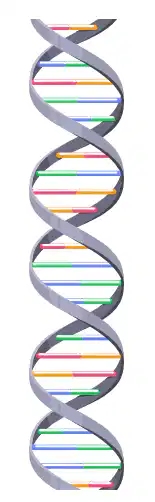
What Does DNA Look Like?
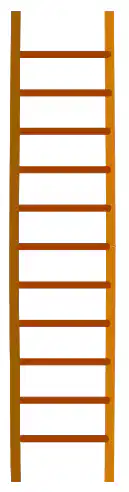
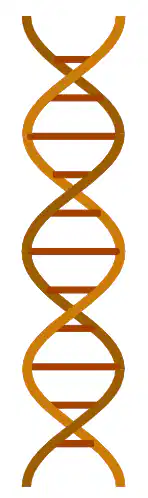
DNA resembles a twisted ladder.
Steps = Nitrogen Bases (A, T, G, C)
Railings = Sugar-phosphate backbone
Scientists use models to study DNA’s complex structure.
4
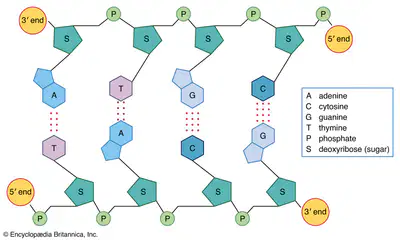
DNA Structure
DNA is made of nucleotides, each with:
Backbone
A sugar (deoxyribose)
A phosphate group
A nitrogen base (A, T, G, or C)
The double helix shape was discovered by Watson and Crick with contributions from Rosalind Franklin using X-ray crystallography.
5
Multiple Choice
The backbone of DNA is made of
base pairs
sugars and phosphates
only sugars
only phosphates
6
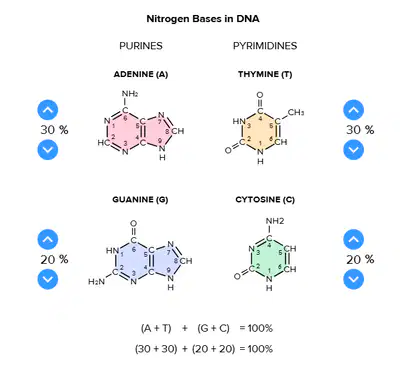
Chargaff's Rule
Discovered by Erwin Chargaff:
Amount of A ≈ Amount of T
Amount of G ≈ Amount of C
This discovery helped understand DNA’s complementary base pairing
7
Multiple Choice
If a DNA molecule has 30% Guanine bases, how many Cytosine bases will it have?
30%
25%
20%
10%
8
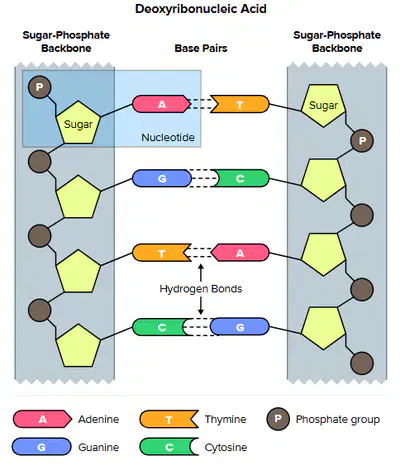
Base Pairing and the Double Helix
Complementary Base Pairing:
A bonds with T (2 hydrogen bonds)
G bonds with C (3 hydrogen bonds)
Keeps the helix uniform in shape.
Steps of the ladder = Base pairs (A-T, G-C)
9
Multiple Choice
Adenine pairs with
Thymine
Thyme
Guanine
Glutamine
10
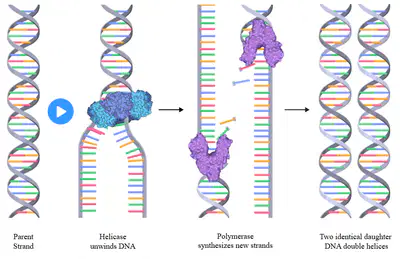
DNA Replication
Occurs in the S phase of the cell cycle.
Key Steps:
DNA helicase separates strands by breaking hydrogen bonds.
DNA polymerase builds new complementary strands.
Semi-conservative process:
Each new DNA molecule = 1 parent strand + 1 new strand.
11
Multiple Choice
The first step in DNA replication is
to unwind and unzip the two strands
to break the backbone in half so the sequence can be copies
to attach new nucleotides
to proof read the sequence
12
Summary
Chargaff’s Rule: A ≈ T, G ≈ C
DNA has a double helix structure with complementary base pairs.
Replication: DNA is copied semi-conservatively.
DNA polymerase ensures accuracy.
13
What You Will Learn
How RNA differs from DNA
Types of RNA and their functions
Role of RNA in protein synthesis
14
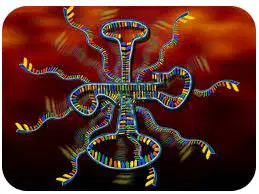
How Information Moves
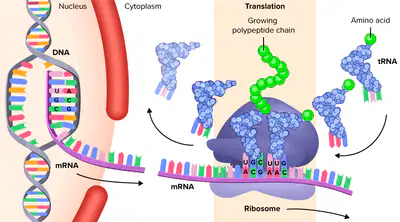
DNA is in the nucleus, proteins are made in the cytoplasm.
RNA acts as the messenger moving genetic information.
Central Dogma: DNA → RNA → Protein
15
RNA vs. DNA
RNA (Ribonucleic Acid):
Works alongside DNA to produce proteins.
Carries instructions from DNA to ribosomes.
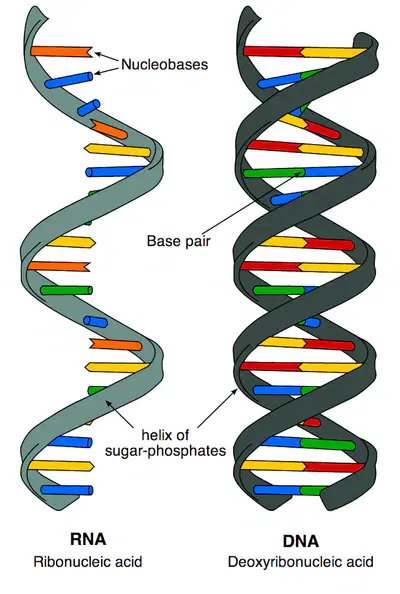
RNA differs from DNA:
Single-stranded (DNA: double-stranded)
Uracil (U) replaces thymine (T)
Contains ribose sugar (DNA: deoxyribose)
16
Multiple Choice
What sugar does RNA have in its backbone?
Ribose
Deoxyribose
Glucose
Fructose
17
RNA and Protein Synthesis
Protein synthesis requires all three types of RNA:
mRNA: Provides the genetic code.
tRNA: Transfers amino acids to the ribosome.
rRNA: Facilitates the assembly of proteins.
18
Multiple Choice
Which molecule exits the nucleus after being made?
RNA
DNA
Water
Energy
19
Summary
RNA is single-stranded, contains ribose, and uses uracil.
Types of RNA:
mRNA: Carries genetic instructions.
rRNA: Forms ribosomes.
tRNA: Transfers amino acids.
RNA is essential for protein synthesis.
4.3 DNA Structure and Replication
4.4 RNA
Show answer
Auto Play
Slide 1 / 19
SLIDE
Similar Resources on Wayground

12 questions
Living Things
Presentation
•
KG
17 questions
Proteins and Nucleic acids
Presentation
•
9th Grade
15 questions
Ecological Succession
Presentation
•
9th Grade
18 questions
Causes and Consequences of Climate Change
Presentation
•
9th Grade
14 questions
Permeability and Porosity
Presentation
•
9th - 10th Grade
14 questions
DNA!
Presentation
•
9th Grade
15 questions
Energy conversions
Presentation
•
9th Grade
15 questions
Exothermic and endothermic reactions
Presentation
•
9th Grade
Popular Resources on Wayground
11 questions
Hallway & Bathroom Expectations

Quiz
•
6th - 8th Grade
10 questions
HCS SCI 03 Summer School Assessment 2
Quiz
•
3rd Grade
11 questions
Home Scope
Quiz
•
7th - 8th Grade
12 questions
2026 TAP Technology in the Classroom
Presentation
•
Professional Development
15 questions
HCS SCI 05 Summer School Assessment 2 Review
Quiz
•
5th Grade
15 questions
HCS SCI 04 Summer School Review 2
Quiz
•
4th Grade
59 questions
Geometry Unit 3 Review
Quiz
•
9th - 12th Grade
14 questions
FAST ELA READING SMAPLE TEST MATERIALS

Passage
•
3rd Grade