
- Resource Library
- Science
- Chemistry
- Endothermic And Exothermic Processes
- Exothermic And Endothermic Reactions

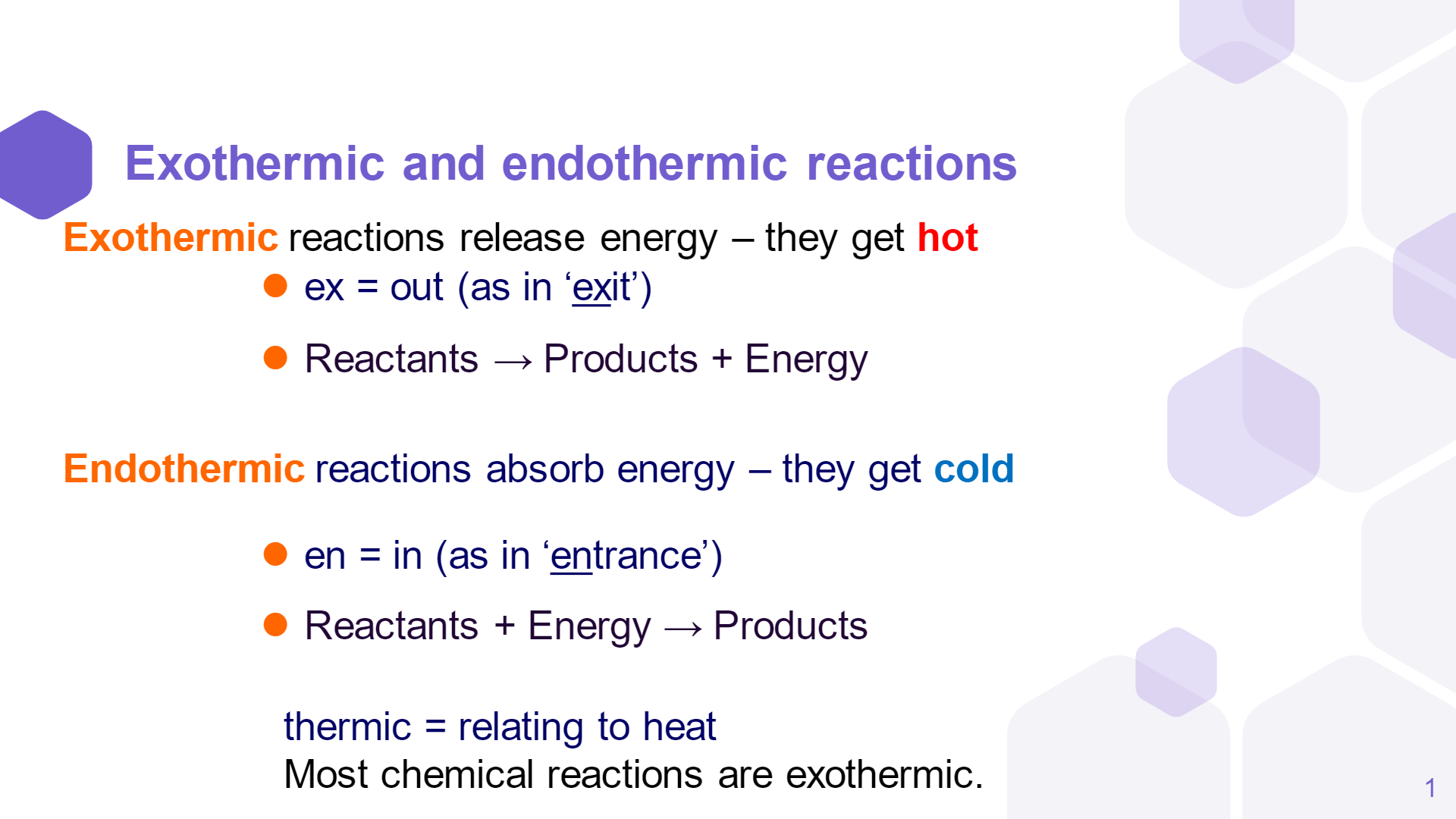
Exothermic and endothermic reactions

Presentation
•
Science
•
9th Grade
•
Practice Problem
•
Medium
Standards-aligned

Fiona Gu
Used 454+ times
FREE Resource
5 Slides • 10 Questions
1
by Miss Gu

2
3

4

5

6
Multiple Choice
1. Equal amounts of four different substances (A-D) where added separately to equal amounts of an acid and a thermometer placed in the mixture. For which substance is the reaction the most exothermic?
A. temperature rises by 3 °C
B. temperature falls by 5 °C
C. temperature falls by 3 °C
D. temperature rises by 5 °C
7
Multiple Choice
2. The breaking of bonds in a chlorine molecule must be?
A. endothermic
B. equilibrium
C. electrolytic
D. exothermic
8
Multiple Choice
3. Which of the following is a chemical change?
A. melting an ice-cube
B. lighting a match
C. cooling a cup of tea
D. dissolving sugar in coffee
9
Multiple Choice
4. Equal amounts of four different substances (A-D) where added separately to equal amounts of an acid and a thermometer placed in the mixture. For which substance is the reaction the least endothermic?
A. temperature falls by 3 °C
B. temperature rises by 5 °C
C. temperature falls by 5 °C
D. temperature rises by 3 °C
10
Multiple Choice
5. When ammonium chloride dissolves in water the temperature falls. The type of energy change is described as?
A. exothermic
B. activated
C. decomposition
D. endothermic
11
Multiple Choice
6. Which of these processes is always exothermic?
A. evaporation
B. burning
C. insulation
D. melting
12
Multiple Choice
7. When an exothermic reaction takes place, the reaction mixture gets hotter because?
A. more energy is released when new bonds are formed than is taken in when existing bonds in the reactants are broken
B. exothermic changes always produce gases
C. energy is always released in a chemical change which makes new substances
D. in an exothermic change the products are more stable than the reactants
13
Multiple Choice
8. When an endothermic reaction takes place, the reaction mixture takes in heat because?
A. in an endothermic change the products are less stable than the reactants
B. less energy is released when new bonds are formed than is taken in when existing bonds in the reactants are broken
C. energy is always absorbed in a chemical change which makes new substances
D. endothermic changes always produce energy
14
Multiple Choice
9. The chemical change when a fuel burns can be described as?
A. a precipitation
B. a reversible reaction
C. an endothermic reaction
D. an exothermic reaction
15
Multiple Choice
10. Change 1. When calcium carbonate forms calcium oxide and carbon dioxide heat is absorbed.
Change 2. Calcium oxide releases heat when shaken with carbon dioxide.
Which line BEST describes these changes?
A. change 1 is exothermic; change 2 is endothermic
B. change 1 is endothermic; change 2 is exothermic
C. change 1 is endothermic; change 2 is endothermic
D. change 1 is exothermic; change 2 is exothermic
by Miss Gu
Show answer
Auto Play
Slide 1 / 15
SLIDE
Similar Resources on Wayground

11 questions
Early Astronomy
Presentation
•
9th Grade
10 questions
Slope given a Graph
Presentation
•
9th Grade
11 questions
Quadratics Attributes/Characteristics
Presentation
•
9th Grade
11 questions
What is a Revolution?
Presentation
•
9th Grade
15 questions
Energy conversions
Presentation
•
9th Grade
13 questions
Physical and Chemical Changes
Presentation
•
8th Grade
12 questions
Intro to Thermochemistry
Presentation
•
10th Grade
13 questions
Photosynthesis
Presentation
•
9th Grade
Popular Resources on Wayground
10 questions
How much do you know about our Portrait of an Eagle?

Quiz
•
10th Grade
10 questions
Fast Food Slogans
Quiz
•
6th - 8th Grade
21 questions
Continents and Oceans
Quiz
•
6th Grade
20 questions
Parts of Speech
Quiz
•
5th Grade
16 questions
Subject & Predicate
Quiz
•
5th Grade
25 questions
Multiplication Facts
Quiz
•
5th Grade
12 questions
Map Skills
Quiz
•
3rd Grade
22 questions
Continents and Oceans
Quiz
•
5th Grade
Discover more resources for Science
10 questions
Exploring Chemical and Physical Changes

Interactive video
•
6th - 10th Grade
20 questions
Atomic Structure
Quiz
•
9th Grade
10 questions
Decoding the Periodic Table of Elements
Interactive video
•
6th - 10th Grade
10 questions
Exploring the Periodic Table
Interactive video
•
6th - 10th Grade
22 questions
Periodic Table Review
Quiz
•
9th - 12th Grade
20 questions
Observation vs. Inference
Quiz
•
7th - 9th Grade
10 questions
Exploring the States of Matter
Interactive video
•
6th - 10th Grade
10 questions
Exploring Physical and Chemical Changes
Interactive video
•
6th - 10th Grade