

The California Gold Rush

Presentation
•
Social Studies
•
5th Grade
•
Practice Problem
•
Easy

Sabrina Wagner
Used 5+ times
FREE Resource
20 Slides • 3 Questions
1
Learners can:
identify the California Gold Rush as a significant event in American history
identify reasons why people from various backgrounds were drawn to California during the gold rush
analyze the causes and effects of the California Gold Rush

2
people in search of gold
prospectors
a method used to separate gold from soil or gravel by swirling the mixed material in a pan with water
panning


3

4
Mexico became independent from Spain in 1821. Fewer than 4,000 people lived in California, part of Mexico at the time, not counting the Native American population.
Many Americans were not attracted to settling in California at the time because if you wanted to own land, you had to ask permission from Mexico City. However, that all changed in the mid-1800s.
5
In 1839, one European, John Sutter, arrived in California from Switzerland.
Sutter became a Mexican citizen and settled on a 50,000-acre ranch in northern California.
He named his ranch “New Helvetia.”
John Sutter

John Sutter became a Mexican citizen and settled in California.
6

7
Draw
What was Sutter's Fort used for?
8
James Marshall played an important role in the gold rush because he was the first person to find gold at Sutter's Mill.
The secret about the gold quickly got out! Prospectors, or people in search of gold, began rushing to California hoping to get rich.
Several of the first prospectors found gold and became rich. Most of the people who arrived later did not find gold or riches.
9

10
Draw
When did the California Gold Rush officially begin?
11
In 1849 alone, about 90,000 people arrived in California in search of gold. These people were called the Forty-Niners because they arrived in 1849.

12
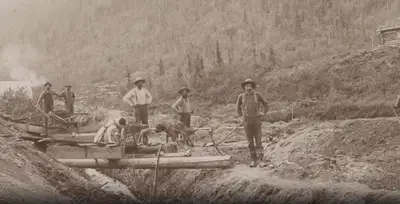
The original miners panned for gold.
Panning was a method used to separate gold from soil or gravel by swirling the mixed material in a pan with water.
Miners would place gravel and water into a pan and shake it back and forth.
Gold is heavy, so it would settle into the bottom of the pan.
Prospectors would work 12- to 16-hour days, six days a week.
Panning For Gold

13
As gold was discovered in different areas, miners would move in and set up camp. These camps sometimes grew rapidly into towns, known as boomtowns.
San Francisco was a boomtown during the California Gold Rush. Its population went from around 1,000 people when gold was first discovered to around 30,000 within a few years.
Most boomtowns did not last, but San Francisco still exists today.
Boomtowns

14
Boomtowns were not just homes for miners.
Businesses selling supplies also followed the gold. Miners needed supplies such as picks, pans, and shovels to dig for gold. They also needed everyday items like food, clothing, and bedding.
Often business owners sold these supplies at high prices because the miners were willing to pay the high prices.
Businesses

15
As the gold ran out in some areas, people moved on to other places in search of gold.
Many boomtowns were often abandoned and became quiet and empty. These became known as ghost towns.
Bodie, California was a boomtown that became a ghost town and later became a popular tourist attraction.
Ghost Towns

16
Settlement in California continued and by the end of the 1850s California's population had grown to 380,000.
San Francisco, Sacramento, and San Diego grew into large cities.
The Native American population in California was greatly reduced by the arrival of others.
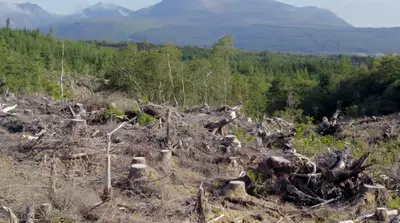
The gold rush also had effects on the environment, including the loss of many forests, soil erosion, and water pollution.
California's nickname is still “The Golden State," named after the gold rush.
Effects of the Gold Rush
17
The California Gold Rush was an important event in the history of the United States because it brought people from all over the world to California.
Some were looking to become rich from gold, and others were looking to start new businesses and make money by selling items to the miners.
This made California grow quickly and become a state faster. It also brought many different cultures to California.
18
The California Gold Rush drew many people West with the promise of riches. Many of them left their families behind in the East.
The Pony Express was a way to quickly send mail back and forth between the East and the West.
The Pony Express

The Pony Express was established in 1860.
19

20
The Pony Express only operated for a year and a half.
Many people used it to send mail, but the price was very high. Another issue included riders being attacked along the way by Native Americans.
In addition, telegraph lines connecting Nebraska and California were finished in 1861, so people began using telegraph lines to communicate.
21
Draw
What were two reasons people from all over the world came to California during the 1850s?
22
Describe two effects that the California Gold Rush had on the state of California.
23
You learned that James Marshall was the first person to spot gold at Sutter's Mill in 1848.
You also learned that California became a popular state in the 1850s due to the California Gold Rush.
Finally, you learned that a new mail delivery system was created during that time called the Pony Express.
Wrap Up
Learners can:
identify the California Gold Rush as a significant event in American history
identify reasons why people from various backgrounds were drawn to California during the gold rush
analyze the causes and effects of the California Gold Rush
Show answer
Auto Play
Slide 1 / 23
SLIDE
Similar Resources on Wayground

20 questions
Studies Weekly 5 Lesson
Presentation
•
5th Grade
20 questions
Common Sense
Presentation
•
4th - 5th Grade
14 questions
Cold War
Presentation
•
5th Grade
18 questions
Republican Government
Presentation
•
6th Grade
20 questions
Colonial Government
Presentation
•
5th Grade
19 questions
Women During the Industrial Revolution
Presentation
•
4th - 5th Grade
21 questions
Mississippian Civilization
Presentation
•
5th Grade
21 questions
Types of Government
Presentation
•
5th Grade
Popular Resources on Wayground
10 questions
How much do you know about our Portrait of an Eagle?

Quiz
•
10th Grade
10 questions
Fast Food Slogans
Quiz
•
6th - 8th Grade
21 questions
Continents and Oceans
Quiz
•
6th Grade
20 questions
Parts of Speech
Quiz
•
5th Grade
16 questions
Subject & Predicate
Quiz
•
5th Grade
25 questions
Multiplication Facts
Quiz
•
5th Grade
12 questions
Map Skills
Quiz
•
3rd Grade
22 questions
Continents and Oceans
Quiz
•
5th Grade
Discover more resources for Social Studies
22 questions
Continents and Oceans
Quiz
•
5th Grade
50 questions
United States Map
Quiz
•
5th Grade
20 questions
13 Colonies Review
Quiz
•
5th Grade
17 questions
3 Branches of Government 5th grade
Quiz
•
5th Grade
20 questions
50 states
Quiz
•
5th - 6th Grade
5 questions
Frances Willard

Interactive video
•
5th Grade
26 questions
Turn of the Century Review
Quiz
•
5th Grade
15 questions
13 colonies
Interactive video
•
5th Grade