Search Header Logo
Heat and Temperature

Heat and Temperature

Assessment

Presentation

Science

5th Grade

Practice Problem

Medium

Created by

Rudi Setyawan

Used 2+ times

FREE Resource

24 Slides • 50 Questions

1

Temperature and Heat

media

2

When you think of the word temperature, you probably think of it as a way to measure heat.    


WRONG!!!!!!!!!

3

There are words that we use in our everyday lives that are incorrectly used in a scientific context. Heat and temperature are two examples. Starting today, you will need to begin thinking about these words differently. 

4

Let's begin by taking a look at the word temperature. Temperature is actually a measure of the average kinetic energy of the atoms or molecules of a substance. Watch the video on the next screen.

5

6

Multiple Choice

As the kinetic energy increases, what happens to temperature?

1

It decreases.

2

It increases.

7

Watch the next video that also shows you that temperature is a measure of kinetic energy.

8

9

We also use the word "heat" incorrectly. Heat is actually a process. Heat is the transfer of energy from a substance at a higher temperature to a substance at a lower temperature. We will be exploring heat in the next lab.

10

Heat and temperature

If a hot body is brought into contact with a cold body, heat will be transferred from the hot body to the cold body. 

 In order to measure the quantity of heat, we must have a suitable heat unit.   

Heat is a form of energy and therefore has the same unit as any other form of energy, ie the joule (J).

media

11

12

Heat

  • the thermal Energy that is transferred from one system to another

  • –Movement of atoms

    –Total potential and kinetic energy of molecular motion in a substance.

    –Depends on speed, number (size and mass), and type of particles.

    –Transfers between objects

    –Units Joules, Calorie

  • symbol is Q, Q = mCΔT

  • A large object can have more heat that a small object with a higher temperature. Ex. water trough and hot cup of coffee

13

Temperature

  • a measurement of the average kinetic energy of the particles in a system

  • –Thermo =heat

    –Meter = to measure

    –Measurement of the average kinetic energy of molecular motion in a substance.

    –Hotness or coldness

    –Does not depend on the speed or type of particle.

    –Units Celcius, K, F

14

media

15

16

media

17

media

18

media

19

media

20

media

21

22

media

23

24

Measuring using a thermometer

The correct technique to read from a thermometer is as shown in Diagram C.

media

25

26

Multiple Choice

How does heat transfer when you hold an ice cube in your hand?

1

from the cold ice cube to your warm hand

2

the cold ice cube makes your hand cold

3

from your warm hand to the cold ice cube

4

very carefully

27

Multiple Choice

McDonald's keeps my Big Macs warm under a heat lamp which transfers heat through

1

conduction

2

convection

3

radiation

4

science stuff

28

Multiple Choice

Smoke rises at a campfire because

1

the heated gas is less dense

2

the heated gas is more dense

3

the heated gas conducts heat to space

4

smoke follows beauty

29

Multiple Choice

When I drink coffee in the morning, I warm my hands on the mug by what type of heat transfer?

1

conduction

2

convection

3

radiation

4

coziness

30

Multiple Choice

Energy that transfers from one substance to another until the temperatures are equal is called...

1

Joe

2

temperature

3

MELTS

4

heat

31

Multiple Choice

Heat transfer is really neat. It always moves from..

1

hot to cold

2

cold to hot

3

big to little

4

stop singing

32

Multiple Choice

When I cook bacon, it touches the pan. It is cooked because

1

heat transfers from the pan to the bacon through convection

2

heat transfers from the pan to the bacon through conduction

3

heat transfers from the bacon to the pan through conduction

4

heat is transferred as energy

33

Multiple Choice

Which type of heat transfer occurs as heat moves in a circular motion in a liquid or gas?

1

conduction

2

convection

3

radiation

4

cooking

34

Multiple Choice

Which type of heat transfer travels through empty space and does need a state of matter?

1

conduction

2

convection

3

radiation

4

waves

35

Multiple Choice

Is heat energy?

1

Yes, its thermal energy

2

No, Temperature is the one that is energy

3

Yes, its Kinetic Energy

4

No, its just a measurement

36

Multiple Select

If a pan is heated at 40°C and then the stove is turned on, is the pan going to instantly get hotter?

1

Yes, the pan will get hot as soon as the stove is on

2

Yes, the pan will get hot after a while

3

No, first it will lower its temperature to get into equilibrium and then it will get hotter

4

No, it is already hot

37

Multiple Choice

How does heat transfer when you hold an ice cube in your hand?

1

from the cold ice cube to your warm hand

2

the cold ice cube makes your hand cold

3

from your warm hand to the cold ice cube

4

very carefully

38

Multiple Select

Some Examples of man-made sources of heat are:

1

Iron

2

Oven

3

Sun

4

Stove

39

Multiple Choice

The liquid material inside the thermometer is called:

1

Water

2

Mercury

3

Silver

4

solution

40

Multiple Choice

How do we measure temperature?
1
In Degrees
2
In Inches
3
In Centimeters
4
In Pounds

41

Multiple Choice

How is heat transferred?
1
From a cooler object to a warmer object.
2
From a warmer object to a cooler object

42

Multiple Choice

What is the meaning of temperature?

1

The amount of water in a container.

2

The size of a shadow.

3

The measure of how cold or hot something is.

4

Celsius

43

Multiple Choice

_______________________ are materials that do not allow heat to move easily through them.

1

Insulators

2

Electricity

3

Sun

4

Conductors

44

Multiple Choice

The temperature of a substance increases as___.
1
the substance expands
2
the average kinetic energy of its particles increases
3
the substance's volume increases
4
the substance's mass increases

45

Multiple Choice

The boiling of water on the Farenheit, Celsius, and Kelvin scales is respectively,____.
1
98.6⁰F, 37⁰C, 310K
2
212⁰F, 100⁰C, 373K
3
68⁰F, 20⁰C, 293K
4
32⁰F, 0⁰C, 273K

46

Multiple Choice

If the particles of two substances have the same average kinetic energy, then___.
1
the specific heats of the substances are identical 
2
the particles will not react chemically
3
the substances have equal thermal energies
4
the substances have equal temperatures

47

Multiple Choice

In which state do particles move fastest and with little effect on each other?
1
ice
2
gas
3
liquid
4
solid

48

Multiple Choice

If the particles in an object have more kinetic energy, what must be true?
1
The object's temperature is lower
2
The object's temperature is higher
3
The object moves faster
4
The object is heavier

49

Multiple Choice

Water boils at 100⁰ C, which is the same as___⁰F.
1
212
2
273
3
32
4
0

50

Multiple Choice

Temperature____ as average kinetic energy decreases.
1
increases
2
decreases
3
stays the same
4
all of the above

51

Multiple Choice

Heat is thermal energy that flows between objects that differ in___.
1
temperature
2
radiation
3
thermal energy
4
specific heat

52

Multiple Choice

A measure of the average kinetic energy of the particles in an object
1
temperature
2
absolute zero
3
thermal expansion
4
none of these are the answer

53

Multiple Choice

The energy transferred between object's at different temperatures
1
heat
2
thermal energy
3
radiation
4
convection

54

Multiple Choice

Thermal energy that flows between an object at a higher temperature to an object at a lower temperature
1
heat
2
thermal expansion
3
insulation
4
specific heat

55

Multiple Choice

What happens to particles of a substance as its temperature increases?
1
the average kinetic energy increases
2
the average kinetic energy decreases
3
the average kinetic energy stays the same
4
nothing happens

56

Multiple Choice

Question image

When we put a spoon in the hot coffee ...

1

... the spoon heats up, because the coffee transfers heat to the spoon.

2

... its temperature remains the same.

3

... the spoon gets colder.

4

... the coffee temperature remains the same.

57

Multiple Choice

Question image

When on a cold day we open the window ...

1

... the cold enters.

2

... the cold goes out.

3

... the heat comes out.

4

... none of the options.

58

Multiple Choice

Question image

We say that two objects brought into contact reach thermal equilibrium when ...

1

... one of the objects gets hotter.

2

... they remain with the same temperature.

3

... the two objects are at the same temperature.

4

... objects increase their temperatures.

59

Multiple Choice

Question image

A substance loses thermal energy (heat) to the surroundings at a steady rate. The graph shows how the temperature of the substance changes with time.

What could the portion PQ of the graph represent?

1

gas condensing

2

gas cooling

3

liquid cooling

4

liquid solidifying

60

Multiple Choice

As the kinetic energy of the molecules in a substance increases, the temperature of the substance __________.
1
increases
2
decreases

61

Multiple Choice

Freezing point is...
1
32 degrees Fahrenheit
2
0 degrees celsius
3
all of the above

62

Multiple Choice

Boiling Point is...
1
212 degrees Fahrenheit
2
100 degrees Celsius
3
Both

63

Multiple Choice

True or False: Body temperature is 98.6 degrees Fahrenheit.
1
True
2
False
3
Maybe

64

Multiple Choice

Heat transfer always goes from-
1
Cold to Hot
2
Hot to Cold
3
Heat doesn't transfer
4
Freezing to Cold

65

Multiple Choice

What happens to particles as they heat up?
1
They slow down
2
Nothing
3
They don't move
4
They speed up

66

Multiple Choice

Question image

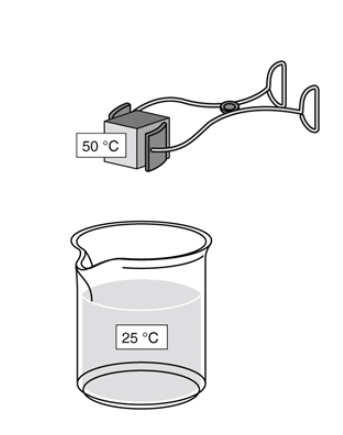
As part of a lab experiment, Tasha drops a metal cube into a beaker of water, as shown in the figure below.


After energy in the form of heat transfers between the substances, what is the final temperature of the water?

1

The final temperature is 25 °C because there is more water than metal.

2

The final temperature is 50 °C because the metal warms the water to the temperature of the metal.

3

The final temperature is between 25 °C and 50 °C because energy is transferred from the metal to the water.

4

The final temperature is between 25 °C and 50 °C because most of the thermal energy is lost to the air around the substances.

67

Multiple Choice

Question image

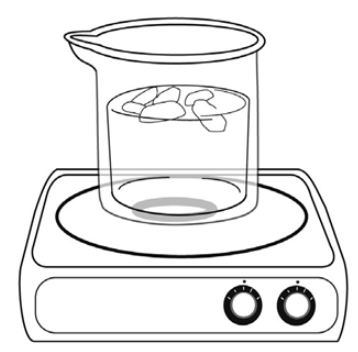
Emerson places a beaker of water on a hotplate and turns the hotplate on. The temperature in the room is 25 ºC. After the water heats to 75 ºC, she adds pieces of ice to the beaker.


Which of the following describes a transfer of heat energy that occurs during this experiment?

1

from the air to the water

2

from the ice to the beaker

3

from the water to the ice

4

from the water to the hotplate

68

Multiple Choice

Question image
Which direction is heat flowing in the picture?
1
from the hand to the ice
2
from the ice to the hand
3
heat is not being transferred
4
there is no way to tell

69

Multiple Choice

Question image

The egg is cooking because heat is transferred from the frying pan via

1

Conduction

2

Convection

3

Radiation

70

Multiple Choice

Question image

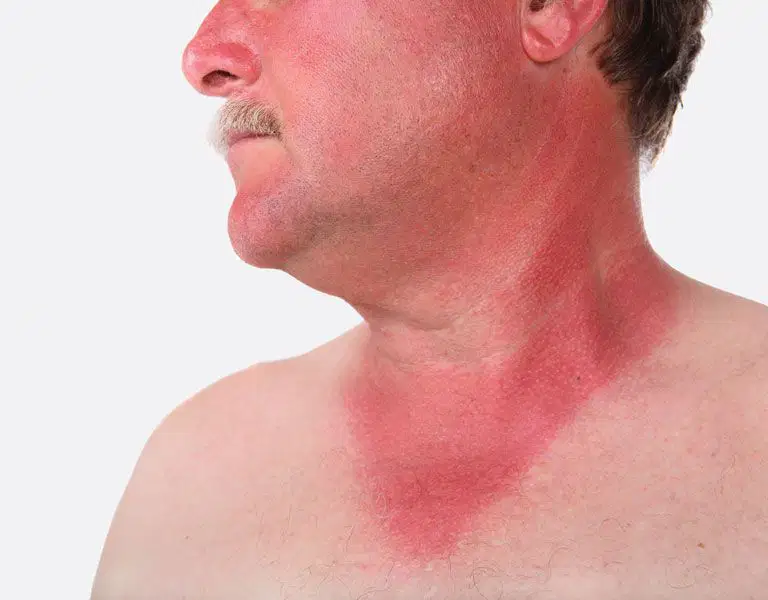
A sunburn is due to

1

conduction

2

convection

3

radiation

71

Multiple Choice

Question image

The movement of water in a boiling kettle is an example of

1

conduction

2

convection

3

radiation

72

Multiple Choice

Question image

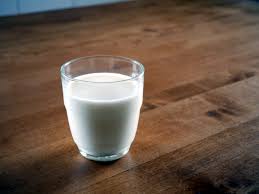
During the summer, Chang takes a glass of milk from the refrigerator and places it on the kitchen counter. Over time, energy as heat is transferred to the milk from the air. Which change would most likely occur?

1

The temperature of the milk will increase.

2

The temperature of the milk will decrease.

3

The milk will change from a liquid to a gas.

4

The milk will change from a liquid to a solid.

73

Multiple Choice

Question image

Kito puts his spoon into a helping of fresh, hot, mashed potatoes as shown in the picture. Which process takes place when the objects come together?

1

The temperature of the spoon increases, but its thermal energy does not change.

2

Energy in the form of heat is transferred by conduction from the warmer mashed potatoes to the cooler spoon.

3

The thermal energy of both the mashed potates and the spoon increase as the energy in the form of heat is transferred between them.

4

The average temperature of the spoon does not change.

74

Multiple Choice

Question image

An ice cube floats in warm water in a container placed outside on a hot, sunny day. Identify the processes by which the warm water contacting the ice cube and the sun warming the air transfer energy.

1

Water transfers energy to ice through radiation. Sun transfers energy to the air through conduction.

2

Ice transfers energy to water through conduction. Air transfers energy to the Sun through radiation.

3

Water transfers energy to ice through conduction. Sun transfers energy to the air through radiation.

4

Both transfer energy through conduction.

Temperature and Heat

media

Show answer

Auto Play

Slide 1 / 74

SLIDE