

Collision phet lab

Presentation
•
Physics
•
9th - 12th Grade
•
Practice Problem
•
Easy
+2
Standards-aligned

Moitreyee Roy
Used 5+ times
FREE Resource
18 Slides • 11 Questions
1
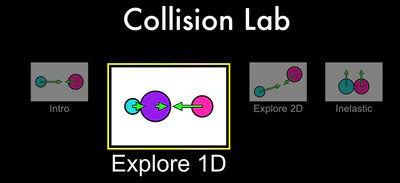
Phet simulation Lab: 1D- collision
2
DO Now (5 mins)
PhET Collision Lab -
Elastic1D (crossout Elastic and write 1D collision)Go to https://phet.colorado.edu/sims/html/collision-lab/latest/collision-lab_en.html
Complete set-up: row 1,2, and 3 in as mentioned in your worksheet.
3
Guided trial
Check if you have the variables set as per #4
Click the play button and answer the questions in the next slide

4
Open Ended
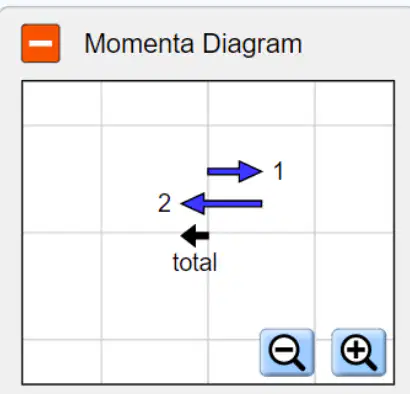
What do you think the black arrow means?
5
Open Ended
What was the total momentum before the collision AND after the collision?
Hint: px refers to the momentum of each ball. The total momentum is both of them added together. In this case it would be “-.25 kg m/s” before the collision.
6
Open Ended

What was the kinetic enrgy before the collision AND after the collision? (Hint: KE in the bottom left is the total KE)
7
5) Describe what happens in your own words
This is an elastic collision (elasticity=100%). As seen in the black arrow, the total momentum is the vector sum of the two momenta (p1 and p2). The total momentum before collision and after collision is the same i.e. the total momentum is conserved during an elastic collision. The total KE is also conserved during elastic collision.The objects bounce back or separate.
8
Independent practice
9
6) Change the table as below

10
Open Ended
What happened to the little black arrow ?
11
Open Ended
What was the total momentum before the collision AND after the collision?
Hint: px refers to the momentum of each ball. The total momentum is both of them added together. In this case it would be “-.25 kg m/s” before the collision.
12
Open Ended
What was the kinetic enrgy before the collision AND after the collision? (Hint: KE in the bottom left is the total KE)
13
7) Describe what happens in your own words
This is an elastic collision (elasticity=100%). The little black arrow disappeared because the total momentum is 0kgm/s. The total momentum before collision and after collision is the same i.e. the total momentum is conserved during an elastic collision. The total KE is also conserved during elastic collision.The objects bounce back or separate.
14
Open Ended
What was different between scenario #4 and #6?
15
Open Ended
Why do you think that was?
16
8) What was different between the two scenarios? Why do you think that was?
In scenario #6 the velocities were just exchanged between the objects after collision which was not the case in scenario #4. I think due to the same mass of the two objects and conservation of momentum, they simply exchanged velocities during collision.
17
Stamp
What is elastic collision?
A collision is elastic when the objects bounce off each other. For elastic collisions the total momentum and the total kinetic energy of the system are conserved (meaning it is same before and after collision.)
18
Inquiry trial 1 (elasticity=50%)
Set the variables according to the table.
50 % elastic (OR partially elastic) collision is most common in our natural world.
Move the Elasticity slider to 50%


19
Predict
20
Test

***Fill in the momentum column in the above table***
21
Open Ended
What is a partially elastic collision?
22
Open Ended
How is it different from elastic collision?
23
Stamp
What is a partially elastic collision?How is it different from elastic collision?
A collision is partially elastic when the the total momentum is conserved but some KE is lost but they still bounce away from each other. During elastic collision both i.e. momentum and KE are conserved but for partially elastic collision does not conserve the kinetic energy during collision.
24
Open Ended
What happens to the KE during partially elastic collision?
25
Inquiry trial 2 (elasticity=0%)
Set the variables according to the table.
0 % elastic (OR completely inelastic)


Move the Elasticity slider to 0%
26
Predict

27
Test

***Fill in the momentum column***
28
Stamp
What is an inelastic collision? How is it different from elastic collision?
During an inelastic collision, the objects stick together and become one mass. It loses a large amount of kinetic energy during collision. The system's total momentum is conserved. During elastic collision, the objects bounce off each other and the total kinetic energy of the system is conserved.
29
Exit ticket (5 mins)

Phet simulation Lab: 1D- collision
Show answer
Auto Play
Slide 1 / 29
SLIDE
Similar Resources on Wayground

22 questions
La Famille Simpson
Presentation
•
9th - 12th Grade
22 questions
Trophic Levels, Food Chains, and Food Webs Review
Presentation
•
9th - 12th Grade
19 questions
SPEED, VELOCITY & ACCELERATION
Presentation
•
8th - 12th Grade
23 questions
3.3 Fluids
Presentation
•
9th - 12th Grade
23 questions
Energy Resources
Presentation
•
10th - 12th Grade
22 questions
Me gusta reading comprehension
Presentation
•
9th - 12th Grade
22 questions
Joint and Marginal Frequency
Presentation
•
9th - 12th Grade
22 questions
Quadratic Word Problems
Presentation
•
9th - 12th Grade
Popular Resources on Wayground
16 questions
Grade 3 Simulation Assessment 2

Quiz
•
3rd Grade
19 questions
HCS Grade 5 Simulation Assessment_1 2526sy
Quiz
•
5th Grade
10 questions
Cinco de Mayo Trivia Questions

Interactive video
•
3rd - 5th Grade
17 questions
HCS Grade 4 Simulation Assessment_2 2526sy
Quiz
•
4th Grade
24 questions
HCS Grade 5 Simulation Assessment_2 2526sy
Quiz
•
5th Grade
13 questions
Cinco de mayo
Interactive video
•
6th - 8th Grade
20 questions
Math Review
Quiz
•
3rd Grade
30 questions
GVMS House Trivia 2026
Quiz
•
6th - 8th Grade
Discover more resources for Physics
11 questions
Electricity Explained
Interactive video
•
9th - 12th Grade
18 questions
Series and Parallel Circuits
Quiz
•
9th Grade
15 questions
waves and wave properties
Quiz
•
9th - 12th Grade
35 questions
Electricity and Magnetism SPS10
Quiz
•
8th - 10th Grade
10 questions
Exit Check 7.1 Intro to Waves
Quiz
•
9th Grade
10 questions
Exit Check 7.2: Electromagnetic Waves
Quiz
•
9th Grade
10 questions
Exit Check 7.3 - Analog and Digital
Quiz
•
9th Grade
18 questions
Unit 1 and 2 Concepts Review
Quiz
•
9th - 12th Grade