

Presidential Powers (Without Questions)

Presentation
•
Social Studies
•
8th Grade
•
Practice Problem
•
Hard

Ross Bowdridge
Used 1+ times
FREE Resource
19 Slides • 0 Questions
1
Presidential Powers

We learned in previous lessons about the powers of the Presidency, as laid out by the U.S. Constitution. But some of the powers that presidents use today are not named in the Constitution.
Over the next few lessons, we’ll be exploring what the Presidency has looked like in action, from 1789 to the present to answer the question: How has presidential power evolved over time?
2
Powers that are named in the Constitution are known as Expressed Powers, Constitutional Powers or the Enumerated Powers. Regardless of which term you use, these powers are ones given directly to the president in the United States Constitution.
These presidential powers are the ones we’ve already explored a little bit. They include powers like:
The power to veto laws
The power of appointment
Types of Presidential Powers
3

Powers that are not directly named in the Constitution, but that Presidents have said they need in order to do the things that are named in the Constitution. These are often called “implied” powers. These presidential powers are a little trickier, because not everyone agrees on what powers the president needs in order to do their job. They include powers like:
The power, as Executive and Commander in Chief, to take actions during emergencies that otherwise wouldn’t be allowed
The power, as Commander in Chief, to use the military without a declaration of war
The power, as Chief Executive, to issue executive orders
Implied Powers
4
When the role of the President was created, one of the reasons people thought it was important to have a single executive was so they could respond quickly in situations that required quick action.
An emergency power is an action the president can take during emergencies, which otherwise would not be allowed.
Congress has given some specific powers to the President that can be used in cases of emergency. Presidents have also claimed the power to do certain things in times of national emergency, without an official sign off from Congress.
The President's Emergency Powers
5
The moment the president declares a “national emergency” - a decision that is entirely up to the president- more than 100 special special presidential actions become available to him. For instance, the president can, with the flick of his pen, activate laws allowing him to shut down many kinds of electronic communications (telephone, text messaging, social media sites) inside the United States or even freeze Americans’ bank accounts.
The president has access to a wide variety of emergency powers. Even if the crisis at hand is, say, a nationwide crop shortage, the president may activate the law that allows the secretary of transportation to seize privately owned vessels at sea.
So far, even though presidents have often advanced questionable claims of constitutional power, awful abuses have been rare, and most of the [powers] available during a national emergency have never been used. But what’s to guarantee that this president, or a future one, will show the restraint of his predecessors?
Emergency Powers
6
Japanese Internment Camps - WWII
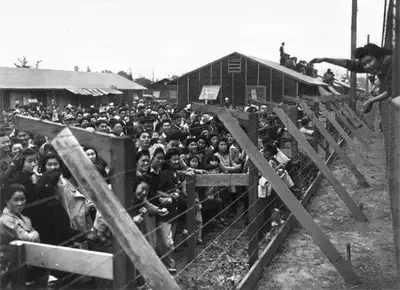
Following the attacks on Pearl Harbor by the Japanese, President Roosevelt issued an Executive Order that required any person of Japanese heritage living in the United States to move into "camps" for Japanese people.
During World War II, about 120,000 people of Japanese heritage were forced to live in these camps, 70,000 of these people were U.S. citizens.
War Powers - World War II

7
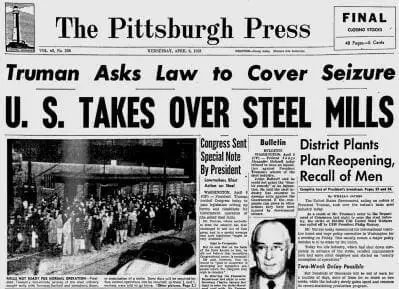
In 1952, during the Korean War, president Harry Truman used his "emergency powers" to seize private property from the Youngstown Steel company.
Steel was an extremely important supply during the Korean War because it was to build military equipment like tanks, ships, airplanes, weapons, and ammunition. However, in 1952 steel workers across the country were getting reading to go on strike after negotiations over pay were unsuccessful.
Youngstown Sheet & Tube Company v. Sawyer
8
When the steel workers went on strike in 1952, President Truman used a power given to the president in 1948. This power allowed the president to take over industry facilities that were unable to fill their government orders for wartime products.
Even though the steel industry was still successfully filling the orders of steel that the government had placed during the strike, Truman felt he had the power to seize and take over the steel industry in the United States. He felt this way because the Constitution says that as commander-in-chief, the president can make all decisions related to the military for the United States.
Steel Strike of 1952
9
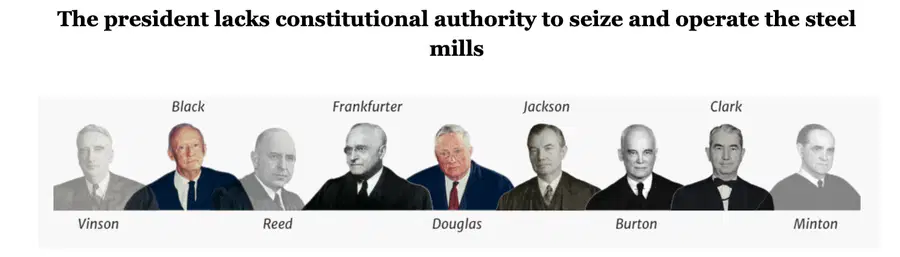
On April 8, 1952 President Truman issued Executive Order 10340 to seize control of the steel industries. The companies sued the federal government which resulted in a Supreme Court case to determine whether or not the president overstepped his Constitutional powers in the steel seizures.
The companies responded by suing the United States government which resulted in a Supreme Court case to determine whether or not Truman overstepped his Constitutional powers in the steel seizures. In a 6-to-3 decision, the Court held that the President did not have the authority to issue the order. The Court found that there was no law that allowed the President to take possession of private property. The Court also held that the President's military power as Commander in Chief of the Armed Forces did not extend to labor disputes.
Youngstown Sheet & Tube Company v. Sawyer
10
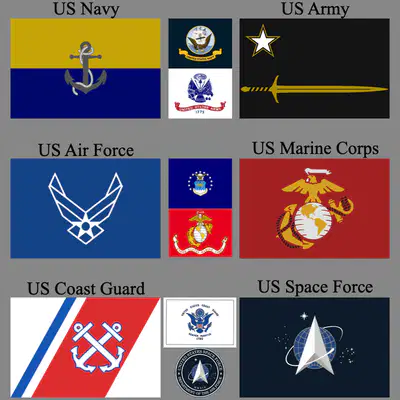
“The President shall be Commander in Chief of the Army and Navy of the United States, and of the Militia of the several States, when called into the actual Service of the United States”
Presidential Use of the Military
That’s what the Constitution says about the President’s power over the military. It also gives Congress the power to declare war.
So… the President can command the military, but only if Congress declares war first, right?
11
Not
Exactly!
The Answer To That Question

12
The president can actually use the military in other circumstances, such as:
Suppressing insurrections
They can use the military to prevent an uprising of the citizens and/or the overthrow of the
government
Enforcing federal laws
They can use the military to enforce federal laws if regular procedure will not work.
Responding to national emergencies
They can use the military to respond to natural disasters, terrorist attacks, or public health
emergencies.
Restoring public order
They can use the military to restore public order, if a state is unable to maintain it.
13
An Example From History
Today, we’ll learn about a time that a President deployed US troops within the country.
We’ll get some background on the events, and then we’ll read letters people wrote to the President, sharing their thoughts about how he had used his presidential power.

14
Little Rock, Arkansas (1957)
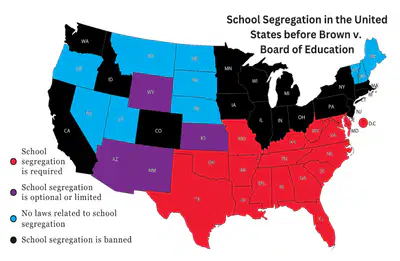
Until the year 1954, school segregation was legal in the United States.
School segregation was when schools legally separated students by race, meaning there were schools only white students could attend and schools only students of color could attend. This was required in 17 states, plus Washington D.C., and allowed in 4 additional states.
15
Brown v. Board of Education
In a famous Supreme Court case called “Brown v. Board of Education,” school segregation was found unconstitutional.
Schools were expected to integrate (which means they were supposed to allow students to attend any school, regardless of their race).
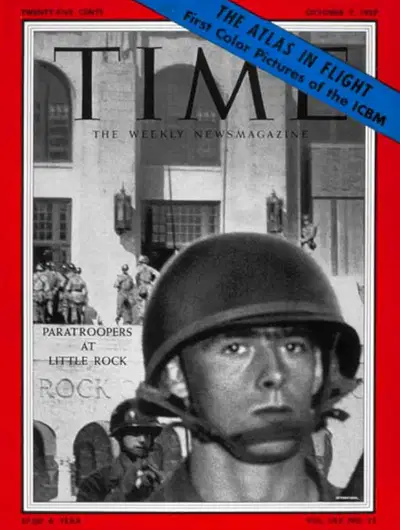
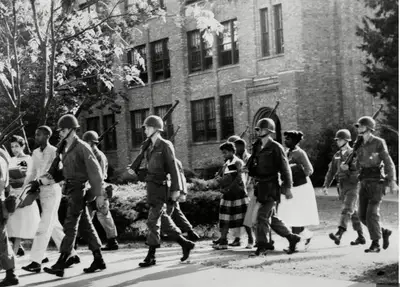
However, in 1957, when nine Black students attempted to attend classes at the previously all-white Central High School in Little Rock, Arkansas, the Governor of Arkansas used the state’s national guard to prevent them from entering the building.
16
The Little Rock Nine
In response to the governor of Arkansas, President Eisenhower used his role as the Commander in Chief of the military end segregation at Little Rock High School. To do this, Eisenhower used the Insurrection Act. The Insurrection Act is a law that empowers the president to use the U.S. military to put down civil disorder, insurrection, or rebellion.
President Eisenhower sent the military to Little Rock High School to protect the 9 black students who became known as the Little Rock 9. The soldiers you see in the picture to the left were there to ensure that the black students could attend school safely. These soldiers were there when they entered the building, exited the building and even attend classes with the students.
Members of the military were present at Little Rock High School from September of 1957 until May of 1958.
17
18
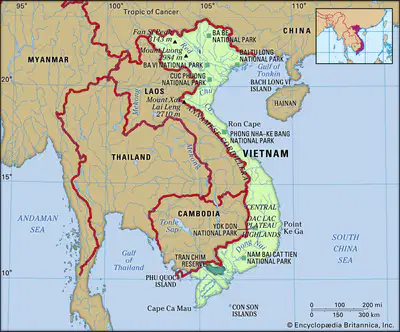
The answer to this question is yes. In fact, from 1965 until 1973 the United States used the military to fight alongside the South Vietnamese in a civil war in the country of Vietnam. Prior to 1965
Congress approved the use of troops in Vietnam in 1965, but the U.S. military had been working alongside the South Vietnamese as "advisors" since the year 1955. Between 1955 and 1973 roughly 2.7 million U.S. soldiers served and faught in this war, even though the United States and Congress never declared war on the country.
Can the president use the military if there is no war?
19
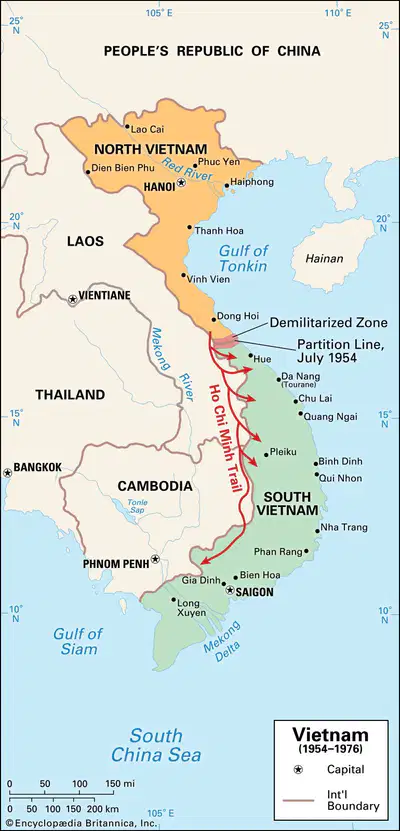
Fighting in Vietnam continued after the United Staes left in 1973 and continued until 1975 when the North Vietnamese captured the city of Saigon, the capital city of South Vietnam. The country of Vietnam has been united since the war the ended in 1975, but the country estimates that somewhere between 1 and 2 million Vietnamese citizens were killed during the conflict.
More than 58,000 U.S. military members died fighting in Vietnam, and another 153,000 were wounded. Many Vietnam War veterans have experienced long-term health effects, including mental health conditions and health issues caused by exposure to toxic chemicals.
The Vietnam War?
Presidential Powers
We learned in previous lessons about the powers of the Presidency, as laid out by the U.S. Constitution. But some of the powers that presidents use today are not named in the Constitution.
Over the next few lessons, we’ll be exploring what the Presidency has looked like in action, from 1789 to the present to answer the question: How has presidential power evolved over time?
Show answer
Auto Play
Slide 1 / 19
SLIDE
Similar Resources on Wayground

12 questions
Erie canal
Presentation
•
8th Grade
11 questions
The Impact of the Euro
Presentation
•
7th - 8th Grade
14 questions
French and Indian War
Presentation
•
7th Grade
14 questions
Applying the Five Themes of Geography
Presentation
•
7th Grade
11 questions
Articles of Confederation
Presentation
•
8th Grade
17 questions
Declaration of Independence
Presentation
•
8th Grade
14 questions
Texas Revolution
Presentation
•
7th - 8th Grade
15 questions
Causes of WWI
Presentation
•
8th Grade
Popular Resources on Wayground
16 questions
Grade 3 Simulation Assessment 2

Quiz
•
3rd Grade
19 questions
HCS Grade 5 Simulation Assessment_1 2526sy
Quiz
•
5th Grade
10 questions
Cinco de Mayo Trivia Questions

Interactive video
•
3rd - 5th Grade
17 questions
HCS Grade 4 Simulation Assessment_2 2526sy
Quiz
•
4th Grade
24 questions
HCS Grade 5 Simulation Assessment_2 2526sy
Quiz
•
5th Grade
13 questions
Cinco de mayo
Interactive video
•
6th - 8th Grade
20 questions
Math Review
Quiz
•
3rd Grade
30 questions
GVMS House Trivia 2026
Quiz
•
6th - 8th Grade
Discover more resources for Social Studies
18 questions
SS8H9 GMAS PREP
Quiz
•
8th Grade
6 questions
N2Y: May the 4th be with You
Presentation
•
5th - 8th Grade
51 questions
Civics EOC Review
Quiz
•
7th - 8th Grade
10 questions
Exploring the Age of Exploration: Key Events and Figures
Interactive video
•
6th - 10th Grade
7 questions
20th Century Texas Politics Lesson
Presentation
•
6th - 8th Grade
25 questions
Civics EOC Review
Quiz
•
6th - 8th Grade
48 questions
Georgia Studies Milestone Review
Quiz
•
8th Grade
34 questions
SE Asia Study Guide
Quiz
•
6th - 8th Grade