

Untitled lesson

Presentation
•
Science
•
KG
•
Practice Problem
•
Hard

Aileen Cirunay
Used 1+ times
FREE Resource
50 Slides • 0 Questions
1

DIVISION OF NAVOTAS CITY
S.Y. 2021-2022
NAVOTAS CITY PHILIPPINES
Science
Quarter 4
7
2

Science – Grade 7
Alternative Delivery Mode
Quarter 4
Second Edition, 2021
Republic Act 8293, section 176 states that: No copyright shall subsist in any work of
the Government of the Philippines. However, prior approval of the government agency or office
wherein the work is created shall be necessary for exploitation of such work for profit. Such
agency or office may, among other things, impose as a condition the payment of royalties.
Borrowed materials (i.e., songs, stories, poems, pictures, photos, brand names,
trademarks, etc.) included in this module are owned by their respective copyright holders.
Every effort has been exerted to locate and seek permission to use these materials from their
respective copyright owners. The publisher and authors do not represent nor claim ownership
over them.
Published by the Department of Education
Secretary: Leonor Magtolis Briones
Undersecretary: Diosdado M. San Antonio
Printed in the Philippines by ________________________
Department of Education – Navotas City
Office Address:
BES Compound M. Naval St. Sipac-Almacen Navotas City
____________________________________________
Telefax:
____________________________________________
E-mail Address:
____________________________________________
Development Team of the Module
Writers: Maria Kristina C. Tapia, Maria Rosario N. Pongasi, Karl Erniell D. Arambulo,
Sarah Faith E. Trinidad, Mary Rozelle I. Dionisio, Lawrence Jay S. Santos
Editor: Rahny S. Pepito
Reviewer: Russell P. Samson
Illustrators: Mary Rozelle I. Dionisio, Maria Kristina C. Tapia, Sarah Faith E. Trinidad,
Lawrence Jay S. Santos
Layout Artist: Rahny S. Pepito
Management Team: Alejandro G. Ibañez, OIC- Schools Division Superintendent
Isabelle S. Sibayan, OIC- Asst. Schools Division Superintendent
Loida O. Balasa, Chief, Curriculum Implementation Division
Russell P. Samson, EPS in Science
Grace R. Nieves, EPS In Charge of LRMS
Lorena J. Mutas, ADM Coordinator
Shirley Eva Marie V. Mangaluz, Librarian II LRMS
Vergel C. Eusebio, PDO II LRMS
02-8332-77-64
navotas.city@deped.gov.ph
3


Table of Contents
What I Know .................................................................................... 1
Module 1 ......................................................................................... 2
Module 2 ......................................................................................... 8
Module 3 ......................................................................................... 12
Module 4 ......................................................................................... 18
Module 5 ......................................................................................... 23
Module 6 ......................................................................................... 27
Module 7 ......................................................................................... 35
Assessment ..................................................................................... 42
Answer Key ...................................................................................... 43
Reference ......................................................................................... 45
4

1
Directions: Choose the letter of the best answer. Write the chosen letter on a separate
sheet of paper.
1.When measuring the lines of latitudes, always begin with the _______ which
represent 0 degrees.
A.prime meridian
B.tropic of cancer
C.equator
D.northern hemisphere
2.Which bodies of water is located west of the Philippines?
A.Philippine Sea
B.Pacific Ocean
C.Sulu Sea
D.South China Sea
2.What statement tells sustainable or proper use of natural resources?
A.Keep on lights when not in use.
B.Use car when going to nearby places.
C.Start community/home garden.
D.Throw garbage everywhere.
3.Why does ozone layer important for living organisms?
A.It increases Earth’s surface
B.It facilitates cloud formation
C.It makes breathing more comfortable
D.It protects us from Sun’s harmful UV rays
5.During the day, how do the temperatures of land and water compare?
A.land is warmer
B.water is warmer
C.it depends on the type of land
D.they are the same temperature
6.What does ITCZ stands for?
A.Intertropical Concurrence Zone
B.Intercontinental Concurrence Zone
C.Intertropical Convergence Zone
D.Intercontinental Convergence Zone
7.How long does it take to make one revolution around the Sun?
A.24 hours
B.365 days
C.30 days
D.12 hours
8.The orbital plane of a revolving body is the geometric plane in which its orbit lies.
Earth’s orbital plane is tilted_________.
A.23.5°
B.22.5°
C.23.0°
D.20.5°
9.Which of the illustrations shows equinox?
A.A only
B.B only
C.Both A and B
D.None of the above
10.If the Sun-Moon-Earth are in parallel position, what celestial body blocks the
light?
A.Moon
B.Earth
C.Sun
D.Star
A
B
5


2
MODULE 1
This module was designed and written with you in mind. It is here to help you
demonstrate how places on Earth may be located using a coordinate system. The
scope of this module permits it to be used in many different learning situations. The
language used recognizes the diverse vocabulary level of students. The lessons are
arranged to follow the standard sequence of the course. But the order in which you
read them can be changed to correspond with the textbook you are now using.
The module is composed of two lessons, namely:
Lesson 1.1: Locating through Imaginary Lines
Lesson 1.2: The Philippine Archipelago
After going through this module, you are expected to:
1.Identify and describe imaginary lines in the globe/map used in locating places.
2.Locate places on a map using a coordinate system.
3.Describe the location of the Philippines using latitude and longitude and
identify the major bodies of water and landmasses surrounding it.
4.Infer the importance of the location of the Philippines with respect to the
continents and oceans of the world
Lesson
1.1
Locating through
Imaginary Lines
Latitude and longitude are imaginary lines drawn on maps or globe, which
helps to locate places. Latitude is an imaginary circle around the Earth halfway
between the North Pole and the South Pole. The starting point for latitude is the
equator which is at 0° (0 degree). At the North Pole, the latitude is 90° N (90 degrees
north). At South Pole the latitude is 90° S (90 degrees south).
The starting point for longitude is the Prime Meridian. The longitude runs
from north to south through Greenwich England, which is measured in 360 degrees.
The Prime Meridian is at 0° (0 degree) longitude. To the right of the Prime Meridian
longitude is written 15° E (15 degrees east) 30° E (30 degrees east) and so on. To the
6


3
left of the Prime Meridian longitude is written 15° W (15 degrees west) 30° W (30
degrees west) and so on.
Lines on a map running parallel to the equator are called lines of latitude.
Latitude is the distance in degrees north or south of the equator. The equator, which
serves as the reference point for latitude, is numbered 0° latitude. The poles are each
numbered 90° latitude. Latitude is thus measured from 0° at the equator to 90° at
the poles. To locate positions in east and west directions use lines of longitude, also
known as meridians. Longitude is the distance in degrees east or west of the prime
meridian, which is the reference point for longitude. The prime meridian represents
0° longitude.
Activity 1.1
Directions: Using your map or globe name the different lines of latitude.
Latitude
Name
0⁰
23.5⁰N
23.5⁰S
66.5⁰N
66.5⁰ N
Activity 1.2
Part I
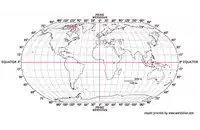
Directions: Use the illustration below to answer the following questions.
Figure 1. Imaginary Line on the Globe
7

4
1.Which ocean is located at 10° S, 75 °E?
2.Which ocean is located at 30° N, 150 °W?
3.Where should you look if you want to find 60 °W?
4.Where should you look if you want to find 90 °W?
5.Not all lines of longitude are shown on a globe. Where should you look if you
want to find 40 °E? How about 40 °W?
6.What does the longitude 180° represent on the illustration mark?
7.The globe does not show all liines of latitudes. Where should you look if you
wish to find 50 °S?
8.How is longitude and latitude measured?
9.Philippines is located North of the globe, how will you describe the exact
location of Philippines using the lines of latitude as refence point.
10.Describe the location of the Philippines using latitude and longitude.
Part II
Directions: Using a globe or map name the cities near the given coordinates.
Part III
Directions: Using a globe or map, to the nearest whole degree, estimate the latitude
and longitude of the following cities. Your answer may be plus or minus two degrees
from the exact answer.
Latitude
Longitude
City
40 ⁰N
2 ⁰E
55 ⁰N
37 ⁰E
34 ⁰S
141 ⁰E
51 ⁰N
0 ⁰W
City
Estimated Latitude
Estimated Longitude
Tokyo
Melbourne
Lima
Manila
Milan
8


5
Lesson
1.2
The Philippine Archipelago
The Philippines is an Archipelago located in Southeast Asia. It is positioned at
the western edge of the Pacific Ocean. It is among the largest archipelago in the
worlds with more than 7000 individual islands. Using latitude and longitude is not
the only way to describe the location of a certain area or country like Philippines.
Another way to describe the location of an area is by identifying its landmasses and
bodies of water surrounding it. There are three main islands in the Philippines
namely: Luzon group, which includes Luzon, Mindoro, and Palawan; the Visayas
group which include Panay, Masbate, Negros, Cebu, Bohol and Samar; and
Mindanao groups which includes Mindanao and the Islands in the Sulu Sea. While
some bodies of water surrounding the Philippines are South China Sea, Celebes Sea,
and Pacific Ocean.
Knowing the latitude and altitude is not the only way that you can describe
the location of a certain country or area. Identifying landmassess and bodies of water
surrounding it can be used also to describe the location of a certain area. A landmass
is a large region or area of land,it is often used to refer to lands surrounded by an
ocean or sea, such as a continent or a large island. There are classifications of bodies
of water: Oceans, seas, lakes, rivers, and canals. Examples of oceans are Atlantic,
Pacific, Indian, Arctic, and Southern Ocean. Can you know describe the location of
Philippines by using latitude and longitude? How will you describe location of the
Philippines through landmasses and bodies of water surrounding it?
Activity 1.3
Directions: Locate the islands and bodies of water mentioned above using the
Philippine Map.
9


6
Activity 1.4
Directions: Use the provided world map to locate the Philippines, then label the map
using the following information inside the box.
https://worldpopulationreview.com/country-locations/where-is-philippines
Philippines
Philippine Sea
Asian Continent
South China Sea
Indonesia Archipelago
Indian Ocean
Australian Continent
Pacific Ocean
10


7
Questions:
a.Is finding locations on the globe the same as locating those locations on a
map?
b.Where is the Philippines in the world map or globe?
c.Why is Philippines called an archipelago?
d.Which bodies of water is in the east of the Philippines? At the west of the
Philippines?
e.Which landmass is found to the north of the Philippines?
f.Aside from latitude and longitude how can you locate Philippines?
g.Why is knowing the Philippine location important?
Activity 1.5: True or False
Directions: Write C if you think that the statement is true and W if the statement is
false and change the underlined word to make it true.
1.All locations East and West of the Prime meridian have longitudes from 0° to
180°.
2.The Philippines is located at a latitude of 14° N and a longitude of 121° E, that
said, the Philippines is above the equator and part of the northern
hemisphere.
3.The Prime Meridian divides the globe into a Northern Hemisphere and a
Southern Hemisphere.
4.Latitudes are imaginary horizontal lines that run from east to west across the
globe or map.
5.Lima Peru City is located 1° N of the equator, and 104° E of the Prime
Meridian.
Activity 1.6
Directions: Complete the concept map about the location of the Philippines, as well
as the landmasses and bodies of water that surround it.
11



8
MODULE 2
This module was designed and written with you in mind. It is here to help you
cite and explain ways of using Earth’s resources sustainably. The scope of this
module permits it to be used in many different learning situations. The language
used recognizes the diverse vocabulary level of students. The lessons are arranged
to follow the standard sequence of the course. But the order in which you read them
can be changed to correspond with the textbook you are now using.
This module has one lesson namely:
Lesson 2: Sustainable Earth’s Resources
After going through this module, you are expected to:
1.Identify and describe the uses of renewable and non-renewable resources.
2.Explain ways on how to sustain Earth’s resources.
3.Identify the human activities that affect the natural resources and describe
their effects.
4.Suggest ways to reduce the negative effects of human activities on natural
resources.
Lesson
2
Sustainable Earth’s
Resources
Our planet Earth’s principal region is composed of air, water, and land where
living things live and survive. Materials found in nature that can be used by people
to meet their needs and support life are called natural resources. These resources
may be renewable which can be used and replaced like sunlight, plants, animals,
and nonrenewable which cannot easily be replaced when used up and take a long
period of time to regenerate like fossil fuels such as coal, oil, natural gas.
Philippines is rich in natural resources. These resources are grouped into
mineral resources which refer to metal deposits and non-metal deposits mined from
the earth. Forest resources protect shorelines, maintain, and provide water quality,
clean air, and wildlife habitats. Agricultural resources contribute to the
preparation, production and marketing of crops, livestock, and its products and
lastly. Marine resources include materials found in the ocean.
12


9
Natural resources are all around us. All life depends on these resources, and
we are using and wasting them up which can cause serious environmental problems
such as: air, water, and land pollution, that lead to decrease in biodiversity. To
sustainably use natural resources we need to think, practice and care which we use
and how we use them so all living things can benefit for now and in the future.
People always need natural resources to live, if they are carelessly used, it will
end up destructing them. So, when we utilize resources, we should keep in mind the
need to save so some will be left for the future generations.
Sustainable use of Earth’s resources are practices that intend to protect and
conserve energy and it occurs when consumption of available materials can last
without harming the environment. To do this we should try to:
•use more renewable resources, like wind and sun’s energy to generate
electricity instead of non-renewable resources, such as fossil fuels.
•promote sustainable natural resources rules and practices for fishing,
agriculture, mining, and logging industry.
•practice reducing, reusing, and recycling systems.
Activity 2.1: Renewable or Non-renewable Resource
Directions: Use the Venn diagram to show similarities and differences of renewable
and non-renewable resources.
Natural Resources
Can be replaced
Cannot be easily
replaced
Coal
Water
Trees
Natural Gas
Animals
Sunlight
Wind gasoline
Gasoline
Oil
Metal
Soil
Lumber
Human
RENEWABLE
NON-RENEWABLE
13

10
Activity 2.2:Natural Resources Group
Directions: Organize the examples inside the box in the proper group of natural
resources.
Mineral Resources
Forest Resources
Agricultural Resources
Marine Resources
Activity 2.3: Knock on Effect
Directions: Read each human activity and its effect on natural resources. Choose
from the box which is the Cause and Effect and write C if it is the cause and E if it
is the effect on the underline.
1.Fishing
____________________________________ ___________________________________
2.Underground mining and quarrying.
____________________________________ ___________________________________
Nickel
Mangrove forest
Iron
Coral reefs
Seafoods
Rice
Dipterocarp forest Corn
Coconut
Copper
Tuna
Pineapple
Marble
Pine Forest
Seaweed
Limestone
Gravel and Sand
Molave Forest Poultry products Crab
_________________________________
_________________________________
_________________________________
_________________________________
_________________________________
________________________________
________________________________
________________________________
________________________________
________________________________
_____
_________________________________
_________________________________
_________________________________
_________________________________
_________________________________
________________________________
________________________________
________________________________
________________________________
________________________________
_____
Reduction of fish population and
destruction of marine habitat
Overfishing, dynamite fishing
Mines collapse or sinking of land
abound the ground
Erosion, green- house gas emission
14

11
3.Air Pollution
____________________________________ ___________________________________
4. Waste Generation
____________________________________ ___________________________________
5. Deforestation
____________________________________ ___________________________________
Activity 2.4: Find the Solution
Directions: Find the solution written on the right column to the given problem on
the left. Write the correct letters inside the parenthesis.
1.A lot of plastic
bottles,
carboard,
aluminum
cans
piling at your home
( ) A.Plant more trees.
2.Running tap wasting water
from the faucet
( ) B.Avoid over hunting.
3.Improper disposal of solid and
toxic wastes
( ) C.Walk, bike, or use public
transportation.
4.Deforestation
or
forest
denudation
( ) D.Avoid usage of aerosol products
that destroy the ozone layer.
5.Animal extinction
( ) E.Avoid plastic use. Bring eco bag
when buying groceries or
shopping.
6.Depletion of the ozone layer( ) F.Turn off lights when not in use.
Use energy efficient appliances
and light bulbs.
7.Prices of fuels are getting
higher
( ) G.Turn off the faucet when not in
use.
8.Destruction of coral reefs that
lead to reduced fish
population
( ) H.Practice proper waste
segregation.
9.Increased plastic waste that
harms the environment
( ) I.Take the materials to recycling
center or Reuse, Reduce and
Recycle.
10.High electricity consumption( ) J.Avoid dynamite fishing. Plant and
restore Coral.
Formation of acid rain which infects
plants and crops thereby making the
food we eat toxic
Burning of fossil fuels
Pollution and Heath Problems
Manufacture and consumption of
different products
Illegal logging, conversion of forest
land to establishments, for lumber or
building houses
Soil erosion, Global warming, and
Climate change
15



12
Activity 2.5: Yes, I Can
Directions: Complete the following statements that show how you can help save our
natural resources.
1.I can conserve energy by _____________________________________________.
2.I can save water by __________________________________________________.
3.I can stop using plastic bag by _______________________________________.
4.I can reduce food waste by ___________________________________________.
5.I can lessen the effect of global warming by ___________________________.
MODULE 3
This module was designed and written with you in mind. It is here to help you
discuss how energy from the Sun interacts with the layers of the atmosphere. The
scope of this module permits it to be used in many different learning situations. The
language used recognizes the diverse vocabulary level of students. The lessons are
arranged to follow the standard sequence of the course. But the order in which you
read them can be changed to correspond with the textbook you are now using.
This module has one lesson, namely:
Lesson 3: Solar Energy and the Atmosphere
After going through this module, you are expected to:
1.Describe the different layers of the Earth’s atmosphere.
2.Differentiate the layers of the atmosphere in terms of temperature and
altitude.
3.Discuss how energy from the Sun interacts with the layers of the atmosphere.
Lesson
3
Solar Energy and the
Atmosphere
In the previous module, you learned that the presence of different natural
resources in the Philippines is related to the country’s location. It was also mentioned
that the climate in a certain area depends on its latitude. In this module, you are
going to learn more about how the location of the Philippines influences its climate
16


13
and weather. To prepare you for this lesson, you must first learn about the envelope
of air that surrounds the Earth where all weather events happen – the atmosphere.
EARTH’S ATMOSPHERE
The atmosphere is the blanket of gases which surrounds Earth. It is held near
the surface of the planet by Earth's gravitational attraction.
Without the atmosphere there could be no life on Earth. The atmosphere:
•contains the air we breathe.
•protects life from harmful radiation from the Sun.
•helps keep the planet's heat from the Sun from escaping back into
space.
•is a major element of the water cycle.
•keeps the climate on Earth moderate compared to that of other planets.
AIR COMPOSITION
Ninety-nine percent of the air surrounding the Earth is found in the troposphere and
the stratosphere. This air is made up of close to four-fifths nitrogen gas, and the rest
is mostly oxygen gas. Small amounts of other gases and molecules are found in the
air we breathe. Some of these are listed below.
Other major components of the air, also known as trace gases: (by descending
percentage)
•Argon
•Carbon dioxide
•Neon
•Helium
•Methane
•Krypton
•Hydrogen
•Water vapor (variable percentage)
LAYERS OF ATMOSPHERE
The atmosphere is divided into five layers based on temperature: the troposphere,
stratosphere, mesosphere, thermosphere, and exosphere.
Figure 2. Composition of Air in the
Atmosphere
17

14
The troposphere is the layer closest to Earth’s surface. The temperature just above
the ground is hotter than the temperature high above. Weather occurs in the
troposphere because this layer contains most of the water vapor. Remember the
water cycle? Without water, there would be no clouds, rain, snow or other weather
features. Air in the troposphere is constantly moving. As a result, aircraft flying
through the troposphere may have a very bumpy ride – what we know as turbulence.
People who have used the airplane for travelling have experienced this especially
when there is a typhoon in areas where the plane passes through.
The stratosphere is the layer of air that extends to about 50 km from Earth’s surface.
Many jet aircraft flies in the stratosphere because it is very stable. It is in the
stratosphere that we find the ozone layer. The ozone layer absorbs much of the Sun’s
harmful radiation that would otherwise be dangerous to plant and animal life.
The layer between 50 km and 80 km above the Earth’s surface is called the
mesosphere. Air in this layer is very thin and cold. Meteors or rock fragments burn
up in the mesosphere.
The thermosphere is between 80 km and 110 km above the Earth. Space shuttles
fly in this area, and it is also where the auroras are found. Auroras are caused when
the solar wind strikes gases in the atmosphere above the Poles. Why can we not see
auroras in the Philippines?
The upper limit of our atmosphere is the exosphere. This layer of the atmosphere
merges into space. Satellites are stationed in this area, 500 km to 1000 km from
Earth.
To summarize what has been discussed: More than three quarters of Earth’s
atmosphere is made up of nitrogen while one fifth is oxygen. The remaining 1% is a
mixture of carbon dioxide, water vapor, and ozone. These gases not only produce
important weather features such as cloud and rain, but also have considerable
influence on the overall climate of the Earth, through the greenhouse effect and
global warming.
WHAT IS THE GREENHOUSE EFFECT?
To understand the greenhouse effect, you need to first understand how a real
greenhouse works.
Greenhouses allow sunlight to enter but prevent heat from escaping. The transparent
covering of the greenhouse allows visible light to enter without obstruction. It warms
the inside of the greenhouse as energy is absorbed by the plants, soil, and other
things inside the building. Air warmed by the heat inside is retained in the building
by the roof and wall. The transparent covering also prevents the heat from leaving by
reflecting the energy back into the walls and preventing outside winds from carrying
it away.
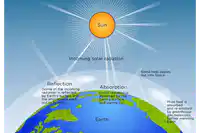
The Earth’s atmosphere is compared to a greenhouse. You know that besides
nitrogen and oxygen, Earth’s atmosphere contains trace gases such as carbon
dioxide, water vapor, methane, and ozone. Like the glass in a greenhouse, the trace
gases have a similar effect on the Sun’s rays. They allow sunlight to pass through,
18


15
resulting in the warming up of the Earth’s surface. But they absorb the energy
coming from the Earth’s surface, keeping the Earth’s temperature suitable for life on
Earth. The process by which the Earth’s atmosphere warms up is called ‘greenhouse
effect,’ and the trace gases are referred to as ‘greenhouse gases.’
INTERACTIONS IN THE ATMOSPHERE
1.Ozone Layer
Something happens between the top of the atmosphere and the surface of the Earth.
Something sucks energy (interacts with it) out
of the energy sent by the Sun. The ozone layer
is a layer of the atmosphere that is about 25
kilometers above the surface of the Earth. Its
main function is to absorb UV light from the
incoming energy of the Sun. Ozone (O3) is
three oxygen atoms bonded together.
When a UV ray hits the ozone molecule, it
breaks apart. You then have one O2 molecule
and one oxygen atom. The oxygen atom is
recycled in the ozone layer because there is
always more ozone being created. Not all the
ultra-violet light is removed, only about 60%
of it.
Figure 3. Greenhouse Gas Effect:
https://www.flickr.com/photos/121935927@N06/13580531193
Figure 4. Ozone Layer:
https://pixabay.com/illustrations/ozon-earth-
ozone-the-ozone-layer-4617739/
19


16
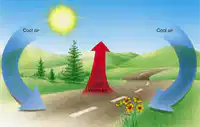
2.Air Convection
Convection is the way heat is transferred from one area to another when there is a
"bulk movement of matter." It is the movement of huge amounts of material, taking
the heat from one area and placing it in another. Warm air rises and cold air replaces
it. The heat has moved. It is the transfer of heat by motion of objects. Convection
occurs when an area of hot water rises to the top of a pot and gives off energy. Another
example is warm air in the atmosphere rising and giving off energy. They are all
examples of convection. The thing to remember is that objects change position.
Activity 3.1
Directions: Follow the instructions for each part of the activity and write your
answers on the space provided.
I.Complete these sentences:
1.The atmosphere is a _____________ of gasses that ___________ The Earth.
2.The main gasses in the atmosphere are ____________, ___________, and
___________.
3.There are _________ layers in the atmosphere: ______________, stratosphere,
_____________, thermosphere, and _____________.
Figure 5. Air Convection: https://www.slideshare.net/guest451a35/heat-transfer-
presentation
20


17
II.Name at least 4 things our atmosphere does for us:
1. ___________________________________
2. ___________________________________
3. ___________________________________
4. ___________________________________
III.Match the layers of the atmosphere with its characteristics:
________1. It contains the ozone layer.
A.Troposphere
________2. The meteorological phenomena occur
here.
B.Stratosphere
________3. This is the outermost layer of the
atmosphere.
C.Mesosphere
________4. This is where we live.
D.Thermosphere
________5. It contains most of the gasses of the
atmosphere.
E.Exosphere
________6. Meteors or rock fragments burn up in
the atmosphere.
IV.Write at least 5 sentences explaining how the Sun interacts with Earth’s
atmosphere:
1._____________________________________________________________________
2._____________________________________________________________________
3._____________________________________________________________________
4._____________________________________________________________________
5._____________________________________________________________________
Activity 3.2: Critical Thinking Questions
Directions: Analyze the question and write you answer on the space provided.
1.What is the importance of Earth’s atmosphere to all organisms?
2.What do you think will happen if there are no greenhouse gases in our
atmosphere?
3.How are you going to help in sustaining the balance in the temperature of our
atmosphere?
21


18
MODULE 4
This module was designed and written with you in mind. It is here to help you
master the different atmospheric phenomena such as land and sea breeze,
monsoons, and the intertropical convergence zone. The scope of this module permits
it to be used in many different learning situations. The language used recognizes the
diverse vocabulary level of students. The lessons are arranged to follow the standard
sequence of the course. But the order in which you read them can be changed to
correspond with the textbook you are now using.
The module has one lesson namely:
Lesson 4: Land and Sea Breezes, Monsoons, and Intertropical Convergence
Zone (ITCZ)
After going through this module, you are expected to:
1.Describe the effect of the difference in temperature and pressure on the
movement of air.
2.Explain the occurrence of land breeze and sea breeze.
3.Identify and describe the effects of different monsoons in the Philippines.
4.Infer the occurrence of intertropical convergence zone (ITCZ) in the
Philippines.
Lesson
4
Land and Sea Breezes,
Monsoons, and Intertropical
Convergence Zone (ITCZ)
In the previous module, you learned that the atmosphere is the blanket of
gases which surrounds Earth. The atmosphere is divided into five layers based on
temperature: the troposphere, stratosphere, mesosphere, thermosphere, and
exosphere. And these layers interact with the sun. In this module, you are going to
learn more about the land and sea breezes, monsoons, and intertropical convergence
zone (ITCZ).
SEA BREEZE AND LAND BREEZE
22


19
The so-called sea and land breeze circulation is a local wind system typically
encountered along coastlines adjacent to large bodies of water and is induced by
differences that occur between the heating or cooling of the water surface and the
adjacent land surface. Water has a higher heat capacity (i.e., more units of heat are
required to produce a given temperature change in a volume of water) than do the
materials in the land surface. Daytime solar radiation penetrates to several meters
into the water, the water vertically mixes, and the volume is slowly heated. In
contrast, daytime solar radiation heats the land surface more quickly because it does
not penetrate more than a few centimeters below the land surface. The land surface,
now at a higher temperature relative to the air adjacent to it, transfers more heat to
its overlying air mass and creates an area of low pressure. Thus, a circulation cell
much like that depicted in the diagram is induced. It should be noted that the surface
flow is from the water toward the land and thus is called a sea breeze.
Since the landmass possesses a
lower heat capacity than water,
the land cools more rapidly at
night than does the water.
Consequently, at night the cooler
landmass
yields
a cooler
overlying air mass and creates a
zone
of relatively
higher
pressure.
This
produces
a
circulation cell with air motions
opposite to those found during
the day. This flow from land to
water is known as a land breeze.
The land breeze is typically
shallower than the sea breeze
since
the
cooling
of the
atmosphere over land is confined
to a shallower layer at night than
the heating of the air during the
day.
MONSOONS
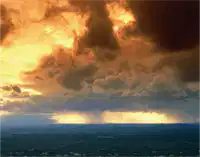
Do you know what monsoons are? Many people think that monsoons are rains. They
are not. Monsoons are wind systems. But these winds usually bring abundant
rainfall to the country, and this is probably the reason why they have been mistaken
for rains. In Filipino, the monsoons are called amihan or habagat, depending on
where the winds come from.
Figure 6. Encyclopedia Britannica, Inc. Typical sea-breeze
(afternoon) and land-breeze (night) circulations with
associated cloud formations. Image. Britanica.com. Accessed
May 4, 2021.https://www.britannica.com/science/climate-
meteorology/Scale-classes#ref29312
23

20
Particularly strong seasonal pressure variations occur over continents. Such
seasonal fluctuations, commonly called monsoons, are more pronounced over land
surfaces because these surfaces are subject to more significant seasonal temperature
variations than are water bodies. Since land surfaces both warm and cool faster than
water bodies, they often quickly modify the temperature and density characteristics
of air parcels passing over them.
Monsoons blow for approximately six months from the northeast and six months
from the southwest, principally in South Asia and parts of Africa; however, similar
conditions also occur in Central America and the area between Southeast Asia and
Australia. Summer monsoons have a dominant westerly component and a strong
tendency to converge, rise, and produce rain. Winter monsoons have a dominant
easterly component and a strong tendency to diverge, subside, and cause drought.
Both are the result of differences in annual temperature trends over land and sea.
The cold air that we experience from December to February is part of this wind
system. This monsoon wind is locally known as amihan. The wind passes over some
bodies of water before it reaches the Philippines. The wind picks up moisture along
the way and brings rain to the eastern part of the Philippines.
INTERTROPICAL CONVERGENCE ZONE
The Intertropical Convergence Zone, or ITCZ, is the region that circles the Earth,
near the equator, where the trade winds of the Northern and Southern Hemispheres
come together. The intense sun and warm water of the equator heats the air in the
ITCZ, raising its humidity and making it buoyant. Aided by the convergence of the
trade winds, the buoyant air rises. As the air rises it expands and cools, releasing
the accumulated moisture in an almost perpetual series of thunderstorms.
Figure 7. Corbis. Monsoon. Photograph. Britanica.com. Accessed May 4,
2021. https://www.britannica.com/science/climate-meteorology/Monsoons.
24


21
Seasonal shifts in the location of the ITCZ drastically affects rainfall in many
equatorial nations, resulting in the wet and dry seasons of the tropics rather than
the cold and warm seasons of higher latitudes. Longer term changes in the ITCZ
can result in severe droughts or flooding in nearby areas.
Activity 4.1
Directions: Below are sketches representing land and sea. Draw what needs to
happen for the wind to blow onto the land during the day in picture 1 and draw what
draw what needs to happen for the wind to blow out to sea in picture 2. Use blue
arrows (cool air) and red arrows (warm air) to show the convection currents.
Picture 1
Land
Sea
Figure 8. UCAR. Intertropical Convergence Zone (ITCZ). Illustration. scied.ucar.edu. Accessed May 4,
2021.https://scied.ucar.edu/learning-zone/storms/monsoons.
25


22
Picture 2
Land
Sea
Activity 4.2
Directions: Use the terms in the box to complete each statement. Write your answer
in the space provided.
rises
Water
clouds
low
ITCZ
planet
converging
rain
monsoon
Monsoon and ITCZ:
1.Air warmed in the tropics _______, flows towards the north and south poles,
then downward in the subtropics, and back to the equator.
2.The area near the equator with _______ pressure and _______, rising winds is
called the Intertropical Convergence Zone (ITCZ).
3._______ vapor condenses as air rises and cools in the _______, forming clouds
and falling as _______.
4.The ITCZ can be seen from space as a band of _______ around the _______.
5.This is where _______ rainfall occurs.
Activity 4.3: Critical Thinking Questions
Directions: Analyze the question and write you answer on the space provided.
1.What is the importance of learning these atmospheric phenomena?
2.What do you think will happen if there are no land and sea breeze, monsoons,
and ITCZ occurring in our atmosphere?
26



23
MODULE 5
This module was designed and written with you in mind. It is here to help you
discover the mechanism of the earth’s rotation and revolution, its effects on the
planet. The scope of this module permits it to be used in many different learning
situations. The language used recognizes the diverse vocabulary level of students.
The lessons are arranged to follow the standard sequence of the course. But the order
in which you read them can be changed to correspond with the textbook you are now
using.
The module has one lesson namely:
Lesson 5: Earth’s Rotation and Revolution
After going through this module, you are expected to differentiate asexual from
sexual reproduction in terms of:
1.describe the movement of the Earth in reference to the Sun.
2.relate the tilt of the Earth to the length of daytime.
3.relate the length of daytime to the amount of energy received.
4.relate the position of the Earth in its orbit to the height of the Sun in the
sky.
Lesson
5
Earth’s Rotation and
Revolution
You probably already know a lot about Earth because it is the planet where
we live. Earth is the third planet from the sun. It moves mainly in two ways: Earth
spins on its axis (rotation) and moves around the sun (revolution). The amazing thing
is that we do not feel the Earth moving, although our planet is speeding the Sun at
30 kilometers each second.
The change between day and night is caused by rotation of the Earth on its
axis. It takes 24 hours for the earth to rotate exactly once so that the sun appears at
the same place in the sky the next day. The Earth also revolves around the sun from
west to east in counterclockwise direction and completes one revolution in one year
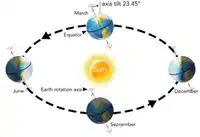
or 365 days. The imaginary axis isn’t straight up and down, it is tilted 23.5 degrees
which caused us different seasons as Earth revolves around the sun during a year.
27


24
The axis of the earth is not perpendicular to the plane on its orbit; it is tilted
23.5 degrees. It makes our days longer or shorter and causes the season.
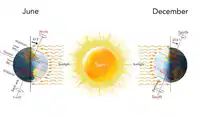
In June, the North pole is tilted toward the Sun, causing the Northern
Hemisphere to be tilted toward the Sun too. The Northern Hemisphere receives direct
rays from the Sun making daytime longer than night which cause us summer
season. Direct rays mean that the rays of sun hit the earth at 90 degrees. The
hemisphere that is more directly facing the Sun at a given point in Earth’s orbit
receives more of the Sun’s energy that result greater warming.
After six months, in December, when the North Pole is pointed away from the
Sun, the Northern Hemisphere does not receive direct rays from the Sun anymore
making nighttime longer than daytime. Currently, the Northern Hemisphere
experiences cold or winter season. On the contrary, when the South Pole is tilted
toward the Sun, the Southern Hemisphere experiences summer. Thus, when it is
cold in the Northern Hemisphere, it is warm in the South Hemisphere.
To summarize, the warm season is brought on by the direct rays of the Sun.
Remember that the Earth is tilted, so only one hemisphere receives direct rays at any
one time and that hemisphere experiences summer at that time. And when one
hemisphere of the Earth experiences summer, the other hemisphere experiences
winter. We do not experience winter because in the Philippines we are too near on
the equator, but we still experience cold days during December, January and
February.
Activity 5.1: Amazing Earth!
Directions: Study figure carefully and answer the guide questions that follow.It
below shows the earth’s different location along its orbit around the sun. The letter
“N” refers to the North Pole while letter “S” refers to South pole, these are two points
where Earth’s axis intersects. The axis is not perpendicular to the orbit.
Figure 9. The Illustration shows the movement and location of Earth at different times of the year. The
axis of Earth is vertical and tilted. (Illustration by: Sarah Faith Trinidad)
28


25
Guide Questions:
1.Based on the figure, in which month is the North Pole tilted toward the Sun?
2.In which month is the North Pole tilted away from the Sun?
Activity 5.2: What A Sky?
Directions: Study figure carefully and answer the guide questions that follow.The
illustration shows how the Earth is oriented with respect to the Sun during the
month of June. Northern Hemisphere refers to the half of the planet that is north to
the equator while Southern Hemisphere refers to the half of the planet that is south
to the equator.
Guide
Questions:
1.In June, which hemisphere receives direct rays form the Sun?
2.In December, which hemisphere receives direct rays from the Sun?
Activity 5.3: Rotate and Revolve!
Directions:
1.Define the two movements of the Earth in the boxes below.
2.Illustrate/sketch each movement.
Figure 10. Direct Sunlight from the Sun in the month of June and December.
(Illustration by: Sarah Faith Trinidad)
29

26
Definition
Here
Rotation
Revolution
Drawing
Here
Rotation
Revolution
3.Answer the questions:
a.Why does a hemisphere experience summer or long daylights?
b.Why does a hemisphere experience winter or short daylights?
c.What would happen if the Earth does not rotate or revolve?
30


27
MODULE 6
This module was designed and written with you in mind. It is here to help you
master the tropics and seasons. The scope of this module permits it to be used in
many different learning situations. The language used recognizes the diverse
vocabulary level of students. The lessons are arranged to follow the standard
sequence of the course. But the order in which you read them can be changed to
correspond with the textbook you are now using.
The module is divided into two lessons, namely:
Lesson 6.1: The Tropics
Lesson 6.2: The Seasons
After going through this module, you are expected to:
1.illustrate the position and movement of the Earth around the Sun.
2.relate the tilt of the Earth to the length of daytime and nighttime and seasons.
3.illustrate the position of the Sun and Earth at different seasons of the year.
4.relate the length of daytime to the amount of energy received.
5.relate the position of the Earth in its orbit to the height (altitude) of the Sun
in the sky.
6.relate the height (altitude) of the Sun in the sky to the amount of energy
received.
7.relate the latitude of an area to the amount of energy it receives.
Lesson
6.1
The Tropics
If all the Earth’s surface received the same amount of solar energy, the
temperature of the lower atmosphere would be the same everywhere, and the great
variety of climates would not exist. The Earth's surface receives different amounts of
energy from the Sun which is related to the latitude of an area where it dictates how
much energy that area will receive.
You will observe that the Sun's rays strike vertically in the area in the globe
near the equator. Direct rays of the Sun mean that the Sun's rays hit the ground at
90 degrees, and it is perpendicular to the ground.
Areas in the globe that are not vertically hit by the Sun's rays result in a warm
climate. This means that as the latitude increases, the smaller the Sun's rays' angle
31

28
strikes the surface. So, when our area is farther from the equator, the cooler the
climate will become.
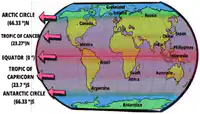
The Earth is divided into different tropic zones which are the Tropic of Cancer,
Tropic of Capricorn, Arctic Zone, Antarctic Zone, and the Equator, which receives
different amount of solar energy due to differences in angle of incidence shown in
Figure 11.
ACTIVITY 6.1: Brighter or Dimmer?
Directions: Do the following procedure and record your observation on the table.
Answer the questions in the space provided.
1.Get a flashlight and a piece of paper.
2.Put the paper on the table and aim the flashlight straight from the tabletop
with a distance of 4 inches.
3.Make sure that the angle where you hold the flashlight is 90 degrees (Figure
A). Write your observations on the table.
Figure 11. The Earth and its different tropic zones
32

29
4.Tilt the flashlight into 45 degrees angle with the same distance from the paper
(Figure B). Write the diameter of light (measure it is using a ruler) and the
intensity of light (brighter or dimmer) on Table 1.
Table 1:
Observations
90 degrees angle
45 degrees angle
Dimmer or brighter light
Diameter of light (cm)
5.Answer the questions based on your observations on Table 2.
Table 2:
Questions
Answers
1.What do you notice with the light beam from the
flashlight when you aim it to the paper at 90 degrees
angle?
2.What do you notice with the light beam from the
flashlight when you aim it to the paper at 50 degrees
angle?
3.Are there differences in your observations? Why or
why not?
4.Which do you think will give higher amount of
energy towards the paper (has brighter light)? Flash
lighted tilted at 90 degrees or 50 degrees? Why?
ACTIVITY 6.2: LA-LA-LATITUDE
A.Directions: Do the following activities and record your observation on the table.
Answer the questions on the space provided.
1.Color the area of the latitude on Earth if you think that area is hot,
average, and cold.
Figure A. 90 degrees
angle of flashlight
Figure B. 45 degrees
angle of flashlight
33

30
Table 3:
Questions
Answers
1.Which part of the globe do you think receives more
heat energy?
2.Which part of the globe do you think receives less
heat energy?
3.Why do you think we have a warm climate in the
Philippines?
4.How does latitude affect climate?
Lesson
6.2
The Seasons
If the Earth’s axis were exactly perpendicular to the plane of the Earth’s orbit
around the Sun, the variation in temperature from equator to pole would be the same
all year round but that is not the case.
Most of the areas on Earth experiences distinct seasons during the course of
the year, each characterize by different overall weather conditions such as Spring,
winter, summer and fall.
Red = HOT
Orange = Average
Blue = Cold
Figure 12. The Effect of Angle of Incidence of Sun Rays on Earth
34

31
But can you explain why there are seasons at all? Do you know why the
seasons change? The following activity will help you understand why.
The seasons on Earth change because the planet Earth is tilted 23.5 degrees
on its axis which orbits the sun. This means different points on Earth receive
sunlight at different times of year. If Earth were not tilted, the Sun would always
appear to be directly above the Equator, the amount of light a given location receives
would be fixed, and there would be no seasons. There also would be no equinoxes or
solstices
Figure 13. Earth’s Revolution around the Sun
Figure 14. Equinox
Figure 15. Summer Solstice
Figure 16. Winter Solstice
35

32
The two solstices happen in June (Figure 15) and December (Figure 16). These
are the days when the Sun’s path in the sky is the farthest north or south from the
Equator.
The equinoxes happen in March and September (Figure 14). These are the
days when the Sun is exactly above the Equator, which makes day and night of equal
length.
The equinoxes occur when the Earth reaches the points in the orbit where the
equatorial and orbital planes intersect, causing the sun to appear directly overhead
at noon at the equator. During equinoxes, the periods of daylight and darkness are
nearly equal all over the world.
Activity 6.3: The Reason for Seasons
Directions:
•Study the next figure A carefully.
•The illustration shows how the Earth is oriented with respect to the Sun
during the month of June.
•Write the data based on the illustration you have observed.
Questions
Answer
1.How many degress does the Earth is titled?
Figure A. The Orientation of the Earth during the
month of June.
36

33
Activity 6.4: Why do the seasons change?
Directions: Figure B shows the Earth at different location along its orbit around the
Sun. As what you have learned in Lesson 1 the Earth is titled 23.5°. Answer the
following questions based on your observations in figure B.
2.What is the two divisions of the Earth?
3.On what division of the Earth does direct light is
focused?
4.What do you think is the climate in North Pole?
5.What do you think is the climate in South Pole?
Questions
Answer
1.On what month does North hemisphere receives direct
rays from the Sun?
2.On what month does South hemisphere receives direct
rays from the Sun?
3.What do you think will be the climate in North pole in
the Month of December?
4.On what month does South hemisphere receives direct
rays from the Sun.
5.What do you think will be the climate in North pole in
the Month of December?
Figure B. Earth’s Revolution around the Sun
37


34
Activity 6.5
Directions:
1.Describe the energy received in each specific area as higher solar energy or
lower solar energy based on their location on the globe illustrated below.
2.Fill in the table with the name of the countries on their respective tropic zone
3.Answer the three questions about the activity.
Number 1:
Number 2:
Arctic Circle
Tropic of
Cancer
Equator
Tropic of
Capricorn
Antarctic
Circle
Number 3:
1.Which countries do you think experiences very hot climate? Why?
2.Which of the countries do you think has a very cold climate? Why?
3.Why different locations on the globe do experiences different climate?
1
Figure C. The Earth and the different Tropic Zones
1
1
1
1
38





35
Activity 6.6
Directions: Choose the correct description from the choices inside the box.
____________________
____________________
____________________
MODULE 7
This module was designed and written with you in mind. It is here to help you
explore the phenomena of solar and lunar eclipse. The scope of this module permits
it to be used in many different learning situations. The language used recognizes the
diverse vocabulary level of students. The lessons are arranged to follow the standard
sequence of the course. But the order in which you read them can be changed to
correspond with the textbook you are now using.
The module has one lesson, namely:
Lesson 7: The Solar and Lunar Eclipse
After going through this module, you are expected to:
1.differentiate solar and lunar eclipse.
2.Illustrate the position of the Sun-Moon-Earth system during a solar and lunar
eclipse.
3.explain how solar and lunar eclipse occur using models.
4.identify belief and practices in relation to eclipses.
Equinox - Equal number of hours during day and night
Solstice - Winter in North Pole
Solstice - Longer days in North Hemisphere
1
2
3
39

36
Lesson
7
The Solar and Lunar Eclipse
In the previous grades, you have learned that the Earth rotates on its axis,
and it revolves around the Sun, and as the Earth goes around the Sun, the Moon is
also revolving around the Earth, and the solar system moves around the center of
our Milky Way. Can you imagine all these celestial bodies do “motions” at the same
time? But still, we do not see that the Earth and Moon moving, we can only observe
its effects. Let us experience further about space phenomenon when the Sun, Moon
and the Earth play.
Do you have any idea how shadow was formed? What about eclipse? Do you
think that shadow and eclipse are related in any way? In this module, you will
experience and learn about Eclipses. There are activities that will help you to
understand about solar and lunar eclipse. Moreover, this learning material will give
you an understanding about some beliefs and practices in relation to the eclipses.
Eclipse is an astronomical event or phenomenon when a celestial body is
temporarily hidden, by passing into the shadow of another body or by having another
body between it and the viewer. The alignment of the Sun-Moon-Earth which usually
happen every year may result to solar and lunar eclipse in some places.
The figure above shows that shadows of the Moon and the Earth are cast into
space. The shadow of the Moon falls on part of Earth. When you are within this
shadow, you will experience a solar eclipse. Solar eclipse happens when the Moon
comes between the Earth and the Sun.
If you are standing within the umbra of the Moon’s shadow, you will see the
Sun disappear from your view. You will experience the so called Total Solar Eclipse
Moon
Earth
Illustration: The Solar Eclipse, Santos, LJ (2021)
40

37
as your surroundings appear like it is early evening. On the other hand, if you are
moon’s penumbra you will see the Sun that was partially covered by the Moon. You
will notice that there are no dramatic changes in the surroundings; there is no
noticeable dimming of sunlight, this phenomenon is what we called the Partial Solar
Eclipse.
The figure above shows another type of space phenomenon, wherein the Moon
is in the shadow of the Earth. The alignment of the Sun, the Earth, and the Moon
results to the occurrence of the lunar eclipse. Lunar Eclipse occurs when the Moon
passes through the shadow of the Earth. When the entire Moon is within the umbra,
it looks totally dark, it is called the Total Lunar Eclipse. However, when the Moon
passes only through its Earth’s umbra, a Partial Lunar Eclipse happens, and a part
of the Moon looks dark while the rest looks bright. Moreover, when the moon passes
Earth’s penumbra, a Penumbral Eclipse occurs.
The occurrence of eclipses led to some beliefs, myths, and superstitions, like
“the Sun being swallowed by BAKUNAWA, (it is a large animal) and the other is the
increase of harmful microorganisms during an eclipse. These stories passed on by
adults to young children until now but still not scientifically proven.
The movement of the celestial bodies especially the Moon has something to do
with the eclipses we are experiencing yearly. There are three solar eclipses and three
lunar eclipses in a year. Eclipses only happen when the three-celestial body (the
Moon, the Sun, and the Earth) are aligned to each other. Just remember, that eclipse
happens only when there is alignment of the three (3) space objects, the Sun-Moon-
Earth or Sun-Earth-Moon. The Moon revolves around the Earth which sometimes
aligns with the Sun and Earth, which leads to the occurrence of eclipses. We may
not observe nor see the movement of these space bodies, but we can witness its
stunning space phenomenon in forms of eclipses.
Moon
Earth
Full Shadow
(umbra)
Partial Shadow
(penumbra)
Partial Shadow
(penumbra)
Illustration: Santos, LJ (2021)
Sun
Earth
Moon
umbra
penumbra
penumbra
Illustration: The Lunar Eclipse, Santos, LJ (2021)
41


38
In science, there are scientifically based beliefs. For example, it is bad to look
directly at the Sun during a solar eclipse. Exposing your eyes to the light during a
solar eclipse without protection can cause “eclipse blindness” or retinal burns, also
known as solar retinopathy. This can destroy cells in the retina that transmit what
you see to the brain, even if only a thin crescent of the Sun is left uncovered by the
moon. So, if you will observe a solar eclipse, be ready with a solar filter or welder’s
goggles to protect your eyes.
Here are sets of activities that will help you learn and appreciate the
occurrence of Solar and Lunar Eclipses. Write your answer on a separate paper.
Activity 7.1: THE WORLD OF ECLIPSES
Directions: Unlock the unfamiliar word by completing the missing letters. Be guided
by the given definition of each word.
Activity 7.2: SOLAR AND LUNAR ECLIPSE
Directions: Differentiate solar and lunar eclipse based on what have you learned
with the use of Venn Diagram below.
42

39
Activity 7.3: THINK ABOUT THOSE ECLIPSES!
Directions: Observe each illustration below and answer the questions that follows.
Write your answer in a complete sentence.
Model A: Solar Eclipse
Observe the appearance of the Moon.
What is the result as the Moon casts shadow on Earth?
___________________________________________________________________________
___________________________________________________________________________
Model B: The Lunar Eclipse
Observe the appearance of the Moon.
What is the result if the Moon passes through the shadow of the Earth?
___________________________________________________________________________
___________________________________________________________________________
Moon
Earth
Illustration: The Solar Eclipse, Santos, LJ (2021)
Think About It!
Why do Total Solar Eclipses coincidence?
Sun
Earth
Moon
umbra
penumbra
penumbra
Illustration: The Lunar Eclipse, Santos, LJ (2021)
43

40
Activity 7.4: WHAT DO THEY BELIEVE?
Directions: Gather beliefs about eclipses. You may ask elders at your home, or in
your community, or do research.
BELIEFS, MYTHS AND SUPERSTITIONS ABOUT ECLIPSES
BELIEFS
KIND OF ECLIPSE
SCIENTIFIC
EXPLANATIONS
1.
2.
3.
Activity 7.5: STORY OF ECLIPSE
Directions: There are two sets of different questions about eclipses. Choose the
one which applies to you. Write your answer on a separate paper.
1.Have you experienced witnessing a space phenomenon called eclipse? What
kind of eclipse? A Solar or Lunar Eclipse? Do you still remember the date and
time? While witnessing an eclipse, what did you do to see the eclipse? Did you
hear anything myths/beliefs about the eclipse?
Think About It!
How long do you think does a total lunar eclipse last?
Think About It!
What do you think these beliefs existed and passed on to young children?
44


41
2.If you have not experienced eclipses yet, what kind of eclipse would you like
to observe? What is your plan to do to witness an eclipse? Did you know any
myths/beliefs related to eclipse?
Activity 7.6:THE ECLIPSE IN MY HAND!
Directions: Follow the instructions given:
1.Create a model that shows the 3 celestial objects the Sun, the Moon and Earth.
2.Choose what kind of eclipse to portrait (Solar Eclipse or Lunar Eclipse).
3.Decide the materials to be used.
4.Include in your design a brief explanation of the eclipse.
5.Refer to the given Rubric in making your output.
Criteria
40
30
20
10
Content
Appropriate
details
support main
Information
adequately
supports
purpose of
visual
Most detailed
support main
idea
Information is
mostly
adequately
and
supportive of
visual’s
purpose
Few details
support main
idea
Inadequate
information is
not nearly
supportive of
visual’s
purpose
No details to
support main
idea
Information
does not
support the
visual’s
purpose
Visual /
Creative
Appeal
Outstanding
use of
Recyclable
materials in
terms of color
design and
space original
and creative
design
Overall design
is pleasing
and
harmonious
Adequate use
of recyclable
materials in
terms of color,
design, and
space
Design is
adequate
Overall design
is pleasing
and
harmonious
in appropriate
use of the
cycle
materials in
terms of color
design, and
space
Design lacks
creativity
Lack of
harmonious
design in
presentation
Little attempt
to use a
recyclable
material in
terms of color
design, and
space
appropriately
Design is dull
Project has
messy
appearance
45


42
Directions: Choose the letter of the best answer. Write the chosen letter on a separate
sheet of paper.
1.A coordinate system is a method for identifying the location of a point on the
earth. To locate exact places on the earth, which must you look at?
A.The equator and lines of latitude.
B.Neighboring city to describe the location.
C.The intersecting lines of latitude and longitude.
D.The prime meridian and lines of longitude.
2.Which large landmass is found to the north of the Philippines?
A.Australia
B.Mainland Asia
C.Malay Peninsula
D.China
3.Which of the following is NOT a sustainable practice and proper use of resources?
A.Unlimited fishing
B.Dry clothes naturally
C.Use compost to fertilize the crops
D.Practice waste segregation.
4.How can we describe a monsoon?
A.Sun does not interact with the atmosphere
B.Ozone layer allows 80% of sunlight to enter Earth
C.Living organisms could survive without atmosphere
D.Too much greenhouse gases could make Earth warmer
5.Warm air over land rising and cool air from the sea taking its place describes
which breeze?
A.sea breeze
B.sea-land breeze
C.land breeze
D.none of the above
6.How can we describe a monsoon?
.
A.An erosion of soil
B.An abnormal rate of rain
C.A seasonal shift in wind direction
D.None of the above
7.The change in temperature during summer is due to ____________.
A.The Earth being titled towards the sun receiving more direct sunlight
B.The Earth being tilted away from the sun distributing sunlight
C.The Sun being closer to the earth
D.The Earth being closer to the earth
8.What type of climate does the countries residing in the equator experiences?
A.Very hot climate
B.Very cold climate
C.Average climate
D.Neither hot nor cold
9.Which of the following events happen during Solstice?
A.It happens when one pole of the Earth is tilted toward the Sun.
B.It happens when the North pole of the Earth is tilted toward the Sun.
C.It happens when the South pole of the Earth is tilted toward the Sun.
D.It happens when neither pole of the Earth is tilted toward o away the Sun.
10.What kind of eclipse occurs when the Earth-Moon-Sun are aligned?
A.Lunar Eclipse
B.Solar Eclipse
C.Full Moon
D.Umbra
46

43
Module 1
Module 2
Module 3
Module 4
What I Know
1.
C 6. C
2.
D 7. B
3.
C 8. A
4.
D 9. B
5.A
10. A
Assessment
1.
C 6. C
2.
B 7. C
3.A
8. A
4.
D 9. A
5.A
10. B
What I Can Do
Activity 1.5
1. C
2. C
3. W- Equator
4. C
5. W-Singapore City
What I Can Do
1.
Using energy efficient
appliances, walking,
biking instead of
driving your own car,
turn off lights and
appliances when not
in use.
2.
Turning the faucet off
when not in use,
storing rainwater
3.
Using reusable bag
when shopping or
buying groceries.
4.
Keep track of available
food, plan meal to
cook, store food you
can consume.
5.
Start
home/community
garden, plant trees
What I Can Do
Answers could be
opinion-based
1.
Atmosphere helps us
to breathe, protect
us from harmful UV
rays from the sun
2.
Our environment will
become cooler since
there are no gases
that traps heat from
escaping Earth
3.
Reduce using
different appliances
that produces
greenhouse gases
What I Can Do
Activity 1.6
What I Can Do
Answers could be
opinion-based
1.
It is important for
everyone to
understand the
varied atmospheric
phenomena so that
we can all prepare
for whatever
changes that occur
in the environment
and cope with these
changes.
2.
Reduce using
different appliances
that produces
greenhouse gases
47

44
Module 5
Module 6
Module 7
What I Can Do
Rotation of the Earth is
it turning on its axis
The Earth takes 24
hours to complete a
rotation with respect to
the sun.
Revolution is the
movement of the Earth
around the Sun.
The Earth takes a full
year (365 days) for one
complete revolution
around the Sun.
What I Can Do
Activity 6.5
ARCTIC CIRCLE
Greenland, Iceland,
Russia
TROPIC OF CANCER
Mexico, Japan, China,
Canada, India,
Philippines
EQUATOR
Indonesia
TROPIC OF CAPRICORN
Brazil, South Africa,
Australia, Argentina
ANTARCTIC CIRCLE
Antarctica
What I Can Do
Activity 6.6
1.
Solstice- Longer days
in North Hemisphere
2.
Equinox- Equal
number of hours
during day and night
3.
Solstice- Winter in
North Pole
48

45
References
Textbook:
ReligiosoT.et al. (2017). You and the Natural World. Quezon City, Phoenix Publishing House.
pp. 234,235,236,237.
Borerro F. et al. (2008). Earth Science (Geology, the Environment and the Universe). USA,
McGrawhill Glencoe. National Geographic. pp 29,30,31,31
Ferriols-Pavico, J.M..et al. (2013). Exploring Life through Science. Quezon City, Phoenix
Publishing House, Inc. pp. 299- 312.
Synergy for Success in Science 7 (2013). Quezon City, Singapore Asia Publishers Pte Lts, p.
235.
Estacio, E.B et al (2020) SDO_Navotas_Science-7_Q2_M7_Effects of Changes in Abiotic
Factors on the Ecosystem. FV (22). Pp. 8-10
Hendrix, Marc S., Graham R. Thompson, and Jonathan Turk. 2015. Earth Science: An
Introduction, Third Edition. Boston: Cengage Learning, Inc.
Marshak, Stephen, and Robert Rauber. 2017. Earth Science: the earth, the atmosphere, and
space. New York: W.W. Norton & Company, Inc
Asuncion, Alvie., Catalan, Maria Helen PhD., Catris, Leticia, PhD., Ferido, Marlene, PhD.,
Gutierrez, Jacqueline Rose., Mantala, Michael Anthony., Malamag, Cerilina., Mejia,
Ivy., Obille, Eligio, Jr., Reyes, Lisa, PhD., Sebastian, Ma. Dulcelina., Tan, Merle, PhD.,
and Treyes, Rodolfo, PhD., “Science Learner’s Material 7.”, Science – Grade 7 Learner’s
Material First Edition, 2017, Ground Floor, Bonifacio Bldg., DepEd Complex, Meralco
Avenue, Pasig City, Philippines 1600, Filipinas Copyright Licensing Society, Inc., FEP
Printing Corporation.
Online Sources:
“10 Solutions for Natural Resource Depletion.” Written by Veterans Off-Grid Last updated:
February 9, 2019 © 2019. Veterans Off-Grid. Retrieved from
https://www.veteransoffgrid.org/blog/10-solutions-for-natural-resource-depletion
“50 Ways to Conserve Natural Resources at Home.” Written by Sara Cifani on July 25, 2017
© 2021 BudgetDumpster.com Retrieved from
https://www.budgetdumpster.com/blog/world-nature-conservation-day/
“Sustainability.” Written by Ollie Saves The Planet © All copyright including intellectual
property remains the property of Sustain Ability International Pty. Ltd. Retrieved
from https://www.olliesworld.com/planet/aus/info/info/sr_nr05.htm
“Earth Resources”. © TeachTalk Syensyamazing Episode
https://www.youtube.com/watch?v=6yeGxxgD8mY&t=551s
World Atlas. Accessed April 29, 2021 from https://www.worldatlas.com/aatlas/world.htm
2021World Population Review. Accessed April 29, 2021 from
https://worldpopulationreview.com/country-locations/where-is-philippines.
Rader, Andrew. “Energy Transfer.”, Thermodynamics and Heat. Accessed April 27, 2021
http://www.physics4kids.com/files/thermo_transfer.html
Siyavula Education. Greenhouse Gas Effect. Illustration. Flickr.com. April 2, 2014. Accessed
April 27, 2021. https://www.flickr.com/photos/121935927@N06/13580531193.
Attribution 2.0Generic (CC BY 2.0)
One94.
Ozone
Layer.
Illustration.
Pixabay.com.
Accessed
April
27,
2021.
https://pixabay.com/ illustrations/ozon-earth-ozone-the-ozone-layer-4617739/.
Guest451a35. "Heat Transfer." Page 22 SlideShare. Last modified October 28, 2008. Accessed
April
27,
2021.
https://www.slideshare.net/guest451a35/heat-transfer-
presentation.
Encyclopaedia Britannica. “Climate – Scalce Classes.”, Encyclopaedia Britannica. May 4,
2021. https://www.britannica.com/science/climate-meteorology/Scale-classes
49

46
Przyborski, Paul. “The Intertropical Convergence Zone.”, NASA Earth Observatory. May 4,
2021.
https://earthobservatory.nasa.gov/images/703/the-intertropical-
convergence-
zone#:~:text=The%20Intertropical%20Convergence%20Zone%2C%20or,humidity%2
0and%20making%20it%20buoyant.
Serm Murmson, (2008). What Causes the Day/Night Cycle on Earth? Last updated: March
09, 2018 Accessed March 14, 2021. Retrieved from https://sciencing.com/causes-
day-night-cycle-earth-15684.html
“Your Sight, Protect Your Eyes from the Sun-SolarEclipse and Your Eyes.” Prevent Blindness.
Accessed March 13, 2021, https://preventblindness.org/solar-eclipse-and-your-
eyes/
Vigdis Hocken and Aparna Kher, “What Is a Total Lunar Eclipse?” time and date. Com,
Accessed March 13, 2021, https://www.timeanddate.com/eclipse/total-lunar-
eclipse.html
50


For inquiries or feedback, please write or call:
Department of Education – Schools Division Office Navotas
Learning Resource Management Section
Bagumbayan Elementary School Compound
M, Naval St., Sipac Almacen, Navotas City
Telefax:
02-8332-77-64
Email Address:
navotas.city@deped.gov.ph
DIVISION OF NAVOTAS CITY
S.Y. 2021-2022
NAVOTAS CITY PHILIPPINES
Science
Quarter 4
7
Show answer
Auto Play
Slide 1 / 50
SLIDE
Similar Resources on Wayground

46 questions
Natural Disasters Review
Presentation
•
6th Grade
43 questions
Weather and Climate
Presentation
•
6th Grade - University
45 questions
Balancing Chemical Equations
Presentation
•
6th - 8th Grade
45 questions
Names and Formulas of Chemical Compounds
Presentation
•
9th - 10th Grade
44 questions
Earth in the Universe
Presentation
•
6th Grade
47 questions
Electromagnetism
Presentation
•
8th - 11th Grade
43 questions
Matter
Presentation
•
6th Grade
45 questions
Motion and acceleration
Presentation
•
6th - 9th Grade
Popular Resources on Wayground
10 questions
Safety Day 2026 – Student Review

Quiz
•
9th Grade
21 questions
Continents and Oceans
Quiz
•
6th Grade
20 questions
Parts of Speech
Quiz
•
5th Grade
16 questions
Subject & Predicate
Quiz
•
5th Grade
25 questions
Multiplication Facts
Quiz
•
5th Grade
12 questions
Map Skills
Quiz
•
3rd Grade
22 questions
Continents and Oceans
Quiz
•
5th Grade
15 questions
Rounding Decimals
Quiz
•
5th Grade