Search Header Logo
  1. Resource Library
  2. Science
  3. Physics
  4. Newton's Third Law Of Motion
  5. Newton's Third Law Of Motion
Newton's Third Law of Motion

Newton's Third Law of Motion

Assessment

Presentation

•

Science

•

8th Grade

•

Hard

•
NGSS
MS-PS2-1

Standards-aligned

Created by

James Gonzalez

FREE Resource

12 Slides • 6 Questions

1

Newton's Third Law

media

2

Objectives:

- I can describe Newton's 3rd Law of motion.

- I can name the force pairs acting on an object.

- I understand how inertia is important in collisions.

3

The first 2 laws of motion apply to individual objects.

1st Law - an object at rest will stay at rest or an object in motion will stay in motion unless there's an outside force.


2nd Law - an object's acceleration is directly proportional to the force, and inversely proportional to the mass.

4

The third law of motion deals with pairs of objects.

This is because all forces come in pairs.


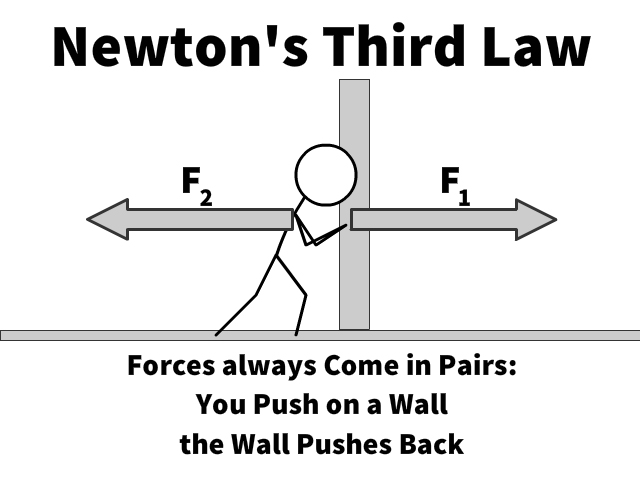
Newton's 3rd Law of Motion - for every action force, there is an 1equal and 2opposite reaction force.

5

1Equal in Strength

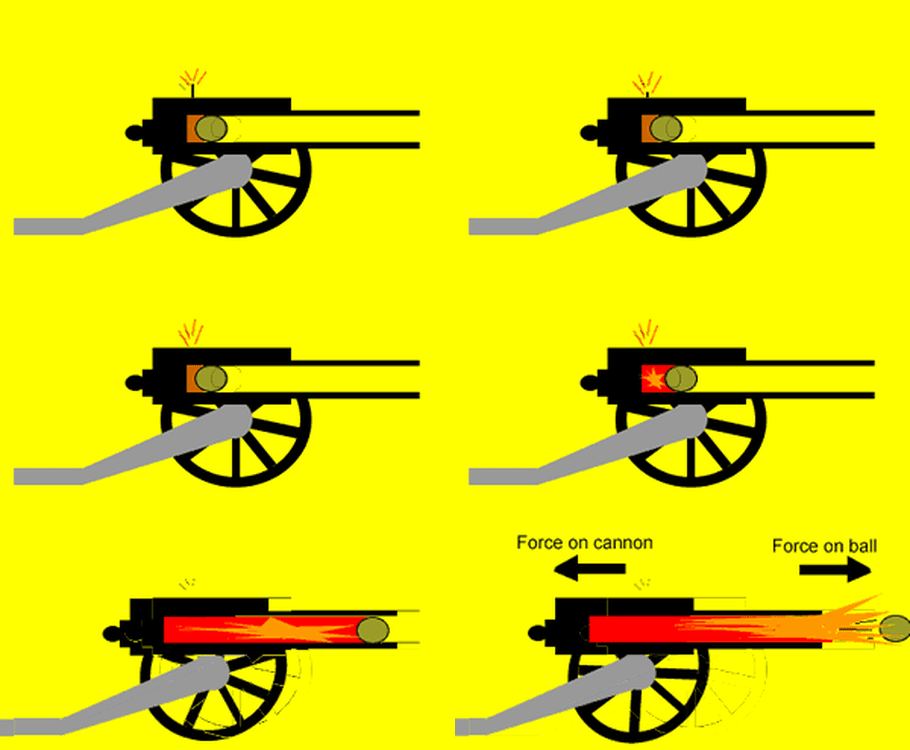
This image shows the force pairs between the force on the cannon and the force on the ball. Newton's 3rd Law says that they must be equal, which is why the canon is pushed backwards.

media

6

1Equal in Strength

Include this diagram in your notes.

media

7

2Opposite in direction

This image shows the force pairs: Action Force and Reaction Force.

-An Action force is the first force acting on an object.

-The Reaction force is the resulting force of the action force in the opposite direction.

In the example:

-The Action force is the

fire extinguisher pushing

to the right.

-The Reaction force is the

chair moving in the

opposite direction resulting

from the fire extinguisher.

media

8

2Opposite in direction

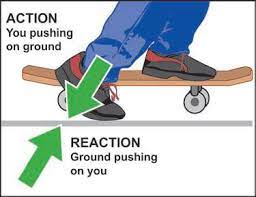
This image shows the force pairs between the force on the ground from your foot, and the force on you from the ground.


The forces that combine to propel you forward are equal and opposite.

media

9

Collisions

Newton's 3rd Law says that any time 2 objects hit each other, they exert equal and opposite forces on each other. However, the effect of the force is not always the same.

10

Collisions

The two people in this example may have exerted the same force on one another, but the result was not the same. Why?

media

11

Open Ended

Why do you think the result of the force pairs in the previous example was different between the boy and the girl?

12

THE ANSWER IS INERTIA!

  • The person with more mass has more inertia, so more force is needed to change his motion.

  • So even though the forces are equal and opposite, there are two very different results based on Newton's 1st Law of Motion, inertia.

13

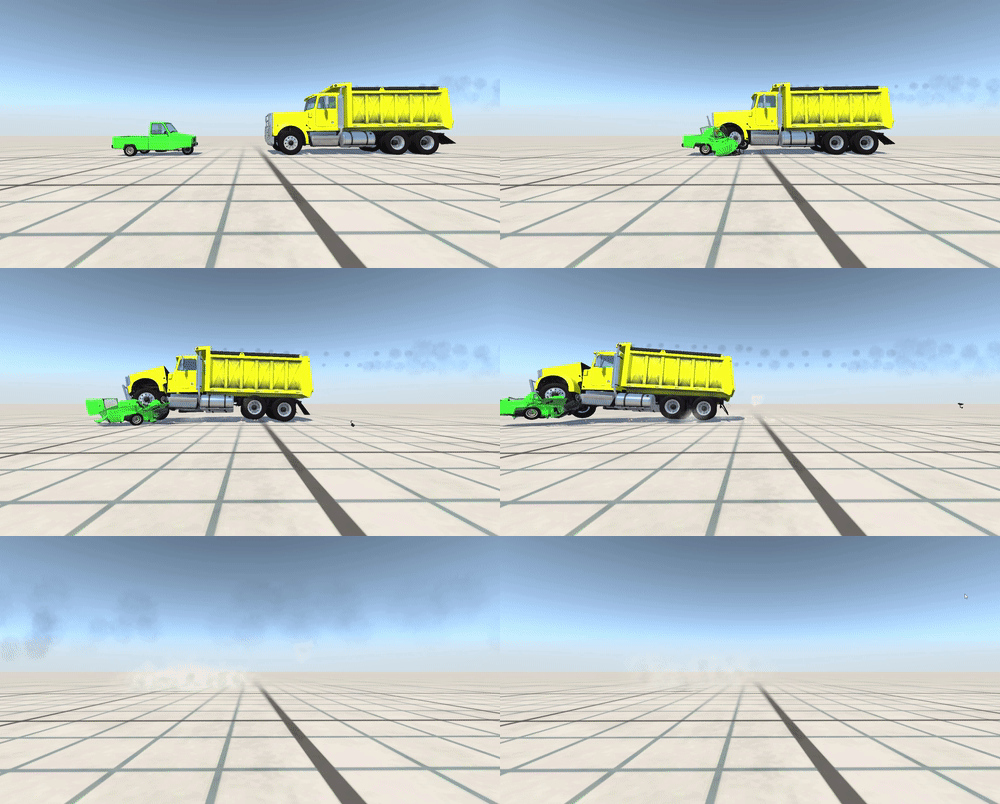
Which truck would you rather be riding in?

The forces that act on each truck may be the exact same, but due to the yellow trucks greater mass and therefore inertia, the results are very different.

media

14

Open Ended

Question image

Explain what force pairs are acting in this example of Newton's 3rd Law.

15

Open Ended

Question image

Explain what force pairs are acting in this example of Newton's 3rd Law.

16

Open Ended

Question image

Explain what force pairs are acting in this example of Newton's 3rd Law.

17

Open Ended

Question image

Explain what force pairs are acting in this example of Newton's 3rd Law.

18

Open Ended

Question image

Explain what force pairs are acting in this example of Newton's 3rd Law.

Newton's Third Law

media

Show answer

Auto Play

Slide 1 / 18

SLIDE