Carbon and Nitrogen Cycle
Presentation
•
Biology
•
10th Grade
•
Hard

James Gonzalez
FREE Resource
10 Slides • 48 Questions
1

Carbon and Nitrogen Cycle
2
Hi Neo, before we start, let's play a game
3
Multiple Choice
Who is the most powerful character in DC Comics?
Superman
Darkseid
Lucifer Morningstar
The Presence
4
Multiple Choice
Who is the fastest Speedster in DC Comics?
The Flash (Wally West)
Reverse Flash
The Flash (Barry Allen)
Zoom
5
Multiple Choice
Which one of these villains is included in Batman's rogue gallery?
The Joker
Mr. Penguin
Bane
All of them
6
Multiple Choice
Who is not a New God?
Darkseid
Steppenwolf
Eclipso
Black Racer
7
Multiple Choice
Which one of these is not a member of the original Teen Titans?
Robin I
Aqualad
Wonder Girl
Raven
8
Multiple Choice
How many Earths are there in DC?
50
52
51
53
9
Multiple Choice
What is the most powerful version of Superman?
Superman Prime One Million
Cyborg Superman
Superman (Classic)
Thought Robot
10
Multiple Choice
What show is this?
Avatar the Last Airbender
Rocko's Modern Life
Zig & Sharko
Amagami
11
Multiple Choice
what are the four nations in the world of the avatar?
water, air, moon, sky
fire, air, water, earth
rock, wind, sun, moon
oxygen, hydrogen, carbon, iodine
12
Multiple Choice
13
Multiple Choice
14
Multiple Choice
15
Multiple Choice
When Korra dies the next Avatar will be born in
the Water Tribe
the Earth Kingdom
the Fire Nation
the Air Nomad Temple
16
Carbon Cycle
17
Meaning
Carbon is the foundation of all life on Earth, required to form complex molecules like proteins and DNA. This element is also found in our atmosphere in the form of carbon dioxide (CO2). Carbon helps to regulate the Earth’s temperature, makes all life possible, is a key ingredient in the food that sustains us, and provides a major source of the energy to fuel our global economy.
18
Meaning
The carbon cycle describes the process in which carbon atoms continually travel from the atmosphere to the Earth and then back into the atmosphere. Since our planet and its atmosphere form a closed environment, the amount of carbon in this system does not change. Where the carbon is located — in the atmosphere or on Earth — is constantly in flux.
19
Meaning
On Earth, most carbon is stored in rocks and sediments, while the rest is located in the ocean, atmosphere, and in living organisms. These are the reservoirs, or sinks, through which carbon cycles.
Let's check the video:
https://www.youtube.com/watch?v=fcna9slTljs
20
Nitrogen Cycle
21
Meaning
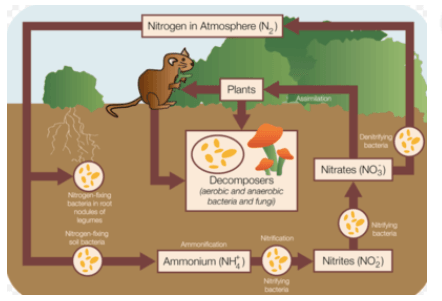
Nitrogen Cycle is a biogeochemical process which transforms the inert nitrogen present in the atmosphere to a more usable form for living organisms.
Let's check the video:
https://www.youtube.com/watch?v=njzFtvMPJ3A
22
Quiz Time
23
Multiple Choice
24
Multiple Choice
What converts nitrogen gas into a usable form for plants and animals?
bacteria
rain
fungi
car exhaust
25
Multiple Choice
Organisms that do not decompose naturally can be buried and become what?
oxygen
nutrients
calcium carbonates
fossil fuels
26
Multiple Choice
The process in which nitrogen circulates and is recycled is called
The nitrogen cycle
The carbon cycle
The water cycle
The phosphorus cycle
27
Multiple Choice
If the plant population decreased, the amount of carbon dioxide in the atmosphere would _________.
Stay the same
Increase
Decrease
28
Multiple Choice
Organisms that need nitrogen to survive.
only plants
only animals
only bacteria
all living things
29
Multiple Choice
30
Multiple Choice
How is nitrogen "fixed" into a usable form for plants?
Through action of bacteria only
Through lightning only
Through action of bacteria and lightning
Through photosynthesis
31
Multiple Choice
32
Multiple Choice
How do animals get the nitrogen they need?
From the air they breathe
From the water they drink
From the food they eat
From the sun
33
Multiple Choice
How does the human body return carbon to the atmosphere in the carbon cycle?
Waste products
Photosynthesis
Cellular respiration
Formation of glucose
34
Multiple Choice
Gas that makes up 78% of our atmosphere.
Oxygen
Nitrogen
Hydrogen
Carbon Dioxide
35
Multiple Choice
In the carbon cycle, animals can release carbon back into the cycle through __________ or through __________.
burning . . . photosynthesis
fixation . . . decomposition
decomposition . . . photosynthesis
respiration . . . decomposition
respiration . . . photosynthesis
36
Multiple Choice
What is the process of combining nitrogen gas with other elements to make nitrogen into usable compounds?
nitrogen composition
nitrogen fixation
ammonia
denitrification
37
Multiple Choice
If a forest fire occurs, what will happen to the carbon in the forest?
It will go into the soil
It will go into the atmosphere
It will runoff into nearby streams and rivers
It will be destroyed
38
Multiple Choice
What is the formula for atmospheric nitrogen?
N
N2
NH3
NO3
39
Multiple Choice
Where does all the carbon in organisms (living things) originate from?
Earth's atmosphere
Rocks
Water
Soil
40
Multiple Choice
What process occurs when dead plant and animal matter decomposes and nitrogen is released back into the atmosphere?
Assimilation
Fixation
Ammonification
Denitrification
41
Multiple Choice
What kind of organism takes out the most carbon from the atmosphere?
Plants
Bacteria
Animals
Humans
42
Multiple Choice
Plants and animals cannot use nitrogen directly from the air.
True
False
43
Multiple Select
Check all the ways that carbon dioxide is ADDED to the atmosphere.
Respiration
Combustion
Photosynthesis
Diffusion
Decomposition
44
Multiple Choice
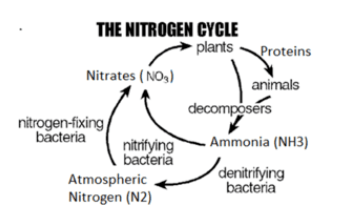
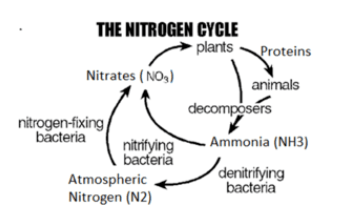
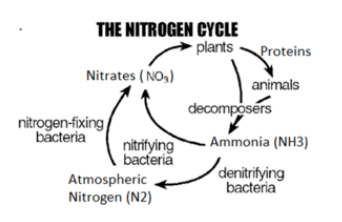
According to this diagram, plants use nitrogen to make _________________________
bacteria
animals
proteins
decomposers
45
Multiple Select
Check all the ways that carbon dioxide is REMOVED from the atmosphere.
Respiration
Combustion
Photosynthesis
Diffusion
Decomposition
46
Multiple Choice
According to this diagram, plants absorb
nitrates
nitrogen fixing bacteria
animals
decomposers
47
Multiple Choice
What are the two main reservoirs for carbon dioxide?
Ocean, fossil fuels
Ocean, atmosphere
Atmosphere, fossil fuels
Calcium Carbonate, ocean
48
Multiple Choice
According to this diagram, animals get proteins from eating ________________________
decomposers
bacteria
plants
sunlight
49
Multiple Choice
Which of the following is a major carbon sink?
Ocean
Atmosphere
Calcium Carbonate
None of the above
50
Multiple Choice
The process that allows organisms to use nitrogen
assimilation
denitrification
fixation
ammonification
51
Multiple Choice
Producers, like plants, do not cellular respiration.
True
False
52
Multiple Choice
A correct path that nitrogen could take would be
air -> animals -> plants -> bacteria
animals -> air -> bacteria -> plants
bacteria -> air -> plants -> animals
air -> bacteria -> plants -> animals
53
Multiple Choice
Bacteria fix nitrogen from the atmosphere into a form plants can use.
True
False
54
Multiple Choice
Bacteria create a form of nitrogen that animals can use directly.
True
False
55
Multiple Choice
What do free living bacteria in the soil do?
Make clouds
Turn atmospheric nitrogen into nitrates
Make carbon dioxide for plants to go through photosynthesis
Help plants take in water
56
Multiple Choice
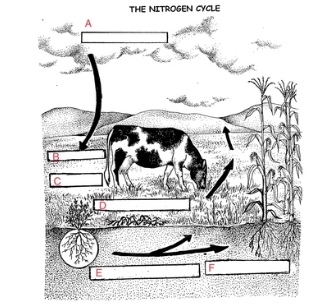
In the nitrogen cycle, what does label A in the diagram represent?
Gas
Clouds
Carbon dioxide in the atmosphere
Nitrogen in the atmosphere
57
Multiple Choice
All plants have nitrogen fixing bacteria in their roots.
True
False
58
That's all for today, see ya!
Carbon and Nitrogen Cycle
Show answer
Auto Play
Slide 1 / 58
SLIDE

Similar Resources on Wayground
54 questions
Review Friday: day 1-day 8
Presentation
•
9th - 10th Grade
57 questions
Theories of Evolution
Presentation
•
10th Grade
53 questions
GRAMMAR
Presentation
•
KG
57 questions
Theory of Evolution Lessons
Presentation
•
10th Grade
53 questions
Photosynthesis
Presentation
•
10th Grade
52 questions
12.6 ENDOCRINE SYSTEM
Presentation
•
10th Grade
55 questions
SB1.a, c, d Combined Lesson
Presentation
•
10th Grade
52 questions
Thinking and Problem solving
Presentation
•
10th Grade
Popular Resources on Wayground
10 questions
5.P.1.3 Distance/Time Graphs
Quiz
•
5th Grade
10 questions
Fire Drill
Quiz
•
2nd - 5th Grade
20 questions
Equivalent Fractions
Quiz
•
3rd Grade
22 questions
School Wide Vocab Group 1 Master
Quiz
•
6th - 8th Grade
20 questions
Main Idea and Details
Quiz
•
5th Grade
20 questions
Context Clues
Quiz
•
6th Grade
20 questions
Inferences
Quiz
•
4th Grade
12 questions
What makes Nebraska's government unique?
Quiz
•
4th - 5th Grade
Discover more resources for Biology
20 questions
Cladogram Practice
Quiz
•
10th Grade
21 questions
Cell Cycle and mitosis
Quiz
•
9th - 10th Grade
20 questions
Food Chains and Food Webs
Quiz
•
7th - 12th Grade
5 questions
Human Impacts: How Do People Disrupt Ecosystems?
Interactive video
•
4th Grade - University
10 questions
Ameoba Sisters: Introduction to cells
Interactive video
•
9th - 12th Grade
22 questions
AP Biology: Unit 7 Review (CED)
Quiz
•
9th - 12th Grade
10 questions
Exploring Evidence of Evolution
Interactive video
•
6th - 10th Grade
10 questions
Exploring Food Webs and Energy Pyramids
Interactive video
•
6th - 10th Grade