

7.NS.A.3 Operations with Rational Numbers

Presentation
•
Mathematics
•
6th - 8th Grade
•
Hard
+12
Standards-aligned

Victor Castillo
FREE Resource
21 Slides • 24 Questions
1
7th Grade Math

2

3
4
5
LINE UP YOUR DECIMALS
6

First you line up the decimals then add.
Some text here about the topic of discussion.
Adding Decimals
7
Fill in the Blanks
2.3
+ 3.4
8
You line up the decimals and subtract.
Some text here about the topic of discussion.
Subtracting Decimals

9
Find the decimal
Line up the decimals
Fill in the empty spots with zero
Add or Subtract
Bring down the decimal in your answer
10
The number with the most digits goes on top
Decimals do not line up
Multiply like normal
Count how many places in the first number (top) the decimal is moved over
Count how many places in the 2nd number (bottom) the decimal is moved over
The total number of places moved in the 1st and 2nd number is how many places you move the decimal in your answer
11
Multiple Choice
When you multiply two decimal numbers, you line up the digits not the decimal points.
True
False
12
Divisor cannot have a decimal
Move the divisor decimal so it is a whole number
Move the same amount of places in the dividend
Place a decimal straight up where you write your answer
Divide like normal
**When the divisor has no decimal but the dividend does, just move the decimal up and divide normally.
13
Multiple Choice
When you add two decimal numbers, you do not need to line up the decimal points.
True
False
14
Multiple Choice
When you divide two decimal numbers, the divisor cannot have a decimal.
True
False
15
IGNORE THE DECIMALS
THEN, COUNT THE DECIMALS TO THE RIGHT OF EACH FACTOR

16
Multiple Choice
7.32 + (-180.6)
-183.32
173.28
-173.28
-187.92
17
Multiple Choice
4.65 - (-32.5)
-37.15
27.85
37.15
-27.85
18
Multiple Choice
−4.6×(−2.73)
12.558
-12.558
-12.5580
12.5580
19
YOUR DIVISOR CANNOT BE A DECIMMAL
IF YOU MOVE THE DECIMAL IN THE DIVISOR, YOU MUST MOVE THE DECIMAL IN THE DIVIDEND THE SAME NUMBER OF PLACES
20
Match
Match the following fraction with the reciprocal
1/6
3/4
2/7
9/10
3/8
6
4/3
7/2
10/9
8/3
6
4/3
7/2
10/9
8/3
21
22
Multiple Choice
37.5÷2.5
0.15
1.5
15
150
23
24
YOU MUST HAVE THE SAME DENOMINATOR
25
Multiple Choice
−65+(−94)
−1185
1185
−1823
−159
26
Multiple Choice
−73−(−145)
1411
−1411
141
−141
27
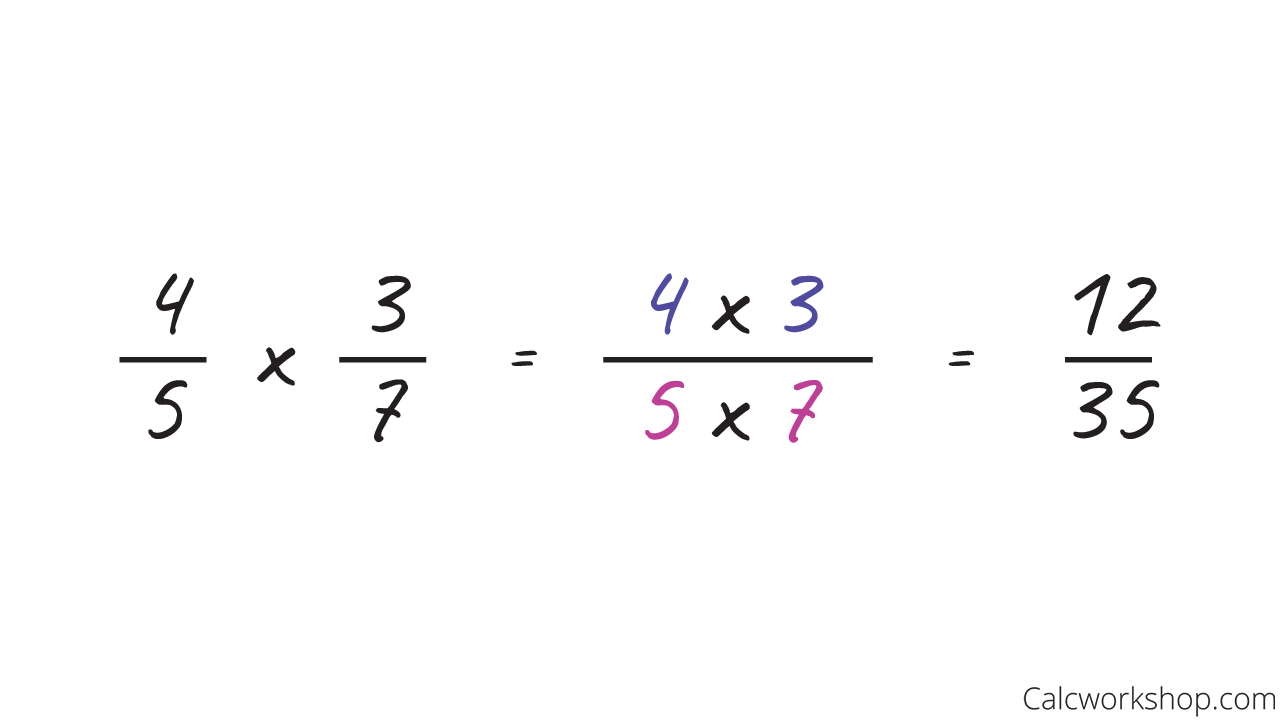
JUST MULTIPLY ACROSS
YOU DO NOT NEED TO HAVE COMMON DENOMINATORS
28
29
Multiple Choice
Solve:
52⋅45
2010
97
21
30
Fill in the Blanks
Solve & SIMPLIFY:
310⋅26
31
A whole number can be written as a fraction by putting it over 1
Remember, anything divided by 1 is itself!

32
Multiple Choice
Solve:
5 ⋅32
310
215
5 32
33
Big C
Multiple the denominator by the integer (whole number), then add the numerator
Denominator stays the same
Draw it out!

34
Multiple Choice
Which fraction is equal to
7 53
3521
521
538
35
Fill in the Blanks
Solve:
3 32⋅51
36

37
Fill in the Blanks
Solve & SIMPLIFY:
5 71⋅31
38
Multiple Choice
Which fraction is equal to
7 53
3521
521
538
39
Multiple Choice
−53×(−67)
3021
−107
107
−3021
40
Multiple Choice
−153×362
−531
531
−5155
5155
41
KCF (KEEP, CHANGE, FLIP)
CHANGE DIVISION TO MULTIPLICATION
FLIP THE SECOND FRACTION TO ITS RECIPROCAL

42
Multiple Choice
5/6 ÷ 3/4 =
Divide the fractions. Simplify the answer.
15/24
20/18
10/9
18/24
43
Multiple Choice
6/7 ÷ 1/4
Divide the answer. Simplify the fraction.
24/7
6/28
3/14
7/24
44
Multiple Choice
8/3 ÷ 5/4
Divide the answer. Simplify the fraction.
15/32
32/15
3/14
7/24
45
Match
Match the following improper fractions to mixed numbers.
15/3
7/2
14/3
25/6
45/10
5
3 1/2
4 2/3
4 1/6
4 5/10
5
3 1/2
4 2/3
4 1/6
4 5/10
7th Grade Math
Show answer
Auto Play
Slide 1 / 45
SLIDE
Similar Resources on Wayground

39 questions
Properties of Multiplication
Presentation
•
4th Grade
40 questions
Transformations, Congruence, Similarity
Presentation
•
6th - 8th Grade
41 questions
Quinn - Review Gr. 6, Unit 8: Preview Gr. 7, Unit 1
Presentation
•
6th - 8th Grade
41 questions
Introduction to Poetry
Presentation
•
6th - 7th Grade
40 questions
FANBOYS
Presentation
•
6th - 8th Grade
39 questions
Ecosystems and Biomes
Presentation
•
6th - 8th Grade
38 questions
Rhetorical Appeals and Strategies
Presentation
•
9th Grade
40 questions
Converting Between Fractions, Decimals, & Percents
Presentation
•
6th - 8th Grade
Popular Resources on Wayground
21 questions
Continents and Oceans

Quiz
•
6th Grade
20 questions
Parts of Speech
Quiz
•
5th Grade
16 questions
Subject & Predicate
Quiz
•
5th Grade
25 questions
Multiplication Facts
Quiz
•
5th Grade
12 questions
Map Skills
Quiz
•
3rd Grade
22 questions
Continents and Oceans
Quiz
•
5th Grade
15 questions
Rounding Decimals
Quiz
•
5th Grade
20 questions
Brand Labels
Quiz
•
5th - 12th Grade
Discover more resources for Mathematics
20 questions
Rational and Irrational Numbers
Quiz
•
8th Grade
16 questions
Proportional and Non Proportional Relationships in Tables, Graphs, and Equations
Quiz
•
7th Grade
20 questions
Decimal Place Value
Quiz
•
4th - 6th Grade
22 questions
Ratio and Ratio Tables
Quiz
•
6th Grade
22 questions
Explore Rational Number Operations and Applications
Quiz
•
7th Grade
20 questions
Add and Subtract Integers
Quiz
•
6th - 8th Grade
25 questions
Linear vs Nonlinear Functions
Quiz
•
8th Grade
20 questions
Graphing Inequalities on a Number Line
Quiz
•
6th - 9th Grade