Sem2 Review Lesson (Units 7-9)
Presentation
•
Science
•
9th Grade
•
Easy
+5
Standards-aligned
Stephen Waltner
Used 13+ times
FREE Resource
25 Slides • 44 Questions
1
Semester 2 Review Lesson
Fill out page 3-4 in your note packets as you work through the lesson
2
You are expected to fill out pages 3-4 in your Unit 10 (new) note packet as you complete this lesson
Are your notes out?
3
Distance Time Graphs

4
5
Multiple Choice
What is happening to the object in this graph?
It is not moving
It is moving at a constant speed
It is accelerating
6
7
8
Multiple Choice
Which line represents an object that is moving faster?
Dotted
Solid
9
What do you think the graph looks like of an object that has a positive acceleration (speeding up)?
10
Graphs that start out slow, then get faster are said to be accelerating
11
Graphs that start out fast, then get slower are said to be decelerating
12
Steps for finding slope:
1. Pick two points on the graph
2. Find their x,y coordinates
3. Plug coordinates into slope equation and solve
Slope Equation:
(y2 - y1) / (x2 - x1)
13
Multiple Choice
What is the velocity?
10 m/s
1 m/s
0.1 m/s
20 m/s
14
Multiple Choice
What is occurring from t=0 to t=4?
at rest
constant velocity
acceleration
15
Multiple Choice
What is occurring during t=4 to t=8?
at rest
constant velocity
acceleration
16
Multiple Choice
What is occurring during t=8 to t=10?
at rest
constant velocity
acceleration
17
Multiple Choice
What is the speed during the interval t=10 and t=16?
10 m/s
0 m/s
5 m/s
4 m/s
18
Multiple Choice
What is the speed during the interval t=0 and t=4?
10 m/s
0 m/s
4 m/s
5 m/s
19
Laws of Motion
A Review

20
Force
This is a push or pull on an object
21
Multiple Choice
What is the unit for FORCE?
N (Newtons)
lbs (pounds)
g (grams)
m/s (meters per second)
22
Newton's First Law of Motion
The first law states that an object at rest will stay at rest and an object in motion will remain in motion at a constant velocity unless acted upon by an unbalanced force.
23
Forces can be balanced or unbalanced
When a force is balanced, it will move with a constant velocity (staying still or moving at the same speed)
When a force is unbalanced, it will accelerate in the direction of the larger force.
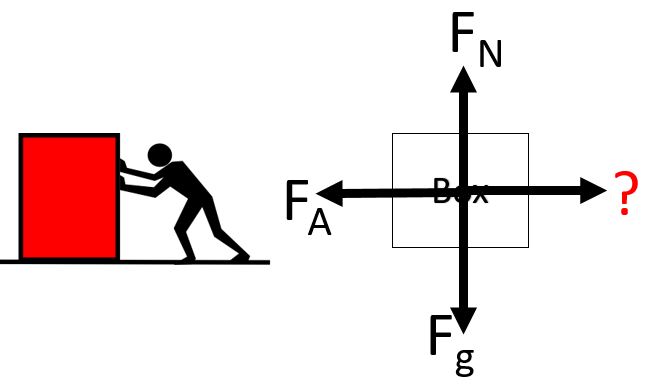
Net force is the combination of all the forces acting on an object. If the forces are going in the same direction they can be added on top of each other.
24
Multiple Choice
25
Multiple Choice
Forces that have a net force of zero
Balanced force
Unbalanced force
26
Multiple Choice
27
Multiple Choice
When Izzy and Zoe pull on the rope with the same amount of force, the forces are _____.
increased
unbalanced
balanced
decreased
28
The first law of motion
is also called the law of inertia. The more mass an object has, the more inertia something has, REGARDLESS OF HOW FAST IT IS GOING.
Inertia: The tendency of an object to keep doing what it is already doing
29
The second law of motion
states that the force = mass x acceleration
As force grows, mass or acceleration can grow.
However, if you are keeping the same force, as mass grows, acceleration will decrease or as acceleration increases, mass will decrease.
30
Multiple Choice
A force of 40 N acts upon a 2 kg block. Calculate the acceleration of the object.
20 m/s2
20 m/s
80 m/s2
80 m/s
31
Multiple Choice
An object with a mass of 100 kg is observed to accelerate at the rate of 5 m/s2. Calculate the force required to produce this acceleration.
20N
500 M/S
500 Kg
500N
32
The third Law of Motion
states that for every action, there is an equal and opposite reaction. In other words, for every action force, there is an equal and opposite reaction force that occurs.
33
Multiple Choice
Stacy is rowing a boat. She wants the boat to move forward. According to Newton's Third Law, in which direction should she move her paddle in the water?
Backwards
Above her head
Forward
East
34
Multiple Choice
35
Multiple Choice
36
Multiple Choice
An archer shoots an arrow. The action force is the bowstring against the arrow, the reaction force is...
Air resistance against the bow
the arrow's push against the bowstring
the grip of the archer's hand on the bow
37
Turn to page 4 and fill out the LEFT side of the page with the next slides
These will be vocab terms for us this unit
Turn the page
38
39
40
41
42
43
44
Match
Match each term to the correct definition
Energy that comes from a vibrating source and moves through matter
The energy from vibrating atoms and molecules
Light Energy
Energy stored in chemical bonds
Energy from the movement of electrons
Sound Energy
Thermal Energy
Radiant Energy
Chemical Energy
Electrical Energy
Sound Energy
Thermal Energy
Radiant Energy
Chemical Energy
Electrical Energy
45
Match
Match each term to the correct definition
Energy from the distortion of an object (object being compressed or stretched)
Energy due to position above the Earth
Any kind of potential or kinetic energy
Energy from an atoms nucleus decaying, or undergoing fission or fusion
The ability to cause (or stop) motion and create forces
Elastic Energy
Gravitational Energy
Mechanical Energy
Nuclear Energy
Energy
Elastic Energy
Gravitational Energy
Mechanical Energy
Nuclear Energy
Energy
46
Review Time
Use your unit 7, 8, and 9 note packets to help you answer the following questions
47
Multiple Choice
Velocity = _______________
Speed – direction
Speed + direction
Speed x direction
Speed / direction
48
Multiple Choice
At what speed would a car have to move in order to travel 20 kilometers in 2 hours.
5 km/hr
10 km/hr
20 km/hr
40 km/hr
49
Multiple Choice
50
Multiple Choice
What is the speed of a car travelling 50m in 4s?
200 m/s
12.5 m/s
12.5 m
200m
51
Multiple Choice
How long does it take a car to travel 40m at 12m/s?
4.8 s
480 s
3.33 s
33.3 s
52
Multiple Choice
53
Multiple Choice
54
Multiple Choice
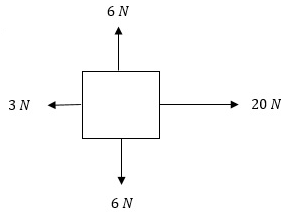
What is the NET FORCE of this diagram?
17 N, right
17 N, left
23 N, right
12 N, up
55
Multiple Choice
The force exerted by ropes and chains is called
tension
normal
elastic
mechanical
56
Multiple Choice
57
Multiple Choice
A 5 kg block is pulled across a table by a net force of 32 N. Calculate the acceleration of the object.
160 m/s2
6.4 m/s2
0.16 m/s2
58
Multiple Choice
59
Multiple Choice
60
Multiple Choice
61
Multiple Choice
62
Multiple Choice
63
Multiple Choice
64
Multiple Choice
During which stage is the object moving away from its starting point?
A
B
C
D
E
65
Multiple Choice
During which stage is the object moving toward its starting point?
A
B
C
D
E
66
Multiple Choice
A dictionary weighing 15 Newtons is placed on a desk.
What is the force that the desk exerts on the dictionary?
none
15 N
1.5 N
150 N
67
Multiple Choice
Which has the MOST inertia?
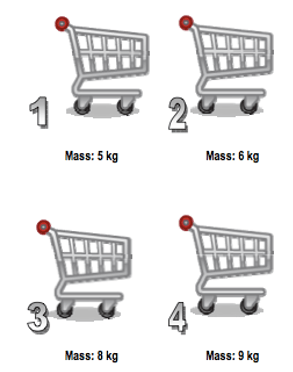
68
Multiple Choice
69
Multiple Choice
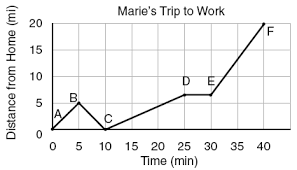
During what period of time was Marie stopped?
0-5 minutes
5-10 minutes
10-25 minutes
25-30 minutes
Semester 2 Review Lesson
Fill out page 3-4 in your note packets as you work through the lesson
Show answer
Auto Play
Slide 1 / 69
SLIDE

Similar Resources on Wayground
64 questions
Pre-Skills 8.G.A.2
Presentation
•
8th Grade
64 questions
The Eye
Presentation
•
9th Grade
63 questions
Energy Transfer
Presentation
•
9th - 10th Grade
61 questions
tekanan benda
Presentation
•
9th Grade
63 questions
The Mughal Empire in India
Presentation
•
9th Grade
64 questions
Force and Motion Test Recap
Presentation
•
8th Grade
63 questions
Force Body Diagrams 2025
Presentation
•
8th Grade
60 questions
The Constitution
Presentation
•
9th - 10th Grade
Popular Resources on Wayground
20 questions
"What is the question asking??" Grades 3-5
Quiz
•
1st - 5th Grade
20 questions
“What is the question asking??” Grades 6-8
Quiz
•
6th - 8th Grade
10 questions
Fire Safety Quiz
Quiz
•
12th Grade
20 questions
Equivalent Fractions
Quiz
•
3rd Grade
34 questions
STAAR Review 6th - 8th grade Reading Part 1
Quiz
•
6th - 8th Grade
20 questions
“What is the question asking??” English I-II
Quiz
•
9th - 12th Grade
20 questions
Main Idea and Details
Quiz
•
5th Grade
47 questions
8th Grade Reading STAAR Ultimate Review!
Quiz
•
8th Grade
Discover more resources for Science
20 questions
Cell Biology and Biochemistry Quiz
Quiz
•
9th Grade
20 questions
Human Impact on the Environment Review #2
Quiz
•
9th Grade
20 questions
Balancing Chemical Equations
Quiz
•
9th Grade
26 questions
Cell Cycle and Cancer Retest
Quiz
•
9th Grade
20 questions
Mendelian Genetics Review
Quiz
•
9th Grade
10 questions
Exploring Light and Waves Concepts
Interactive video
•
6th - 10th Grade
10 questions
Exploring Plant Structures and Adaptations
Interactive video
•
6th - 10th Grade
5 questions
Evolution (Darwin)
Interactive video
•
9th - 12th Grade