Force and Motion Test Recap
Presentation
•
Science
•
8th Grade
•
Medium
+18
Standards-aligned

Julie Beary
Used 1+ times
FREE Resource
23 Slides • 41 Questions
1
Speed
2
Force and Motion Test Recap
3
Speed and Velocity
Speed = Distance/Time
When you divide the total distance of a trip by time you get the average speed
Distance and displacement are not the same
Instantaneous Speed is the actual speed at a given moment.
4
Multiple Choice
How far do you go if you drive for 3 hours at a speed of 60 miles per hour?
20 miles
180 miles
20 mph
180 mph
5
Vectors and Velocity
Distance is either zero or positive value
Velocity is speed with direction
Velocity is a vector, while speed is scalar
Each change in position is added up using positive and negative numbers.
6
Acceleration is measured in m/s2
Acceleration
7
Multiple Choice
8
Multiple Choice
Which is an example of velocity?
A car driving 55 miles per hour south.
A bicyclist traveling 10 meters per hour.
A roller coaster is traveling 10 meters per second.
A rocket blasting off at 2,500 meters per second.
9
Multiple Choice
10
Multiple Choice
When a car goes around a corner at 20 mph, why do we say it accelerates?
The car is accelerating because of the velocity is constant
The car accelerates because it's going 20 mph
Cars always accelerate when they are in motion
The car is accelerating because it's changing direction
11
DISTANCE TIME GRAPHS
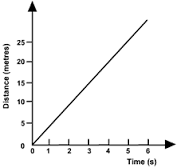
Constant Speed = straight diagonal line
No Motion (stopped) = flat line across
Acceleration = Curve
12
D/T Graph: Constant Speed
A straight diagonal line means the object is moving at a constant speed (speed stays the same)
The steepness of the slope tells you how fast the object is moving
Line A is more steep than B, so A is moving faster than B.
13
Multiple Choice
Which of the following is going the fastest?
A
B
C
All of the the above
14
D/T Graph: Back to Start
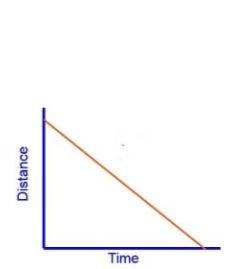
When a diagonal line goes down on a distance/time graph, this means the object is going back to the starting point at a CONSTANT speed.
In this graph, the object left home, stopped, and then went back home.
15
Multiple Choice
Which point on the graph shows the object going back toward the start?
A
B
D
D
16
D/T graph: Acceleration
Acceleration = curve
Increasing speed = faster (curving up)
Decreasing speed = slower (curving to flat line)
17
Multiple Choice
What is happening in this Distance/Time graph?
acceleration: increasing speed
no motion
constant speed
decreasing speed
18
D/T Graph: NO MOTION
A flat line shows no motion, the object is stopped or not moving
19
Multiple Choice
Which runner stopped during the race?
A
B
C
None
20
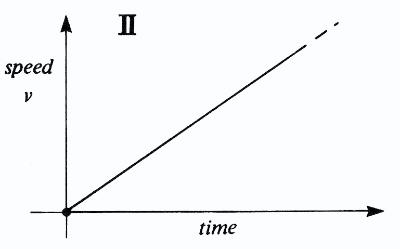
Speed/Time Graph
Constant Speed = flat line
Diagonal Up= faster
Diagonal Down = slower
Flat Line at the bottom = no motion (Speed = 0mph)
21
S/T Graph: Constant Speed
Constant Speed on a SPEED/TIME GRAPH is a flat line
This makes sense, because Speed is on the Y axis
The area in red shows that the object stays moving 3 mi/h
22
Multiple Choice
Between which two points did the object stay at a constant speed?
A to B
B to C
Both
None
23
S/T Graph: Acceleration
On a speed time graph, acceleration is shown with a diagonal line.
A line up means going faster
A line down means going slower
24
Multiple Choice
During which two points did the object accelerate(increase in speed)?
A - B
B - C
C - D
D - E
25
S/T Graph: No Motion
Sorry it's blurry!
On a SPEED/TIME graph, NO motion is a flat line at the very bottom
At what speed do you travel when you're not moving? 0mph!
26
Multiple Choice
During which two points was the object at rest (not moving)?
A - B
B - C
C - D
D - E
27
28
Multiple Choice
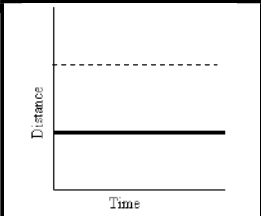
What does the solid line on this graph represent?
Constant speed
Acceleration
At rest
deceleration
29
Multiple Choice
What is the line on this graph showing?
moving away from starting point at a constant speed
moving back towards the starting point at a constant speed
acceleration (getting faster)
deceleration (getting slower)
30
Multiple Choice
What is this line of this graph showing?
moving away from starting point at a constant speed
moving back towards the starting point at a constant speed
acceleration (getting faster)
deceleration (getting slower)
31
Multiple Choice
32
Multiple Choice
33
Multiple Choice
What happened during A to B point?
not moving
increasing speed at a constant rate
moving at a constant speed
acceleration
34
Multiple Choice
35
Multiple Choice
What happened during B to C point?
deceleration
constant speed
at rest
acceleration
36
Multiple Choice
what is the motion described in the graph
all of above
constant speed
acceleration
constant position
37
Force
o A push or pull on an object.
o Able to change the motion of an object.
o Gravity, friction, and air resistance are three common forces on Earth.
38
Net Force
o The overall force exerted on an object; measured in Newtons (N).
o If the net force is 0, then a change in motion will not occur.
o If the net force is greater than 0, then a change in motion will occur.
39
40
Unbalanced Forces
o Unequal forces that cause a change in an object’s motion.
o Cause a change in speed and/or direction of an object – moves the direction of the greater force.
o Forces are unbalanced when the net force does not equal 0 Newtons.
41
Multiple Select
Find the Net Force and determine if the force is balanced or unbalanced.
Pick 2 answers
9N Right
3N Left
Balanced
Unbalanced
42
Multiple Choice
43
Multiple Choice
44
45
46
47
48
Match
Match the following
Objects in motion will remain in motion, and objects at rest will remain at rest unless acted on by an external force.
The net force on an object equals the product of its mass and acceleration.
For every action, there is an equal and opposite reaction.
Newton's 1st Law
Newton's 2nd Law
Newton's 3rd Law
Newton's 1st Law
Newton's 2nd Law
Newton's 3rd Law
49
Drag and Drop
50
Multiple Choice
Which one of Newton's Laws best fits the statement,
"When you push an object, it pushes back."?
Newton's 1st Law of Motion
Newton's 2nd Law of Motion
Newton's 3rd Law of Motion
Newton's 4th Law of Motion
51
Multiple Choice
Which one of Newton's Laws best fits the statement,
"More mass means more force needed to accelerate."?
Newton's 1st Law of Motion
Newton's 2nd Law of Motion
Newton's 3rd Law of Motion
Newton's 4th Law of Motion
52
Multiple Choice
A soccer ball is sitting in the middle of a field. The ball will remain at rest until an outside force like a players foot or the wind acts upon it. Which of Newton's laws is represented by this?
1st
2nd
3rd
53
Multiple Choice
Sally jumps on her trampoline. She exerts a force on the trampoline and the trampoline exerts an equal but opposite force back on Sally. This represents
Law 1
Law 3
Law 2
54
Multiple Choice
When you are running. your foot exerts force on the ground and the ground exerts force back onto you. Which of Newton's laws is represented
1st
2nd
3rd
55
Multiple Choice
If we put the same force on a bowling ball and a soccer ball, the soccer ball will move faster! Which law explains this?
1st
2nd
3rd
56
Multiple Choice
57
Multiple Choice
Which is an example of the law of inertia?
A rocket taking off from Earth
A crash test dummy flies through the windshield in a collision
A small rock skips on a pond faster than a large rock
58
Multiple Choice
Which is an example of the law of action/reaction?
A rocket taking off from Earth
A crash test dummy flies through the windshield in a collision
A small rock skips a pond faster than a large rock
59
Multiple Choice
Which example below BEST illustrates Newton's 3rd Law of Motion?
60
Multiple Choice
61
Multiple Choice
62
Multiple Choice
63
Multiple Choice
Which law does this image represent?
1st Law
2nd Law
3rd Law
64
Multiple Choice
Which law does this image represent?
1st Law
2nd Law
3rd Law
Speed
Show answer
Auto Play
Slide 1 / 64
SLIDE

Similar Resources on Wayground
58 questions
Chapter 6 Declaration of Independence Review
Presentation
•
8th Grade
60 questions
Midterm Review
Presentation
•
7th - 8th Grade
60 questions
Components of the Universe
Presentation
•
8th Grade
61 questions
Climate Zones
Presentation
•
7th Grade
57 questions
Unit 8 Review Lesson
Presentation
•
8th Grade
59 questions
TUAS / MOMEN DAYA
Presentation
•
8th Grade
59 questions
Force Motion Inertia
Presentation
•
8th Grade
61 questions
Intro to the Nile River: Egypt 1
Presentation
•
8th Grade
Popular Resources on Wayground
10 questions
5.P.1.3 Distance/Time Graphs
Quiz
•
5th Grade
10 questions
Fire Drill
Quiz
•
2nd - 5th Grade
20 questions
Equivalent Fractions
Quiz
•
3rd Grade
22 questions
School Wide Vocab Group 1 Master
Quiz
•
6th - 8th Grade
20 questions
Main Idea and Details
Quiz
•
5th Grade
20 questions
Context Clues
Quiz
•
6th Grade
20 questions
Inferences
Quiz
•
4th Grade
12 questions
What makes Nebraska's government unique?
Quiz
•
4th - 5th Grade
Discover more resources for Science
8 questions
Amoeba Sister Asexual vs Sexual Reproduction
Interactive video
•
8th Grade
19 questions
Introduction to Properties of Waves
Presentation
•
6th - 8th Grade
16 questions
Interactions within Ecosystems
Presentation
•
6th - 8th Grade
10 questions
Exploring the Layers of the Earth
Interactive video
•
6th - 10th Grade
20 questions
Energy Transformations
Quiz
•
6th - 8th Grade
46 questions
8th Science STAAR Review
Quiz
•
8th Grade
20 questions
Cell Organelles and Functions
Quiz
•
6th - 8th Grade
20 questions
Moon Phases and Eclipses
Quiz
•
6th - 8th Grade