4/21 - Blitz - Environment
Presentation
•
Science
•
8th Grade
•
Easy
+9
Standards-aligned
Rebecca Keith
Used 6+ times
FREE Resource
6 Slides • 55 Questions
1
Blitz - Environment
2
3
Multiple Choice
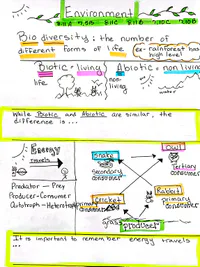
Abiotic can be defined as?
An organism that is alive
Non-living parts of an ecosystem
Living Parts of the environment
A new kind of Pokemon that lives with Pikachu
4
Multiple Choice
Biotic can be defined as
the living parts of an ecosystem
non-living parts of an environment
rocks and water
snakes and water
5
Multiple Choice
Temperature is a(n) _________factor
Biotic
Abiotic
living
cool
6
Multiple Choice
Which of the following is NOT a biotic factor?
Coyote
air
elephant
7
Multiple Choice
Is a deer an abiotic or biotic factor?
abiotic
biotic
8
Multiple Choice
Temperature, sunlight, oxygen, water, and soil are all _____ parts of the environment
alive
biotic
abiotic
living
9
Multiple Choice
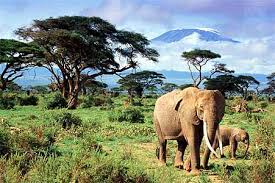
sunlight, elephants, and grasses
sunlight, water, and air
elephants, plants, trees
10
Multiple Choice
Only one species in an area.
The different amount of species in an area
All abiotic life
Nitrogen fixation
11
Multiple Choice
a. It had too little biodiversity
b. It had a lot of resistance to disease
c. It had a few plants that were resistant to disease
d. It had too much genetic variation
12
Multiple Choice
Because all species depend on each other to survive, so if one becomes extinct another species that relies on it could go extinct as well
Because it’s better to have only one variation of each species.
Because it better to only have a few species on Earth.
Honestly, I have no idea what biodiversity is!
13
Multiple Choice
No, sharks are not important.
No, sharks will only affect the seal populations.
Yes, it will disrupt the entire food chain in the ocean.
Yes, but only a little.
14
Multiple Choice
Which ecosystem is more biodiverse?
Desert
Grassland
Tundra
Rainforest
15
Multiple Choice
It prevents one disease from wiping out an entire food crop.
It prevents habitat loss of native species.
It provides different foods for different populations.
It prevents fungal disease from wiping out corn crops.
16
Multiple Choice
No the fish do not need the phytoplanton. Since there are so many fish, there is high biodiversity.
Yes, this ecosystem has low biodiversity. Without a producer the herbivores will die out leaving no food.
Yes, this system has high biodiversity; however the fish can adapt and get food from another source.
Yes, the fish will overate to get all of the phytoplankton that is left, then they will die.
17
18
Multiple Choice
Hawk
Spider
Grasshopper
Shrew
19
Multiple Choice
cricket
frog
hawk
shrew
20
Multiple Choice
There would be more food for secondary consumers.
The number of primary consumers would increase.
The number of plants would increase.
The number of secondary consumers would increase.
21
Multiple Choice
mutualism
competition
predator/prey
parasitism
22
Multiple Select
Which of these are producers in this food web?
Phytoplankton/algae
Crabs
Clams
Copepods
23
Multiple Choice
Which organism in this food chain is a producer?
Seaweed
clam
starfish
seagull
24
Multiple Choice
If the grasshopper were to be removed completely from the food web, what organism would be most effected?
The squirrel
The shrew
The deer
The rabbit
25
Multiple Choice
In this food chain, what will happen if the frogs become extinct?
The snakes will increase.
The grasshoppers will decrease.
The eagles will remain the same.
The grasshoppers will increase.
26
Multiple Select
Which of these are consumers in this food web (multiple answers)?
Phytoplankton
Crabs
Clams
Copepods
27
Multiple Select
Which of these consumers are herbivores (multiple answers)?
Caterpillar
Rabbit
Snail
Eagle
Lizard
28
Multiple Select
Which of the organisms are most likely to compete for water, minerals, and sunlight (multiple answers)?
The shrub
The shrew
The tree
The rabbit
The grass
29
Multiple Choice
Heron
Snail
Frog
Water lily
30
31
Multiple Choice
100%
90%
10%
1%
32
Multiple Choice
The largest group of organisms with the most energy found in an energy pyramid would be:
Primary Consumers
Producers
Decomposers
Tertiary Consumers
33
Multiple Choice
According to the energy pyramid, the organism that obtains the least energy is the ___
Garter Snake
Field Mouse
Red-tailed Hawk
Alfalfa
34
Multiple Choice
In this energy pyramid, which organisms have the most energy available?
Producers
Carnivores
Herbivores
Top Predator
35
Multiple Choice
In this energy pyramid, which organism has the least amount of energy available?
Producers
Herbivores
Carnivores
Top Predator
36
Multiple Choice
A
B
C
D
37
Multiple Choice
The direction of population migration
Differences in dietary habits
Progressively smaller organisms
The direction of the energy flow
38
39
Multiple Choice
Primary or secondary ecological succession?
40
Multiple Choice
Primary or secondary ecological succession?
41
Multiple Choice
Primary or secondary ecological succession?
42
Multiple Choice
Primary or secondary ecological succession?
43
Multiple Choice
Primary succession begins in an area with:
Bare Rock
Soil
44
Multiple Choice
Secondary succession begins in an area with:
Bare Rock
Soil
45
Multiple Choice
The first species to appear in an area:
discovering species
pioneer species
new species
colonizing species
46
Multiple Choice
What is formed during primary succession that doesn't need to be formed during secondary succession?
soil
grass
pioneer species
lichen
47
48
Multiple Choice
Which of the following is NOT a source of pollution in the ocean?
Fertilizers used on land.
Sand drifting along the bottom of the ocean floor.
Oils found on city streets.
Emissions from gas-burning vehicles.
49
Multiple Choice
Which piece of evidence BEST explains why trash has accumulated in the ocean?
Humans manufacturing and quickly discarding plastic products has caused the garbage patches to grow.
The best way to discard plastic trash is to dump it in the ocean.
Only plastic that cannot be recycles is found in the ocean.
Trash has not accumulated in the ocean.
50
Multiple Choice
What is a fertilizer runoff?
When fertilizer runs into a body of water.
When water makes fertilizer.
When algae grows rapidly.
The industrial production of fertilizers.
51
Multiple Choice
What happens when a fertilizer runoff happens?
Fish get bigger.
Algae grow rapidly.
The water becomes very clear.
The oxygen level in the water increases.
52
Multiple Choice
What happens to the fish if there is fertilizer runoff?
The fish thrive because of increase in Nitrogen and Phosphorous.
The fish die because of lack of oxygen.
Nothing happens to the fish.
The fish thrive because there is more algae to eat.
53
Multiple Select
Which of the following is the cause of dead zones in the ocean? (select all that apply)
An increase in the number of fish.
An increase in runoff from fertilizer
An increase in oxygen
A decrease in oxygen
54
Multiple Choice
Fisheries renew themselves naturally each year, but __________________ has caused a shortage of fish in some areas.
Aquaculture
Fishing regulations
Overfishing
Global warming
55
Multiple Choice
Review the graph showing marine fishing rates.If the fishing rate in Asia continues to grow, what will most likely happen as a result?
The fish population will continue to rise.
A wide range in ocean temperatures will be seen worldwide.
The U.S. human population will decline.
The overfishing will cause an imbalance in marine ecosystems.
56
Multiple Choice
What is one way humans are trying to positively impact the ocean?
Fishing
Drilling for oil and natural gas
Creating artificial reefs
Transporting goods in ocean vessels
57
Multiple Choice
The ______________ natural reefs in some places has led to people building "artificial" ones.
increase of
multiplication of
lack of
rise of
58
Multiple Choice
Juniper
Pine
Spruce
Fir
59
Multiple Choice
Whip Scorpion
Wind Scorpion
Daddy long legs
Scorpion
60
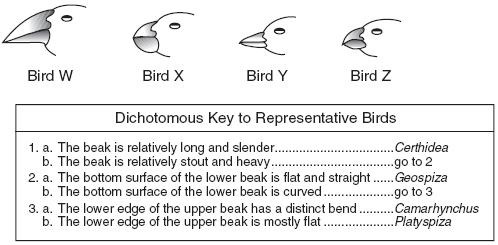
Multiple Choice
Certhidea
Geospiza
Camarhynchus
Platyspiza
61
Multiple Choice
Which leaf is shown in the drawing?
Magnolia
Redbud
Sweetgum
None of the above
Blitz - Environment
Show answer
Auto Play
Slide 1 / 61
SLIDE

Similar Resources on Wayground
54 questions
U0: The Nature and Practice of Science
Presentation
•
7th Grade
55 questions
Age of Jackson- Jacksonian Democracy
Presentation
•
8th Grade
58 questions
Westward Expansion & The Mexican-American War
Presentation
•
8th Grade
56 questions
Genetics Make-up Session
Presentation
•
7th Grade
56 questions
Earth's History
Presentation
•
8th Grade
56 questions
Earth History Systems
Presentation
•
8th Grade
60 questions
Unit 3 Energy Test Review
Presentation
•
7th Grade
56 questions
Marine life
Presentation
•
8th Grade
Popular Resources on Wayground
15 questions
Grade 3 Simulation Assessment 1
Quiz
•
3rd Grade
22 questions
HCS Grade 4 Simulation Assessment_1 2526sy
Quiz
•
4th Grade
16 questions
Grade 3 Simulation Assessment 2
Quiz
•
3rd Grade
19 questions
HCS Grade 5 Simulation Assessment_1 2526sy
Quiz
•
5th Grade
17 questions
HCS Grade 4 Simulation Assessment_2 2526sy
Quiz
•
4th Grade
20 questions
Equivalent Fractions
Quiz
•
3rd Grade
24 questions
HCS Grade 5 Simulation Assessment_2 2526sy
Quiz
•
5th Grade
20 questions
Math Review
Quiz
•
3rd Grade
Discover more resources for Science
20 questions
8th Grade Science STAAR Review
Quiz
•
8th Grade
16 questions
Interactions within Ecosystems
Presentation
•
6th - 8th Grade
20 questions
Earth Day
Quiz
•
3rd - 12th Grade
30 questions
GMAS Physical Science Review
Quiz
•
8th Grade
100 questions
GMAS Science Review
Quiz
•
8th Grade
5 questions
History of Earth Day
Passage
•
6th - 8th Grade
100 questions
STAAR Review
Quiz
•
8th Grade
10 questions
Exploring Earth's Seasons and Their Causes
Interactive video
•
6th - 8th Grade