Emojis Get A Big (Thumbs-Up Emoji) From British Linguist Day 2
Presentation
•
English
•
6th - 8th Grade
•
Practice Problem
•
Medium
Jesus Garcia
Used 9+ times
FREE Resource
6 Slides • 13 Questions
1
Open Ended
Warm-Up Question: Favorite Emoji & Its Meaning 🎉📱
What is your favorite emoji, and why do you like using it?
Sentence Stem:
My favorite emoji is _ because _.
2
3
Multiple Choice
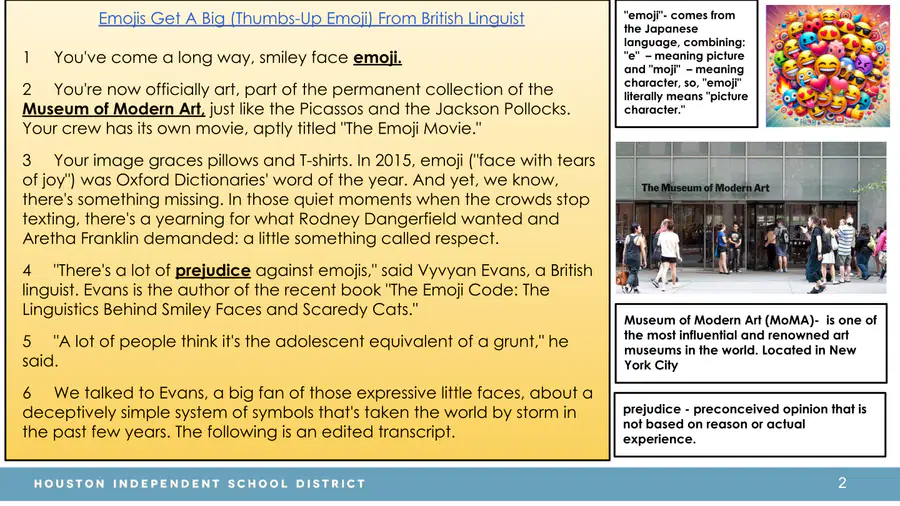
1. Based on paragraph 3, what inference can be made about the significance of emojis in modern culture?
Emojis are only used for entertainment and do not have a deeper meaning.
Emojis are becoming widely accepted as a serious form of communication.
The popularity of emojis is decreasing due to new technology.
People only use emojis when they do not know what to say.
4
5
Multiple Choice
2. Read these sentences from paragraph 2.
"You're now officially art, part of the permanent collection of the Museum of Modern Art, just like the Picassos and the Jackson Pollocks."
What can the reader infer about the author’s attitude toward emojis?
The author believes emojis are trivial and unimportant.
The author thinks emojis have achieved recognition in the art world.
The author is skeptical about emojis being categorized as art.
The author feels that emojis should not be compared to famous works of art.
6
Multiple Choice
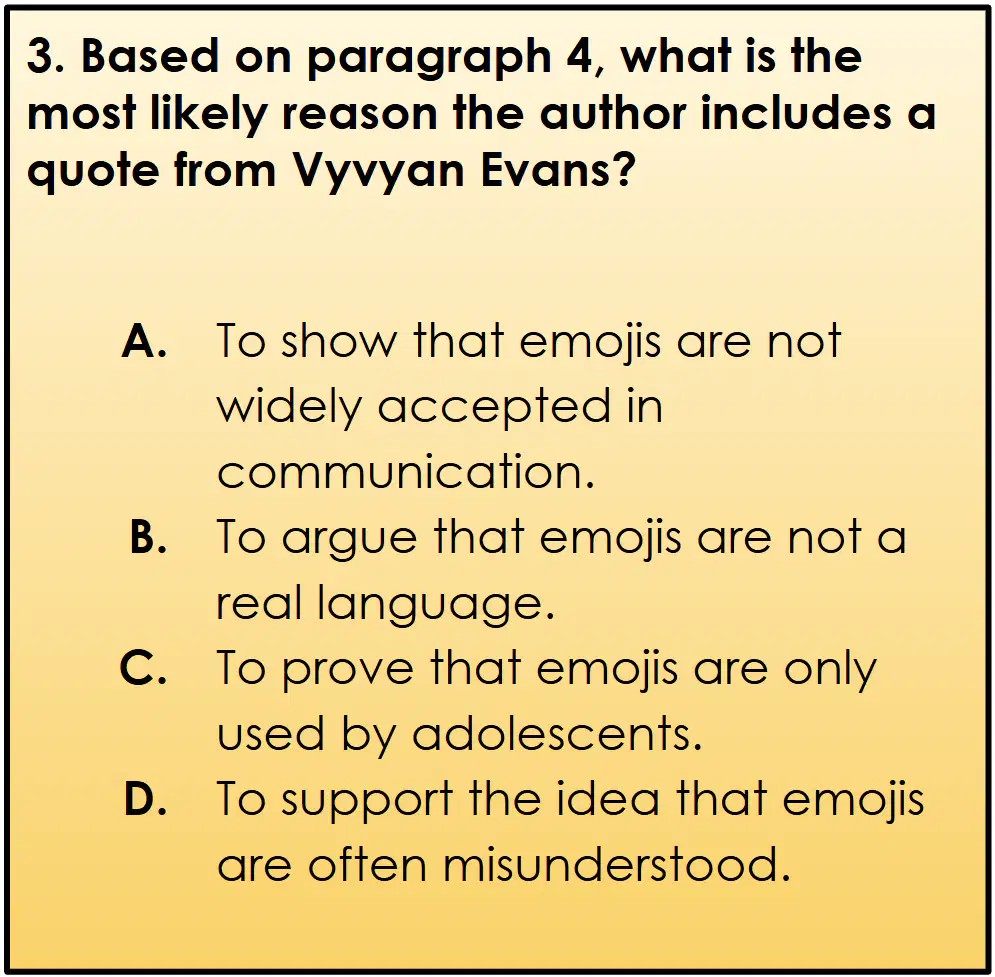
3. Based on paragraph 4, what is the most likely reason the author includes a quote from Vyvyan Evans?
To show that emojis are not widely accepted in communication.
To argue that emojis are not a real language.
To prove that emojis are only used by adolescents.
To support the idea that emojis are often misunderstood.
7
8
Multiple Choice
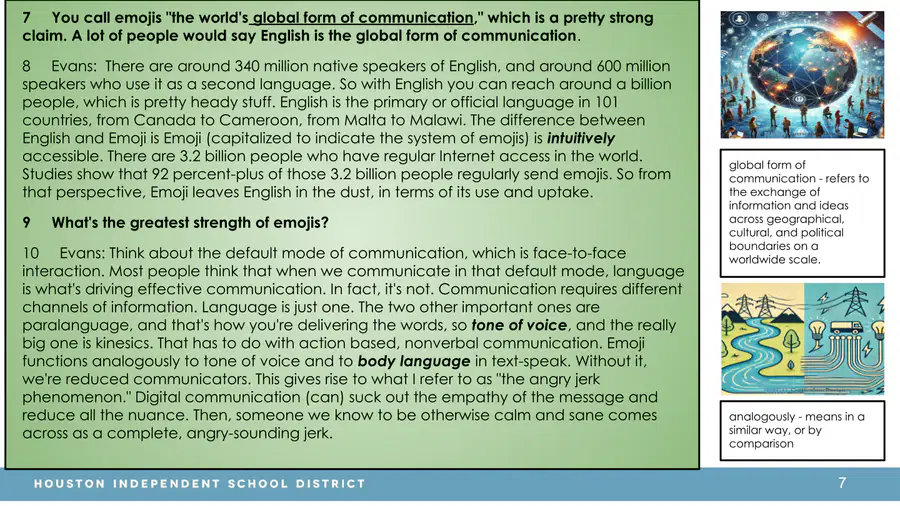
4. Which definition best matches how "intuitively" is used in paragraph 8?
In a way that is based on instinct rather than conscious reasoning.
Without needing to be taught; naturally.
In a way that is easy to understand or grasp.
Through careful analysis and logical deduction
9
Multiple Choice
4. Read these sentences from paragraph 8.
"There are around 340 million native speakers of English, and around 600 million speakers who use it as a second language. So with English you can reach around a billion people, which is pretty heady stuff."
What can the reader infer about English based on these sentences?
English is not spoken by many people worldwide.
English is primarily spoken in North America and Europe.
English is widely used, but other forms of communication are more universal.
English is a language that is difficult for non-native speakers to learn.
10
Multiple Choice
5. Based on paragraph 8, what is the most likely reason the author provides statistics on English speakers?
To demonstrate that English is the most effective language for communication
To show that English is used by fewer people than emojis
To argue that English is becoming less important globally
To prove that emojis should be the official language of the internet
11
Multiple Choice
6. Based on paragraph 10, what can the reader conclude about digital communication?
It is more effective than face-to-face communication.
It allows people to express emotions more accurately.
It prevents misunderstandings in conversations.
It often lacks important elements of human interaction.
12
13
Open Ended
7. SCR - How does the author use text structure to support the argument that emojis are globally significant?
STEMS:
The author uses…
The passage compares…
This show that…
14
15
Multiple Choice
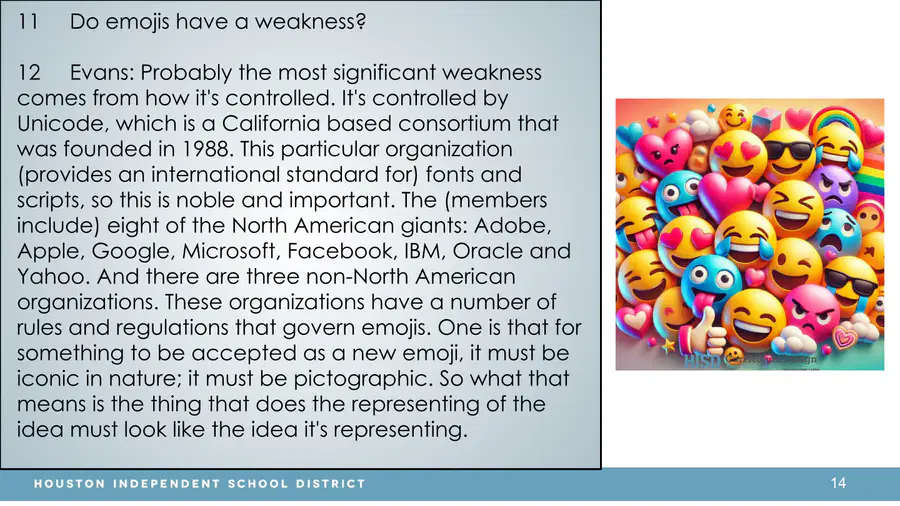
What is the main weakness of emojis according to Evans in paragraph 12?
Emojis are not used by enough people worldwide.
The Unicode Consortium strictly controls which emojis get approved.
Emojis are too difficult for people to understand.
There are too many emojis, making communication confusing.
16
17
Multiple Choice
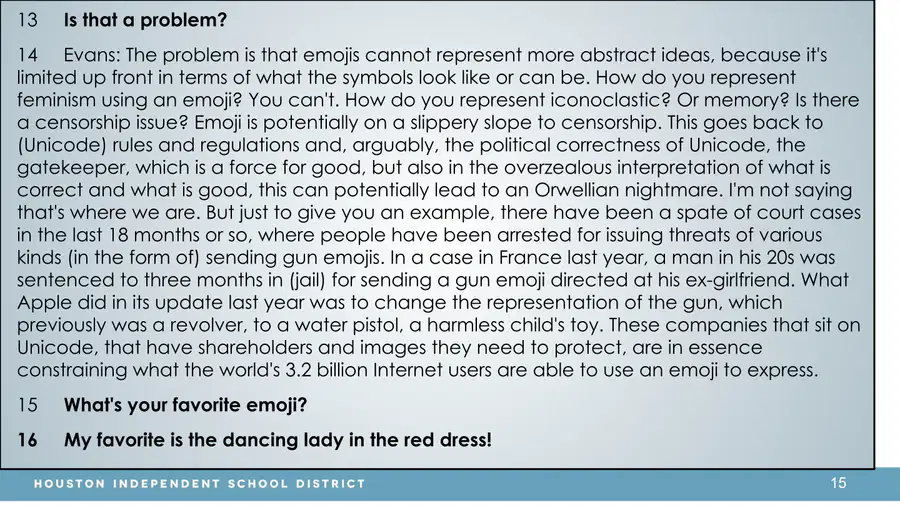
8. Based on paragraph 14, what is the most likely reason Unicode has regulations on emoji design?
To prevent confusion in communication.
To limit user creativity.
To allow users to freely create new emojis.
To ensure all emojis look similar.
18
Multiple Choice
9. What can the reader conclude about the censorship of emojis based on paragraph 14?
Unicode is actively suppressing certain messages.
Companies influence what emojis can represent.
Emojis are not subject to any regulation.
19
Multiple Choice
10. Based on paragraph 15, why does the author mention their favorite emoji?
To argue that certain emojis are more useful than others.
To suggest that emojis are more symbolic than literal.
To prove that emojis are difficult to interpret.
To provide a personal touch to the discussion.
Warm-Up Question: Favorite Emoji & Its Meaning 🎉📱
What is your favorite emoji, and why do you like using it?
Sentence Stem:
My favorite emoji is _ because _.
Show answer
Auto Play
Slide 1 / 19
OPEN ENDED

Similar Resources on Wayground
15 questions
Complex Sentences
Presentation
•
6th - 8th Grade
15 questions
Analogies
Presentation
•
6th - 8th Grade
15 questions
B.W. Day 15 Conjunctive Adverbs
Presentation
•
6th - 8th Grade
15 questions
Writing a Summary Paragraph
Presentation
•
6th - 8th Grade
12 questions
Character Interaction
Presentation
•
6th - 8th Grade
14 questions
Affixes
Presentation
•
6th - 8th Grade
14 questions
4.1 reading comprehension
Presentation
•
6th - 8th Grade
15 questions
Direct Objects
Presentation
•
6th - 8th Grade
Popular Resources on Wayground
19 questions
Naming Polygons
Quiz
•
3rd Grade
10 questions
Prime Factorization
Quiz
•
6th Grade
20 questions
Math Review
Quiz
•
3rd Grade
15 questions
Fast food
Quiz
•
7th Grade
20 questions
Main Idea and Details
Quiz
•
5th Grade
20 questions
Context Clues
Quiz
•
6th Grade
20 questions
Inferences
Quiz
•
4th Grade
19 questions
Classifying Quadrilaterals
Quiz
•
3rd Grade
Discover more resources for English
20 questions
Context Clues
Quiz
•
6th Grade
20 questions
Figurative Language Review
Quiz
•
6th Grade
14 questions
Context Clues
Quiz
•
4th - 6th Grade
50 questions
The Giver Ch 1-23
Quiz
•
6th Grade
34 questions
7th Grade ELA EOG Review
Quiz
•
7th Grade
12 questions
Final Figurative Language Review
Presentation
•
6th - 8th Grade
50 questions
ELA EOG Prep 7th Grade
Quiz
•
KG - University
39 questions
6th Grade Reading SOL Review Terms
Quiz
•
6th Grade