


Joseph Anderson
FREE Resource
11 Slides • 5 Questions
1
Sonnets
Jasper Jebamalar P.J.
I. B.Ed. English
2
What are sonnets?
A sonnet is a type of fourteen-line poem. The fourteen lines of a sonnet consist of an octave (or two quatrains making up a stanza of 8 lines) and a sestet (a stanza of six lines).
3
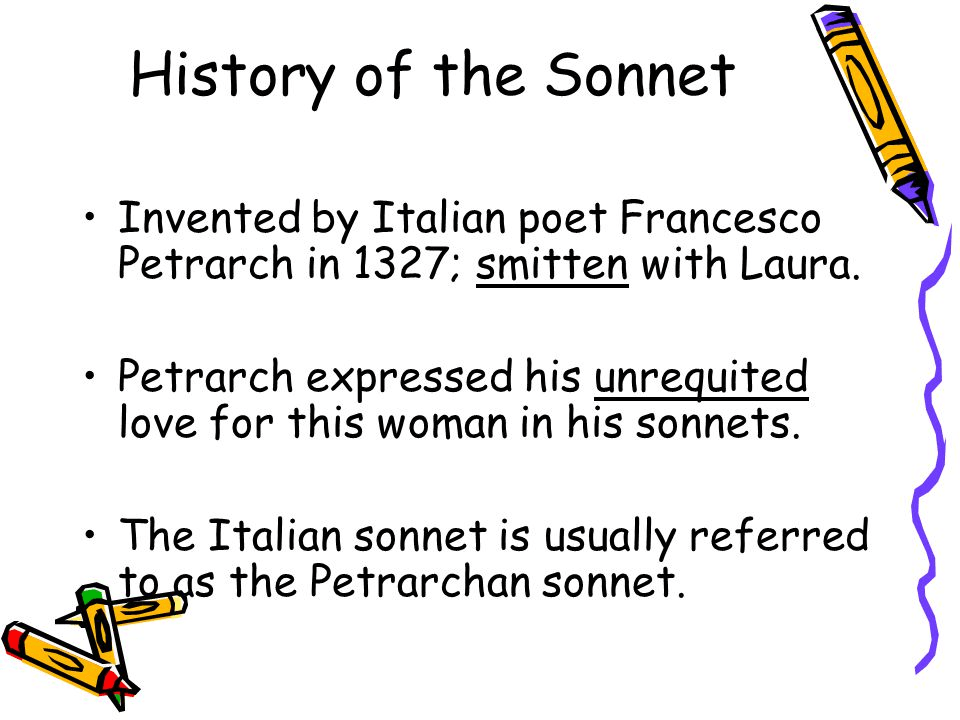
History of sonnets
Before William Shakespeare’s day, the word sonnet could be applied to any short lyric poem.
In Renaissance Italy and then in Elizabethan England, the sonnet became a fixed poetic form, consisting of 14 lines, usually iambic pentameter in English
4
5
Meter
A pattern of stressed and unstressed syllables creates the rhythm of lines of poetry. The units of the meter are called feet. Feet have different stress patterns. For instance, an iamb is "a foot" with an unstressed syllable followed by a stressed syllable (de-fine), while a trochee has the opposite: a stressed syllable followed by an unstressed syllable (Po-et).
6
Meter
Poetic meters are defined by both the type and number of feet they contain. For example, iambic pentameter is a type of meter used in many sonnets that contains five iambs per line (thus the prefix “penta,” which means five).
7
Rhyme Scheme
Poems such as sonnets that make use of end rhymes (rhymes at the end of each line), often do so according to a repeating, predetermined pattern. That pattern is called a rhyme scheme. Rhyme schemes are described using letters of the alphabet, so that each line of verse that corresponds to a specific type of rhyme used in the poem is assigned a letter, beginning with the letter A. For example, a four-line poem in which the first line rhymes with the third, and the second line rhymes with the fourth has the rhyme scheme ABAB.
8
Types of Sonnets
Italian Sonnet
The English Sonnet
Modern Sonnet
Spencerian Sonnet
Caudate Sonnet
Word Sonnet
9
Subject matter in Sonnet
With few exceptions, Italian sonnets and early English sonnets are about unrequited love. Then, in the 17th century, John Donne began writing religious sonnets, and shortly thereafter John Milton began using the form for everything from satirical poems to more serious poems of soul-searching and reflection. In the 19th century, the sonnet's popularity among poets around the globe soared, such that by the end of the century so many variations had been made to the form that it was seen as well-suited to any subject matter. Today, as a result, sonnets don't have to take any particular subject as their focus.
10
Who invented the English sonnet?
Thomas Wyatt (who wrote poetry about his love for Anne Boleyn) and the Earl of Surrey both pioneered the sonnet in the English language in the mid-sixteenth century at the court of Henry VIII, some 200 years after Petrarch had first popularised the sonnet in medieval Europe. But it was an author named William Baldwin who wrote the first sonnet to be published in English.
11
Who invented the Shakespearean sonnet?
The ‘English sonnet’, also known as the Shakespearean sonnet, is different from the Italian or Petrarchan sonnet. Although it comprises 14 lines the same as the Petrarchan form, the Shakespearean sonnet has a different internal structure, comprising three quatrains (four-line sections) all rounded off by one final couplet. The rhymes are also more varied, with the sonnet rhyming abab cdcd efef gg. The ‘turn’ in Shakespearean sonnets usually occurs at the start of this final couplet. But Shakespeare didn’t come up with this rhyme scheme: Henry Howard, Earl of Surrey was the first to write sonnets like this. Shakespeare didn’t invent the Shakespearean sonnet.
12
Open Ended
What is a Sonnet?
13
Multiple Choice
How many lines are present in a sonnet?
10
18
14
20
14
Multiple Select
Which of the following is NOT a type of sonnet?
English sonnet
Italian sonnet
Draconian sonnet
Petrarchan sonnet
15
Fill in the Blank
Type answer...
16
Poll
The last two lines of a sonnet are called a rhyming couplet.
True
False
Sonnets
Jasper Jebamalar P.J.
I. B.Ed. English

Show answer
Auto Play
Slide 1 / 16
SLIDE

Similar Resources on Wayground
12 questions
Will vs. Going to
Presentation
•
9th - 12th Grade
12 questions
Prepositions
Presentation
•
3rd Grade
12 questions
Main Idea
Presentation
•
10th - 12th Grade
12 questions
READING COMPREHENSION
Presentation
•
10th - 11th Grade
12 questions
Stay Hydrated
Presentation
•
10th - 11th Grade
10 questions
Sleep
Presentation
•
10th - 11th Grade
12 questions
Second Conditional - Inglês
Presentation
•
9th - 12th Grade
13 questions
Joy Luck Club
Presentation
•
9th - 12th Grade
Popular Resources on Wayground
10 questions
5.P.1.3 Distance/Time Graphs
Quiz
•
5th Grade
10 questions
Fire Drill
Quiz
•
2nd - 5th Grade
20 questions
Equivalent Fractions
Quiz
•
3rd Grade
22 questions
School Wide Vocab Group 1 Master
Quiz
•
6th - 8th Grade
20 questions
Main Idea and Details
Quiz
•
5th Grade
20 questions
Context Clues
Quiz
•
6th Grade
20 questions
Inferences
Quiz
•
4th Grade
12 questions
What makes Nebraska's government unique?
Quiz
•
4th - 5th Grade
Discover more resources for English
18 questions
Informative or Argumentative essay
Quiz
•
5th Grade - University
20 questions
Figurative Language Review
Quiz
•
10th Grade
10 questions
Test Taking Strategies for State Reading Assessments
Interactive video
•
6th - 10th Grade
20 questions
Mood and Tone STAAR Review
Quiz
•
10th Grade
35 questions
STAAR Revising and Editing (2026)
Presentation
•
9th - 12th Grade
20 questions
Figurative Language Review
Quiz
•
6th - 12th Grade
20 questions
English 2 STAAR Grammar Review
Quiz
•
9th - 11th Grade
12 questions
Commas, Commas, and More Commas
Quiz
•
10th Grade
