Search Header Logo
Biomass and Trophic Levels

Biomass and Trophic Levels

Assessment

Presentation

Biology

9th Grade

Hard

Created by

Joseph Anderson

FREE Resource

12 Slides • 18 Questions

1

Energy Pyramids and Biomass

media

E.Q: how can we know the amount of energy available to an organism based on its trophic level

2

In this lesson we will

  • Explore energy transfer among trophic levels

  • Define biomass

  • Understand why pyramids are used to show both energy transfer and biomass

media

3

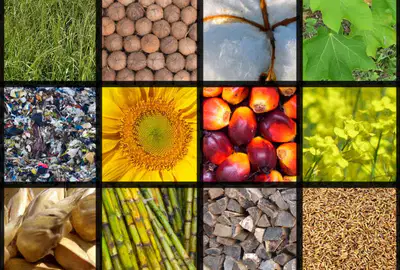
Vocabulary: Biomass

biomass: total mass of a group of organisms

Bio = life
Mass = amount of matter in an object

Biomass refers to the mass of whatever group of organisms you are studying.

media

4

Vocabulary: energy pyramid

energy pyramid: model that shows the energy available at each trophic level of an ecosystem

media

5

6

Multiple Choice

Question image

What does biomass refer to in the context of the video?

1

The mass of living things in a specific area.

2

The number of species in a specific ecosystem.

3

The size of individual organisms in a population

4

The total land area covered by a specific organism.

7

Multiple Choice

According to the video, what is the most amazing piece of Earth's biomass?

1

Humans

2

Fungi

3

Viruses

8

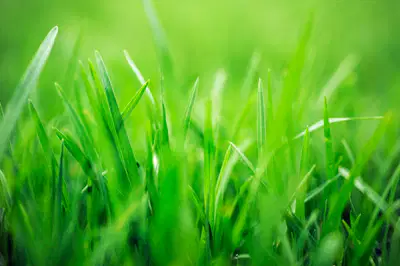
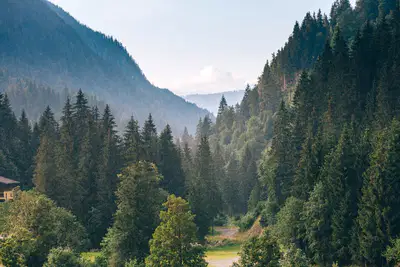
Biomass can sometimes give you better information than simply counting the number of organisms. Grass is composed of many very small plants. Forests are composed of very large trees.

media
media

9

Imagine the number of each type of plant in 1 m2. Since trees are large, there will be very few. You may even find only one tree in 1 m2. However, thousands of blades of grass fit in that same area. There are more blades of grass, but the trees have more biomass.

Biomass considers the mass of all members of a population: a large population of small organisms can have greater biomass than a small population of large organisms.

media
media

10

Multiple Choice

What is the main difference between the number of trees and grass plants in 1 m2?

1

There are more trees than blades of grass

2

There are fewer trees than blades of grass

3

There are equal numbers of trees and blades of grass.

11

Multiple Choice

why can a large population of small organisms have greater biomass than a small population of large organisms?

1


Small organisms are more efficient at producing biomass.

2


Small organisms have a lower energy requirement.

3

Small organisms can be more numerous within a given area.

12

Remember - in an ecosystem there are usually more prey organisms than predators

The same idea applies to biomass:
Producers have the greatest biomass in an ecosystem

This provides energy to all of the primary consumers while leaving enough producers to reproduce. In any ecosystem there are more primary consumers than secondary consumers and more secondary consumers than tertiary consumers.

media

Biomass Pyramid

13

Multiple Choice


What role do producers play in an ecosystem?

1

They provide energy to all consumers.

2

They reproduce more than other organisms.

3

They rely on other organisms for energy.

14

Multiple Choice


Which statement is true about the number of primary consumers and secondary consumers in an ecosystem?

1


There are more primary consumers than secondary consumers.

2

There are more secondary consumers than primary consumers.

3

The number of primary and secondary consumers is equal.

15

Multiple Select

What is the relationship between the biomass of producers and the energy available to consumers?

1


The biomass of producers and the energy available to consumers are unrelated.

2

The biomass of consumers determines the energy available to producers.

3


The biomass of producers determines the energy available to consumers.

16

Because there needs to be more biomass of grass than of cows in an ecosystem, the total biomass decreases with each trophic level.

Trophic level 1 has the most biomass.
Trophic level 4 or 5 has the least biomass.

media

Biomass Pyramid

17

Multiple Choice


Which trophic level has the most biomass?

1


trophic level 1

2

trophic level 3

3

trophic level 5

18

Energy Pyramid

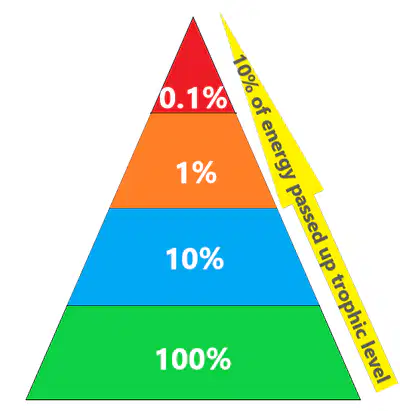
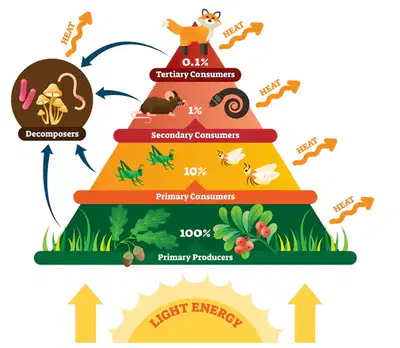
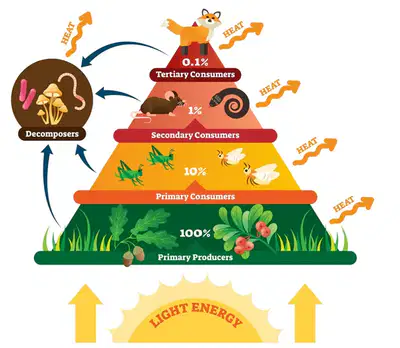
An energy pyramid is a model that shows how energy is passed from one level to the next in an ecosystem.
It is very similar to a biomass pyramid.
Instead of biomass, each step of the pyramid represents the amount of energy available for organisms to use.

media

19

Energy Pyramid

The base of an energy pyramid represents producers in trophic level 1.

It contains 100% of the energy captured by producers. However, the producers use most of that energy for their own life processes.


Most of the energy is used by producers to do work, or it is lost as heat

media

20

Energy Pyramid

When a consumer eats a producer, about 10% of the energy the plant captured goes to the consumer

The primary consumers in trophic level 2 have only 10% of the original energy to use for themselves.

When a secondary consumer eats, only 10% of that 10% remains.

This means that only
1% of the original energy is available to trophic level 3.

This is why populations of apex predators is usually
small.
The lack of energy is also the reason most ecosystems only have four trophic levels. By trophic level 5, only 0.01% of the energy would be left.

media

21

Multiple Choice

Question image
In the energy pyramid here, how much of the energy in each level gets lost as heat or used by the organism for survival?
1

80%

2

90%

3

10%

4

20%

22

Multiple Choice

A plant captures 2,300 Calories of energy from the sun. A cow eats the plant.

How much energy will the cow gain?

1

2,300

2

230

3

23

23

Multiple Choice

Question image

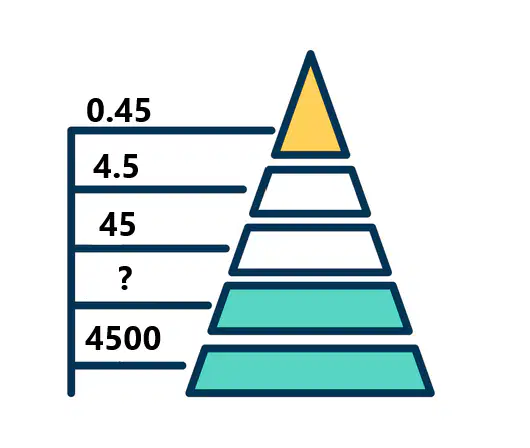
Examine the energy pyramid shown.

What number best completes the diagram to replace the question mark?

1

45

2

145

3

450

4

4000

24

Multiple Choice

What will you always find at the first level (bottom) of an energy pyramid?

1

plants

2

animials

3

decomposers

25

Multiple Choice

An energy pyramid is a model that shows how energy is related between organisms in an ecosystem. Which factor most likely limits how many trophic levels in an energy pyramid?

1


decomposition of detritus

2


the number of primary consumers that producers eat

3

energy loss at each trophic level

4


biomass of the highest trophic level

26

Multiple Choice

Question image

The top of a biomass pyramid is small because only a few apex predators can be supported in an ecosystem.

1

True

2

False

27

Multiple Choice

Question image
In the energy pyramid here, which organisms have the most energy available?
1

Producers

2

Carnivores

3

Herbivores

4

Top Predator

28

Multiple Choice

Question image
If these organisms were arranged in a food pyramid, which organism would have the least amount of total energy available?
1

coyote

2

insect

3

lizard

4

shrub

29

Multiple Choice

Question image
In the energy pyramid here, how much of the energy in the producers gets passed to the herbivores?
1

10%

2

20%

3

80%

4

90%

30

Multiple Choice

Question image
A food pyramid represent the relative amount of energy in trophic levels. Which of the following correctly shows a food pyramid?
1

A

2

B

3

C

4

D

Energy Pyramids and Biomass

media

E.Q: how can we know the amount of energy available to an organism based on its trophic level

Show answer

Auto Play

Slide 1 / 30

SLIDE