Central Dogma Review
Presentation
•
Biology
•
9th - 10th Grade
•
Hard

Joseph Anderson
FREE Resource
7 Slides • 36 Questions
1
Unit 5 Molecular Genetics Review
Central Dogma: DNA to mRNA to Protein
2
Multiple Choice
Who developed the double-helix model of DNA?
Watson & Crick
Avery
Hershey & Chase
Franklin
3
Multiple Choice
Who discovered that A = T and C = G?
Chargaff
Franklin
Watson & Crick
Griffith
4
Multiple Choice
Who took a picture of DNA using X-ray diffraction?
Rosalind Franklin
Watson & Crick
Oswald Avery
Hershey & Chase
5
Multiple Choice
Central Dogma
RNA -> DNA -> RNA -> protein
protein -> RNA -> DNA
DNA -> RNA -> protein
DNA -> amino acid -> RNA - > protein
6
Multiple Choice
The process of creating mRNA based on a DNA sequence is called
transcription
translation
replication
reverse transcription
7
Multiple Choice
The process of creating a protein from RNA is called
transcription
translation
replication
reverse transcription
8
Multiple Choice
9
Multiple Choice
What role do ribosomes play in the central dogma of molecular biology?
correct errors in DNA
recycle RNA back into DNA
transfer information from DNA to RNA
use RNA to manufacture proteins
10
DNA vs. RNA
Both: nucleic acid polymers made of nucleotides
DNA: Double stranded, deoxyribose sugar, nitrogen bases (A, T, C, G), stays in the nucleus
RNA: Single stranded, ribose sugar, nitrogen bases (A, U, C, G), moves between nucleus and ribosomes
11
3 Parts of a Nucleotide
Phosphate group
5 Carbon sugar (deoxyribose in DNA, ribose in RNA)
Nitrogen base (DNA = A, T, C, G) (RNA= A, U, C, G)
12
Multiple Choice
What determines the code, or information, of a DNA molecule?
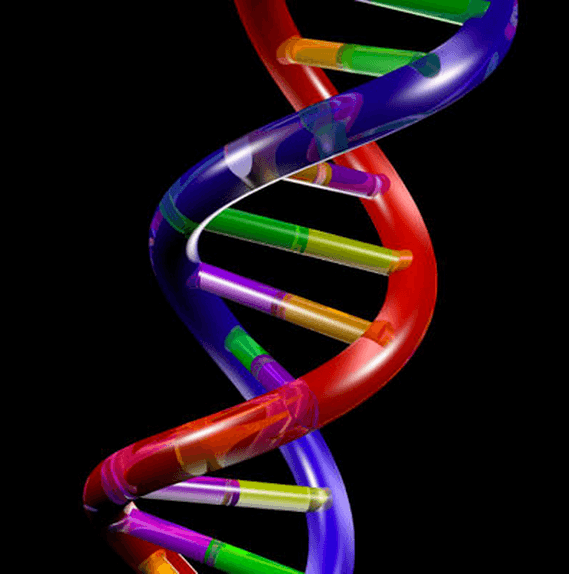
the shape (structure) of the nitrogen bases
the order (sequence) of the nitrogen bases
the color of the nitrogen bases
the frequency (number) of nitrogen bases
13
Multiple Choice
14
Multiple Choice
In a molecule of double-stranded DNA, the amount of Adenine present is always equal to the amount of
cytosine
guanine
thymine
uracil
15
Multiple Choice
Which of the following units are repeatedly joined together to form a strand of DNA?
amino acids
nucleotides
fatty acids
polysaccharides
16
DNA Replication
Happens in the S phase of interphase before cell division
DNA strands are antiparallel (oriented in opposite directions)
Semiconservative replication: DNA polymerase builds new strands off each template (old) strand
17
Multiple Choice
Which sequence of DNA bases would pair with this partial strand
ATG TGA CAG
ATG TGA CAG
TAC ACT GTC
GTA AGT GAC
CAT TCA CTG
18
Multiple Choice
Which model shown in the image best represents DNA replication?
1
2
3
19
Protein Synthesis
Transcription: DNA to mRNA in the nucleus
Translation: mRNA to amino acid sequence (protein) at a ribosome in the cytoplasm
20
Multiple Choice
21
Multiple Choice
During transcription, this type of ribonucleic acid is responsible for copying the DNA and brining it out of the nucleus.
tRNA
mRNA
rRNA
dRNA
22
Multiple Choice
23
Multiple Choice
24
Multiple Choice
Which of the following is the complementary mRNA sequence to this DNA strand: AAC TGA
UUG ACU
TTG ACT
AAC TGA
AAC UGA
25
Multiple Choice
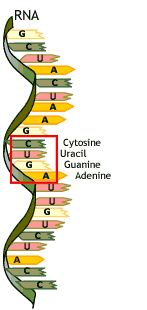
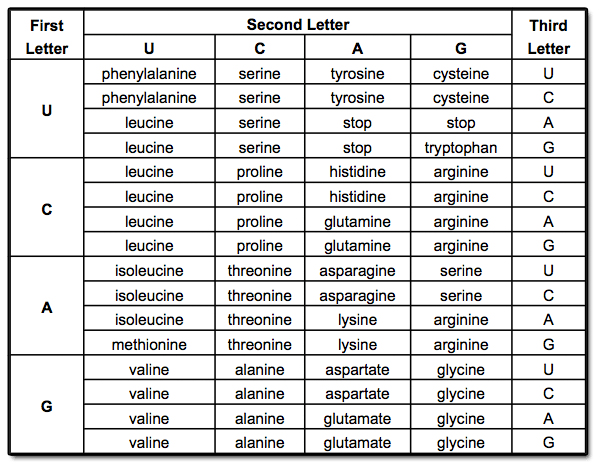
What amino acid is represented by the codon UUA?
Phenylalanine
Tyrosine
Leucine
Stop codon
26
Multiple Choice
When these bond together, they form a protein
Amino Acids
Peptide Bonds
Ribose
Nucleotides
27
28
Multiple Choice
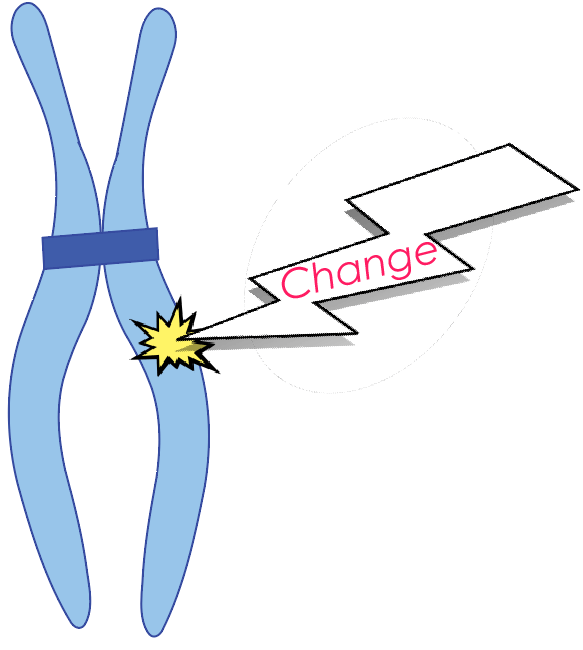
A change in a gene, group of genes or chromosome that results in a change in the proteins
Replication
Mutations
Translation
Transcription
29
Multiple Choice
Part of one chromosome is transported and attached
to a non-homologous chromosome
Inversion Mutation
Translocation Mutation
Duplication Mutation
Point Mutation
30
Multiple Choice
Part of a chromosome is reversed.
Inversion Mutation
Deletion Mutation
Translocation
Point Mutation
31
Multiple Choice
Part of a chromosome is repeated
Gene Mutation
Point Mutation
Deletion Mutation
Duplication Mutation
32
Multiple Choice
Part of a chromosome
is deleted
Deletion Mutation-Gene
Translocation
Deletion Mutation -Chromosomal
Crossing Over
33
Multiple Choice
A nucleotide base is inserted or deleted shifting the entire DNA sequence. Entire protein will be changed.
Substitution Mutation
Silent Mutation
Frameshift Mutation
Translocation
34
Multiple Choice
Another name for a point mutation is:
Substitution
Frameshift
Insertion
Deletion
35
Multiple Choice
A substitution mutation that has no effect
on amino acids sequence
Insertion Mutation
Translocation
Silent Mutation
Deletion Mutation
36
Multiple Choice
A mutation in which only one nucleotide is altered is called a:
Frameshift Mutation
Deletion Mutation
Point Mutation
Insertion Mutation
37
Biotechnology - technology based on biological processes
Restriction enzymes cut DNA for genetic modification or gel electrophoresis
Transgenic organisms have been modified with DNA from another organism. (genetically modified = GMO)
38
Multiple Choice
What does transgenic mean?
An organism that can change its genes at will
A stem cell that can differentiate into anything
An organism that has had another species' DNA put in it
A bacteria that reproduces asexually
39
Multiple Choice
Which of these is the correct definition of genetic modification/genetic engineering?
Choosing individuals to mate based on desired characteristics
Observing genetic changes in populations over time based on adaptive traits
Extracting stem cells to differentiate into specialized tissues
Altering the DNA of an organism at the molecular level
40
Multiple Choice
This is the practice of cutting DNA and separating it by the size of the pieces
Cloning
Gel Electrophoresis
Genetic Engineering
DNA Fingerprinting
41
Multiple Choice
Which of these is NOT a use for DNA Fingerprinting?
Identifying the person whose DNA was left at a crime scene
Determining the father of a child
Cloning a sheep
Figuring out which species are more closely related
42
Multiple Choice
Which suspect matches the crime scene sample?
1
2
3
4
43
Multiple Choice
Based on the DNA fingerprint, who is the child's father?
Bob
Larry
Unit 5 Molecular Genetics Review
Central Dogma: DNA to mRNA to Protein
Show answer
Auto Play
Slide 1 / 43
SLIDE

Similar Resources on Wayground
39 questions
Basic Ecology Terms
Presentation
•
9th - 10th Grade
39 questions
Photosynthesis and Cellular Respiration
Presentation
•
9th Grade
39 questions
Naming Acids and Bases
Presentation
•
10th Grade
39 questions
Algebra 1 EOC Review #5
Presentation
•
9th Grade
36 questions
SSWH16 Rise of Nationalism & Worldwide Imperialism
Presentation
•
10th Grade
37 questions
Immune System
Presentation
•
9th - 10th Grade
39 questions
Origins of Life
Presentation
•
8th - 10th Grade
37 questions
Exploring Organisms and Their Environment
Presentation
•
9th - 10th Grade
Popular Resources on Wayground
10 questions
GPA Lesson
Presentation
•
9th - 12th Grade
7 questions
Albert Einstein
Quiz
•
3rd Grade
31 questions
Bridge A Review
Quiz
•
3rd Grade
6 questions
Blue Sue and Red Ruth
Quiz
•
3rd Grade
8 questions
(Day12 HW) Inverse Trig Ratios
Quiz
•
9th Grade
20 questions
Summer Geometry QUIZ (Week3)
Quiz
•
9th Grade
16 questions
Theme Practice
Quiz
•
7th Grade
20 questions
Taxes
Quiz
•
9th - 12th Grade
Discover more resources for Biology
10 questions
GPA Lesson
Presentation
•
9th - 12th Grade
8 questions
(Day12 HW) Inverse Trig Ratios
Quiz
•
9th Grade
20 questions
Summer Geometry QUIZ (Week3)
Quiz
•
9th Grade
20 questions
Taxes
Quiz
•
9th - 12th Grade
16 questions
Warm Up: Basics of Geometry
Quiz
•
9th Grade
16 questions
Translations and Reflections
Quiz
•
9th - 10th Grade
17 questions
High School Survival Guide
Presentation
•
9th - 12th Grade
20 questions
Banking
Quiz
•
9th - 12th Grade