

Protein

Presentation
•
Biology
•
University
•
Hard

Joseph Anderson
FREE Resource
12 Slides • 8 Questions
1

Protein Synthesis, Processing and Regulation pt.1
2
Agenda for today
Quiz reviewing translational regulation
Warm Up
Cool Down
Work Out
Jigsaw
Matching Activity
3
Open Ended
How do proteins achieve their final shape?
4
Open Ended
Can that shape be altered or regulated?
5
Open Ended
Are there faulty shapes? If so, how are they prevented?
6
Protein Folding
Chaperones, Chaperonins and PDI
7
Chaperones
8
Fill in the Blanks
9
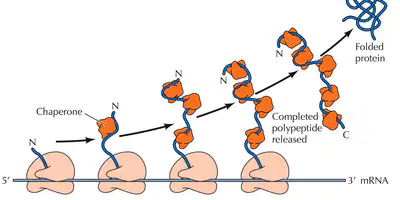
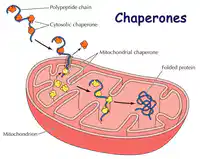
Chaperones
Prevents protein aggregation
Many chaperones are HSPs (heat shock proteins) which means they become up-regulated upon heat shock
Interact with proteins while they are being synthesized (keeps them linearized)
They allow proteins destined for the mitochondria to be open to be able to go through aqueous channels
10
Chaperonins
11
Open Ended
What do you remember about chaperonins?
12
Chaperonins
Chaperonins ALSO prevent protein aggregation
"Dressing room" where proteins that don't fold properly in the presence of other proteins to fold in isolation
Transfer from chaperones to chaperonins requires energy

13
PDI
14
Open Ended
What do you remember about PDI?
15
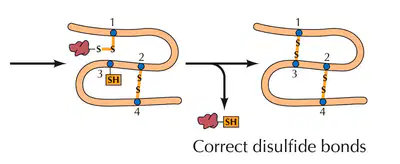
Disulfide bonds are important determinants in the final shape of proteins
Cysteines residues form disulfide bonds
For disulfide bonds to form, there must be an oxidative environment
PDI fascilitates the formation/rupture of disulfide bonds
PDI is exclusive to the the ER
PDI
16
Fill in the Blanks
17
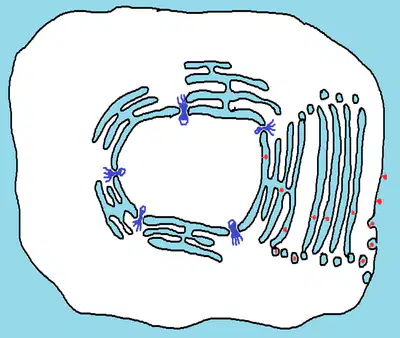
What is reducing and what is oxidizing?
The luminal environment contained within membrane bound organelles of the cell (peri nuclear, lumen of the Golgi and ER) is the equivalent to...
Where are disulfide bonds preferentially formed?
Questions
18

19
Categorize
Collagen I
Deformities in bone and cartilage
Poly-glutamine-containing protein (slippery polymerase repeat it more than 39 times )
Huntingtin
Loss of coordination and balance
Dramatic increase in neuronal cell death
Amyloid Precursor Protein
Reduction of brain cortex leading to loss of memory
Prions: force proteins to adopt the wrong conformation
Neuronal cell death. Cause mainly by eating meat
Plaques (aggregates)
Variant Creutzfeldt-Jakob disease
20
Protein Synthesis, Processing and Regulation pt.1
Show answer
Auto Play
Slide 1 / 20
SLIDE
Similar Resources on Wayground

18 questions
DNA to Protein FRAME
Presentation
•
12th Grade
14 questions
Iº Medio - Antes de la Lectura - Guía 12
Presentation
•
12th Grade
21 questions
Central Dogma: Protein Synthesis
Presentation
•
University
15 questions
Polimer
Presentation
•
12th Grade
16 questions
U5L2 - Lecture Presentation - Microanatomy of Skeletal Muscle
Presentation
•
11th - 12th Grade
10 questions
Exam 3 Review
Presentation
•
University
16 questions
soal latihan sel
Presentation
•
KG - University
13 questions
Enzymes
Presentation
•
11th - 12th Grade
Popular Resources on Wayground
19 questions
Naming Polygons

Quiz
•
3rd Grade
10 questions
Prime Factorization
Quiz
•
6th Grade
20 questions
Math Review
Quiz
•
3rd Grade
15 questions
Fast food
Quiz
•
7th Grade
20 questions
Main Idea and Details
Quiz
•
5th Grade
20 questions
Context Clues
Quiz
•
6th Grade
20 questions
Inferences
Quiz
•
4th Grade
19 questions
Classifying Quadrilaterals
Quiz
•
3rd Grade
Discover more resources for Biology
50 questions
ELA EOG Prep 7th Grade
Quiz
•
KG - University
20 questions
Guess The App
Quiz
•
KG - Professional Dev...
11 questions
dog breeds
Quiz
•
3rd Grade - Professio...
11 questions
NFL Football logos
Quiz
•
KG - Professional Dev...
19 questions
Minecraft
Quiz
•
6th Grade - Professio...
20 questions
Block Buster Movies
Quiz
•
10th Grade - Professi...
10 questions
Would you rather...
Quiz
•
KG - University
49 questions
AP Environmental Science Final Exam Review
Quiz
•
10th Grade - University